Sir:
I have received a notice from your office that has been sent to some local police stations and thence to the relevant buildings regarding an “imminent terrorist threat” and the precautions to be taken. I understand the importance of security measures, but most of the points you have brought in are applicable on a day-to-day basis and they are not followed. Therefore, what is the value of informing the citizens that this will be on until January 1st? What happens after that?
Within two kilometres of where I live, there is every place of worship and several bars and restaurants with liquor permits. On New Year’s Eve I believe most places will be allowed to remain open until the early hours of dawn and people will be drunk. Who will the cops keep an eye out for - those who might indulge in drunken misbehaviour or those who are praying? How do you judge suspicious-looking characters? The milkman may have a mean-looking moustache but is a hardworking guy who is earning his livelihood. You insist he should have an ID card when he visits the building everyday. You want those who deliver groceries and other essentials to show proof that they are who they are. The security guards should be more vigilant. Why only now? They should always be vigilant. You have not said anything about firecrackers; their sounds can create havoc both literally and figuratively.
The intelligence agencies have discovered that four terrorists have turned up in our megapolis. I find that rather curious. They have made sketches of these guys, which means they have no photographs and they have not been ever caught before. Apparently, they are supposed to hit at certain areas during the holiday season. This has created a fear psychosis and will only make the already pampered sections feel more pampered. They go around with personal bodyguards as well as police protection when there are extortion or other threats from the underworld.
I would like to know whether the letter I got has also been sent to the slums, for within this radius there are slum colonies too, the ones that have not been bulldozed yet or been forced out by builders who are part of the system. I don’t mind the naka-bandi, I don’t mind the frisking, the checking of vehicles. But do not invest too much power in the local residence associations. The tendency to become keepers of society can be a power trip. And they will create their own sub-sects of what and who is suspicious.
No one bothers when there is work going on in residences and labourers walk in and out without the owners bothered about being at home and putting their neighbours at risk; the security keeps no track and the incidence of crime can increase in such cases too. Therefore, how would filling in details in the security register help? Can people not lie? Most societies do not have watchmen from reputed firms, so who will keep track of them?
And why the need to sound apologetic about the presence of police personnel? This itself reveals that there is paranoia, not only about terrorists but the police force.
I assure you of all help, but I would also want to be assured that the poor people are not harassed only because they look suspicious to the rich, and that those drunken sods don’t mow down people sleeping in the footpaths or molest or ‘eve tease’ women and get away with it, and the noise decibels do not reach dangerous levels in what are clearly residential localities and there are hospitals around, too. Should there be any unfortunate mischief in a place of worship it should be treated as just that and not a terrorist act. We have seen this sort of cow-pig thing happen before, so let us grow up.
As a citizen and a loyal Mumbaikar, I do so hope that we can enter the new year when our minds are without fear.
Sincerely,
FV
PS: I hope you will keep the media out or else we will hear no end to stories of celebrities who just missed a potential threat by a whisker and how the bhajiwalla became a braveheart.
30.12.10


Killing Aarushi Again, Making Jessica Alive?

The Central Bureau of Investigation came into the picture soon after the Noida police made no headway. Perhaps, the entry of the CBI was the big mistake. Big people need big people to get mouths shut.
They found the weapon, they have a reasonable motive – “immediate provocation”, they know of missing files and the swapped vaginal swab, they know that someone was tampering with evidence. Then, why is it so difficult to find out who and why?
It is impossible that the findings reveal absolutely nothing. What did the DNA sample show? What did the brain-mapping reveal? Who cleared the room before the police came in? It need not be one person. These are people in different places doing different things. Who was calling the shots? And why?
Instead, the CBI has washed its hands of the case:
“The agency has filed a final report for the closure of the case on grounds of insufficient evidence in the competent court.”
It has been only two and a half years. There are cases that are pending for decades. I would like to see what Aarushi’s parents do next. It must surely be tough on them to have a daughter raped and murdered in the next room and the place cleaned up while they were around just a few metres away, isn’t it? They should file a case against the Noida police and the CBI and the hospital authorities for shirking their duty and making a mockery of justice.
They have the power, being educated and relatively better-off than many who do not have the means. Let this be a fight for the silent Aarushis and the silenced ones.
- - -
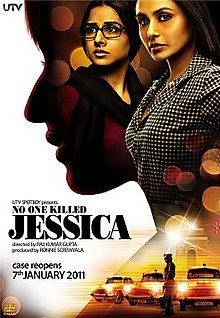
They are so insensitive and ignorant that they happily dance and sing when the subject is clearly not a tamasha. I am not saying that the reality shows they appear on lend themselves to such gravitas or should, but can they not at least respect the dead person on whose name they are trying to score? The PR people would most definitely have sent them on these errands, but what they do there is certainly impromptu. It is about them, their best role, their song, their mutual admiration.
Anyhow, the film will be seen by high society because it is all the in-the-know people who will be ‘touched and moved’ that at last Jessica’s memory has been kept alive, never mind the fractured sides that were taken whenever the case came up for hearing. The premiere will be another Page 3 moment with buttered popcorn and Diet Pepsi.
26.12.10
Veena Malik represents freedom of expression?
Last night we got to see Pakistan’s best and worst on TV. There was ghazal maestro Ghulam Ali on the grand finale of the music show Sa Re Ga Ma Pa and then there was Veena Malik, the has-been wannabe – yes, she seems to be a veteran of wannabe-ing – who even in her moment out of Bigg Boss kissed the mirror she was gifted. There was a second’s poignant flash when she spoke about being tanha (lonely), but that is a personal aspect that one may or may not identify with. It isn’t even narcissism.
It is rather sad that only because some mullahs are baying for her blood due to her clothes and ‘open’ behaviour she has become a symbol for freedom of speech and an opportunity to take on the moral brigade. “This is not too dissimilar to the public floggings of the Taliban variety,” said one commentator. Really? Those women do not have a choice regarding what they wear and what they say. In Pakistan Veena would be doing precisely what she is doing now – and she has admitted so herself – and no one would notice.
I am afraid if some Pakistanis think this is the modern version of their country that they wish to hawk to India, whose film industry incidentally is being dissed for “commodification”, then they’d please prop her up in the salons of Karachi and Lahore. She has just declared that she will return despite the threats. So give her a hero’s welcome. I mean, do we want to hear stuff like she “has dared to participate in the famous and brainless Indian reality TV show”? She was considered powder-puff before she came on this show; all the newspapers had relegated her to the gossip genre on which she was feeding. Her appetite for this had been detailed in their media, and that was before the mullahs reared their beards.
In India she would be on par with any item girl performing in some small town on New Year’s Eve. Her attempts at being anglicised and modern were laughable, especially her language skills. She would try out PTV Urdu when it suited her and then shout out in English with a Multan-Manhattan accent. And just what was it about calling that other has-been ‘Ash-mit’. Since I started watching the show a few weeks after its debut, I had initially thought it was some inside joke, but when the host Salman Khan corrected her a few times, I knew this is how she pronounced it. Why is it so difficult for a Pakistani to say Ashmit? Does she refer to, say, an Ashfaque as ‘Ash-fack’? Does she say ‘ash-aar’ for ashaar (couplets)? Her local roots came through glaringly when she’d call Shweta ‘Shivaeta’.
If Pakistanis think that what we have is a “Bollywood circus”, then the likes of Veena Malik may only manage to be molls of the clowns. Anyone remember Meera?
It is understandable that she wants to grab eyeballs, and who does not on that show and in showbiz? But, I wish Pakistanis would realise that making such people into a cause to uphold demeans the women who wear what she does and are bold and brazen and go out and work. And, no, I am not making noises about the Hudood Ordinance here. Please, that is a separate and important issue. Clubbing it all with this drama-daasi (slave) - she has miles to go to become a drama queen - only reveals that otherwise sensible people too are getting so affected by this ‘failed state’ business that they’d latch on to anything that looks unIslamic. Guess what? She thinks she is answerable only to Allah!
And like that bikini contest winner, she too might talk about nationalism and taking a message of Indo-Pak peace. Thanks, but no thanks. We have our own mirrors and our own filthy ponds and our own pebble pelters. Where ripples are concerned, and much else, we are pretty self-sufficient.
 |
| She IS black and white |
I am afraid if some Pakistanis think this is the modern version of their country that they wish to hawk to India, whose film industry incidentally is being dissed for “commodification”, then they’d please prop her up in the salons of Karachi and Lahore. She has just declared that she will return despite the threats. So give her a hero’s welcome. I mean, do we want to hear stuff like she “has dared to participate in the famous and brainless Indian reality TV show”? She was considered powder-puff before she came on this show; all the newspapers had relegated her to the gossip genre on which she was feeding. Her appetite for this had been detailed in their media, and that was before the mullahs reared their beards.
In India she would be on par with any item girl performing in some small town on New Year’s Eve. Her attempts at being anglicised and modern were laughable, especially her language skills. She would try out PTV Urdu when it suited her and then shout out in English with a Multan-Manhattan accent. And just what was it about calling that other has-been ‘Ash-mit’. Since I started watching the show a few weeks after its debut, I had initially thought it was some inside joke, but when the host Salman Khan corrected her a few times, I knew this is how she pronounced it. Why is it so difficult for a Pakistani to say Ashmit? Does she refer to, say, an Ashfaque as ‘Ash-fack’? Does she say ‘ash-aar’ for ashaar (couplets)? Her local roots came through glaringly when she’d call Shweta ‘Shivaeta’.
If Pakistanis think that what we have is a “Bollywood circus”, then the likes of Veena Malik may only manage to be molls of the clowns. Anyone remember Meera?
It is understandable that she wants to grab eyeballs, and who does not on that show and in showbiz? But, I wish Pakistanis would realise that making such people into a cause to uphold demeans the women who wear what she does and are bold and brazen and go out and work. And, no, I am not making noises about the Hudood Ordinance here. Please, that is a separate and important issue. Clubbing it all with this drama-daasi (slave) - she has miles to go to become a drama queen - only reveals that otherwise sensible people too are getting so affected by this ‘failed state’ business that they’d latch on to anything that looks unIslamic. Guess what? She thinks she is answerable only to Allah!
And like that bikini contest winner, she too might talk about nationalism and taking a message of Indo-Pak peace. Thanks, but no thanks. We have our own mirrors and our own filthy ponds and our own pebble pelters. Where ripples are concerned, and much else, we are pretty self-sufficient.
Sunday ka Funda
What do we want? What do we get? Liquid steams...the voice dips deep into the stomach churning, turning, whisking away...
Sometimes you need it then you don't and you let go...whatever it is. Nothing like the sensual to make a lot of other things acquire similar meanings.
Sometimes you need it then you don't and you let go...whatever it is. Nothing like the sensual to make a lot of other things acquire similar meanings.
25.12.10
Why did my momma not warn me about the spirit?
I went to a regular school, although not regularly. It was a proper convent where the day started with hymns that were later made more 'secular' and we did not have to assemble in the hall anymore, what with the installation of speakers, and smell coconut oil in hair and post breakfast smells still on lips. Oh, one was obedient, if you ignore the short uniform that was ripped open at the hemline on inspection day and the nails forcibly trimmed. I did not chuck the chalk at the blackboard, did not know the dates in history texts by rote - I just happened to like history. I wished the nuns and the teachers in the corridors 'Good morning, Good evening". If I did something wrong, it was not to be a nuisance or to go against authority. I did not think anyone was authority. They were just given that position and one day we would all grow up and get some position somewhere, it could be in the kitchen, it could be in the boardroom, it could be in some underground movement, it could be as queen bee. Anything. I was certain about that.
I do not recall being told that the system would break my spirit. I did not even know it was a system. It was school and I knew I had to be there for a limited amount of time and then I'd be out to find anything I sought.
No system has swallowed me. I have done pretty much what I wished to and when I did make adjustments it was when I wanted to because I wanted to. My spirit is still soaring.
Therefore, Julian Assange's mommy's quote about not sending little Julian to school because his spirit would be broken is a bit of romanticising, and it works because his stock is currently high.
I've done okay fighting the demons, and sometimes becoming one. But, hey, no one is going to bail me out. So, it is Julian who is now a part of the system that his ma protected him from.
I do not recall being told that the system would break my spirit. I did not even know it was a system. It was school and I knew I had to be there for a limited amount of time and then I'd be out to find anything I sought.
No system has swallowed me. I have done pretty much what I wished to and when I did make adjustments it was when I wanted to because I wanted to. My spirit is still soaring.
Therefore, Julian Assange's mommy's quote about not sending little Julian to school because his spirit would be broken is a bit of romanticising, and it works because his stock is currently high.
I've done okay fighting the demons, and sometimes becoming one. But, hey, no one is going to bail me out. So, it is Julian who is now a part of the system that his ma protected him from.
Cowell Christ?
I can imagine Simon Cowell as a latter-day rock-star pontiff, but a 21st century Jesus? The Evangelical magazine ‘Re’ has given him the title and the reason is rather unusual: it is for his acerbic tongue that has been likened to the Messiah’s straight-talking.
I know there are several interpretations of how people view Christ, but I cannot imagine him sitting with others, listening to people who want to become idols for a year, and passing judgment over a competition. It is difficult that anyone might imagine Jesus’s straight-talking with Cowell’s rather sophomoric expertise.
Anyhow, just for the heck of it, here is the lordly and the good lord himself replying (actual quotes transposed):
SC: “If your lifeguard duties were as good as your singing, a lot of people would be drowning.”
JC: “Do unto others as you would have them do unto you.”
SC: “The end of the animal trade would leave more time to trap or beat to death pop star wannabes.”
JC: “I say, I've fed his sheep. Now I'll tend to them, ... tend to my sheep.”
SC: “If you've got a big mouth and you're controversial, you're going to get attention.”
JC: “It is easier for a camel to pass through the eye of a needle than for a rich man to enter the Kingdom of Heaven.”
SC: “I think you have to judge everything based on your personal taste. And if that means being critical, so be it. I hate political correctness. I absolutely loathe it.”
JC: “The good man brings good things out of the good stored up in his heart, and the evil man brings evil things out of the evil stored up in his heart. For out of the overflow of his heart his mouth speaks.”
SC: “I think he knows how to articulate something that people are entertained by and still be true to the message he's trying to send, ... very aware of himself.”
JC: “No one lights a lamp and puts it in a place where it will be hidden, or under a bowl. Instead he puts it on its stand, so that those who come in may see the light.”
SC: “If I said to most of the people who auditioned, 'Good job, awesome, well done,' it would have made me actually look and feel ridiculous. It's quite obvious most of the people who turned up for this audition were hopeless.”
JC: “For we walk by faith, not by sight.”
SC: “You've got quite a good voice, the problem I have is this looks to me like 10 years ago.”
JC: “Ask and it will be given to you; seek and you will find; knock and the door will be opened to you.”
SC: “You are a saucy little thing aren't you?”
JC: “Let him who is without sin cast the first stone.”
- - -
Simon Cowell is really into the Christian spirit and decided to gift X-Factor co-stars $ 4500 worth of Botox packages. He in a sort of three-in-one Magi manner, one might say. After all, gold, frankincense and myrrh have been traditionally used to adorn and embellish. So, our man is only taking the gold polish, incense and unguent tradition forward and looking for frozen faces that make his smile seem brighter. A wise man, he is.
I know there are several interpretations of how people view Christ, but I cannot imagine him sitting with others, listening to people who want to become idols for a year, and passing judgment over a competition. It is difficult that anyone might imagine Jesus’s straight-talking with Cowell’s rather sophomoric expertise.
Anyhow, just for the heck of it, here is the lordly and the good lord himself replying (actual quotes transposed):
SC: “If your lifeguard duties were as good as your singing, a lot of people would be drowning.”
JC: “Do unto others as you would have them do unto you.”
SC: “The end of the animal trade would leave more time to trap or beat to death pop star wannabes.”
JC: “I say, I've fed his sheep. Now I'll tend to them, ... tend to my sheep.”
SC: “If you've got a big mouth and you're controversial, you're going to get attention.”
JC: “It is easier for a camel to pass through the eye of a needle than for a rich man to enter the Kingdom of Heaven.”
SC: “I think you have to judge everything based on your personal taste. And if that means being critical, so be it. I hate political correctness. I absolutely loathe it.”
JC: “The good man brings good things out of the good stored up in his heart, and the evil man brings evil things out of the evil stored up in his heart. For out of the overflow of his heart his mouth speaks.”
SC: “I think he knows how to articulate something that people are entertained by and still be true to the message he's trying to send, ... very aware of himself.”
JC: “No one lights a lamp and puts it in a place where it will be hidden, or under a bowl. Instead he puts it on its stand, so that those who come in may see the light.”
SC: “If I said to most of the people who auditioned, 'Good job, awesome, well done,' it would have made me actually look and feel ridiculous. It's quite obvious most of the people who turned up for this audition were hopeless.”
JC: “For we walk by faith, not by sight.”
SC: “You've got quite a good voice, the problem I have is this looks to me like 10 years ago.”
JC: “Ask and it will be given to you; seek and you will find; knock and the door will be opened to you.”
SC: “You are a saucy little thing aren't you?”
JC: “Let him who is without sin cast the first stone.”
- - -
Simon Cowell is really into the Christian spirit and decided to gift X-Factor co-stars $ 4500 worth of Botox packages. He in a sort of three-in-one Magi manner, one might say. After all, gold, frankincense and myrrh have been traditionally used to adorn and embellish. So, our man is only taking the gold polish, incense and unguent tradition forward and looking for frozen faces that make his smile seem brighter. A wise man, he is.
24.12.10
Life of and for Comrade Binayak Sen

Dr. Binayak Sen has been awarded a life sentence. There is no evidence to nail him down. I will not go into the details of this case that will stand up for scrutiny only in a banana republic, not in a democracy.
The war against the state is a convenient ploy. Dr. Sen, an award winning doctor and national vice-president of the People’s Union for Civil Liberties (PUCL) was arrested in Bilaspur on May 14, 2007. He has been behind bars ever since. And it was not a fashionable ‘statement’ arrest.
His crime is that he passed letters to the Maoist ideologue, Narayan Sanyal. Together with a young businessman, Piyush Guha, they are seen as a triumvirate. The letters were apparently to “establish an urban network of the banned extremist group CPI (Maoist)”.
The charges are drawn from the Unlawful Activities (Prevention) Act, 1967, the Chhattisgarh Special Public Security Act, 2005, and the IPC for conspiracy for war against the state and treason, apart from being the accused as members of a banned organisation.
Let us go along for a minute with the charges. What war has been fought against the state due to the efforts of Dr. Sen? How many politicians are arrested for creating wars within their own states? What is treason here? To speak out, to believe that a people have the right to seek a space? The moot point is: have they got it? As regards being members of a banned organisation, may I know how it is possible when an organisation that is banned becomes irrelevant, a persona non grata, so to speak? Therefore, his being a part of it is a non sequiter.
Apparently, the prosecution has problems with him being addressed as ‘Comrade’ in two postcards. “Comrade usi ko kahaa jaata hai jo Maowadi hai,” (Only a Maoist is called comrade) said prosecutor Pandya who is probably a comrade-in-arms with the state machinery and a whole ideology based on idiocy. If you refer to someone as 'Bhai', does it mean the person is an underworld don? Communist leaders still use the term comrade. Even so, he has every right to be a Maoist, just as people can be Bajrang Dali or Jamaatis; at least he is not using obfuscation.
How do you imagine Dr. Binayak Sen is linked to international terror groups? The sessions court in Chhattisgarh said that his wife Ilina was corresponding with Pakistan’s ISI based on some letters written by her to “some Fernandes of the ISI”.
Here is the report from the TOI:
The email said: “There is a chimpanzee in the White House.” Pandya said: “This may be code language... this perhaps means terrorists are annoyed with the US... We do not know who this Fernandes is, but ISI, as we all know, means Pakistan.”I am currently writing about Indian Stupid Insecurity (ISI). The imagination of the prosecution aside, I have issues with the use of ‘perhaps’ in a case of this nature, that involves the life of a person and the life of civil liberties. The prosecution is supposed to verify its claims before charging a person. If it is a code word, then decode it; if it is terror groups, snoop around and check the IP address. We don’t live in the stone age that this is not possible.
TOI spoke to Walter Fernandes, currently director of the North Eastern Social Research Institute in Guwahati. “Ilina and I are good friends and we frequently exchanged correspondence on development-induced displacement among tribals, which has been my subject for the last 20 years,” he said. He described the prosecution’s attempt to interpret ISI (Indian Social Institute) as Pakistan’s Inter Services Intelligence wing and link it to Binayak Sen as “either ignorance or bad will”.
There will be an appeal against this judgement. But, it is a sad state of affairs when after 1000 pages of the charge-sheet, the Indian courts come out the worse for the wear. There is nothing that reveals that Comrade Binayak Sen has betrayed the country. The judiciary has.
- - -
Updated here
22.12.10
Mohamed Haneef and the Middle-class
Mohamed Haneef and the Middle-class
by Farzana Versey
Countercurrents, December 22
Julian Assange has given the Indian middle-class and the media the thumbs up. He is probably not aware of the lobbying controversy. Besides mentioning our “vibrant” journalism, he told an Indian newspaper that he was optimistic because “you have a rising middle class. You have more people getting access to the internet. So, I am quite hopeful of about what is going to develop in India”.
The middle-class, whether rising or otherwise, tends to be complacent. Such leaks have worked as scoops before; we have had politicians eat crow and then gone on to crow about it. That’s how it works here and that’s how it works elsewhere. The moralistic middle-class did not flinch about a Bill Clinton and it elects parties that have $1000 ticket events for fund-raising, not to speak about celebrity endorsements. And in Australia how many middle-class people booed out the former Prime Minister John Howard for his anti-immigrant statements, specifically targetting a certain religious group?
This brings us to the closure of the case of the Indian doctor, Mohamed Haneef, who was arrested in Australia, where he worked, and imprisoned for two weeks without a charge against him only on the basis of a suspicion of involvement in the Glasgow International Airport terrorist attack. He will be paid compensation, reportedly worth Aus $1 million. The manner in which his inquiry was conducted, the lack of evidence or rather the wrongful use of evidence, shows that there was a vicious attempt to incarcerate him, probably also the first showpiece for its 2005 Australian Anti-Terrorism Act. Since July 2007 when he was arrested to now, he has had to fight to prove that he is innocent.
The rising middle-class did not come out to support him, not in India, not in Australia. A ‘public outcry’ has become just another ruse for demonising the victim, for it furthers the case for kangaroo courts. The internet is obsessed with people and events that are ‘happening’. There won’t be any leaks about these incidents, even though none of this can happen with the connivance of the powers. This was a cross-continental case. Why are the authorities not being put on trial for bungling it, as the independent inquiry has found they did?
Dr. Haneef will get the money, and he had “sought damages for lost earnings, the interruption to his medical career, damage to his reputation and emotional stress”. Unfortunately, the emphasis will be on the monetary aspect and not on the real issue of making a case on the basis of suspicion. It raises questions about how the stereotyping starts at the top and percolates down to those who have access and are ‘wired’ to the world. This is just such a superficial indulgence. I can imagine how the media will want to know what he will do with the money, will he take up the cause of others like him, all hinting at the settlement. Rules have been flouted, but that will be forgotten. He has had to live with being tainted when terror screams out from the power peaks of establishments that terrorise people into believing that they are at risk. It is made out to be some kind of epidemic, and the rising middle-class wants to be safe because it is awfully sorry for itself. This is the package deal of morality combined with upward mobility.
Dr. Haneef, too, talks about moving on. This is the middle-class fallacy. No one moves on; they just move ahead and don’t look back in anger. This lack of ire is what will make sure that any expose remains in the realm of a whodunit. It is time for popcorn.
I was surprised to read a senior official’s comment that the WikiLeaks model would work in India. “There is incredible amount of corruption and a lot of it is well documented. The problem is that our government servants, who have access to these files, are very, very afraid to leak documents. They don’t even trust most reporters.”
Since when has corruption begun to be well-documented? In really big cases, there are files that have been passed and dates with names that can be pinned down. But it is the government servants who are the beneficiaries. It is convenient to point fingers at the politicians, but what about the bureaucracy? Yes, the same much-in-demand, dowry-enabled bureaucracy? Before entering a politician’s cabin, everyone from the trader to the big businessman, has to go through babudom, the kingdom with lost keys. The same one with the middle-class morals has to rise, after all. The uniform changed from polyester shirts, to the safari suit and is now more striped Park Avenue or even the odd Marks and Spenser’s.
This babu is the one who files the culpable files as well as those implicating innocents. Why are we not concerned about the latter? Why is it only about the wrong-doings when the ones who have done no wrong far outnumber the criminals? Look at the undertrials in prison, look at those waiting for provident fund or fighting to get their dues. Is there exposure about such cases?
There used to be a middle-class that cared, even if it sat helplessly, hand in head, chopping onions. Now, it does not. It isn’t only because onions are expensive, but because in the world of quick news you cannot just crib about price rise; you need to have a point of view about onion and the economy that drives it. This is spoon-fed and the middle-class person feels empowered with such knowledge. With this empowerment, sitting in a creaking armchair, now called antique instead of just a doddering old piece of furniture, this person will forget that buying power is being systematically reduced for essentials. The big players sell big dreams on plasma TV screens. It is all about the Big Picture.
The Raj Kapoor cinematic fantasy in black and white has become a mall rat flaunting, “Mera joota hai Japani, yeh patloon Englistani, sar pe lal topi Russi, phir bhi dil hai Hindustani” (My shoes are Japanese, trousers English, cap Russian, but the heart remains Indian.) This heart is now in the right place – at the centre of the hub. It isn’t about donning a cap, but how far we can go with the visiting Russian leader Dmitry Medvedev. Even a song that warmed so many people’s lips has now become a propeller for collaboration and business and the global euphoria.
The official quoted earlier had added, “It is not that we don’t have whistle-blowers in our system, but they need to be assured of secrecy.”
We did and Satyendra Dubey was killed. The rising middle-class did not have time. And that is what is frightening. Every case is a pushover. Until the next one comes along and we clear the cache.
by Farzana Versey
Countercurrents, December 22
Julian Assange has given the Indian middle-class and the media the thumbs up. He is probably not aware of the lobbying controversy. Besides mentioning our “vibrant” journalism, he told an Indian newspaper that he was optimistic because “you have a rising middle class. You have more people getting access to the internet. So, I am quite hopeful of about what is going to develop in India”.
The middle-class, whether rising or otherwise, tends to be complacent. Such leaks have worked as scoops before; we have had politicians eat crow and then gone on to crow about it. That’s how it works here and that’s how it works elsewhere. The moralistic middle-class did not flinch about a Bill Clinton and it elects parties that have $1000 ticket events for fund-raising, not to speak about celebrity endorsements. And in Australia how many middle-class people booed out the former Prime Minister John Howard for his anti-immigrant statements, specifically targetting a certain religious group?
This brings us to the closure of the case of the Indian doctor, Mohamed Haneef, who was arrested in Australia, where he worked, and imprisoned for two weeks without a charge against him only on the basis of a suspicion of involvement in the Glasgow International Airport terrorist attack. He will be paid compensation, reportedly worth Aus $1 million. The manner in which his inquiry was conducted, the lack of evidence or rather the wrongful use of evidence, shows that there was a vicious attempt to incarcerate him, probably also the first showpiece for its 2005 Australian Anti-Terrorism Act. Since July 2007 when he was arrested to now, he has had to fight to prove that he is innocent.
The rising middle-class did not come out to support him, not in India, not in Australia. A ‘public outcry’ has become just another ruse for demonising the victim, for it furthers the case for kangaroo courts. The internet is obsessed with people and events that are ‘happening’. There won’t be any leaks about these incidents, even though none of this can happen with the connivance of the powers. This was a cross-continental case. Why are the authorities not being put on trial for bungling it, as the independent inquiry has found they did?
Dr. Haneef will get the money, and he had “sought damages for lost earnings, the interruption to his medical career, damage to his reputation and emotional stress”. Unfortunately, the emphasis will be on the monetary aspect and not on the real issue of making a case on the basis of suspicion. It raises questions about how the stereotyping starts at the top and percolates down to those who have access and are ‘wired’ to the world. This is just such a superficial indulgence. I can imagine how the media will want to know what he will do with the money, will he take up the cause of others like him, all hinting at the settlement. Rules have been flouted, but that will be forgotten. He has had to live with being tainted when terror screams out from the power peaks of establishments that terrorise people into believing that they are at risk. It is made out to be some kind of epidemic, and the rising middle-class wants to be safe because it is awfully sorry for itself. This is the package deal of morality combined with upward mobility.
Dr. Haneef, too, talks about moving on. This is the middle-class fallacy. No one moves on; they just move ahead and don’t look back in anger. This lack of ire is what will make sure that any expose remains in the realm of a whodunit. It is time for popcorn.
I was surprised to read a senior official’s comment that the WikiLeaks model would work in India. “There is incredible amount of corruption and a lot of it is well documented. The problem is that our government servants, who have access to these files, are very, very afraid to leak documents. They don’t even trust most reporters.”
Since when has corruption begun to be well-documented? In really big cases, there are files that have been passed and dates with names that can be pinned down. But it is the government servants who are the beneficiaries. It is convenient to point fingers at the politicians, but what about the bureaucracy? Yes, the same much-in-demand, dowry-enabled bureaucracy? Before entering a politician’s cabin, everyone from the trader to the big businessman, has to go through babudom, the kingdom with lost keys. The same one with the middle-class morals has to rise, after all. The uniform changed from polyester shirts, to the safari suit and is now more striped Park Avenue or even the odd Marks and Spenser’s.
This babu is the one who files the culpable files as well as those implicating innocents. Why are we not concerned about the latter? Why is it only about the wrong-doings when the ones who have done no wrong far outnumber the criminals? Look at the undertrials in prison, look at those waiting for provident fund or fighting to get their dues. Is there exposure about such cases?
There used to be a middle-class that cared, even if it sat helplessly, hand in head, chopping onions. Now, it does not. It isn’t only because onions are expensive, but because in the world of quick news you cannot just crib about price rise; you need to have a point of view about onion and the economy that drives it. This is spoon-fed and the middle-class person feels empowered with such knowledge. With this empowerment, sitting in a creaking armchair, now called antique instead of just a doddering old piece of furniture, this person will forget that buying power is being systematically reduced for essentials. The big players sell big dreams on plasma TV screens. It is all about the Big Picture.
The Raj Kapoor cinematic fantasy in black and white has become a mall rat flaunting, “Mera joota hai Japani, yeh patloon Englistani, sar pe lal topi Russi, phir bhi dil hai Hindustani” (My shoes are Japanese, trousers English, cap Russian, but the heart remains Indian.) This heart is now in the right place – at the centre of the hub. It isn’t about donning a cap, but how far we can go with the visiting Russian leader Dmitry Medvedev. Even a song that warmed so many people’s lips has now become a propeller for collaboration and business and the global euphoria.
The official quoted earlier had added, “It is not that we don’t have whistle-blowers in our system, but they need to be assured of secrecy.”
We did and Satyendra Dubey was killed. The rising middle-class did not have time. And that is what is frightening. Every case is a pushover. Until the next one comes along and we clear the cache.
Over-the-top: TOI/Assange, Sachin/Shane
This is such an obsequious sucking up to a trend, and a trend this WikiLeaky thing has become. The Times of India that often front pages its achievements of being the largest, the biggest, the best, has this on its masthead:

The report quotes Julian Assange:
Quite simply laugh-inducing because he discovered all this “based on his dealings with Indians”. If they are media people, then the very fact that they keep their mouths shut about corruption, when not playing with the powers or games with each other, reveals that their vibrancy is relegated to talking big and thinking small. And just how easily the TOI has accepted validation of being one of the “great little journalistic groups” and possibly from the “medium and lower level”! He obviously does not know about the advertising-editorial relationship, where even the front page is often taken over by some company’s wares or services and where Page 3 pictures are paid for, in cash or kind and ad space is bought with the condition that there will be editorial content favouring it.

Ok, so Tendulkar is unstoppable. So is Warne. One has clocked up 50 hundreds, the other has sent 100s to 50 or more.
But Sachin is the good guy. Shane is bad. And for those who think the bad guys are the ones who win, not so. Even Shane is praising Sachin.
And Shekhar Kapur says:
Has Sachin scored only on Indian soil? Can atheists not appreciate cricket? Does god have to be an achiever and break records? Or is it god giving Sachin those records? Then, does he deserve all the credit?
At least Shane Warne can hog on his hormones and spin that ball without divine intervention.

The report quotes Julian Assange:
“There are some very great little journalistic groups in India, pointing out the TOI among others. Journalism in India is quite vibrant in the medium and lower level.”
Quite simply laugh-inducing because he discovered all this “based on his dealings with Indians”. If they are media people, then the very fact that they keep their mouths shut about corruption, when not playing with the powers or games with each other, reveals that their vibrancy is relegated to talking big and thinking small. And just how easily the TOI has accepted validation of being one of the “great little journalistic groups” and possibly from the “medium and lower level”! He obviously does not know about the advertising-editorial relationship, where even the front page is often taken over by some company’s wares or services and where Page 3 pictures are paid for, in cash or kind and ad space is bought with the condition that there will be editorial content favouring it.
- - -
Ok, so Tendulkar is unstoppable. So is Warne. One has clocked up 50 hundreds, the other has sent 100s to 50 or more.
But Sachin is the good guy. Shane is bad. And for those who think the bad guys are the ones who win, not so. Even Shane is praising Sachin.
And Shekhar Kapur says:
“And then I look at Sachin and god still lives in India.”
Has Sachin scored only on Indian soil? Can atheists not appreciate cricket? Does god have to be an achiever and break records? Or is it god giving Sachin those records? Then, does he deserve all the credit?
At least Shane Warne can hog on his hormones and spin that ball without divine intervention.
Definitely!
Mirriam-Webster’s can keep its austere pragmatism to itself. I’ve got my own ideas. The dictionary has got out its list of top ten words of the year based on what people went sniffing around for.
The real meaning will be available at the site and others, but what are words if they cannot provide some delicious new meanings?
Here are my definitions to the chosen 10:
1. austerity: Ossifying basic needs so that you can have the temerity to pretend you were accustomed to luxuries
2. pragmatic: The ability to brag about being pneumatic
3. moratorium: Putting a stop to morals at the last minute.
4. socialism: A political ideology that allows you to socialise without feeling guilty
5. bigot: A shortened term for big idiot
6. doppelganger: A gangster who is trying to repel his dope habit
7. shellacking: A lack of shells to chuck
8. ebullient: A schizophrenic bullish attitude that is always close to turning lenient
9. dissident: Someone who disses anything that lacks teeth
10. furtive: The use of fur to pretend to be what you are not
I have never been a dictionary junkie even though I love words. When I was young, I would mark the ones I did not know the meanings of and try to figure out what they meant in the sentence, within the context. It was a long process, but exciting. I was often wrong, but I was right too. How did I know? I asked people who did. It gave me an opportunity to discover words, discover the possibility of their usage and to know how much others knew!
I find the idea of people who are interested in current affairs running to check words that are used quite commonly rather curious. Some would consider it a step towards knowledge. In a way, it is. But, if the word ‘austerity’ has made it on the basis of the hits during a time of crisis, in Greece to begin with, where people went on strike and there was acute shortage of essentials, then I find this sort of intelligence seeking mercenary, taking the phrase ‘ignorance is bliss’ to another level of was bliss.
Besides, dictionary definitions can be rather limiting. Each culture has such wonderful colloquialisms and slang and meshing of dialects to include in the mainstream of English that a static definition just cannot convey. Purists would look down upon it, but then purists happily gorge on Latin proverbs and those French exclamations and Spanish forms of address to make perfectly capable Anglo-Saxon look like a mixed-up soup. If that’s what we permit, then let’s just add various condiments and learn the language of our thoughts. So, what’s on your mind?
The real meaning will be available at the site and others, but what are words if they cannot provide some delicious new meanings?
Here are my definitions to the chosen 10:
1. austerity: Ossifying basic needs so that you can have the temerity to pretend you were accustomed to luxuries
2. pragmatic: The ability to brag about being pneumatic
3. moratorium: Putting a stop to morals at the last minute.
4. socialism: A political ideology that allows you to socialise without feeling guilty
5. bigot: A shortened term for big idiot
6. doppelganger: A gangster who is trying to repel his dope habit
7. shellacking: A lack of shells to chuck
8. ebullient: A schizophrenic bullish attitude that is always close to turning lenient
9. dissident: Someone who disses anything that lacks teeth
10. furtive: The use of fur to pretend to be what you are not
I have never been a dictionary junkie even though I love words. When I was young, I would mark the ones I did not know the meanings of and try to figure out what they meant in the sentence, within the context. It was a long process, but exciting. I was often wrong, but I was right too. How did I know? I asked people who did. It gave me an opportunity to discover words, discover the possibility of their usage and to know how much others knew!
I find the idea of people who are interested in current affairs running to check words that are used quite commonly rather curious. Some would consider it a step towards knowledge. In a way, it is. But, if the word ‘austerity’ has made it on the basis of the hits during a time of crisis, in Greece to begin with, where people went on strike and there was acute shortage of essentials, then I find this sort of intelligence seeking mercenary, taking the phrase ‘ignorance is bliss’ to another level of was bliss.
Besides, dictionary definitions can be rather limiting. Each culture has such wonderful colloquialisms and slang and meshing of dialects to include in the mainstream of English that a static definition just cannot convey. Purists would look down upon it, but then purists happily gorge on Latin proverbs and those French exclamations and Spanish forms of address to make perfectly capable Anglo-Saxon look like a mixed-up soup. If that’s what we permit, then let’s just add various condiments and learn the language of our thoughts. So, what’s on your mind?
21.12.10
Will Sonia divorce Manmohan? Or Digvijay?

The problem with these educated politicians is that they think they are being clever and don’t realise that those quotes they bark out could bite them.
Why is everyone so chuffed about Prime Minister Manmohan Singh’s Shakespearean reference? This came about at the final session of the 83rd AICC plenary when he said he was ready to face questions by the Joint Parliamentary Committee on the 2G spectrum probe:
“I wish to state categorically that I have nothing to hide from the public at large and as a proof of my bona fides, I intend to write to chairman of the PAC (Public Accounts Committee) that I shall be happy to appear before the PAC if it chooses to ask me to do so. I sincerely believe that like Caesar’s wife, the Prime Minister should be above suspicion.”
Aye, aye, sire. Forsooth thou forgeteth the dark shadow of seduction. Caesar Sonia had already laid the ground by emphasising Dr (Pompeia) Singh’s strengths, but King Julius had divorced his wife despite her not being implicated because “Caesar’s wife should be above suspicion”. He did not want her to be paraded before a committee. He struck before that and pre-empted any doubts and stood up for probity, instead of getting the linen washed in public to prove there were no stains.
To mix my Bard a bit, the PM ought to have chosen Macbeth’s wife and merely uttered, “Out, damned spot”. For, the blood may be illusory but the swift murder of integrity haunts.
There is still time for the Ides of March and the elections.
- - -
Et tu Brute?

And while we are at it, is Digvijay stabbing the Congress in the back with his kindness? I am afraid that even though I agree with his views on the RSS and saffron terror, he may land in big trouble for pushing it:
"The RSS in the garb of its nationalist ideology is targetting Muslims the same way Nazis targetted Jews in the 1930s.”

It is obvious to anybody that he could not possibly be literal. The RSS and the rest of the Hindutva parties have often expressed their admiration for Hitler; they use the swastika as their symbol and they also have the same form of salute. They believe in the supremacy of culture as seen from the majoritarian point of view and their dream is a Ram Rajya.

However, it is a known fact that the Jews are touchy about their suffering under the Nazis and also very possessive about it. Immediately after Digvijay’s statement, an Israel embassy spokesperson said:
“Without entering the political debate, no comparison can be made with the Nazi Holocaust in which six million Jews were massacred solely because they were Jewish.”
Of course, the numbers and the manner of those killings were horrendous. But, I do not see why the reference should cause the embassy such a problem. Is it because the people compared here happen to be Muslim and they have a huge baggage with regards to Palestine, which is now seen as a Muslim issue? Why this need to hold on to their tragedy as though such cruelty inflicted on them is to be patented?
With this overt protest, the Congress party could be in a spot. It is not dealing with Holocaust memories or the Israeli embassy or even Israel; it is dealing with the United States of America. Deep shit. Don’t forget that following the Mumbai attack of 26/11 in which the Jewish Chabad House was one of the targets, by an ‘Islamist’ group it may be emphasised, we have become extremely cautious. Had you ever seen Jews distributing sweets on Hanukah before, that too outside the Gateway of India? This year you did. It is the Obama-Israel-Manmohan triangle that will be at work. We have to consider the nuclear deal, the fight against terror and the global economy.
"Though this be madness, yet there is method in 't."
(From Hamlet)
20.12.10
Vote for the black gay woman?
Inside every American there is a president waiting to come out. So it would seem from former Prez Jimmy Carter’s recent statements. I find this open-for-all attitude rather patronising in a subtle way. It also assumes that the top post validates a section of society that the candidate represents. This is not quite true, for even within those segments there are hierarchies. Besides, the person who holds the position is supposed to represent all of the country and not just where s/he came from, so to speak. It might be added that no person is just one aspect and, therefore, cannot be reduced to a cause or a race or a sexual orientation.
So, is the US ready for a gay president? And why would that be so important? He said in a recent interview:
This is just so simplistic, especially his “obviously”. How would a black female gay person be different in the White House? The very fact that this is emphasised reveals a lack of real change. A woman in a powerful position is seen as masculine in so many ways; in many countries, including the UK, she is called the only man in the cabinet. She has to play tougher and get a macho act together. I can well imagine a gay person’s sexuality will be up for scrutiny and will therefore begin to sound almost asexual. I can bet you won’t have an Oval office blue dress/tie situation. As for blacks, we have seen how white it can be, not to speak of how forgetful of origins.
Has it altered how the blacks in certain parts of the country are viewed? I will leave the world aside for now, and it might well be worse in many other parts. People need laws, but more important than that is they need to go out and mix around. A totem is just that. S/he does not change the way things are at the grassroots. I don’t think peanut farmers really benefited from Mr. Carter’s presidency.
Rather unthinkingly, he likened the issue of homosexuality to the race issue 50 years ago. There is an important difference – one is a choice, however natural it may for the person, the other is inherited, ingrained and leaves one with being branded for ancestry, colour, culture, subjugation and all it stands for. There are occasions when both are socially ostracised, but racism of this kind has lent itself to putting people way behind in education, in work, in social settings.
Gays and blacks are ostracised and there are protest avenues for both, but I have not seen the equivalent of ‘gay pride’ marches for blacks in the US.
The issue, however, is not what category the president is from, but how the individual understands the needs of all kinds of people to the extent is humanly possible with all frailties intact but prejudices leashed!
So, is the US ready for a gay president? And why would that be so important? He said in a recent interview:
“I think the entire population of America has come tremendous strides forward in dealing with the issue of gays. And I would say that the answer is yes. I don’t know about the next election, but I think in the near future…The country is getting acclimated to a President who might be female, who might obviously, now be black and who might be, as well, a gay person.”
This is just so simplistic, especially his “obviously”. How would a black female gay person be different in the White House? The very fact that this is emphasised reveals a lack of real change. A woman in a powerful position is seen as masculine in so many ways; in many countries, including the UK, she is called the only man in the cabinet. She has to play tougher and get a macho act together. I can well imagine a gay person’s sexuality will be up for scrutiny and will therefore begin to sound almost asexual. I can bet you won’t have an Oval office blue dress/tie situation. As for blacks, we have seen how white it can be, not to speak of how forgetful of origins.
Has it altered how the blacks in certain parts of the country are viewed? I will leave the world aside for now, and it might well be worse in many other parts. People need laws, but more important than that is they need to go out and mix around. A totem is just that. S/he does not change the way things are at the grassroots. I don’t think peanut farmers really benefited from Mr. Carter’s presidency.
Rather unthinkingly, he likened the issue of homosexuality to the race issue 50 years ago. There is an important difference – one is a choice, however natural it may for the person, the other is inherited, ingrained and leaves one with being branded for ancestry, colour, culture, subjugation and all it stands for. There are occasions when both are socially ostracised, but racism of this kind has lent itself to putting people way behind in education, in work, in social settings.
Gays and blacks are ostracised and there are protest avenues for both, but I have not seen the equivalent of ‘gay pride’ marches for blacks in the US.
The issue, however, is not what category the president is from, but how the individual understands the needs of all kinds of people to the extent is humanly possible with all frailties intact but prejudices leashed!
19.12.10
Cops in high spirits

Yesterday, a group of cops was on a training session. It isn’t about new weapons, strategy, fitness or even how to be polite and citizen friendly. They were seeking spiritual intervention. The reason is the recent cases where two senior inspectors have been caught in criminal/inappropriate acts. Arun Borude has gone underground after raping a 15-year-old girl; Baburao Gaikwad committed suicide after an extra-marital affair got messy.
Mumbai Mirror reports that Sakshi Ramkripalji of Sci-Divine Foundation was called in and the Additional Police Commissioner Ramrao Pawar said:
“Cops face constant stress and need such counselling sessions to tackle problems – both personal and professional – in a positive manner. We do not want more cases like Borude and Gaikwad to happen.”
Counselling is different from this spiritual stuff. 550 people attended, and it included the officers, constables and their families. The police force needs to have its own mechanism to deal with the professional problems. A spiritual lecture will not ensure pay hikes, better facilities, and more forces where required. It is sheer poppycock to believe that there won’t be more such cases. When was the last time you got to know about a spiritual guru/tantric who was not on some power trip himself or had control over his own instincts?
But the guruji managed to hold forth for an hour asking the men to control their carnal desires.
“These officers lead very stressful lives. They spend long hours, sometime days on end, away from their families. This makes them vulnerable.”
True, but so do people in other professions. There is no need to control their desires, but to unleash them in places where it is wanted and acceptable.
“Policemen need to be strong. They need to understand the importance of moral behaviour given the power that they yield.”
This is not about morality. They should understand that their job is to protect citizens. It is a responsibility. By making them seem vulnerable, the police force is shirking its role. When the havaldar takes a bribe, is it about stress? Or is it about making some extra money? When a high-profile case gets in the news, what makes a top-level officer hobnob with the socialite crowd?
And there is absolutely no need to go on and on about how these officers have brought shame upon the force. This is really obfuscating the issue. Officers are frustrated because of the attitude of their seniors or just the nature of their jobs. The police force must have strict penalties for those who commit crimes.
Clubbing the two cases mentioned is in itself wrong. While Borude’s is truly a crime of power, I am not sure about the extra-marital one. He did not force himself on the woman. So, had he not used a service revolver to kill himself would it have been any different?
The report went on to mention how women are always ready to fall for these men because of their power and their vulnerability. No one has bothered to talk about what happens when women come in to register cases, the questions they have to answer and sometimes the consequences where justice is delivered in the chowkies itself? How many ask questions about what happens to the juvenile suspects who are picked up and what happens before they land up at remand homes and sometimes even after in the course of the follow-up? What about their using the services of commercial sex workers for free to 'protect' them? How many want to know about why you only hear about the inspector level vulnerability and not about the creamy layer?
A spiritual guru won’t have the answers or will not give the answers. He needs to be called again to titillate the ‘essence within’.
Sunday ka Funda
“Very little of the great cruelty shown by men can really be attributed to cruel instinct. Most of it comes from thoughtlessness or inherited habit."
- Albert Schweitzer
“Cruelty, like every other vice, requires no motive outside of itself; it only requires opportunity”
- George Eliot
Such habits destroy others, such opportunities take people a step up on the ladder of beaten up bodies and corpses. The worst is when the victims are those who do not even know what the fight is about.
18.12.10
Why I did not become PM
 |
| Too many daily soaps or soap in the eyes? |
Does Sonia Gandhi, as reports suggest, have to write a whole book to tell us why she refused the prime minister’s post? One sentence should suffice: “Jab my thee-whee deck-na chhaatee hu toe moo-jay remote khan-troll haat my chhaayiye.” (When I want to watch TV, I need the remote control in my hand.)
Or, another one, paraphrasing a song: "Moo-jay kootch bee na chhaayiye, moo-jay mey-re haat may remote dey do." (I want nothing, just hand me the remote)
Rahul Gandhi, Saffron Terrorism and America
 |
| Time to come out |
Had anyone heard Rahul Gandhi talk about ‘Hindu terrorism’ before? Then why is everyone jumping the gun and accusing him of vote-bank politics? Will the saffron leaders make up their minds whether he is trying to get Muslim votes or that he should not have talked to a foreign diplomat? Were these parties not crowing just the other day about how in Nitish Kumar’s economic paradise, Bihar, Muslims voted for him just as they had done in Narendra Modi’s Gujarat? So, why are they getting into a tizzy?
 |
| Closing ranks - Uma Bharti with the BJP's Lalji Tandon |
Uma Bharti wants Rahul to learn history, and indeed he should, just as much as she should not only learn history but also stop telling lies. And denying the existence of saffron terrorism. History is Nathuram Godse. History is the Jan Sangh that was in opposition to the Muslim League even before the Partition. History is that religious politics has been around.
I again wish to point out, as I have done earlier, that these WikiLeaks cable reports are quoting western diplomats. In this case:
(Rahul) Gandhi is reported to have told US ambassador Timothy Roemer although “there was evidence of some support (for the LeT) among certain elements in India's indigenous Muslim community, the bigger threat may be the growth of radicalized Hindu groups, which create religious tensions and political confrontations with the Muslim community”.
 |
| Where would she be without them? Sadhvi Pragya with the BJP top leadership |
Is this not true? While Jammu and Kashmir has seen outside infiltration, we cannot ignore the local militant groups and the role of the security forces, whether there are WikiLeaks about it or not. And no one can deny the polticisation of the armed forces during the BJP regime. That was a very real threat. Sadhvi Pragya was with an armyman.
Incidentally, it is Muslims who should be raising their voices since he has mentioned support to LeT from the indigenous Muslim community (and not even ‘radicalised Muslim groups’). But, we shall let that pass because not everyone can be in denial.
Anyhow, compare the casualties caused by the Lashkar-e-Taiba in the rest of India with those in communal riots. Don’t the figures speak for themselves?
Here are some quotes:
- Ravi Shankar Prasad, BJP
“If he sees a fringe group as the biggest threat…it only underscores how ignorant he is about India.”
The BJP, VHP, RSS, Bajrang Dal, Shiv Sena are fringe groups? Don’t try and divert attention. He mentioned the radicalised political groups and everyone knows about the support they get. As much as the LeT gets from the powers in Pakistan.
“It is ‘shocking’…there is a race among senior Congress leaders to project Hindus as terrorists.”
- RSS
This should have happened long ago. It is unfortunate that the RSS is branding all Hindus and assuming they support this sad little organisation. Just as not all Muslims will support the Jamaat-e-whatever and the Indian Mujahideen. Hindutva parties must fight the Congress for its role in communal politics as and when it actually takes place. But at that time these parties are busy doing their own ballot dancing.
“They don’t know what the Hindu ethos stands for. To call Hindu groups more dangerous that the LeT is the product of a sick mind.”
- Prakash Javdekar, BJP
Is the BJP in charge of the Hindu ethos? It is a way of life, isn’t it? It is about karma, isn’t it? So, let the Hindus decide what ethos they wish to follow. I don’t know how exactly Rahul Gandhi has been quoted, but since he has stood by the general comment, I’d like to state that any person with some perspective can see that ‘more dangerous’ is contextual. It also means that the BJP is not denying anything.
 |
| Narendra Modi - the economy is at the tip of his sword |
One can safely aver that had he said that it was less dangerous the effect would have been the same.
Some have said that he should have shown maturity while talking to a foreign diplomat. Had he said something really nasty about the Indian Mujahideen would anyone have questioned his maturity?
I am pleasantly surprised he dropped all inhibitions to state this. Consider the background. The US plays Pakistan rather well and knows pretty much what it is up to. He has given them another headache to worry about. This has nothing to do with vote-bank politics, but the survival of the Congress party’s supremacy in Indo-US cooperation. If America says, “Fight terrorism”, then the Congress will shoot back that we will be with you, Uncle Sam, but help us out to deal with our opposition.
I’d say, this is a new mature Rahul Gandhi, and never mind what you will watch in the debates on TV tonight. All that frothing will create minor studio storms. The Gandhi guy has ensured that the pool of still waters will run deep into the US mindset. He is not interested in what Indians think.
I won’t vote for him, but I’ll lend him my ear.
17.12.10
Secularism - not yet

So, I open the papers today and I see this picture. The caption says:
RELIGION NO BAR: Hindu members of the Madhursang Ganpati-Muharram Mandal of Crawford Market observe Muharram. The mandal's members also celebrate the Ganpati festival.
Since I have been accused of cribbing about Times of India and generally the media’s attitude of showing images of minorities doing the majority thing, I thought I’d give the flip side as well now that the newspaper has finally given us a peek into it.
I only hope these Hindus are not beating themselves with chains.
Having said this, I reiterate that religion is a private matter and when it does spill out as celebration or mourning, it needs to be confined to a certain space. In the name of secularism let us not make a tamasha of it and disturb the peace.
- - -
Those matkas (pots) of water that you see are placed in many localities; it is to symbolise, among other things, the denial of water to Imam Hussein. Anyone, and I mean anyone, can drink that water. Years ago, my mother was going somewhere and at a small store a woman was feeling faint and thirsty. In those days, bottled water was not available just about anywhere. But these pots were there, so my mother suggested she drink from it; the woman refused saying she would not drink Muslim water. It isn’t much different from how even within Muslim sects some would not touch water in the home of someone from another sect.
If one is not particularly religious, it also becomes difficult to explain some customs. I recall once being asked by a South Indian gentleman how Muslims celebrated Muharram. And because my memory was of those pots, I mentioned it. He looked surprised and asked, “Enough?” Obviously, festivals mean something more. So I told him it had a historical reason. “What?”
“Water problem,” I blurted out. Not the best answer, but he was a builder so it must have made some sense to him.
- - -
kijiye aur koi zulm agar zidd hai yehi
lijiye, aur meri lab pe duaein aayi*
(Jigar Moradabadi)
*My rough translation:
Torture me as much as you will
More prayers will spill forth from my lips
True sacrifice can be encapsulated in these sentiments, according to me.
15.12.10
Men love honey traps

This South Korean invention will have video calls from a virtual model. Mina is 22; a real model posed and recorded about a hundred messages. She has now been transformed into an App.
One would imagine that as technology progresses people would understand that the progress in mindsets would follow. Apparently it isn’t so.
This is for lonely men; women are not supposed to feel lonely or want someone to talk to them.

Here are some lines she speaks:
“I saw a horror movie today and I’m so scared.”
This just reinforces the belief that women are fearful little creatures who need to be saved even from horror movies, when the bloke who is watching her is the one horrified of his own life.
“I miss you honey! Good night, I will see you in my dreams.”
Fine. It would take a fool to believe this, knowing that he has got the application, and he knows she has never seen him. But it can give men the power to believe that their invisibility, their lack of grooming, their persona are irrelevant and they can get away with being bumpkins and bums.
“Are you still sleeping? Time for breakfast!”
This line assumes that she is the one who will be serving him. I am sure she is not waking him up to get her breakfast in bed. So the spoilt brat of a man can get a bit of extra snooze and the scent of waffles instead of getting egg on his face.
At $1.99, Mina comes cheap, which is again a problem because men will begin to think that women are easy to get. You think I am just over-reacting to some fun? She is on call. Said one bloke:
“Mina called me while I was working overtime. This is just great.”
Poor, tired souls, these men. And they need women for refreshment.
And this one clinches it:
“I wish I could meet Mina before I die.”
The martyr fella. It isn’t a fantasy; it is payback time for all the charged up moments she gave him. Now if only Mina could land up there with an ice pick. Dying can get lonely.
14.12.10
God knows, the kids don't

I felt sad, yes sad, seeing this picture. What do these kids know about Muharram? Does mindlessly beating their chests educate them about Imam Hussein's suffering? Why do we teach children to mimic adult grief?
I do not wish to run down how people feel and express belief so long as it does not interfere in the public domain of others. But I have always taken strong exception to children being used. This is making use of children. It is not about Dawoodi Bohras (among the most progressive Muslims); it is about any sect, any religion or even any so-called movements against terrorism that put up hoardings using kids for communal harmony.
It is wonderful that the Syedna Mohammed Burhanuddin in his sermons preaches peace and harmony. It also means a harmonious existence within oneself. He probably does not know that parents bring their children here and they are made aware of conflicts, not harmony.
Leave them alone and let them grow up and discover the wonders of nature, of life and of how they wish to perceive god.
12.12.10
Sunday ka Funda
“A man is rich in proportion to the number of things which he can afford to let alone.”
- Henry David Thoreau
Is being rich only about money? Don't we let go off what is not essential or important to us, even if we do not think about doing away with them willfully? Skin sheds.
- - -
And here is a smile for today, a wry smile:

- - -
Got this in my inbox...thanks, Sanjeev
11.12.10
The Kashmiri Professor's Posers Are At Least Not Postures
 |
| Happy to help? |
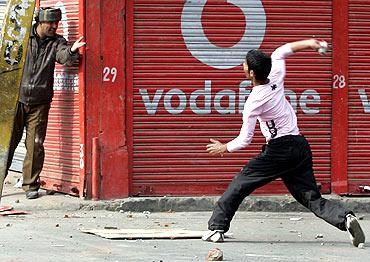
“Are stone pelters the real heroes?” is a question that is on the minds of many Kashmiris. In a winter that follows a summer of over a hundred deaths, would they have gone cold and numb?
Were these the thoughts in Professor Noor Mohammed Bhatt’s mind?
A Kashmir University professor was arrested on Friday for framing a question paper for first-year BSc students that included, “Are stone pelters the real heroes?”— referring to the three-month agitation across the Valley this summer in which more than 110 people were killed.
The second impugned question sought translation of a passage from Urdu to English, which contained a diatribe against Kashmir’s “occupation” with provocative passages like “Kashmiri blood is being spilled like water, Kashmiri children are being killed by the police and Kashmiri women are being showered with bullets.”
Besides his arrest, it has caused embarrassment. Why? Aren’t they embarrassed by the situation in the state? Aren’t they embarrassed by the manner in which the struggle gets overtaken by outside sympathisers who reduce their struggle into a Pakistani add-on?
Protest movements have used such methods in the past. This is the equivalent of flyers and posters, only it used a more potent and legitimate source to get back at a potent and legitimate force. University politics is not unusual and it is very clearly run by political parties. In this case one is not sure. I am just wondering what would have been the reaction had the question been, “Is Omar Abdullah the real hero?”
Prof Bhatt’s colleagues reacted with shock saying they were puzzled because he was not known for his extreme views. Most, instead, believe he was trying to kick off a debate among the young on the futility behind endless protests and their chosen method of pelting stones. The examination controller is now scrutinizing all the other question papers to ensure no more such nasty surprises await students.
His colleagues obviously do not understand what extreme views are. There is no allusion to ‘futility’ here. Indeed, the reference to ‘occupation’ is unfortunate, but he is most likely trying to push the envelope. And anyway, why blame a Kashmiri Professor who lives there and has seen the bloodshed and has taught at the university for 20 years saying it when others come and barf this stuff from the dais?
He has had no chance to go to the media and create a sympathy or rumour wave for himself. He has been arrested. It will be for misusing his position, misleading students, causing unrest…what else? Has any Kashmiri leader come to his rescue or spoken up on his behalf, even if it needs an apology for using the wrong forum? Where are the azadi people? Come on, fess up?
The authorities will be careful from now on, but the question paper went through. Maybe the disaffection is deeper and far more widespread than some fantasies would like us to believe. These are BSc students and will probably want to graduate and get jobs. Will they get jobs?
The newspapers smartly added a boxed item to this report about how 13,000 Kashmiri youth turned up braving the cold, riding buses and motorbikes (and this is like important news…isn’t that how people go anywhere?) to fill up 232 vacancies for the post of constables.
What is this supposed to mean? That the youth is so happy? Or that 12.768 people will return in the freezing cold, riding buses and bikes to their homes and gather stones?
Ask the vexpert - 23
Question: Could you please let me know if there is any procedure/medicine to conceive twins?
Sexpert: Whose decision is this? Are you autocratic in your relationship? Have you thought of the extra burden of pregnancy and birth your wife will have to bear? There is no such medication available.
Me: As you know it is the fastest sperms that get to the goalpost, so you will have to start a reward programme which makes team work imperative. It will be like a doubles at Wimbledon. They will have to first go through a dry run, so to speak, and make sure they know what they are getting into. It is a commitment and most sperms just do the dash in and veer away due to the phobia of being sentenced to an egg cell. These two will need to be certain. Then they have to practise speed and accuracy of aim. If they are comfortable, they might enter one egg together or they could find a home in two separate eggs. Accordingly, your wife will bear identical or non-identical twins.
To train your sperms you will have to follow the same method you would to have an extra-marital affair – work harder or fake better.
Sexpert: Whose decision is this? Are you autocratic in your relationship? Have you thought of the extra burden of pregnancy and birth your wife will have to bear? There is no such medication available.
Me: As you know it is the fastest sperms that get to the goalpost, so you will have to start a reward programme which makes team work imperative. It will be like a doubles at Wimbledon. They will have to first go through a dry run, so to speak, and make sure they know what they are getting into. It is a commitment and most sperms just do the dash in and veer away due to the phobia of being sentenced to an egg cell. These two will need to be certain. Then they have to practise speed and accuracy of aim. If they are comfortable, they might enter one egg together or they could find a home in two separate eggs. Accordingly, your wife will bear identical or non-identical twins.
To train your sperms you will have to follow the same method you would to have an extra-marital affair – work harder or fake better.
Meera badnam hui zaalim India ke liye?
 |
| Time for 'zandu balm'? |
Why are Indians taking out morchas saying that the frisking of our ambassador to the US is an insult to India? I think they should object to headlines like ‘Indian envoy Meera Shankar patted down in US’. Seriously, it isn’t funny.
Some say it was because she was wearing a saree and everyone’s patriotism is frothing on placards. I think even the Pakistani former envoy used to wear a saree. So, Ms. Shankar is merely dressing in what she is comfortable and probably accustomed to rather than upholding Indian pride. She is on assignment and could be on the job in Tanzania or somewhere next.
The US airport security is supposedly following the rule books. I know we have complained about other prominent examples and it is time to question the prudence of diplomatic licence. If the US is extra vigilant, then I think every country ought to be. How did David Headley get in here? Wasn’t it the Indian embassy that gave him the visa? Forget this pat down ruckus and trying to make it into a women’s issue, which it is not. We all get ‘patted down’ in our own airports and with all the metal someone like me has on her person they find rather interesting places that are not even pat-downable.
If the VIPs do not want to go through the ‘insult’ then all countries must just insist on a separate enclosure. Let us not carry this ‘mai-baap’ attitude further. Had someone questioned her inappropriately or said something nasty about India, then we have every right to protest.
End quote:

“Our democracy has become a bit too noisy.” Pranab Mukherjee
I understand, Pranabda. When you find a silent democracy please let us know.
8.12.10
Under watcher
If anyone of you has had the pleasure of diving, then will you please tell me how important is it for you to look at the time?

This watch by Rolex is one big fat catch, but why market it as a ‘diver’s watch’? I don’t know the habits of watch buyers and mine don’t fit in this scheme, yet I don’t think you would be impressed by something that reassures you that you are on time. Is it that you have an appointment to keep with a very special fish or have you been informed that the sharks will appear at such and such hour and you had better get to the shallows?
300 metres under water you would be looking at the sea bed, marveling at what nature has to offer, not looking at the time. I also don’t think any sensible person would want to go for a casual few laps in the pool with a watch on. Imagine skinny dipping with a timepiece…you can at least say you had something on.
So, anyone who wants to sell me anything water-resistant, think again. I only have my sweat and tears. And all the time for them.

This watch by Rolex is one big fat catch, but why market it as a ‘diver’s watch’? I don’t know the habits of watch buyers and mine don’t fit in this scheme, yet I don’t think you would be impressed by something that reassures you that you are on time. Is it that you have an appointment to keep with a very special fish or have you been informed that the sharks will appear at such and such hour and you had better get to the shallows?
300 metres under water you would be looking at the sea bed, marveling at what nature has to offer, not looking at the time. I also don’t think any sensible person would want to go for a casual few laps in the pool with a watch on. Imagine skinny dipping with a timepiece…you can at least say you had something on.
So, anyone who wants to sell me anything water-resistant, think again. I only have my sweat and tears. And all the time for them.
6.12.10
India’s FCUK
The French head of state may not have had the streets washed and buildings painted in his honour, but he and his wife might just get an Indian baby.
Item 1:
They went to the Salim Chishti dargah at Fatehpur Sikri and reportedly the caretaker, Peerzada Rais Mian Chishti, asked the lady, “What is your wish, your prayer?” She is supposed to have said, “Pray for my son, and pray I have another.” The news says he "gave her a red thread that she tied round her wrist, recited the ayat-ul-kursi, and blew". I don’t if it was on the thread or her forehead, as is often done.
Anyhow, the papers have mentioned that the lady was veiled and there are some ‘yippee’ comments about it because you know of the French position on the veil. Well, the lady was not veiled. She had wrapped a shawl round her head, that’s it.
What’s the big deal, anyway? And why did she ask for a son? They gave her the story about how Emperor Akbar walked to the shrine to get an heir. He had an empire to run and it was years ago when patriarchy was deeply entrenched. Here we have Sarko who is funded by a cosmetics company, L’Oreal, so what’s this sonny need? He has three form earlier marriages; she has one from her previous husband. Rais Mian, like most of the custodians of shrines, are always in the limelight during such visits, and he had formed an opinion about her: “Very kind, warm-hearted and extremely family-oriented mohtarma (lady).” I gather the desire for a boy makes her family-oriented.
What he should have done is given that red thread to Sarkozy saab and not Begum sahiba and blown over his head because the Y chromosome is with him, Salim Chishti or no Salim Chishti. At least Akbar Badshah knew that. Of course, Sarko stuck to his jogging regimen to stay fit; he knows he cannot rely on a thread and the breath of a man who looks after a tomb.
Item 2:
Now that the French couple has done the rounds of the tourist sites and seen turbans everywhere, if they thought they’d get some rest and bare heads, then they are mistaken:
Out PM has done this before at other meets and mentioned how the turban is “a very essential part of the Sikh way of life”. True. However, don’t you think this should be conveyed through emissaries and not during delegation-level talks? This is especially important because the PM himself wears a turban and it would seem like he is taking advantage. As a host, he needs to be more careful.
I might also add that had APJ Abul Kalam Azad discussed the veil ban issue, it would not have been considered proper. It would have been deemed regressive. Then, any aspect of religion in which we are trapped is harking back to something that was expected for certain reasons way back in time. Sikhs do not carry swords because it is not feasible and I am not sure how many wear the kachcha (loose underwear) beneath their tight jeans or don’t trim their hair.
Item 3:
Not quite certain about choice of French cuisine or Indian, the chefs decided to do a fusion. It seemed to have appealed to the palate of the guests, though one wonders how…maybe the lady being Italian has some acceptance of farm food so this would seem like really rich. The hotel plans to name something or the other in her honour. May I suggest Carla Coq au dahi and Bruni Blanquette de gosht? Let’s not leave the man out, so the two other items can be enjoyed with stuffed Nicolas naan.
- - -
Rough translation/meanings of the captions:
1. Wow, I am gonna be a mommy
2. Don’t worry, the work has been done
3. Give him an inch and he will take a yard
Item 1:
They went to the Salim Chishti dargah at Fatehpur Sikri and reportedly the caretaker, Peerzada Rais Mian Chishti, asked the lady, “What is your wish, your prayer?” She is supposed to have said, “Pray for my son, and pray I have another.” The news says he "gave her a red thread that she tied round her wrist, recited the ayat-ul-kursi, and blew". I don’t if it was on the thread or her forehead, as is often done.
 |
| Hai! Main maa ban-ne waali hoon |
Anyhow, the papers have mentioned that the lady was veiled and there are some ‘yippee’ comments about it because you know of the French position on the veil. Well, the lady was not veiled. She had wrapped a shawl round her head, that’s it.
What’s the big deal, anyway? And why did she ask for a son? They gave her the story about how Emperor Akbar walked to the shrine to get an heir. He had an empire to run and it was years ago when patriarchy was deeply entrenched. Here we have Sarko who is funded by a cosmetics company, L’Oreal, so what’s this sonny need? He has three form earlier marriages; she has one from her previous husband. Rais Mian, like most of the custodians of shrines, are always in the limelight during such visits, and he had formed an opinion about her: “Very kind, warm-hearted and extremely family-oriented mohtarma (lady).” I gather the desire for a boy makes her family-oriented.
 |
| Fik’r mat karo, maine kaam kar diya |
What he should have done is given that red thread to Sarkozy saab and not Begum sahiba and blown over his head because the Y chromosome is with him, Salim Chishti or no Salim Chishti. At least Akbar Badshah knew that. Of course, Sarko stuck to his jogging regimen to stay fit; he knows he cannot rely on a thread and the breath of a man who looks after a tomb.
Item 2:
Now that the French couple has done the rounds of the tourist sites and seen turbans everywhere, if they thought they’d get some rest and bare heads, then they are mistaken:
Government sources indicated that the contentious issue of ban on Sikh turbans in France will again be taken up with the French side. The government is expected to politely convey to Sarkozy how strongly India feels about the issue when he holds delegation-level talks with PM Manmohan Singh on Monday.
 |
| Yeh lo, ungli diya tau haath pakad liya |
Out PM has done this before at other meets and mentioned how the turban is “a very essential part of the Sikh way of life”. True. However, don’t you think this should be conveyed through emissaries and not during delegation-level talks? This is especially important because the PM himself wears a turban and it would seem like he is taking advantage. As a host, he needs to be more careful.
I might also add that had APJ Abul Kalam Azad discussed the veil ban issue, it would not have been considered proper. It would have been deemed regressive. Then, any aspect of religion in which we are trapped is harking back to something that was expected for certain reasons way back in time. Sikhs do not carry swords because it is not feasible and I am not sure how many wear the kachcha (loose underwear) beneath their tight jeans or don’t trim their hair.
Item 3:
Not quite certain about choice of French cuisine or Indian, the chefs decided to do a fusion. It seemed to have appealed to the palate of the guests, though one wonders how…maybe the lady being Italian has some acceptance of farm food so this would seem like really rich. The hotel plans to name something or the other in her honour. May I suggest Carla Coq au dahi and Bruni Blanquette de gosht? Let’s not leave the man out, so the two other items can be enjoyed with stuffed Nicolas naan.
- - -
Rough translation/meanings of the captions:
1. Wow, I am gonna be a mommy
2. Don’t worry, the work has been done
3. Give him an inch and he will take a yard
Subscribe to:
Posts (Atom)