13.10.13
Burning Evil
How interesting evil is. It makes all else look good in comparison. Without evil, there would be no concept of good. But can evil exist without good? It is like this: evil does not need something to compare itself with. You can see a wrong as an independent entity, as intent too. The right comes with an inbuilt halo, and there is a tendency to assume that a right thing is also the ultimate truth.
Today, on Dussehra, as the effigy of Ravana is burned, it is seen as a triumph of good over evil. I have attended one Ramlila at Mumbai's Chowpatty beach where the story of Lord Rama's battle with the king of demons is enacted. The costumes are garish, the swords covered with shiny foil. The actors are usually from the villages, and the audience is made up of a largely immigrant population from Bihar and Uttar Pradesh. After casting curious glances our way, they were totally focused on what was so obviously over-the-top performances and looked fake, including crowns falling from heads, silky dhotis causing a few falls.
They guffawed not at this, but at the loud monologues, designed to produce just such an effect. For them, it was all believable. Even though the seats were plastic and so were the emotions. Even though they were munching peanuts and hollering out to old acquaintances from their hometowns. Even though they would return to the one-room tenements they shared with ten others and would report next morning to work in houses, from palatial to modest, or drive cars that cost a fortune or were bought on easy monthly installments.
They did not even want to think about how Ravana was quite a scholar, had the strength to move mountains, and that in some ways by kidnapping Sita he was only avenging the honour of his sister Surpanakha whose nose was cut by Rama's brother Lakshmana.
All this was inconsequential to this audience, as it is to most devotees. For those few hours, they believed what they had been brought up to believe. My understanding is that these people would not be communal. They were happy in their pragmatic devotion, their idols, their calendar with a photo of a deity on a peeling wall. They would not feel the compulsion to compare. They had seen the good and the evil within what was theirs. They owned and owned up to it.
I do not think the burning of the Ravana effigy is imperative for them. As a finalé, yes. Nothing more. As a sidelight, I might add that fire is a cleanser, and is used in certain cultures as such. Therefore, would it not amount to purifying evil? But that does not seem to be the purpose. It is an aggressive act. If we do it year after year, does it not reveal that evil does not die...it does not even get burned to toast? What we do is to beat an assumed-to-be-dead horse.
It is a cosmetic moral victory. The evil within, and the struggle to overcome our shortcomings, is sorely lacking. It is a vicarious thrill to watch a gargantuan ten-headed monster, a caricature of all that is bad, afire and turning to ash. Then we return to other caricatures and stereotypes in our heads.
Our walls have no mirrors. Nothing will burn. There will be no flame. No light.
© Farzana Versey
---
Image: Painting of Ravana's abduction of Sita, and the bird Jatayu coming to the rescue.
---
1.11.11
7 Billion Mutinies Now: The Fight For Women
![]() |
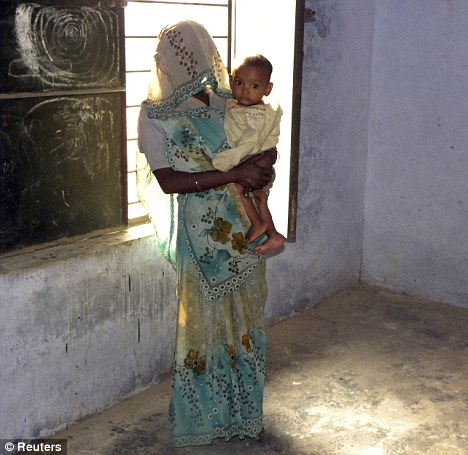
| Phul Kumari with her son |
Across the globe, the seven billionth addition to the human population has been welcomed symbolically. Baby deaths, another vital statistic, can be pushed aside.
Numbers are nice. They give us an idea about just how insignificant we are and how each of us has to wage a battle. The seven billionth girl in India was born in Lucknow – the symbolism here is of the girl child. There are photographs and nice family moments.
Imagine a situation where a few years from now she could be married and forced to become the shared booty between brothers because she survived. Nobody poked a coat hanger in her mother’s womb to kill her. No one poisoned her milk or just threw her in the dustbin. The tragedy of her life is her survival.
What I mention about shared booty is a shocking report that somehow did not cause a flutter in the mainstream Indian media. My inbox that is usually flooded with information about female circumcision in some African country or how women in Saudi Arabia have to fight the authorities to be able to drive did not have a word about this news. We Indians are concerned about how the world treats women when we are among the worst criminals.
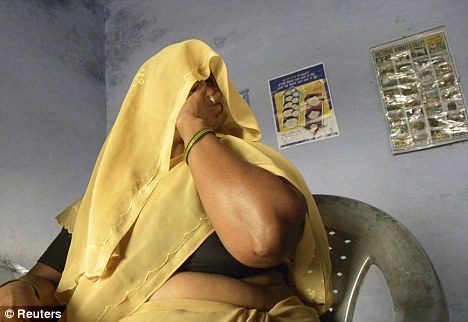
Baghpat does not figure in the maps we understand. It is a small village in North India, two hours away from the capital New Delhi and 500 kms from the 7 billionth baby girl. The report mentions the story of a woman, now in her 40s, who had come like any other bride to her new home. Munni did not know what awaited her. In her words:
"My husband and his parents said I had to share myself with his brothers. They took me whenever they wanted – day or night. When I resisted, they beat me with anything at hand. Sometimes they threw me out and made me sleep outside or they poured kerosene over me and burned me."
She has three sons from her husband and his two siblings. She would not be able to tell who is whose father. She filed no police complaint. She had no choice; some would say her position is better because others are kidnapped and raped or sold to brothels.
The British Medical Journal quotes the astounding figure of 12 million deaths of female children in three decades. Voluntary agencies mention the sex ratio. In Baghpat for every 1000 men there are 858 women; nationally the ratio is 1000 men for 940 women.
This is a far more delicate problem than rape and human trafficking, for it is kept within the family. In Haryana, brides are imported from the vastly different cultural southern state of Kerala. It would be a good example of breaking regional barriers, but many of the women are bartered.
We also need to look beyond the skewed sex ratio, because in some ways it ends up sounding like a justification even as we deplore it. We also have mythology to rely on. In the Mahabharata, the Pandavas – the good guys of the epic – all marry Draupadi. The reason? They are obedient sons. Their mother Kunti always told them that they should share whatever they get. After Arjuna successfully wins Draupadi in a swayamwar, upon their return they tell their mother they have brought alms and she repeats her advice. One can look upon this as less literal than it is because it is mythology. However, later these brothers do put their wife at stake in a game of dice.
![]() |
| Munni, the victim, is shamed; the shameless get away |
Munni of Baghpat does not have a kingdom she can claim to belong to or a Krishna she can seek succour from. There must be many such women who are not only shared by the brothers but also sold or loaned to the desperate bachelor population.
Such a sense of camaraderie and community living was not uncommon in tribal societies. In fact, there were matrilineal societies too, but power was vested in the hands of the woman and lineage also passed through her. It did not give rise to any questions about fatherhood. Women had control over choice of mate and property.
If the Baghpat type situation were reversed and women indulged in this sort of polyandry in today’s times, it would most certainly be unacceptable. For all our talk of women’s empowerment, even offbeat cinema sees a woman’s sexuality as the masculinisation of her. Or, an error.
In UP, too, the fact that Munni is not even granted respect and treated as a sex object should alert us to the fact that the sex ratio figures could well turn into a ruse for polygamous relationships. Where men do not need to pay for sex and can get women to work in the farms and at home to cater to their every need, it might alter the dynamics of gender relationships and parenting. One is bound to sneer at what appears to be an urban concern, but gender relations are not only about seminar discussions. It is about how they affect people of two sexes.
If the men are following the patriarchal format and want to propagate their lineage, why are they not concerned about who the father is? Is there any guarantee that they are not going out with other women to satisfy their sexual urges? What about the issue of diseases? Education of women is a priority as the agencies there rightly point out, but will it ensure that the woman gets out of this circle? They obviously have little control over the gender of their offspring and what happens to it. Since it is the men who seem to ‘suffer’ due to lack of women, should they not be educated and informed about the long-term consequences of snuffing out the life of the girl child?
Munni’s story is incomplete without pondering over a few concerns. She has three sons. Did she have any daughters that she had to get rid of? Had the daughters been allowed to live, would their own fathers have exploited them for no one would know who the natural parent is?
By now, we have gone much beyond the seven billionth figure and if a girl has survived in some backward village, her fate is sealed – sold and delivered. It could be to a client or it could be one husband too many.
(C) Farzana Versey
Also published in Countercurrents
13.7.07
You think I can save Islam?
I don't know why Islam needs to be reformed. If you have some element of intellect, then you choose what floats your boat; if not, then you sink with it or swim with whatever tide takes you wherever. Islam is more a way of life than Hinduism; it tells you how to wash your elbows, for god's sake...how much more can an instruction manual do?
Religion is a belief system and therefore in the public domain. You visit places of worship, sing hymns, and become part of a community. What you do in private is take this public learning and transport it in your homes - whether it is a puja room, a picture of Christ or Quranic sayings and then you pray. It is akin to a closed-door meeting about the declaration of a mutual fund's progress.
Westernisation is consumerist progress. So if you have call centres where people speak in American accents rather than madrassas where they shake their heads, they call it progress. But, the call centre employee can be a fanatic and the madrassa student need not be. Secularism is not a rejection of religion. Secularism is an acceptance of various religious streams of thought, whether one practises any one or not. And secularism does allow you to be able to say that the works of Neruda or Shakespeare have equal validity and sanctity in your life as any holy book might. It does not reduce the latter in any way, unless one is heavily into reductionism.
This whole ‘moderate’ behemoth puts me off. Once again, two nights ago, I was invited for another such TV panel discussion and I told the person that if I chose to appear in purdah would she still think of me as a 'liberal'? She kept quiet. Then she said, "What sort of subject should I approach you for?" I told her, "Sex." Silence again.
My Muslimness is one part of my identity, just one. If some people wish to fall in this trap of playing to the stereotype of ‘people on the mend’, then please do so. Leave me out of this.
I won’t even deny that the basis of Islam is violence as it is of all religions. Islam has just polished its sword to look shinier. It does not mean that the others are playing chess…heck, if you read some of the epics even chess has a violent and devious motive.
So, I am not interested in reforming Islam at all. Besides being ill-equipped to do so, it just does not make logical sense to me. If Islam says live by the sword, and I think it works for me, I shall sleep with one by my side. It does not mean we cleave whatever comes in the line of the sharp edge. Some of us are very picky.