Showing posts with label plays. Show all posts

9.11.17

Revisiting Akbar-Salim-Anarkali


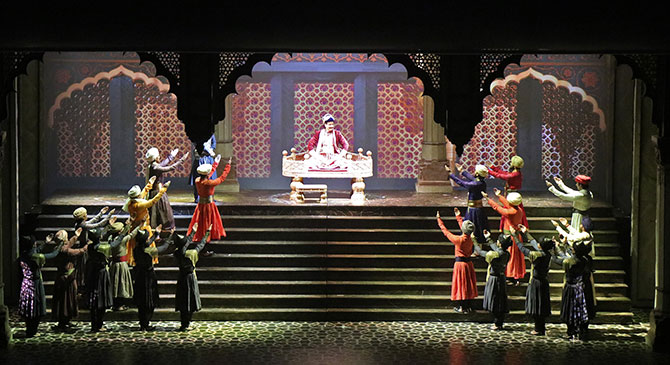
Last weekend I watched the stage version of Mughal-e-Azam. I like new perspectives, even if they do not hold the old charm.

Feroz Abbas Khan’s take on the Anarkali-Prince Salim love story under the not benevolent eye of Emperor Akbar is an ambitious project. How could K.Asif’s landmark movie translate in the confined space of a stage, especially since there weren’t any claims at ‘reinventing’ the classic and the intent was to almost repeat the scenes and the dialogues verbatim?

As a tribute it succeeds; it has the  head-bowed quality about it, aware all the time of looking up to an icon. And it has improvised marvellously. That battle scene is breath-taking because it relies on lights, sound and choreography. The same applies to the kathak interludes – these are professional dancers and, to be honest, it was they who elevated the Pyar kiya to darna kya song sequence by adding heft to Anarkali’s challenge, and pathos; in the film the song was about Madhubala. There was also an innovative use of ‘mirrors’ and light to create the sheesh mahal, although the light hitting the audience made me squint and miss out on some ‘chakkars’ by the dancers.

There was also live singing. Neha Sargam as Anarkali did a marvellous job, but was it necessary, considering it was the same music? It was also rather disappointing when at curtains down, the announcer mentioned how people weren’t convinced that it was live singing and asked her to sing a few lines right there. To my mind, this was insulting to the artiste. The makers do not have to justify anything and ask their own actors to give proof.
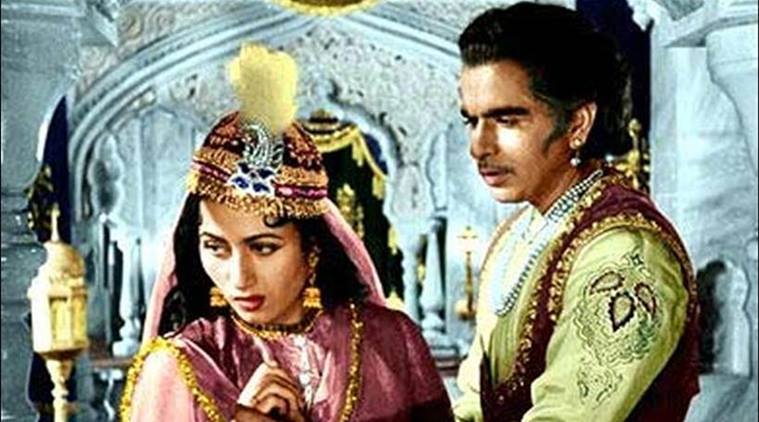

If the original was about performances, this was not. For a supposedly more intimate medium, the acting was alienating. Probably it is the stage where expressions rely on voice and body language. Nissar Khan as Akbar was powerful at moments and desultory at others. Sunil Palwal as Salim has presence, but where was the angst? And where was the passion with Anarkali, the understated caresses, that choke in the voice? As for Jodha, there is no real pining for a son nor the conflict between suhaag and motherhood. Bahar’s - the daasi hoping to become a princess - character too does not have enough oomph and guile that the original possessed.

For me that was sad because on the film I felt Nigar Sultana had overtaken Madhubala in the qawaali not due to the lines but gumption (aidedhugely by Shamshad Begum’s voice).

Naushad’s music was the stuff of legend and it was good to revisit it ‘pictorially’, even if not entirely satisfactorily. Theatre, unlike cinema, is not really a director’s medium. But here the director rules, followed by stage design, lighting, choreography. It was treated like an occasion. People were taking selfies before the posters in the lobby…after all they had paid good money for the tickets.


-->
I’d say it was worth the few thousand bucks. For the million bucks’ worth, buy a DVD for a couple of hundred rupees.

26.12.11

Closed Doors: Band Darwaaze - Satyadev Dubey


Satyadev Dubey made me uncomfortable. On two occasions.

First: Prithvi Theatre. Lights out. Power outage. Everyone stood where they could find space – the foyer, near the entrance or in the lane outside. Many were familiar faces. The cafĆ© was full with those who were not going to watch the play. It was always full. Writers, directors, actors, wannabes, has-beens. I stood near the tree at the curve of the entrance; a short stocky man in a kurta was ambling the distance of a few feet. Makarand Deshpande, whose play was being staged, introduced us. There was a short verbal exchange, but his eyes continued to speak, to probe. It was as though he was taking up the air around me, converting it into frost that would cage me in some unfathomable way.

I was already acquainted with his work (films and stage) and recall watching Sambhok Se Sanyas Tak (From Lust to Sublimation) at the Karnataka Sangh, not one of those charmed places where everything different is seen as ‘path-breaking’; the different was meant to be just that. No overdose of adjectives. Dubey was in some ways the Osho of the theatre world, and the serious aficiandos might take offence to it, which would be precious because he was offensive most of the time. His work was designed to hit where it hurt. His gaze unrelenting.

The second uncomfortable Dubey moment was again in the dark. The same stocky figure waiting at a park for a young girl, trailing her wherever she goes, a foreigner in a country that is supposed to be alien, but which is more like him than anything he has known. A playwright who has so dramatised his life that he is looking for a grand finale to it. Nothing else, or less, will do.

She is young, pert and full of ammo. On the face of it, a propah English girl, but slowly, with every professional failure, she unclothes herself before our eyes to reveal what she has always denied: Her alienness. She does not quite belong, so she is shunned. She is displaced and grudgingly has to admit that to be deflowered she needs not a gentle touch but to be roughed up. To unleash her anger, her potential. The music must rise from the waltz, the jive, the samba to a deafening crescendo of Antigone’s cry.

Dubey could not be for real. He acted the part he wrote in It Could Happen Only In London, taking you on a fantastical journey of a girl becoming a woman and a man turning into a boy. It is about age catching up with us or making us regress. About seduction. Violence. Ambition. Realisation. And at the end of it all the menace of futility being unable to prevent that glimmer of light from penetrating through its transparent wings.

Satyadev Dubey died yesterday and is closer to the sun now. But that night, tucked away in a lane in Juhu under canopy of fake stars, I had discovered the full thrust and throb of what “effing your head off” truly meant. It was about chasing an evanescent dream, and when it assaults resistance gives way to release.

20.5.08

Vijay Tendulkar: Khamosh...

I saw him coming out of the gate of Sahitya Sahwas, the complex for littƩrateurs in Bandra east where he lived. He was wearing very dark glasses and for a moment looked like one of those dark characters that he created so well.
Vijay Tendulkar would just have easily been relegated to the small world of ‘art cinema’, but going by the films he scripted, the plays he wrote, it is clear that there weren’t many like him around at the time to sustain the avante garde movement. But Tendulkar was not experimenting; he was giving it to us as real as it was, mostly a hard slap ...with the sharpness of a whip.
He was groping the underbelly of society – tribal, rural and urban.
He exposed hyprocrisy – political, social, gender. The last I am a bit iffy about. His men may have been victims but they were pretty much in charge. However, it is when he showed them as vulnerable and helpless did they become human and not the off-beat version of machismo.
I suppose of all his work I do rate Manthan the best, precisely because it was a subtler film; the intent was less oblivious…perhaps the subject lent itself to that sort of pace.
In theatre, Tendulkar will forever be known for Sakharam Binder and the pathbreaking Ghashiram Kotwal. In the latter he coalesced folk theatre, music and dance to make a hugely political point using history.
I shall always remember this play fondly because it was the main actor who enacted Nana Phadnavis, Dr. Mohan Agashe (he is a practising psychiatrist) who drove me to the hall after feeding me laddus and then went and sat at the ticket counter minutes before the powerhouse performance. This is commitment.
This is how people like Tendulkar woke us up to several realities. In some ways, even his own death...yesterday, May 19.
- - -
A list of some of his works:

# Shantata! Court Chalu Aahe (Silence! The Court Is in Session) (1972)
# Nishant (End of Night) (1975)
# Saamna (Confrontation) (1975)
# Manthan (Churning) (1976)
# Simhasan (Throne) (1979)
# Gehrayee (The Depth) (1980)
# Aakrosh (Cry of the Wounded) (1980)
# Akriet (Unimaginable) (1981)
# Umbartha (The Threshold) (1981)
# Ardh Satya (Half Truth) (1983)
# Kamala (1984)
# Sardar (1993)

23.4.07

As you like it...

Today, April 23 is William Shakespeare's birth and death anniversary.

Hamlet's Soliloquy:


To be, or not to be: that is the question:
Whether 'tis nobler in the mind to suffer
The slings and arrows of outrageous fortune,
Or to take arms against a sea of troubles,
And by opposing end them? To die: to sleep;
No more; and by a sleep to say we end
The heart-ache and the thousand natural shocks
That flesh is heir to, 'tis a consummation
Devoutly to be wish'd. To die, to sleep;
To sleep: perchance to dream: ay, there's the rub;
For in that sleep of death what dreams may come
When we have shuffled off this mortal coil,
Must give us pause: there's the respect
That makes calamity of so long life;
For who would bear the whips and scorns of time,
The oppressor's wrong, the proud man's contumely,
The pangs of despis'd love, the law's delay,
The insolence of office and the spurns
That patient merit of the unworthy takes,
When he himself might his quietus make
With a bare bodkin? who would fardels bear,
To grunt and sweat under a weary life,
But that the dread of something after death,
The undiscover'd country from whose bourn
No traveller returns, puzzles the will
And makes us rather bear those ills we have
Than fly to others that we know not of?
Thus conscience does make cowards of us all;
And thus the native hue of resolution
Is sicklied o'er with the pale cast of thought,
And enterprises of great pitch and moment
With this regard their currents turn awry,
And lose the name of action.-- Soft you now!
The fair Ophelia! Nymph, in thy orisons
Be all my sins remember'd.
- - -
Macbeth's Soliloquy:

Is this a dagger which I see before me,
The handle toward my hand? Come, let me clutch thee.
I have thee not, and yet I see thee still.
Art thou not, fatal vision, sensible
To feeling as to sight? or art thou but
A dagger of the mind, a false creation,
Proceeding from the heat-oppress'd brain?
I see thee yet, in form as palpable
As this which now I draw.
Thou marshall'st me the way that I was going;
And such an instrument I was to use.
Mine eyes are made the fools o' the other senses,
Or else worth all the rest; I see thee still,
And on thy blade and dudgeon gouts of blood,
Which was not so before.
- - -
Sonnets:

Shall I compare thee to a summer's day?
Thou art more lovely and more temperate:
Rough winds do shake the darling buds of May,
And summer's lease hath all too short a date:
Sometime too hot the eye of heaven shines,
And often is his gold complexion dimm'd;
And every fair from fair sometime declines,
By chance or nature's changing course untrimm'd;
But thy eternal summer shall not fade
Nor lose possession of that fair thou owest;
Nor shall Death brag thou wander'st in his shade,
When in eternal lines to time thou growest:
So long as men can breathe or eyes can see,
So long lives this and this gives life to thee.
- - -

Let me not to the marriage of true minds
Admit impediments. Love is not love
Which alters when it alteration finds,
Or bends with the remover to remove.
O no! it is an ever-fixed mark
That looks on tempests and is never shaken;
It is the star to every wand'ring bark,
Whose worth's unknown, although his height be taken.