Tonight we watched a story unfold: of how doctors take money to amputate perfectly healthy limbs of beggars from the Mafia that runs the show. IBN-CNN must be commended for this expose, “Why beggars don’t scream” , but will it stop here?
Another televised drama? We have been promised that the case will be pursued, the offending doctors will be arrested…ministers have assured that action will be taken.
Let us look beyond that. Will it stop at these three doctors trapped in the sting operation? Is it restricted to Ghaziabad? What about instances of quacks operating?
The existence of a beggar mafia has been fairly common knowledge, and some of us who have done stories know that territories are marked by groups. The police get hafta (bribe), the kingpin gets his cut and usually the beggar gets just food.
I suspect that not much will happen to the doctors.
A few years ago I had followed up a case of neglect that could have led to death. A wrong blood group diagnosis prior to surgery. In a chawl at the far suburb of Ghatkopar in Mumbai resided this lower middle-class family; they put all their papers and trust before me. It was late night when I left them.
Next morning I decided to meet the doctor. I entered the clinic and after a very long wait his wife, also a doctor, told me he was not in town. It was a lie for the fruit vendor outside had in fact given me the exact address and also confirmed his presence.
When I went out, I told him he wasn’t in. “Aisa kaise ho sakta hai? Hum ne khud dehka aatey hue aur unki gaadi bhi yahaan hai.” (How is it possible? I saw him enter and his car is still there.)
It was raining outside. I crossed the street and lay in wait, hoping for something. Nothing. The showers were getting incessant and I was drenched. It must have been the time of a blink of an eye when I saw THE car get out of the gate. I couldn’t move. Where would I? How? It was a helpless situation. I left. An hour later a colleague from a magazine told me that he had got a call from the doctor, he was a nice man, very influential. The message was that I should keep shut.
I did not.
What happened? Did the family get anything out of it? No. Except that they had raised their voice. No action was taken despite their case being put before the medical council.
Slowly, it was almost forgotten…a year or so later I was shocked to read that this doctor had been given some award by his own fraternity.
The media today has a greater reach, more influence. It should use it as a weapon against offenders and act as a shield for those who need protection.
As for me, that scene still haunts me of a car that escaped and the rain that wouldn’t stop. It haunts me that I could do nothing. Absolutely nothing.
31.7.06


25.7.06
The little Prince?
As I switched on the TV on Sunday night and saw the ticker talking about Prince being rescued from a ditch, I began to wonder what the heck was good ole Charlie upto. Or did William fall off a horse? Or was Harry punch drunk? And why was Manmohan Singh sending them blessings?
Or was it one of our Rajasthan type ‘hukooms’?
Or was it a police sniffer dog that was chasing a Tashkar-e-Taiyba terrorist who seem to be so easy to find?
Then I squinted my eyes as I read that the Haryana chief minister had offered Rs. 2 lakh to Prince. All this was breaking news. Later, images were flashed and I got to know that the whole country had been riveted for two days by the ordeal of a five-year-old who had fallen into an open sewer.
He was hailed by commoner and cynic alike as a hero.
I was just glad I wasn’t around to be “glued to the TV”. The Prince episode makes me sick. It has exposed the malaise that besets urban society – boredom.
K. Natwar Singh, our former external affairs minister, dedicated his column in The Asian Age to “A new little hero for India”.
He asks with utter naiveté, “How did a billion Indians adopt him as their own, why did so many perform pujas and collective prayers?” and then proceeds to answer with the even more naïve, “Because we are an emotional and sentimental people”.
Where are our emotions and sentiments when children walk around like zombies with bloated hungry stomachs, who die before they are born, who live in pipes that are not even two-feet wide? Where are our emotions when tribals are displaced, slums are demolished, people killed in cold blood?
He gushes, “What a wonderful, heart-lifting, skillful job the rescue team, the doctors and the administration did.”
Where are the rescue teams when calamities strike, when women are raped, villages plundered?
He further states, “The chief minister of Haryana has given Rs 2 lakh to the boy’s parents. The Prime Minister has announced free medical aid. This is not enough. Also announce that Prince’s education from primary school to university will be met by the government of Haryana.”
Where are our politicians when many such children die due to lack of basic healthcare? Why did Prince get Rs. 2 lakh? If it is compensation for the neglect of the authorities that left the sewer open, then the person responsible ought to be thrown out of his job first. This is a sop and will encourage the powers-that-be to become heroes by default. The prime minister should be sending his blessings to all the impoverished children of India for displaying resilience every single day of their lives.
On what grounds must the Haryana government sponsor the child’s education? Because a CCTV was monitoring him and he survived on biscuits and chocolates?
Why are TV channels being lauded? They want reality? They should park their cameras in villages where some kids run hard and fast hoping to become athletes if only they could afford a pair of shoes. Then let us see how many people pray.
Natwar Singh is extremely insensitive when he says, “The other reason is that this happy ending took our minds away from perpetual doom and gloom, from terror attacks in Mumbai, rape in Ghaziabad, abduction in the Northeast, violence in Somalia and Sudan, American folly in Iraq, an air crash here and a train disaster there, Israeli bombing of Southern Lebanon, Hezbollah retaliating with deadly determination, from a suicide by a girl in a Delhi school to murder in Vasant Vihar, I could go on and on.”
I am quoting from one article by an articulate, apparently intelligent man (never mind that he makes a comment like, “This five-year-old kid obviously has a very strong horoscope and a very strong constitution”), but this obviously seemed to be the mood around.
So, as citizens of the world, must we ignore the gut-wrenching happenings around us? Must we use a personal trauma as ‘time-pass’ and in turn transform an unlikely candidate into a hero?
To call Prince “a role model to millions of children of our beloved India” would mean waiting for every child to fall into a ditch, literal or metaphorical.
Or was it one of our Rajasthan type ‘hukooms’?
Or was it a police sniffer dog that was chasing a Tashkar-e-Taiyba terrorist who seem to be so easy to find?
Then I squinted my eyes as I read that the Haryana chief minister had offered Rs. 2 lakh to Prince. All this was breaking news. Later, images were flashed and I got to know that the whole country had been riveted for two days by the ordeal of a five-year-old who had fallen into an open sewer.
He was hailed by commoner and cynic alike as a hero.
I was just glad I wasn’t around to be “glued to the TV”. The Prince episode makes me sick. It has exposed the malaise that besets urban society – boredom.
K. Natwar Singh, our former external affairs minister, dedicated his column in The Asian Age to “A new little hero for India”.
He asks with utter naiveté, “How did a billion Indians adopt him as their own, why did so many perform pujas and collective prayers?” and then proceeds to answer with the even more naïve, “Because we are an emotional and sentimental people”.
Where are our emotions and sentiments when children walk around like zombies with bloated hungry stomachs, who die before they are born, who live in pipes that are not even two-feet wide? Where are our emotions when tribals are displaced, slums are demolished, people killed in cold blood?
He gushes, “What a wonderful, heart-lifting, skillful job the rescue team, the doctors and the administration did.”
Where are the rescue teams when calamities strike, when women are raped, villages plundered?
He further states, “The chief minister of Haryana has given Rs 2 lakh to the boy’s parents. The Prime Minister has announced free medical aid. This is not enough. Also announce that Prince’s education from primary school to university will be met by the government of Haryana.”
Where are our politicians when many such children die due to lack of basic healthcare? Why did Prince get Rs. 2 lakh? If it is compensation for the neglect of the authorities that left the sewer open, then the person responsible ought to be thrown out of his job first. This is a sop and will encourage the powers-that-be to become heroes by default. The prime minister should be sending his blessings to all the impoverished children of India for displaying resilience every single day of their lives.
On what grounds must the Haryana government sponsor the child’s education? Because a CCTV was monitoring him and he survived on biscuits and chocolates?
Why are TV channels being lauded? They want reality? They should park their cameras in villages where some kids run hard and fast hoping to become athletes if only they could afford a pair of shoes. Then let us see how many people pray.
Natwar Singh is extremely insensitive when he says, “The other reason is that this happy ending took our minds away from perpetual doom and gloom, from terror attacks in Mumbai, rape in Ghaziabad, abduction in the Northeast, violence in Somalia and Sudan, American folly in Iraq, an air crash here and a train disaster there, Israeli bombing of Southern Lebanon, Hezbollah retaliating with deadly determination, from a suicide by a girl in a Delhi school to murder in Vasant Vihar, I could go on and on.”
I am quoting from one article by an articulate, apparently intelligent man (never mind that he makes a comment like, “This five-year-old kid obviously has a very strong horoscope and a very strong constitution”), but this obviously seemed to be the mood around.
So, as citizens of the world, must we ignore the gut-wrenching happenings around us? Must we use a personal trauma as ‘time-pass’ and in turn transform an unlikely candidate into a hero?
To call Prince “a role model to millions of children of our beloved India” would mean waiting for every child to fall into a ditch, literal or metaphorical.
6.7.06
Megha chhaae aadhi raat, bairan ban gayee nindiyaa
Yesterday I was out. I took my mother for her post-op check-up. This wasn’t the bhutta and garam chai kind of rain. It was frightening.
We had to change route four times to get to the hospital. I am not complaining. I cannot. The scenes I saw in the street wouldn’t let me. People were holding on to each other, vehicles were stalled, rows of shops that I always grumbled caused traffic snarls and stared at me with the latest fashion accessories were shut. Above one row the windows had come off the hinges.
For the first time I think I looked at my school with affection! It looked lost – I could see the doors of the classrooms closed. How we would wait for the rains for a holiday to be declared and then make paddle-boats of our shoes before we reached home to the safe cocoon of hot chocolate, warm hugs before our hair was towel dried as every strand whipped our faces wet.
Was such innocence dead?
Yesterday, I was surprised to see it still alive. Groups of young boys soaked to the skin were patrolling the areas to help; a young couple whizzed past on a motorbike till it whirred to a stop… the guy looked behind and she smiled and held him close; urchins waved at everyone as they bathed in the muddy water; as we made our way towards Bandstand, a cop in a yellow raincoat motioned us to turn away.
We went via Mount Mary’s church. The carts with candles were covered with sheets, but some were left open. Faith’s flame could not be doused.
This is a view of the waters before the greater deluge where once there was a street.

Here is Bandstand just before we were stopped.

Mount Mary’s Church with the plastic sheet-covered candle stalls.

These are the downed shutters of shops and in the far right corner a man who has found shelter.

I did not get any vicarious thrill clicking these photographs. Some little kids did in fact give me their practised ‘Canon’ised smiles, but I refrained. I just had the camera in my bag and these are the places where I have walked, driven through, prayed, shopped almost everyday of my life.
I did not want to see people “bounce back”. This is what makes others take us for granted. TV channels invite politicians, cops, bureaucrats, admen, citizen’s initiative types who are not in touch with the ground reality. They talk about how Mumbai pays Rs. 60,000 crore in taxes, but the appalling drainage system (said to be anywhere from 70 to 150 years old) is blamed on encroachments.
The pictures I have shown you, the places I have mentioned are the so-called elite areas of the suburbs. The road where the cop stopped us from entering houses Shahrukh’s, Salman Khan’s and Rekha’s homes.
The encroachments are not only the slums but the illegal buildings. A very fancy atrium structure has come up at the end of the lane where I live; it has caused complete havoc in this once-beautiful stretch. Its silly little waterfall mocks me when it ought to be mocking itself.
I cannot complain. I will not. I saw the municipal guys clearing the garbage, emptying your filth and mine in the trucks despite the downpour. That would have made for a great picture. But it would have taken away their dignity.
These faceless, nameless people may never ask for it. It is the least we can give them.
We had to change route four times to get to the hospital. I am not complaining. I cannot. The scenes I saw in the street wouldn’t let me. People were holding on to each other, vehicles were stalled, rows of shops that I always grumbled caused traffic snarls and stared at me with the latest fashion accessories were shut. Above one row the windows had come off the hinges.
For the first time I think I looked at my school with affection! It looked lost – I could see the doors of the classrooms closed. How we would wait for the rains for a holiday to be declared and then make paddle-boats of our shoes before we reached home to the safe cocoon of hot chocolate, warm hugs before our hair was towel dried as every strand whipped our faces wet.
Was such innocence dead?
Yesterday, I was surprised to see it still alive. Groups of young boys soaked to the skin were patrolling the areas to help; a young couple whizzed past on a motorbike till it whirred to a stop… the guy looked behind and she smiled and held him close; urchins waved at everyone as they bathed in the muddy water; as we made our way towards Bandstand, a cop in a yellow raincoat motioned us to turn away.
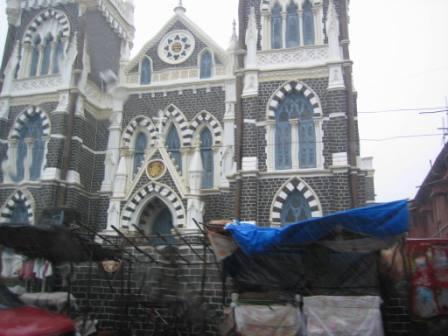
We went via Mount Mary’s church. The carts with candles were covered with sheets, but some were left open. Faith’s flame could not be doused.
This is a view of the waters before the greater deluge where once there was a street.
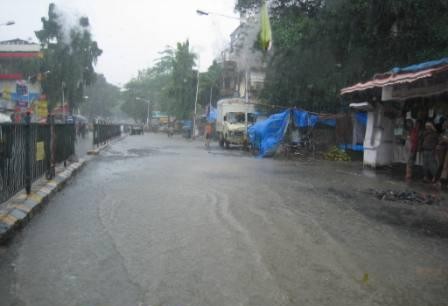
Here is Bandstand just before we were stopped.

Mount Mary’s Church with the plastic sheet-covered candle stalls.
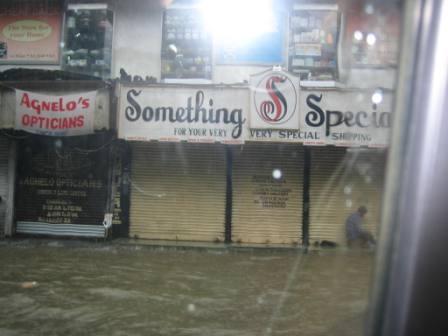
These are the downed shutters of shops and in the far right corner a man who has found shelter.
I did not get any vicarious thrill clicking these photographs. Some little kids did in fact give me their practised ‘Canon’ised smiles, but I refrained. I just had the camera in my bag and these are the places where I have walked, driven through, prayed, shopped almost everyday of my life.
I did not want to see people “bounce back”. This is what makes others take us for granted. TV channels invite politicians, cops, bureaucrats, admen, citizen’s initiative types who are not in touch with the ground reality. They talk about how Mumbai pays Rs. 60,000 crore in taxes, but the appalling drainage system (said to be anywhere from 70 to 150 years old) is blamed on encroachments.
The pictures I have shown you, the places I have mentioned are the so-called elite areas of the suburbs. The road where the cop stopped us from entering houses Shahrukh’s, Salman Khan’s and Rekha’s homes.
The encroachments are not only the slums but the illegal buildings. A very fancy atrium structure has come up at the end of the lane where I live; it has caused complete havoc in this once-beautiful stretch. Its silly little waterfall mocks me when it ought to be mocking itself.
I cannot complain. I will not. I saw the municipal guys clearing the garbage, emptying your filth and mine in the trucks despite the downpour. That would have made for a great picture. But it would have taken away their dignity.
These faceless, nameless people may never ask for it. It is the least we can give them.
26.6.06
Get the hell out of the way!
Oh my gott, my dear Mumbai has been judged the rudest city in the world! Must I keel over and feel like lightning has struck me (that would be cruel, for lightning in fact did kill a girl recently)? Or must I get all ballistic because this is just so rude? Or should I get self-righteous and start giving examples of how we ooze kindness from every pore?
“Reader's Digest magazine sent reporters into the principal cities of each of the 35 countries where it is published, to conduct a survey of local politeness. Three tests were employed: dropping papers in a busy street to see if anyone would help; checking how often shop assistants said ''thank you''; and counting how often someone held a door open.”
1. Assuming you are walking down a busy street and going someplace with a bunch of papers, why would you drop them? That reveals carelessness on your part, not rudeness on the part of passersby because I think it is extremely rude to eye anyone’s personal papers.
2. In Mumbai shop assistants will unfurl yards of cloth even if you look like the kind who would not wear much, so it is you – the customer – who should be doing the thanking. And anyway, having travelled to many parts of the world, I have not encountered too many ‘thank yous’ after a purchase.
3. What doors need to be opened?? Most doors in Mumbai are already open. People leave lift doors open, store doors ajar with airconditioning seeping out. Our chemists have open entrances, gates are left wide open for strays, thieves and visitors.
Returning to the invigorating subject of rudeness, it is such a huge relief compared with the “Helloji, how’re you ji?” of Delhi, or the “Bhalo, hain?” seemingly sweet as rossogulla enquiry of Kolkata, or the rocking of the head with the accompanying, “Good no?” down South.
Mumbai does not ask you how you are; it tells you. In a fast-paced life where people discover who their neighbours are after they have been killed, there is something comforting in the thought that you are given directions to the state of your well-being. And the fact is you are as good as you are made to feel.
Yes, we Mumbaiites have been accused of brazenness, of being callous, uncaring. We are perhaps all of these and we make no excuses. I like it if someone tells me they are busy rather than saying, “Oho, pliss come, come, anytime” and then the person disappears or makes you wait.
Mumbai traffic moves like a turtle, but you won’t find rickshaw drivers climbing on to the pedestrian walkways “for shortcut”.
Mumbai has little time for niceties and that is the nicest thing about it. You don’t have to plan to meet it with fake smiles. Mumbai welcomes your scowls and you merge with it effortlessly.
This sounds suspiciously like love. Perhaps love is the rudest thing two people can do to each other…
“Reader's Digest magazine sent reporters into the principal cities of each of the 35 countries where it is published, to conduct a survey of local politeness. Three tests were employed: dropping papers in a busy street to see if anyone would help; checking how often shop assistants said ''thank you''; and counting how often someone held a door open.”
1. Assuming you are walking down a busy street and going someplace with a bunch of papers, why would you drop them? That reveals carelessness on your part, not rudeness on the part of passersby because I think it is extremely rude to eye anyone’s personal papers.
2. In Mumbai shop assistants will unfurl yards of cloth even if you look like the kind who would not wear much, so it is you – the customer – who should be doing the thanking. And anyway, having travelled to many parts of the world, I have not encountered too many ‘thank yous’ after a purchase.
3. What doors need to be opened?? Most doors in Mumbai are already open. People leave lift doors open, store doors ajar with airconditioning seeping out. Our chemists have open entrances, gates are left wide open for strays, thieves and visitors.
Returning to the invigorating subject of rudeness, it is such a huge relief compared with the “Helloji, how’re you ji?” of Delhi, or the “Bhalo, hain?” seemingly sweet as rossogulla enquiry of Kolkata, or the rocking of the head with the accompanying, “Good no?” down South.
Mumbai does not ask you how you are; it tells you. In a fast-paced life where people discover who their neighbours are after they have been killed, there is something comforting in the thought that you are given directions to the state of your well-being. And the fact is you are as good as you are made to feel.
Yes, we Mumbaiites have been accused of brazenness, of being callous, uncaring. We are perhaps all of these and we make no excuses. I like it if someone tells me they are busy rather than saying, “Oho, pliss come, come, anytime” and then the person disappears or makes you wait.
Mumbai traffic moves like a turtle, but you won’t find rickshaw drivers climbing on to the pedestrian walkways “for shortcut”.
Mumbai has little time for niceties and that is the nicest thing about it. You don’t have to plan to meet it with fake smiles. Mumbai welcomes your scowls and you merge with it effortlessly.
This sounds suspiciously like love. Perhaps love is the rudest thing two people can do to each other…
6.6.06
Karoge yaad to har baat yaad aayegi...
It was a small box, nondescript. There was something written on it – the name of a jeweller. I opened it. On the red velvet were two tiny bottles, their necks sliced off. The bottles had their labels intact. They were injections.
For 14 and half years I had preserved them. They were the last shots my maamu, maternal uncle, had been given before he was pronounced dead.
The last shots before he had looked into my eyes, his large eyes flashing with an unknown need to connect.
Those last shots that had pierced his flesh a few minutes before I had let out the piercing scream that would leave me semi-conscious.
Why had I preserved them? I know that a couple of days later I was in the room and found them on the side table. I knew that heart failure is normal. Was this evidence against anyone? Or was this to be a helpless reminder that when nothing can be done, then nothing can be done?
Had I preserved them to remember or to forget?
How can anyone forget if you keep a memo pad? You can. It is like those bottles with their sharp heads would tell me everyday that it was over. In those initial days – months – I would keep the box within reach. Then, with time, I moved it to safer places. Finally, it was in the last draw in the cupboard that I rarely use, the draw that cannot be opened unless I move a small seat I have propped against it.
I use this seat every day. It is a half sofa. It is a beautiful rust colour, a bit like flaming autumn leaves.
It is strange. Among the many things I found during my ‘looking for something but don’t know what’ time were foreign currencies in small change. Several countries had left me with heavy metal. I looked at them from all angles. Right now where I am they are worth nothing. Once I am on wings again, they may not buy me a piece of the earth to lay my weary head on, but they will surely make a homeless person in some alien street happy. Just a coin dropped into a bowl – for music played, for still statues, for hunger, for the desperate urge to live.
I ran my fingers over those coins and understood their true value.
In the black bag that held my discards, I finally picked up the courage to throw those two bottles. I ran my fingers over them too. And in one final moment of deep loss, I poked myself with its pointed edge. No blood.
Had it become blunted?
Or have I stopped bleeding?
For 14 and half years I had preserved them. They were the last shots my maamu, maternal uncle, had been given before he was pronounced dead.
The last shots before he had looked into my eyes, his large eyes flashing with an unknown need to connect.
Those last shots that had pierced his flesh a few minutes before I had let out the piercing scream that would leave me semi-conscious.
Why had I preserved them? I know that a couple of days later I was in the room and found them on the side table. I knew that heart failure is normal. Was this evidence against anyone? Or was this to be a helpless reminder that when nothing can be done, then nothing can be done?
Had I preserved them to remember or to forget?
How can anyone forget if you keep a memo pad? You can. It is like those bottles with their sharp heads would tell me everyday that it was over. In those initial days – months – I would keep the box within reach. Then, with time, I moved it to safer places. Finally, it was in the last draw in the cupboard that I rarely use, the draw that cannot be opened unless I move a small seat I have propped against it.
I use this seat every day. It is a half sofa. It is a beautiful rust colour, a bit like flaming autumn leaves.
It is strange. Among the many things I found during my ‘looking for something but don’t know what’ time were foreign currencies in small change. Several countries had left me with heavy metal. I looked at them from all angles. Right now where I am they are worth nothing. Once I am on wings again, they may not buy me a piece of the earth to lay my weary head on, but they will surely make a homeless person in some alien street happy. Just a coin dropped into a bowl – for music played, for still statues, for hunger, for the desperate urge to live.
I ran my fingers over those coins and understood their true value.
In the black bag that held my discards, I finally picked up the courage to throw those two bottles. I ran my fingers over them too. And in one final moment of deep loss, I poked myself with its pointed edge. No blood.
Had it become blunted?
Or have I stopped bleeding?
6.5.06
Phir teri kahani yaad aayee, Naushad
On my walks down Carter Road, we often passed ‘Ashiaana’, the bungalow where Naushad saab lived. There were never any crowds outside, yet it was a landmark. A few metres away was Rajesh Khanna’s mansion, which at one time had hordes outside.
I remember Naushad through some forced moments – times when I was dragged for reruns of films because someone wanted ‘company’. And of course those post-dinner sessions at home where we’d sit on the gaddas; I was a mute witness.
Also, a good ‘internaliser’, I think. For I knew most of the songs, every word, every tune.
I would not have known who was behind the music had there not been the occasional sound of, “Wah, Naushad saab, kya baat hai…! He was nowhere in sight, but so palpable.
I smile at the memory of Tasveer banaataa hoon, tasveer nahin banatee, because as a kid I was in charge of making that ‘toin, toin’ sound!
And koi saagar dil ko behalata nahin was like a satin sheet over silken skin; I can feel the flesh quiver at the next line, Main koi patthar nahin insaan hoon…
On a slightly lighter note, I can see some of his songs become theme songs or anthems for different groups.
eik shahanshaah ne banvaa ke haseen tajmahal – The Cynic
do sitaaron ka zameen par hai milan aaj ki raat – The Sublime Lovers
aajaa meri barbaad mohabbat ke sahaare -- The Helpless
insaaf ki dagar pe, bachchon dikhaao chal ke – The Hopeful
kya mil gaya bhagwaan tumhe dil ko dukhaake -- The Agnostic
man tadapat hari darsan ko aaj -- The Faithful
mere mehboob tujhe meri muhabbat ki qasam -- The Suave Wooer
milate hi aankhein dil hua deewaana kisika – The Incorrigible Romantic
mohabbat ki jhuthi kahani pe roye – The Unrequited Lover
mohe bhool gaye saanvariya – The Deceived
nanhaa munna raahi hoon, desh ka sipaahi hoon – The Patriot
suhaani raat dhal chukee, na jaane tum kab aaoge – The Eternal ‘Waiters’
teri mehfil mein kismat aazmaa kar hum bhi dekhenge – The Challengers
jab dil hi toot gaya -- The Pessimists
teri mehfil mein kismat aazmaa kar hum bhi dekhenge – The Challengers
tu kahe agar jeevan bhar, main geet sunaataa jaaoon – The Pleasers
uthaaye jaa unke sitam aur jiye jaa – The Masochists
yaad mein teri jaag-jaag ke hum, raat bhar karvatein badalte rahe – The Insomniacs
And this is one I love – for being subtle, that slight shrug which says more than a thousand slaps would not…
na milata ghum to barabaadi ke afsaane kahaan jaate
agar duniya chaman hoti to viraane kahaan jaate
chalo achchha hua apnon mein koiii ghair to nikalaa
agar hote sabhi apane, to begaane kahaan jaate
duaaein do mohabbat hamane mitkar tumko sikhala di
na jalate shamaa mein to parvaane kahaan jaate
tumheen ne ghum ki daulat di badaa ehsaan farmaayaa
zamaane bhar ke aage haath phailaane kahaan jaate
I remember Naushad through some forced moments – times when I was dragged for reruns of films because someone wanted ‘company’. And of course those post-dinner sessions at home where we’d sit on the gaddas; I was a mute witness.
Also, a good ‘internaliser’, I think. For I knew most of the songs, every word, every tune.
I would not have known who was behind the music had there not been the occasional sound of, “Wah, Naushad saab, kya baat hai…! He was nowhere in sight, but so palpable.
I smile at the memory of Tasveer banaataa hoon, tasveer nahin banatee, because as a kid I was in charge of making that ‘toin, toin’ sound!
And koi saagar dil ko behalata nahin was like a satin sheet over silken skin; I can feel the flesh quiver at the next line, Main koi patthar nahin insaan hoon…
On a slightly lighter note, I can see some of his songs become theme songs or anthems for different groups.
eik shahanshaah ne banvaa ke haseen tajmahal – The Cynic
do sitaaron ka zameen par hai milan aaj ki raat – The Sublime Lovers
aajaa meri barbaad mohabbat ke sahaare -- The Helpless
insaaf ki dagar pe, bachchon dikhaao chal ke – The Hopeful
kya mil gaya bhagwaan tumhe dil ko dukhaake -- The Agnostic
man tadapat hari darsan ko aaj -- The Faithful
mere mehboob tujhe meri muhabbat ki qasam -- The Suave Wooer
milate hi aankhein dil hua deewaana kisika – The Incorrigible Romantic
mohabbat ki jhuthi kahani pe roye – The Unrequited Lover
mohe bhool gaye saanvariya – The Deceived
nanhaa munna raahi hoon, desh ka sipaahi hoon – The Patriot
suhaani raat dhal chukee, na jaane tum kab aaoge – The Eternal ‘Waiters’
teri mehfil mein kismat aazmaa kar hum bhi dekhenge – The Challengers
jab dil hi toot gaya -- The Pessimists
teri mehfil mein kismat aazmaa kar hum bhi dekhenge – The Challengers
tu kahe agar jeevan bhar, main geet sunaataa jaaoon – The Pleasers
uthaaye jaa unke sitam aur jiye jaa – The Masochists
yaad mein teri jaag-jaag ke hum, raat bhar karvatein badalte rahe – The Insomniacs
And this is one I love – for being subtle, that slight shrug which says more than a thousand slaps would not…
na milata ghum to barabaadi ke afsaane kahaan jaate
agar duniya chaman hoti to viraane kahaan jaate
chalo achchha hua apnon mein koiii ghair to nikalaa
agar hote sabhi apane, to begaane kahaan jaate
duaaein do mohabbat hamane mitkar tumko sikhala di
na jalate shamaa mein to parvaane kahaan jaate
tumheen ne ghum ki daulat di badaa ehsaan farmaayaa
zamaane bhar ke aage haath phailaane kahaan jaate
27.4.06
Behind the veil
I saw this funny sight yesterday. I was at the traffic light near Dr. Ambedkar's statue. Riding pillion on this snazzy bike was this woman in a burqa, only the slits making her eyes visible. This is not a regular sight in Mumbai. She was holding on tightly to the guy riding the bike.
It was obvious he was her husband. They were a young couple. What surprised me was this guy. He was wearing tight crotch-flaunting jeans; he had a diamond ear stud, his hair had blonde streaks and was gelled back and he wore trendy shades. Everything about his demeanour was shouting for attention. I wanted to roll down the glass and shake him up, give him a piece of my mind.
How could he so callously want his partner to be all wrapped up and project himself so? Did he not imagine that she might like to have some freedom of movement? It has become so convenient these days in resurgent and born-againism to say that women are 'finding' themselves in such clothes. This may be true in some cases, but often it suits the men perfectly.
This time, the traffic and ennui prevented me from 'interfering'. On an earlier occasion, I had. At the time I also had a proper reason -- he was ogling at the group of us. So, I asked him why he had put his own woman behind the veil. He had the audacity to say it was for safety reasons. I told him, "Instead get all the men like you to cover their eyes. The moment you have some shame, then all women will be safe."
Some men are such cowards. They fear their own kind...
It was obvious he was her husband. They were a young couple. What surprised me was this guy. He was wearing tight crotch-flaunting jeans; he had a diamond ear stud, his hair had blonde streaks and was gelled back and he wore trendy shades. Everything about his demeanour was shouting for attention. I wanted to roll down the glass and shake him up, give him a piece of my mind.
How could he so callously want his partner to be all wrapped up and project himself so? Did he not imagine that she might like to have some freedom of movement? It has become so convenient these days in resurgent and born-againism to say that women are 'finding' themselves in such clothes. This may be true in some cases, but often it suits the men perfectly.
This time, the traffic and ennui prevented me from 'interfering'. On an earlier occasion, I had. At the time I also had a proper reason -- he was ogling at the group of us. So, I asked him why he had put his own woman behind the veil. He had the audacity to say it was for safety reasons. I told him, "Instead get all the men like you to cover their eyes. The moment you have some shame, then all women will be safe."
Some men are such cowards. They fear their own kind...
Subscribe to:
Posts (Atom)