Showing posts with label influences. Show all posts

30.4.13

Where are the sparrows?


It is easy to run down television, but aren't we overdoing its impact on children?

Does it convey a dumbing down if children between three and four can recall names of brands and TV channels, but do not recognise a sparrow?

TOI reporting on the survey conducted by Podar Institute across a few schools in Mumbai started with this statement:

“Parents often pride themselves on their children’s skills but a recent survey might leave many embarrassed."

Many parents these days push their children on TV reality shows. One might question some of them, and even the intent to be in the public eye, but it is essentially to showcase the talent they think their kids possess.

Before such shows, children invariably were asked to perform before visitors - “Beta, recite that poem...show aunty that dance...tell uncle how you will save your sister with karate chops..." (How many children are asked to show skills in mathematics or history?) TV shows have given a wider platform to these same performances. While I do get pretty disgusted watching people so young make adult moves, tell off-colour jokes, is it not a fact that in real life this would be seen as 'older than her/his age'?

The survey sample was 2000 — 500 each from the 3/4 year and fe/male gender bracket. It also concentrated on a fairly uniform socio-economic background. The director of the institute observed:

“Children learn many things from watching television, especially commercials. Brands are not something parents or schools teach, but kids automatically absorb the information because it comes from a very colourful medium.”

I would extend the argument to iconic people and events as brands. The images of Gandhi are 'colourful' — his clothes, glasses, spinning wheel, and his quick gait. I recall a cousin dressing up as Tagore for a fancy dress competition and another as Indira Gandhi, much as one sees them on some reality shows. What, then, makes the latter bad? Some kids talk about events, and although I vehemently oppose children being used to make a point about religion or terrorism, one may surmise that they are not unaware of things around them.

The absorption is based on observation. If 85 per cent could name brands of chocolate, is it only due to the onslaught of televised images? There is no doubt that a story related to the product makes it easy to remember, but what child of an earlier generation would not tell you about the same, and even of other products? Perhaps, if a survey was conducted in those days, the results may not have been too different. I clearly recall Kiss Me toffees and Cadbury's.

90% could identity fast-food joints and names of powdered energy drinks. Is it because of the electronic media or more access? More families are eating out and the family dinner is about where to eat as much as what to eat. Energy drinks on TV work in tandem with how parents force them down kids. Again, Bournvita, Horlick's and Ovaltine have always been used to lure children to have milk.

The input has a lot to do with availability. Tigers are exotic, so everyone was aware about them. The reason probably only 20% could recognise sparrows is because they are not as visible as they used to be. This is borne out by the fact that crows scored better with 70%.

This same principal applies to fruits. Kiwis, bananas, pears, pineapples were known; only 12% could spot chikoos.

There is too much concern about the influence of consumerism. Children do not think about that. If they’d see butterflies, they’d still chase them. If we want to give the butterfly a brand name and they recall that, it does not denude the wonder they feel for it.

© Farzana Versey

4.12.12

Is English an island?


How English is English?  Will we ever know why an editor deleted several words of foreign origin from the Oxford English Dictionary? Was he a racist? Or a purist? In the socio-historical context, both these words have been used interchangeably a few times. Nazism and apartheid do believe they uphold purity of a race.

How does language fare as far as this is concerned?

There is a touch of espionage in the manner in which OED’s editor Robert Burchfield went about the process of erasing. Sarah Ogilvie, a former OED editor, writes in her book 'Words of the World' that he started a rumour that the earlier editors were resistant to outside influences. Her research revealed quite the opposite:

"I observed a pattern, that actually it was the earlier editors who were dealing with words in a really enlightened way. They certainly weren't these Anglocentric, judging kind of editors – they were very sensitive to cultural differences and they seemed to be putting in a lot of foreign words and a lot of words from different varieties of English, which must have been amazing for that day when colonial varieties of English were just emerging.”

I’d like to interject here. Foreign words are not the same as different varieties of English. A foreign word may or may not be used in an English context, but has been absorbed into it. Therefore, these are not “loan words”; they are borrowed, or more appropriately, absorbed words. Do they make the English language richer?

As someone from a country that was once colonised, but who has benefited from an education where English was the primary language, I used to try and stick to Anglo-Saxon words when writing, unless they were snatches of conversations. I did make a departure in my columns when I used Hindi headlines occasionally. The bold typeface in 24-point would stare defiantly at the reader. It may sound strange, if not cheesy, but the titles usually come to me first when I mull over the topic I am to write about. I discovered that it connects. Of course, overdoing it would not work.

I still avoid using common Latin and French phrases, but where would our courts be without suo moto and how would we explain that something is the raison d’être? We can indeed go on with several examples. The question here is: how malleable should language be? Let us not forget that it is not merely a literary tool.

When the OED was in its liberal phase, Ogilvie quotes a reviewer who wrote: “There is no surer or more fatal sign of the decay of a language than in the interpolation of barbarous terms and foreign words.”

Can we talk about these two in the same breath? Barbarous, says the OED, means “coarse and unrefined” in the context of language. It could include slang and curse words; they might be seen to degenerate the language. Do foreign words do the same? Is not slang based on specific colloquialisms? Swear words too, which Ogilvie states were in fact introduced by Burchfield, may have varied ethnic roots.  If they are not included in a dictionary, it could well mean they are not seen as polite or do not fit into the politically-correct paradigm. Are they, then, reliable? I discovered that William Gladstone had written a letter to The Times and found this word that we use so regularly as “vile”. Reliable is American. Ain’t that groovy?

Burchfield deleted 17 per cent of the words included by his predecessors and they were all of foreign origin. However, from the reports, they don’t seem to be particularly ripe for plucking out. Is it where they came from rather than what they are that bothered him? If he was so convinced, then why did he lie that those words were removed earlier?

Ogilvie said: 

"The only way I can explain him doing it is that, in the scholarly word of linguistics, the 1970s was when the first work on varieties of English started to come about. Maybe he wanted to be seen as part of all that."

It is interesting that while he had problems accepting other words, he led a dichotomous existence that stood up for those words because it was trendy to do so.

Can we not say the same about ourselves? We often use words that are ‘in’, even if we might not have any sympathy or understanding of their origins or what they mean to the societies they come from. Such words are demonised in the course of their literary and political usage. The N word is not uttered, but does it end apartheid towards Blacks? Why has every war become a jihad, when a jihad in its purest sense is not even an external war? Is fatwa really understood for what it is– an opinion passed as an edict by a group/leader that does not have universal sanction and is not binding upon all? Should languages where these words originate from object at their misuse? Even nirvana is employed casually, as though each time a person sits in the lotus yoga position s/he has attained the ultimate freedom from the Self.

However, the English language would be poorer if foreign words did not embellish it, particularly in symbolic form. Some might wish to pronounce a fatwa against them, but for those who strive to better themselves it is time for linguistic jihad. We may or may not produce a magnum opus but, to use a couple of Americanisms, wouldn’t it be fab if it turned out to be awesome? 

(c) Farzana Versey

14.10.12

Kofi with Rajat Gupta. Gates too

We talk about corruption in India, of sycophancy, of using influence. We are ready to take those who commit financial irregularities to court. This is as it should be. 

After the farce of the 'Friends of Rajat Gupta' cabal, it seems to be the turn of the international frat boys club to come forward to support Gupta, who is being tried for insider trading. In what is a clear case of pushing in his favour, many prominent people have asked the judge in the US to show fairness. This is extremely insulting to the judiciary as well as being ridiculous and arrogant. According to a report:

Microsoft Corp co-founder Gates, in one letter among about 200 written to US district judge Jed Rakoff, wrote that he wanted to help “round out Rajat’s profile as you consider the appropriate sentence for him.”
The judge would know his job, but Gates has got his reasons. Those not blinded by his philanthropy would understand how these things work. The report says that when Gupta chaired the Global Fund to Fight AIDS, Tuberculosis and Malaria, Gates became acquainted with him. Is this reason enough for him to have the temerity to write that “many millions of people are leading better lives -- or are alive at all -- thanks to the efforts he so ably supported”? 

I do know of hardened criminals who help social causes -- to make use of tax benefits, or to appease their guilt, or because they truly believe in giving. Does it take away from the crimes they commit? Millions of people benefit from employment in the mafia and with underworld gangs. In times of recession, this is probably crucial to their existence. Will anyone be permitted to speak up for these gang leaders?

Bill Gates' Foundation, its good work notwithstanding, is only one among the many that support the underprivileged. Several NGOs and international agencies too work relentlessly for these causes without as much fanfare. The attitude of, "Look, we save lives" is not only half the story; it does not give those who offer financial assistance the right to believe they can be absolved of anything else they do that is suspect or anti-social. 

The world cannot be held accountable to Wall Street.

  
The timing of the letters is disconcerting because it is close to the date of the final court verdict and also the US elections. Well-known industrialists and academics are not the only ones to have pitched in with their bludgeoning tactics garbed as good wishes. 

Former UN secretary-general Kofi Annan has written to the judge:


“I urge you to recognize Rajat for the good he has done in the world, to give him the credit that he deserves for helping others and to take into account his efforts to improve the lives of millions of people.”
Perhaps, these people do not realise that insider trading is not only about a few million bucks shared between friends. The ramifications have a trickle-down effect that pinches everybody in the long run, and that is precisely what has happened to the US economy, that snowballed and reached half the world. 

This selfish bunch has no ethical right of talking down to the beneficiaries of their wealth simply because of who they are. It is such bluster that makes one wonder about their intentions.

I was told that the American justice system in matters of financial scrutiny is above-board. It would be prudent for the court to call upon Bill Gates and Kofi Annan, and whoever else has written to them, to appear as wtinesses providing evidence that Rajat Gupta is not guilty of insider trading, for which he is being tried. He can sing lullabies, put in dollars in donation boxes, and make the world a better place from his room with a view. That is not what the case is about. 

He may well be let off, and his friends can then celebrate with bubbly and talk of saving the lives of millions. Until then, it would help if they stayed away from matters they have chosen to ignore.

(c) Farzana Versey

My earlier post on Rajat Gupta's Indian friends.

5.9.12

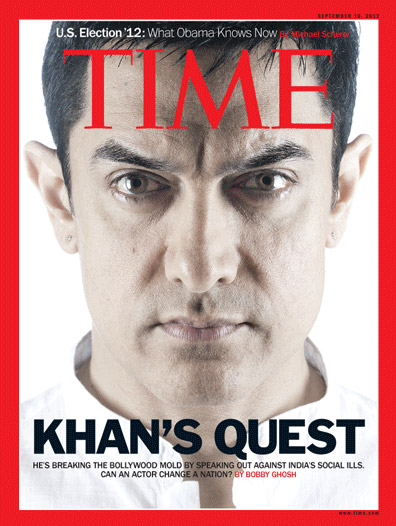
Aamir Khan: Only a matter of Time


It is not the fact that Aamir Khan is on the cover of the September issue of Time magazine that is as important as how he is projected.

Recall how our beauty contest winners won with that finale answer about their idol being Mother Teresa? The purpose was a clear need to sell beauty products to the huge Indian market. Once that was achieved, we had the Bill Gates-Warren Buffett philanthropy where our industrial bigwigs were lectured about the art of giving, something they had mastered thanks to income tax exemption to channelise black money. Publicly aired social consciousness is only a part of this.

The extracts from the Time story makes it seem as though the Indian population is a willing hostage to one actor.

The blurb itself sets the tone:

"He's breaking the Bollywood mould by tackling India's social evils. Can one actor change a nation?"

Would they say the same about Hollywood stars who speak on social issues or take strong political stands? India’s social evils have great demand for a hungry media, at home and outside. For the outsider, this obviously has some exotic appeal.

"Now, with his groundbreaking TV show Satyamev Jayate (Truth Alone Prevails), he has dispensed with commercial considerations to indulge his conscience. With it, Khan has taken on the mantle of the country's first superstar-activist.”

Has he dispensed with commercial considerations? We have been through it here before. The conscience does not gather a herd. What does being the first superstar-activist mean? There have been films from years ago that raised social issues - Duniya Na Maane, Do Bigha Zameen, Mother India. These were not a candyfloss look at farmer suicide, widow remarriage, dowry, poverty. And I am not even talking about regional cinema and parallel cinema.

The piece is obviously a paean when it says:

“It's a ballsy move, and potentially jeopardizes his status as the beloved idol of millions.”

If anything, it has got him a new audience, the sort that attends rallies by Anna Hazare or Sri Sri Ravi Shankar’s Art of Living sessions. It is utterly patronising to read that the show tackled subjects that “are precisely the sorts of harsh realities from which many of Khan's fans seek escape in his movies”; it probably works for this group.

If anything, the actor fancies that he does films that have a message, whether it is Lagaan, Rang de Basanti, Taare Zameen Par, Mangal Pandey, Peepli Live. He makes a point to go on a road show as a ‘messenger’.

"Can a movie star affect the mores of a nation of 1.2 billion? It might just be possible in India, where a national obsession with cinema, unparalleled in the world, gives popular actors an influence beyond the imagination of Hollywood scriptwriters.”

Such a limited understanding. There are places where cinema halls have been shut down. Films are banned. If the national obsession is an escape, then it applies to realistic cinema too, for that reality is not mirroring what people go through, but what characters go through. Cinematic projection of such truths is like sharing misery with others, if we really wish to look at films in that manner.

Hollywood actors use a particular issue and take it to a forum to push for change. One may be cynical about their motives, but the public does not assume they will bring about change.

“Whatever Khan chooses to do next in his quest for grace, there's a good chance it will lift India a little closer to what he - and fellow Indians - would wish their country and society to be.”

This is just so weird. It builds up an individual as a messiah, that too on a personal “quest for grace”. India has several dreams and different people have different dreams. This certificate of granting one person the keys to the kingdom is so feudal. I wonder why Time magazine did not make him wear a maharajah turban in the cover picture. Or, perhaps contemporary maharajahs just look intensely into the eyes of the camera.

(c) Farzana Versey

- - -

The rest of my pieces on Satyamev Jayate are here


6.2.12

Kingmaker Robert Vadra?


Should Robert Vadra join politics? It is the sort of question one asks at the dinner table if you are awfully fond of your relatives. However, it has become news. This is not the first time that Priyanka Gandhi’s husband has campaigned for the Congress.

There are two factors here:
  • The Congress Party wants to act obsequious, so anything remotely connected with the family will be wooed.
  • The Opposition sees this as an opportunity to bait.

Let us get a few fundamentals out of the way. Spouses, siblings and even special friends campaign during elections. There is always a trusted group. Atal Behari Vajpayee had his adopted family; L.K.Advani has his daughter; and almost all the ‘maharajahs’ have family members involved. Elections are about immediate and extended families.

Robert Vadra had to make a sacrifice when he married. He broke ties with his own family. Is he looking for some returns? This is what he said:

“I am here for my brother-in-law. For me politics will come if I think I can make a difference for the people, only when I can feel I can focus and I can give my best and full attention for the development of the people. I am totally enjoying what I am doing right now. The family I married into is in politics. It's something I cannot run away from. When the time is right, if it is what is required at that time may be yes but my focus is on my work right now.”

Priyanka said he was misquoted and he is happy with his “vyaapar” (business). The news clip immediately cut to the portion where he did mention that if people wanted he would join politics. Is it unusual? Not quite. He knows that Indians like package deals. We do not consider nepotism bad; it is our birthright. We assume that experience rubs off on those in one family. He used the words “cannot run away from” where he was trying to convey a sense of responsibility. He is also seen as a son of the Gandhis, for he is there on every occasion, especially on death anniversaries, seated in white kurta pyjama to share the moment.

There will be sniggers over this comment:

“Right now it is Rahul's time, Priyanka's time will also come.” 

It is a smart one. That Priyanka has chosen to play homemaker earns him brownie points. It means that while supportive of her aspirations, he is also in control. Her “time will also come” sends out a nice patriarchal promise to a patriarchal society that the lady they think should play an active role might do so in the future, so support her brother now.

Whether as asset or as baggage Robert Vadra will work in favour of Rahul Gandhi. In one scenario, he will be the strong backdrop; in the other, the guy who makes Rahul look so good and correct that he just cannot fail.

- - -

End note:

Rahul Gandhi says that unlike others he has no ambition of being Prime Minister. It is time the Congress initiated him in a real role with some other portfolio. The grassroots stuff is good, but he cannot be walking around all the time. He should put himself to test, if it is the language of politics he wants to talk.

29.12.11

Why Can't Science Let Us Be?


If you don’t wear stilettos and still get orgasms, then pat your back. You are the last hope of science. It’s funny that ‘science-ologists’ think such theories need to be debunked. The “year’s worst abuses against science” by celebrity offenders is the annual list that is part of the Sense About Science (SAS) campaign.

The organisation’s managing director Tracey Brown sets the tone for the attempt:

"It's tempting to dismiss celebrity comments on science and health, but their views travel far and wide and, once uttered, a celebrity cancer prevention idea or environmental claim is hard to reverse. At a time when celebrities dominate the public realm, the pressure for sound science and evidence must keep pace."

By making an issue of it, SAS is in fact giving it celebrity endorsement. Why are famous people asked to put their lot behind prominent medical causes like HIV and cancer? Don’t they often become a reason for treacle-inducing stories rather than gain any merit based on a factual analysis or research? Most celebrities perform at rock concerts and charity balls for these issues. How does it reach the real target audience when they are cocooned in their gowns and dinner jackets parroting what one version of the sponsor group tells them?

If scientific endeavour reaches a dead-end because of rumours or what someone personally believes, then it does not speak too well about science. A small group of people who are completely besotted by what celebrities say does not constitute the population of the world. None of the views they have listed can cause any damage.

Here are a few and my take:


  • TV personality Nicole Polizzi: "I don't really like the beach. I hate sharks, and the water's all whale sperm. That's why the ocean's salty."


People do not like the beach for several reasons; some do fear sharks; sperm – or semen at least – might be considered salty, although human and whale sperm could well be different. And don’t we say that even a drop makes an ocean. So there.


  • American singer-songwriter Suzi Quatro: "I used to get a lot of sore throats and then one of my sisters told me that all illnesses start in the colon. I started taking a daily colon cleanser powder mixed with fresh juice every morning and it made an enormous difference."


How is this harmful? Anything done in excess is bad, but I suspect the keepers of science are also the keepers of the pharmaceutical industry and the medical fraternity, and how they’d like to replace the powder-juice combo with a nice little capsule.


  • Kate Middleton, the Duchess of Cambridge, said that spending more time with horses had made her less allergic to them.


That is her experience. It is not like the whole of Britain or monarchists are going to line up at the stables to get rid of their horsy allergies, which they would be imagining about anyway.


  • Pippa Middleton: “It (cold water rinse) closes the pores and gives it a lift and shine... it really works.”


SAS tells us that hair does not have pores. All salons insist on washing off conditioner with cold water so that it does not become limp. How will it affect the hair to get a cold rinse?


  • Simon Cowell was ticked off for saying that he found vitamin injections “calming”.


Doctors use such placebos routinely, and many people are addicted to vitamin supplements.


  • Heiress Miss Ecclestone said her secret to prevent falling ill: “I have acupuncture to boost my immune system every month or so.”


Alternative medicine has been practised for centuries. She is using acupuncture as a preventive measure and not a cure.

  • Gwyneth Paltrow believes that a detox diet helped her liver and gave her “mental clarity”.


So? Don’t we harp on psychosomatic illnesses? Are people not uncomfortable if they are too full of themselves, so to speak? Getting rid of some of the elements might in fact make a person think clearly or at least not be so preoccupied with what is within.


  • Christian Louboutin, a French footwear designer, was taken with something a fellow party guest told him about shoes: "She said that what is sexual in a high heel is the arch of the foot, because it is exactly the position of a woman's foot when she orgasms. So putting your foot in a heel, you are putting yourself in a possibly orgasmic situation.”


An anthropologist or a psychologist would have the good sense to see it as body language or how illusions and analogies work.

Instead, they got a consultant in sexual medicine to ‘debunk’ this myth. Kevan Wylie, (“responded drily”, as the report states, which makes one wonder):

"A woman's foot may be in this position during orgasm, but that does not mean that putting her foot into this position under other circumstances will result in orgasm.”

The woman is not suggesting that, just as men do not get an erection if they hold a gun. She is fantasising.. The shoe industry uses such fantasies, too, as do other advertised brands. Why do some people find stilettos sexy and others think wedges are? Why do some like pumps while others prefer those mean leather boots?

I wish I had thought about this arched footwear…the image is wonderful.

The science saviours can go work on their test tubes. I am thinking of little needles poking into me and a small shot of calming vitamins as I get under the shower to wet my hair with freezing water that will leave it shining and bouncy. I shall then go the riding club and inhale deeply as I get astride a horse. We reach the beach and I walk on my toes on the sand and ever so hesitatingly dip my feet in the ocean. The fear of sharks lends an edgy feeling as I cup my hands and gather a bit of salty water.

29.1.11

Switch it on


Now they are going to tell us what quality time is. This is your chance. Wonderful. To register you have to send a text message. Bucks. You log on to the site. Hits. This is a Hindustan Times venture and there are other sponsors, which means you get their products and services in lieu of television.

While it is true that a lot of people have ceased to go out and prefer to watch TV, many of them also indulge in the activities mentioned. If they can. Marine Drive and Oval Maidan are open spaces; senior citizens do get together; yuppies try and spend time with their kids. Not so sure about “dinner with my masterchef”.

Just in case these concerned organisations care to know, in quite a few cities there are power cuts, so TV watching is not uninterrupted. For people with careers, this is time to clean the house, get provisions and be at home. Commuting isn’t easy in a city like Mumbai.

For all the negative points against TV, I think there can be occasions for family and friends to bond. How many spouses discuss the walk they want for or the food they ate? Now think of the conversation about soaps and news, soaps in their own right. Multiplexes have made a visit to the movies quite expensive, so when films barely a couple of months old are telecast, it is a boon for them. Sports that were inaccessible are now on air. These things do create cult figures and covert advertising does push the viewers towards consumerism. But, you cannot walk down a road today and not meet blinking neon lights or encounter someone hawking something, sometimes even themselves – whether it is a helpless person or one on the make, whether it is poverty or glitz.

I watch TV everyday, but that is not all that I do. And there are many like me.

Just imagine if on this grand occasion of ‘No TV Day’ some channel decides to go to town shooting people at random doing what they always do and flaunting it as a success of this bold initiative. And we get to watch it live! Anything can happen.

Anyway, what’s this token one day going to achieve? People will return to their remotes and start surfing. There just aren’t enough waves in the sea.