Showing posts with label godmen. Show all posts

30.8.17

India’s Tryst with Godmen Criminals


Charlatan godman Gurmeet Ram Rahim Singh Insan, head of the Dera Sacha Sauda, has been sentenced to 20 years of rigorous imprisonment for the rape of two of his devotees. To prepare for this court pronouncement, the army had to conduct a flag march, the police was on high alert, some areas were placed under curfew. One might have imagined that a terrorist was on the loose. 

In India when a godman is arrested on rape or murder charges, his followers can and will take to the streets to avenge a court order. This happened on Friday, August 26 as a Central Bureau of Investigation court convicted Singh. The country was shocked that 200,000 of his band of followers had congregated well before the verdict precisely as a strategy to create mayhem — they stoned building windows, torched buses and cars, including television broadcast vans; 30 people were killed and over 250 injured. What the country does not get shocked over is the existence of such fake gurus and the respect they command among those who matter and their constant presence in the media. 

Gurmeet Singh has been sentenced for a crime he committed 15 years ago; the sexual assault on the two young women continued over three years. It was Ram Chander Chhatrapati, a journalist from a small local Hindi newspaper called Poora Sach (the full truth), who had exposed the sins of the saint. A few months after he carried the letter of a victim, he was shot dead outside his house. The murder case is still pending. 

The letter was addressed to the then prime minister, BJP’s Atal Bihari Vajpayee. The young woman had given a detailed account of her trauma. She was not the only one. Her turn to be used came once every month. When she was sent for the first time, Singh was sprawled in his bed watching porn, a remote in his hand, a revolver by his side. Her parents who were followers had insisted that she join the sect. She was stunned by what she saw. She is educated and asked questions. He silenced her protests with threat, flashing her parents’ devotion as well as his clout.

And then he used his spiritual hold over her: “He told me that at the time of becoming his disciple, I had dedicated my wealth, body and soul to him and he had accepted my offering. By this logic, your body is mine now.”

In fact, many female disciples were asked to go into his private chambers for ‘maafi’, forgiveness. He sold sexual assault as penitence although there was nothing they had to repent for. “We appear like devis (pious women), but our situation is that of prostitutes.”

If women were sexually exploited, men were rendered sexually incapable. There are reports of castration of at least 400 men. They were drugged and their testes were surgically removed.

Singh seems to have wanted to play the role of an ancient king with a harem and a retinue of eunuchs. Clearly, it appears his masculinity felt threatened.
***

Singh’s Dera Sacha Sauda empire is spread across 700 acres in Sirsa, Haryana. It is a fort-like establishment that ran along the lines of a philanthropic corporation even as the guru produced kitschy films on social consciousness where he essentially promoted his ego. Not only was he cocking a snook at the famed Indian austerity and belief in abjuring, he was also challenging the white and saffron robed hypocrisy of the prevalent uniform of godmen.


His seeming lack of hypocrisy should have been a red rag. Instead, he was feted as a guru reaching out to the new masses with chutzpah. Where other gurus had bhajans (religious hymns) playing in the background, he brandished a guitar and belted out off-key pop music. News channels that began trending him as “RapistRamRahim” and inviting responses to increase their viewership were promoting him a few months ago as a movie messiah, a multi-talented maverick. The mainstream media that is today taking a moral high ground did not bother about following up on the cases against him or even boycotting him until the verdict had been pronounced. He added to the entertainment quotient as “bling baba”. Were they not alerted by his lifestyle to question his credentials?

When they now flash the photograph of Chhatrapati with the “lest we forget” hashtag it is ironical, for they had forgotten. They were woken up with a jolt only because their vans and their reporters became the targets. And much of their ire was against the followers.

Singh has around 60 million followers, and most would not be aware of what happened inside the gufaa, his cavelike residence. The Dera Sacha Sauda, like other deras, isn't a cult started on the whims of a guru. It is a group of sects that believes in the scriptures but does not owe sole allegiance to it. Their tagline is “confluence of religions”. The guru’s name itself reflects that confluence. Everybody uses ‘Insan’ (human being) as their last name.

***

Following Gurmeet Ram Rahim Singh Insan’s sentencing, there has been discussion on what drew so many people to him. One of the reasons put forth was that he catered to the lower castes that were left out of the upper caste hold on the faith and the economy. It is a plausible argument. However, this assumes that the poor kept his image alive, which is not true. Indeed, those who are denied comfort and luxury do look up to pomp and pageantry, as can be witnessed in loud and garish celebration of festivals in the streets. But that cannot be sustained over such a long period. Besides, how would they identify with his “love charger” blatancy, that too in English? 

Like most gurus, he offered welfare. The Dera ran a hospital, had medical camps. It is unlikely that this is what the devotees came for and stayed back with, although it might have helped them at some point. The operative term is slavish obeisance. Whether through drugs, hypnosis, guilt, threat or fear, followers can be held hostage. 


Political leaders genuflect before these godmen in full public view, often consulting them on matters of state and law, making a mockery of the Constitution. Singh had helped the BJP win seats in the Punjab and Haryana regions. The Congress Party too had earlier enjoyed his goodies. Prime Minister Narendra Modi praised his efforts for his government’s cleanliness drive. Two days after the godman’s men went on a rampage, the PM in his radio address to the nation said, “No one has the right to take the law into one’s own hands in the name of one’s beliefs.” It is easy to pick on a mass of unknown faces and names with pop pleas. He made no reference to the charlatan or his crime or to the verdict. Because there are many such gurus who owe their existence and provide patronage to politicians. 

And one reason Indians even on the right are celebrating this conviction is because Gurmeet Singh is a Sikh who took potshots at Sikhism and Hinduism. He was grudgingly accepted for facilitating new money and votes, unlike the glowing accolades reserved for the levitating elevated gurus of mainstream godliness.

***

Rather shockingly, a day after the protests in support of Gurmeet Singh The Indian Express carried a piece by Sadhguru Jaggi Vasudev (who is often invited by media think tanks for their seminars) in which he wrote: “All the embodiments of the divine you worship — Rama, Krishna, Shiva — cannot call be called morally correct figures. They are not. Because it never occurred to them to be that way. But they are the peak of human consciousness.”

This echoes Singh’s stance. When he boasted that he was god to the sadhvi he planned to rape, she had asked him whether god did such things. He replied: “Sri Krishna too was God and he had 360 gopis (milkmaids) with whom he staged Prem Lila (love drama). Even then people regarded him as God. This is not a new thing.” Asaram Bapu, another godman and rape convict, had said: "Lord Buddha, too, had faced such kind of allegations and I am also facing the same. But the truth will come out…I am willing to go to jail with a smiling face. And I think I want to spend some time in Tihar jail. I consider jail as my Vaikunth (heaven)."

But Indians live in denial. Each time a person who owes allegiance to a god comes under the scanner, the knee-jerk reaction in the 140-character and 4-minute read op-ed world is, “Stop calling him a godman.” The fact is that they become the powerhouses they are because they project themselves as men of god and are accepted as such not only by the masses, but by the elite too. India is a country of gods and in this crowded environment there are bound to be middlemen who make devotion accessible and human, even if not humane.

In 2005, the Communist Party of India had exposed Baba Ramdev for using human and animal bones and flesh in his ayurvedic concoctions; he runs a thriving empire today. Yogi Adityanath is the chief minister of the largest state in India. MPs attend Parliament wearing saffron robes. A monk even addressed the Haryana assembly naked.

Indians love to idolise, whether it is godmen or judges. The judge who sentenced Gurmeet Singh is being lauded for his bravery. It does not strike anybody that this is what the law says and the judge was doing his job. 

The CBI took 15 years. This, when the victim had stated categorically in her letter: “If a probe is conducted by the press or some government agency, 40 to 45 girls — living in utmost fear at the Dera — if they are convinced, are willing to tell the truth.

There are many more victims of many more such godmen who represent neither religion nor culture. Their ashrams are dens of vice preying upon gullible minds to further their spiritual corporate empires.

--
Published in CounterPunch

19.11.14

Rampal, Ramdev and Political Complicity


He is a criminal. And a godman. He operates from a fortress that he calls an ashram. And his followers are armed. This man should have been arrested long ago. But in India godmen, even the charlatans, not only survive but thrive.

The often-exaggerated reporting on television was this time quite accurate, at least in the scenes they showed us. It did look like a war zone. Sant Rampal began to call himself a saint inspired by Sant Kabir and as happens often managed to attract a crowd of people to believe in him.

There are no checks on such people, and even their crimes are not treated with seriousness. He has been charged with the murder of a villager by one of his devotees, and he has avoided attending court after 40 summons. He is still free. What powers does he possess that no police force, no intelligence agency, no government can find him and put him behind bars?

On Tuesday, cops surrounded the Satlok Ashram, but could do little. Because this despicable 'godman' has transformed his followers into an armed militia. They threw acid and petrol bombs at the police. Worse, they used human shields, including women and children. Bodies were found; seven of his followers are dead, cause not yet ascertained. Rampal is safe.


Some devotees who came out said they had been forced to stay inside; others, almost 2000, put up a brave front and protested on behalf of their guru even as the cops used batons and water cannons.

In all this, the police started beating up the journalists. At some point the news story altered a bit and the focus was on the media being attacked. Nobody knows why this happened. Were there some higher orders to divert attention?

As it turns out, it was the local people of Haryana who forced the authorities to stop water and power to the ashram. But knowing how powerful the ashram is, they would be well-equipped or provisions could be arranged. It is a well laid out high security den that has its secret entrances and exits.

After the violence, fresh charges have been filed by the Haryana Police:

The case has been filed under Sections 121 (waging, or attempting to wage war, or abetting waging of war, against the Government of India), 121A (conspiring to commit certain offences against the state) and 122 (Collecting arms etc. With the intention of waging war against the Govt of India).

Besides, the cases have also been slapped against the accused under Sections 123 (concealing with intent to facilitate design to wage war) and other charges that include attempt to murder, assault and under various Sections of the Arms Act, police said.


This looks good on paper. But, how did the devotees get an audience with Home Minister Rajnath Singh and also the President of India?

Rampal supporters demanded a CBI probe into allegations of his role in a murder conspiracy. A team of five of his supporters also met President Pranab Mukherjee and submitted a memo seeking a CBI probe. The Union home ministry has so far decided not to intervene, but is closely monitoring events.


Do victims of violence during riots have such access to political leaders?

All this is extremely dangerous because people like Rampal set up a second-rung establishment. 'Baba's Commandos' take direct inspiration from the RSS; they are called the Rashtriya Samaj Sewa Samiti (RSSS). This is how planned it is:

RSSS functions like an army battalion, which is divided into several companies and platoons. Each company and platoon is headed by trained commanders. These days, they assemble every morning and evening to be briefed about their routine for the entire day. Armed with pistols, RSSS's quick reaction team patrol the ashram round the clock. Its intelligence wing is closely monitoring the movement of police in adjoining Barwala and Hisar towns and instantly provides information to their headquarter in the ashram.


There are some 4000 young people in this army that guards the 12-acre property. Do they have a licence for those guns? It is surprising that there has been no big exposé on this.

We have become accustomed to soft power centres that do well because the political power centre might benefit in some manner. Think of Chandraswami, Asaram Bapu, Swami Nityanand, not to speak of the politically active Adityanaths. Ashrams are often dens of money stashing and vice. These are social crimes that feed off the public. Why are they protected?


Just as the Rampal tense situation continues, we are left to ponder over why the new government has decided to provide Z-category security to that other charlatan, Baba Ramdev. 40 CRPF personnel will provide him cover wherever he goes.

Who has threatened him? Have there been any checks? If Z-security is all about vanity, then why is Ramdev, a yogi, granted such vanity even as he must not seek it too? This man has a cure for everything, from AIDS and cancer to homosexuality. What is he vulnerable to?


He is a friend of the BJP who is allowed to often speak on behalf of the government. Nobody in the government questions him or his motives.

We saw him in action during the street protests and his escape wearing a salwaar-kameez. He had audaciously claimed when he was externed after his tamasha at the Ramilla Grounds (the pavilion air-conditioned for his common man comfort): “Today is the blackest day in history. We will observe black day all over India. The fast is not over."

He could see his history as India's history because he has the backing of leaders who believe in a convoluted history. Unfortunately, where such 'spiritual' leaders are concerned, all political parties either fall for their claims or use those claims to cover up their own. Nobody is serious about putting an end to their antics. (Read The Republic of Ramdev and the comments.)

It isn't as simple as bad godmen. It is about bolstered-by-politicians godmen.

With the threat these Babas pose to us, all Indians should get Z-security as protection against them.

---

[Update: News comes in that Rampal has been arrested. BJP spokespersons are using this as evidence of how they've been quick to end the reign of a "Congress baba". There will be political oneupmanship, and once again this diversion will take away from the blatant abuse of illegal power.]

9.9.13

Cringe-worthy news

Three recent examples.

Prime Minister Dr. Manmohan Singh said:

"I have always maintained that Rahul Gandhi would be an ideal choice for the PM post after 2014 elections (Lok Sabha). I will be very happy to work in the Congress under the leadership of Rahul Gandhi."

As a sitting PM, it does not behove him to 'abdicate'. Whatever the behind-the-scenes happenings, he ought to give the perception of being in charge. He may praise Rahul Gandhi, but the country most certainly does not like its leader to announce that he will work "under" anybody. It was a weak-kneed obsequious comment.

---

Watched a rather nice interview of Zubin Mehta on NDTV after his concert in Srinagar. However, two of his comments were rather off:

• “Let (us) have another way, a spiritual way and I think yesterday there was a beginning of some process of healing because Hindus and Muslims were sitting together in complete harmony."

The Kashmir issue is not a communal matter. If this harmony works, then the Kashmiri Pandits who feel shortchanged and have been applauding the concert should also accept the maestro's version of harmony. They will not. So, one cannot expect it from those who live under the threat of the bullet.

• "Geelani Sahab hum to aapka dost hoon (I am your friend). You don't believe it! I wish all of our opposition would have come and enjoyed the music."

The 'opposition' is made up of several streams of thought. Singling out Geelani just made it appear as though he drives Kashmiri aspirations alone.

Sidelight:

Later on 'We the People' regarding the same subject, someone described as a media person who spoke against elitism mentioned how her car was stopped several times, documents checked and added, "This is not an everyday thing in Srinagar." It was so superficial. In fact, there are barricades and checkpoints and the less privileged are stopped everyday. She ended up doing the varnish job while trying to complain about it.

---

The Times of India carried a story discussing how spirituality and sex and not mutually-exclusive in Hinduism. It started and ended with Asaram Bapu, in effect conveying that he does not have to be a celibate.This was not in their "Sacred Space" or even an Op-Ed or a feature. It was a report.

This is disgusting, considering how the newspaper has been commercialising its concern for rape 'survivors'. Here is how it starts:

"Asaram is being pilloried by everybody, from parliamentarians to journalists, for alleged sexual assault on a teenager and is in jail now. Some of the horrified public responses at his alleged act can also be attributed to the general notion that dissociates sex from spirituality. This notion considers everybody on the spiritual path as 'wedded' to celibacy. But is this perception correct?...This possibly explains why many Hindi newspapers and TV channels are aghast at the preacher's 'fall from grace'."

Rather conveniently, the blame has been placed on Hindi channels, and Christian priests used as a counterpoint in the English media. This is asinine. It also reveals the mindset. Rape is not a sexual relationship. Such idiocy camouflages the intent to airbrush the image of this godman.

"...ancient Hindu rishis were known to have families and children. Even modern spiritualists like Swami Ramakrisnha Paramhansa... were all householders...If Asaram has broken the law with the alleged sexual assault on a minor then of course the book must be thrown at him."

This is for the courts to decide, and not some scripture. Asaram's celibacy or lack of it is not the issue. Had it been consensual with an adult, and had he — and his followers — not gone around promoting some form of sexual purity, it would not have at best been a salacious moment. Remember Nityananda and his video clips? (Aside: The same English media pilloried N.D. Tiwari for being caught with some women, although he is not a godman.)

The article mentions sex abuse by Christian priests, but not a word about many cases in ashrams in India. If Hinduism permits sadhus to have a sex life, then why do they talk about 'sanyas'? It is the pinnacle, and they obviously have not reached it.

All this apart, it is just appalling that when a man is in court for a crime like rape, an attempt is made by a big mainstream newspaper to discuss spiritualism and sexuality with his case as a backgrounder. Shameful, any which way we look at it.

© Farzana Versey

19.2.13

Hunt for a baby

Helen Hunt with her baby

When I read about Helen Hunt getting a baby due to an ‘uplifting experience’, I adduced it must have been close to Immaculate Conception. 

What transpired, instead, was a combination of superstition and auto-suggestion.  The uplifting experience was a ‘lift’.  On the David Letterman show, Hunt shared her experience with Indian guru Sri Chinmoy, who has been described as a “United Nations-recognised master”.  The UN has a questionable record on political issues; therefore, one wonders on what basis it might have certified a spiritual guru as a master.  In form of address ‘master’ is quite the norm, but it is by believers. Did the UN test spiritual powers and, if so, how did it measure these?

Bollywood films used to have a standard cure for infertility – a visit to a godman or guru. Often, the person would be a villain with beady eyes, smacking his lips and while showering blessings on the woman giving her a once-over. Depending on how the characters were to develop in the script, the woman would either be forced to succumb or escape. Art-house cinema too explored the misuse of tantric practices. This, unfortunately, is not relegated to cinema.

A scene from the recent Bollywood film 'Oh My God - OMG'

Even today, one reads about charlatans from different cults and faiths using their ‘powers’ to offer women more than spiritual guidance. The better-known gurus have an ostensibly clean image and a celebrity flock. They cater to bruised egos, including their own, and in India while their role in politics was earlier mainly on the sidelines, these days they pontificate on major national issues. This camouflages the exploitative nature of the smaller players.

Hollywood has been a good place for those who managed to charm an international clientele. Everyone seems to have been in some form of rehab, and needs succour. Scientology has already asserted itself. Tibetan Buddhism too has done so, for those with political sympathies for the Dalai Lama.  Beverly Hills easily alternates between the good life and the god life, one feeding the other.  People do feel the need to rejuvenate and/or seek a higher purpose.

However, when someone certifies that an important bodily activity has been performed due to such intervention, one needs to look more closely.

Here is the extract from a report:

The guru, who passed away in 2007, was famous for showing off mind-over-matter feats of strength, and he celebrates the achievements of people he admires by lifting them above his head.

Hunt explains, “He lifted people that he felt had achieved something, that had contributed something to the world… (Archbishop) Desmond Tutu, Muhammad Ali and me.

“I went with my goddaughter… and we pull into this place and women open the car door and they’re dressed in, like, floral gowns, and they walk me into this garden. Then I get on this contraption, walk up four steps and he lifted me up.”

It is obvious that Sri Chinmoy understood achievement. It does call for a celebration, although this is a most unusual way to express it. Why did this single experience convince her that she could become a mother? It coincided with her conceiving. “I wanted to have a baby and he was encouraging me to pray and not give up and I did have a beautiful daughter, so he was right.”

There is place for coincidence and serendipity in our lives, and some of us have had what are known as ‘out-of-body’ experiences. These, if we try and understand rationally, are part intuitive and part strong desire. The mind is an extremely powerful tool. Ask those who suffer from psychosomatic disorders. One needn’t go that far. It is possible to experience a state of suspension merely due to a fever.

But making babies does require some amount of hard work and it is far from being a meditative state. One cannot merely wish to conceive or be so uplifted as to create out of nothing. The concept of Immaculate Conception has fascinated me for long and it is a profound spiritual metaphor for creation. Taking it out of the realm of its religious context, it is symbolic of the purest birth of what could change the world – it could be a piece of art or an ideology.

Helen Hunt’s encounter with the guru lacks this sublimity. It appears to have been at best a spiritual transaction; it was also two famous people meeting as a trade-off. Why could she not pray on her own? How much did merely sharing her deep need for a child have to do with it? Is it not possible that the seed had to be sown in her mind for her body to accept it?

She is fortunate that she is who she is. But, the legitimacy she gives to such errant experiences conveys that although thoughts are potent, she could not even think them on her own.

© Farzana Versey

24.4.11

Satya Sai Baba: Spiritual Rockstar


Baba died this morning of April 24, 2011. According to his own spiritual calculations, he was scheduled to depart earth in 2022. While I understand the grief of the followers, I do not understand the disposition towards worship. I usually do not fathom any kind of mass belief, so this is not to single out an individual. Not individual, say the faithful, it is Bhagwan. We need gods. Sachin Tendulkar is god, and Sachin was not going to celebrate his birthday because he wanted to pray for Satya Sai Baba’s recovery.

At 85, he did lead a full life. He was known for his miracles, more magical than any magician’s. Unfortunately, his own bodily organs failed and no doctors could revive them. Strangely enough, even the prayers of the devotees could not nor his own divine powers. 

This is a profound disclosure of the spirituality business. Many people need guidance; many people suffer from some sort of misery. Wealth, education and even therapy do not work. They prefer being part of a gathering where a guru offers solace by the mere fact of her/his existence. It is a rockstar phenomenon, a classic case of collective catharsis. 

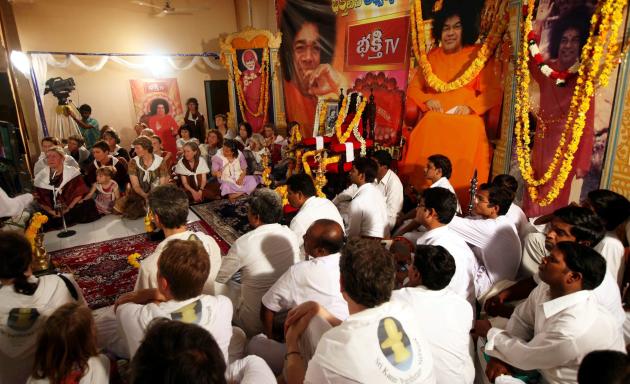
I was witness to it at Baba’s Whitefield ashram almost 15 years ago. I admit it was as a voyeuristic tourist that I went. A blue plastic shade covered a huge tent-like area. People were ambling about and most were foreigners. As I recollect, it was only Whites, a phenomenon that is noticeable in most such ashrams. You rarely see Blacks or other races, although there is considerable Japanese presence at the Osho ashram, because he had this thing about Zen. These foreigners wore carelessly draped cream-coloured sarees and bindis on the forehead; the men were in kurta-pyjama. At a water-tap a woman, her hair coiled at the nape of her neck, bent to drink water by cupping the palm of her hand. It was a memorable image, reminiscent of villages as seen in Bollywood films.

There was a canteen across the road run by the ashram. It was packed with people. Long wooden benches and tables. I am not sure if one had a choice, but the stuff on my plate was terribly spicy and as tears ran down my eyes, I watched the rest whose palates were even less trained for such food. They were eating with their fingers, seemingly enjoying every morsel. I thought to myself that perhaps this is what the spiritual journey is all about – getting used to whatever is on your plate. 

Back to the main ashram, they said Baba was going to give a darshan. The ground was dusty, but a platform was ready; soon there would be a throne for him to sit in and deliver his sermon and bless the congregation. Some had already begun reserving their places on the floor.

What were they looking for? They could read hundreds of tomes on spiritualism from several masters; they could be believers without moving from their homelands. They chose to travel all those miles just to become a part of the enterprise and get a glance of the man. Is this faith or is it about auto-suggestion where you begin to believe in your own delusions? How much of a role does any guru play in this, except for being a conduit to their greater search for going beyond the material? Can people not give up luxuries in their own environment and contribute to their societies? Where does the guru fit in when they cook, clean and eat humble meals?

Is it not a contradiction to see the person they have faith in sitting on a gilded throne and being hailed by the most powerful people, people who are willing to publicly be obsequious, unmindful of their reputations? Does that make them spiritual when after the ‘special’ moment they are back to their corporate offices and ministerial bungalows dictating policies that are hardly austere?

Baba had declared himself the incarnation of the Sai Baba of Shirdi; the latter’s devotees are not necessarily his worshippers and that itself should say something. 

It is also pertinent to note that when it comes to proving faith-healing and miraculous powers, it is the poor who are brought forward. It can be deduced that for them just a touch of any god-like creature is enough of a status leap. You won’t see them rubbing shoulders at community canteens with the rich devotees. Therefore, the Satya Sai Baba empire had little to do with his ability to produce Rolex watches out of thin air and vibhuti (holy ash) from his palms. Both have been challenged and proven by the Rationalist Society, but it has not affected the attitude of the faithful, even the ones with reasoning powers.

This is more likely about channelising wealth into a nirvana factory. Baba’s educational and health institutions are often quoted as examples of the good work beyond the ashram. These are commendable activities, but they also encourage people to owe their knowledge and their lives to Baba. Besides, there is a lot of money involved in maintaining ‘international standards’. Attempts to probe into the functioning of not only this but any religious organisation always meet with a dead-end because among the believers are those who run the investigating agencies. Any other improprieties are also shut up. Will any people’s movement have the courage to look into the financial dealings at the several ashrams and even madrassas and missionary-run outfits?

Complicit in this is the media. Rarely has any media group raised questions and when they do there is an arching over backwards to give a balanced picture. I was once told to “go slow” on religious figures for one of my columns, although I had written about Imam Bukhari of Delhi's Jama Masjid and the Pope earlier. In a casual conversation with someone much later, I discovered that the editor was a devout worshipper. It makes one wonder, then, what balance we are speaking about when there are already treacly tributes pouring in.

Ever since Baba took ill, news reports gave a daily update. It is fine since he does have enormous appeal and people were concerned. However, it was distressing to read about security arrangements at Puttarpathi, where his main operations are run from and in the ashram where he will be kept in state now. The forces are there because there will be a rush of VIPs. I can already imagine people killing themselves in grief. Who will do so? The poor. Not the rich and influential.

What does it tell us about the prospect of individuals as institutions? As Satya Sai Baba had once said, “Devotion has to be unintermittent, uninterrupted, like the flow of oil from one vessel to another.” Pity, he did not keep another vessel ready. Who will be in charge of the various organisations run by the private trust? It will be interesting to see how things unfold and whether Baba’s legacy can continue under the tutelage of his trusted aide, an IAS officer, or his nephew. It is unlikely. There will be a fight for the spoils. Spiritualism goes on the ventilator.

(C) Farzana Versey

Also published in Counterpunch, April 25