Showing posts with label FV archives. Show all posts

25.11.13

No end to justice: The Aarushi-Hemraj murder verdict


The verdict is out. But this is only another beginning. Rajesh and Nupur Talwar, parents of 14-year-old Aarushi have been pronounced guilty of her murder and that of their domestic help, Hemraj, in the early hours of May 16, 2008. There is also the charge of destroying evidence and filing a false FIR.

They issued a statement saying they will fight for justice. For themselves. Aarushi, even in death, was treated with disdain. Every bit of her for public consumption. No one was concerned about her reputation. Dead people don't have reputations. No one was concerned about Hemraj. I include myself in this group of people who treated his death cursorily.


This is what the death of the poor mean. What is even more astonishing is that after the verdict, there is sadness. People have short memories. The media that enjoyed the spectacle of conjecture now talks about probity. The media that sensationalised the case now thinks in terms of giving respectful space and not judging. Who were they to judge, to begin with? But not only did they judge, they decided on the 'turn of events'. Reporters were posted in Noida and acted as detectives. The change was quite evident.

I have written quite a bit about the case and following are excerpts.

June 2, 2008

Her father Dr. Rajesh Talwar is under suspicion for having killed her and their servant because he found them in a compromising position; other reports suggest that the girl knew about her father’s extra-marital affair. Whatever it is, I do find it surprising that the mother, Nupur, is appearing on several television channels to save her husband. She should be in the lawyer’s offices, with the police. Not giving sound bytes to the cameras. I am afraid I feel no sympathy for her when I watch her. Besides, they say she was in the house when the murders took place.

[I mentioned today that she was on TV a day after the murder. There were cameras covering this, so I did think in terms of a soundbite. Now, it appears she gave an interview to NDTV a week later. Apparently, that is fine. Also, I am told to remember that she was "stoic". That is not the point. It is whether you want justice for your daughter or for your husband and yourself?]

Now comes the part about the media. Aaj Tak channel had a story in the initial days titled, “Papa yeh tu ne kya kiya?” (Papa, what have you done?) What is this? Some soap opera? And when the mother was mentioned they played the track of the song “Maa…tu sab jaanti hai…” from the film Taare Zameen Par.


July 13, 2008

Criticising the UP police once again for their alleged irresponsible handling of the Aarushi murder case, Union minister for women and child development Renuka Choudhary said that the family should sue the police. “The family should sue the state police and those responsible for bungling the case must be suspended,’’ she said.

This isn’t mere concern about how the case was handled and the character assassination of Aarushi’s father Dr. Rajesh Talwar. It is about party politics.

This is a way to make the Mayawati government accountable.

It is true the police was most shabby in how they went about getting evidence, but why did the Talwars not mention their compounder Krishna’s name right then? Now he is the prime suspect. The question also remains as to where the parents were when the murder took place and how soon did they inform the police.

And just for the information of the minister, it wasn’t merely the cops who tarnished Aarushi’s name; the media went haywire. There was no need to report all that and no need to show all those teachers and students certifying the girl’s reputation. All this only draws attention to something that may be untrue but gives enough scope for rumours.


Dec 30, 2010

The CBI can’t solve a case. Aarushi... has left enough traces. But those traces do not seem to find their way to the source.

The Central Bureau of Investigation came into the picture soon after the Noida police made no headway. Perhaps, the entry of the CBI was the big mistake. Big people need big people to get mouths shut.

They found the weapon, they have a reasonable motive – “immediate provocation”, they know of missing files and the swapped vaginal swab, they know that someone was tampering with evidence. Then, why is it so difficult to find out who and why?

It is impossible that the findings reveal absolutely nothing. What did the DNA sample show? What did the brain-mapping reveal? Who cleared the room before the police came in? It need not be one person. These are people in different places doing different things. Who was calling the shots? And why?

Instead, the CBI has washed its hands of the case:

“The agency has filed a final report for the closure of the case on grounds of insufficient evidence in the competent court.”

It has been only two and a half years. There are cases that are pending for decades. I would like to see what Aarushi’s parents do next. It must surely be tough on them to have a daughter raped and murdered in the next room and the place cleaned up while they were around just a few metres away, isn’t it? They should file a case against the Noida police and the CBI and the hospital authorities for shirking their duty and making a mockery of justice.

They have the power, being educated and relatively better-off than many who do not have the means. Let this be a fight for the silent Aarushis and the silenced ones.


I don't know what to add except that there are silenced Hemrajs too.

There cannot be closure for facts change over a period of time because perceptions of them do.

20.9.13

Have stings replaced news?


The anchor held up a piece of paper and shouted down a politician with the precious words: "I have this secret information." A rival channel did its own bit of smirking: "Our sting operation will give you the whole story."

It will not. This too is fed information. The reason there is a surfeit of 'stings' — how can a formal letter by a cop to his bosses be called a sting operation when he has written it and sent it? — is because newspapers and TV channels have saturated the regular routes and want to entertain. Many of the readers and viewers too wish to be entertained, and news stories, however controversial, become more interesting when they stink.

Sting operations get a whole lot of points by a gullible public that assumes those blurred video clips are done as an act of public good. No one bothers to check out the motives behind these moves. It is high time we made the mainstream media answerable, but the alternatives are not always as above-board as they appear simply because they too depend on the largesse of sponsors, advertising and benefactors.

A few noises are being made now about some of these exposés. I wish it had been done earlier, too. Then we would have been spared this rush and rash of scoops where dirt covers only more dirt.

I've said it in earlier pieces, and instead of repeating myself I shall reproduce two extracts, one from 2010, the other from 2007. [Unfortunately, opinions do not qualify as scoops and exposés!]:

Stings that stink, 2007, Asian Age Op-Ed:

Have sting operations changed anything? Have people stopped having their palms greased? Is there more awareness about wrongdoing? Are the culprits shunned by society?

You know the answers. They have, on the contrary, become even more important.

A reporter of a Delhi television channel tried to expose a teacher for forcing her students into prostitution. It turned out to be fake. It was done on the prodding of a businessman as a planned strategy to hit out at the teacher for owing him Rs 100,000. He called up a reporter who we are told harangued her to make a few quick bucks by getting into the flesh trade and supply women. It is said she fell for this bait. A colleague of the reporter was sent as a potential girl ready for the job.

The whole story sounds bizarre. Would a woman in a respectable profession be so gullible as to get into criminal activity? If there is any truth, then why has it been labelled fake? This is not a big channel. Had it been one of those fancy ones, do you imagine anyone would have made such a noise about its lack of authenticity? The reporter has been arrested. I would like to know what is being done to the channel owners. This isn’t just a sensational story. It is about an issue that concerns women and any sensible person. Sting operators cannot get away with it.

Is this about vigilantism at all? (In 2005), there was an exposé where 11 Members of Parliament were bribed to pose questions in the House. The website carried tape recorders and cameras to catch them red-handed and a TV channel aired what they thought was a complete travesty. These clippings were later shown in Parliament. Newspaper reports were dramatic: "Parliament was stunned into shamed silence."

Does Parliament feel no shame when elected members throw slippers and chairs at each other? Has no ministry ever been shamed for taking kickbacks by giving a contract to an undeserving company?

And who were the MPs who were paid Rs 15,000 to just over a lakh for asking questions? Were they important enough names? These nobodies suddenly got notorious fame as "the dirty eleven." I can lay a bet that even if they were not bribed and were told they would be given some media coverage, they would still have done what they did. The sting operation only helped make scapegoats of a few unknowns to let the real sharks march around like saints. A whitewash job has never been simpler.

The real scoop was this, and it had been reported in this newspaper: The television channel gave the sting operators about Rs 58 lakhs. Less than Rs 10 lakhs was spent on the entire operation. The bribe amount was less than Rs 3 lakhs. Other expenses were about Rs 5 lakhs. The equipment was available on loan. Was the balance money returned to the TV channel? Does anyone know?

There should be transparency regarding sting operations too. Jaya Jaitly, who ought to know, had made an interesting comment, that it would be honest if a person went to these sting operators and told them that someone was taking money for asking questions or getting things done; the snoops could then accompany the person and catch the culprit in the act.

---

Would they do a sting operation on cultural organisations or famous "respectable" artistes who get special privileges? What about nominated MPs from the "world of arts" who use their position to further their personal causes? What about NGOs that misuse foreign funds? What about media houses that take money from socialites to promote them?


The media as middleman, 2010, CounterPunch

Journalists have often got prime posts in social organisations or are sent on junkets; many of the hugely respected senior names conduct all their ‘investigations’ over the telephone, which means they are fed information by interested groups. What about owners of channels who get elected and become MPs?

To push the envelope (no pun intended) further, what about freedom of speech? Does the industrial house not have the freedom to lobby? Does the lobbyist not have the freedom to push her case? Does the journalist not have the freedom to act as a go-between?

---

Political stooges have always existed, only the level of subtlety has altered their persona. You just have to spend some time in any of the intellectual hubs in Delhi and you will see a journalist supping with a politician or a bureaucrat. There are TV channels that have given preference to young recruits merely due to their proximity to and sometimes family connections with such powerful people.

The (Radia tapes) revelations have become such a talking point, ironically, because they have been exposed with much flourish outside the mainstream media in India. Internationally, the Washington Post mentioned ‘paid news’ and reported that The Foundation for Media Professionals plans to host a conference on journalists as power brokers. The organisations’s spokesperson said, “We are actually happy that these practices have come out in the open. It forces us to address the problem. We as journalists sit in judgment of others all the time. We should hold ourselves to a higher standard.”

Journalists are fallible and their standards should be decreed by ethics and not morality and most certainly must not become a ruse for nobility. The self-examination should also raise questions about the media conducting kangaroo courts and making a spectacle of helpless common people.


"False history gets made all day, any day, the truth of the new is never on the news." (Adrienne Rich)

© Farzana Versey

21.2.13

What Makes Premji a ‘Muslim tycoon’?
Can we see his philanthropy without religious blinkers?

Right said, Premji? Pic: The Telegraph


Azim Premji is the right type of man. India deserves every bit of him and his contribution, both as entreprenueur and philanthropist.

Therefore, when he announced recently to give more, it sounded just right:

“I strongly believe that those of us who are privileged to have wealth should contribute significantly to try and create a better world for the millions who are far less privileged.”

No one can have a problem with this. However, it raises two issues.

  • Did he have to sign up with the ‘Giving Pledge’ group, co-founded by Bill Gates and Warren Buffett? I have discussed my reservations about this sort of philanthropy earlier. It is his money, his country, his concerns. Globalising it obscures intent, if not action. He is right that education is the way forward. Unfortunately, there appears to be an increasing move for ‘quality’ education, ignoring the massive illiterate ‘market’.   
  • Is it necessary to make him into a showpiece of a community? There is a difference between keeping a low profile and not being proactive. It is indeed commendable that he does not flash his faith (a luxury he has, incidentally, because money has no religion), but what about the desperation by others to thrust it on him, and for him to do the proper secular thing?

I will have to reproduce in entirety the piece I wrote in 2007 in Counterpunch as a response to the execrable interview in Wall Street Journal. Azim Premji may be “The Bill Gates of India” (which tells us more about our foreign obsession than globalisation), but even the international media will sell his story tagged with religion:

Is Azim Premji really the world’s richest Muslim entrepreneur? Is there a list which mentions the richest Hindu, Jew, Buddhist, Christian, Scientologist, atheist, Rastafarian?

Unlikely. At least nothing that would make the Wall Street Journal want to give it front page legitimacy. Talking of legitimacy, surely we are talking about legitimate enterprise, for the underworld and the mafia, Muslim or otherwise, are flush with money. In all likelihood, they are investors in the big companies.

Mr. Premji heads Wipro, India's third-largest IT exporter. Its fortune rests at $17 billion. I like rich people. But this gentleman is not just rich; he has been saddled with baggage. And the newspaper goes out of its way to prise it open by saying that he defies all conventional wisdom about Islamic tycoons - he does not hail from the Persian Gulf and does not wear his faith on his sleeve.

Where did the term ‘Islamic tycoon’ come from? What is unconventional about not wearing your faith on your sleeve? Is it even important to discuss?

Of course, it is. Imagine the world we are living in. Azim Premji has to be displayed as the nice guy – no beard, well-fitted suit, an amiable demeanor, likeable. He might have been a crass bore with filthy lucre, the Tom Cruise type who had to jump on an Oprah Winfrey sofa to declare his love for a Kate to become interesting. Mr. Premji has been given a moment quite unlike that cheesy one. He has been profiled (and do pardon the pun) in an article titled, “How a Muslim Billionaire Thrives in Hindu India”.

I am an Indian and have always lived in the country of my birth. It is not a Hindu nation. It may have a majority of Hindus, but then it has a majority of illiterates. Why wasn’t the report called, “How a literate billionaire thrives in illiterate India”? There are many such potential headlines I may offer, but I should hope the point has been made.

This ‘Muslim billionaire’ has thrived because he had a family business to start with. He had money to get a decent education and he had the spirit of enterprise. Hindu India did not contribute to these, neither did Muslims. It is an individual achievement.

It is unfortunate that Muslims are being made accountable for aspects of life that would under normal circumstances not identity them with religion.

Yaroslav Trofimov, the writer of the article, says, “Yet, to many in India's Muslim community, Mr. Premji's enormous wealth, far from being inspiring, shows that success comes at a price the truly faithful cannot accept. They resent that Mr. Premji plays down his religious roots and declines to embrace Muslim causes – in a nation where people are pegged by their religion and where Hindus freely flaunt theirs.”

What price has Mr. Premji had to pay? He has quietly gone and made a success of his business. There is no resentment against his hesitation to talk about his Muslim identity, and no Muslim social organisations are dependent on his largesse.

What is resented is the fact that in a country where most of the 150 million people of the community are ghettoized, the likes of Premji are touted as examples of Hindu tolerance. This just does not wash. It is most patronizing, and a huge insult to those who do make a decent living but are tagged in ways that are negative simply because they lack the visibility of a high-profile profession. On any given day there will be a handful of Muslims taken out of the celebrity closet to reveal the mothballed magnanimity of the majority community.

No one wants Premji to stand up and be counted. But there is no reason for him to play along with this secular sham, and he has been doing so for a while. He said in an interview to the paper, “We have always seen ourselves as Indian. We've never seen ourselves as Hindus, or Muslims, or Christians or Buddhists.”

The report further states, “Mr. Premji has mentioned his Muslim background so rarely in public that many Indian Muslims don't even know he shares their heritage. None of Wipro's senior managers aside from Mr. Premji himself are Muslims. The company maintains normal working hours on Islamic high holidays.”

This does not sound like a report in a respected newspaper but something straight out of a pamphlet. What heritage are we talking about? Is there one Muslim heritage? His last name could well be Hindu as his roots are in Gujarat. What is so heart-warming and significant about not working on Islamic holidays? Does it become news when many Hindu-owned companies celebrate religious festivals with a puja (prayer) and in fact during Diwali (that is an unabashed ode to the goddess of wealth) people even offer prayers to account books? Is it news that this includes Muslim entrepreneurs? What is the purpose behind such a statement? And why is it surprising considering that most of the 70,000 employees of Premji’s company are non-Muslim?

These are devious little tricks. No one mentions good old Adnan Khashoggi and his cruise liners in which the international high and mighty had fun vacations.

Isn’t there a mean between riding the Islamophobia and secular waves? The latter is as ridiculous as Mohamed al Fayed screaming about being discriminated against by British society because of his religion.

Azim Premji is a thriving businessman in the globalized world he keeps talking about. A globalized world that is unwilling to dignify him as just another wealthy guy and has to mention his religion not just in passing but as the very crux of his defiance – a defiance that is as imaginary as other stereotypes.

He says with what appears to be an element of arrogance, “All our hiring staff are trained to interview in English. They're trained to look for Westernized segments because we deal with global customers.”

Indeed. The Chinese, the Japanese, the Russians are doing rather well for themselves, and they don’t go around kowtowing to some colonial mentality that talks about English in such a fashion. He mentions that most Muslims are educated in Urdu. Perhaps he might like to check the statistics that say Urdu is a dying language. Perhaps he might like to sponsor some schools for Muslim children; he can do so incognito so that his secular credentials are safe. Perhaps he might like to know that even madrassas these days use his computers, so it is entirely possible they are cracking codes on them. Perhaps he might like to not even entertain questions about his Muslim identity. He is rich enough to afford to say, “No comments”. That is true liberation.

However, being called a Muslim tycoon is like being addressed as a hot Eskimo. And who doesn’t like a touch of oxymoron?
Are we grown up enough to accept him without strings attached and our baggage of expectations and stereotypes? Why does he or anyone need to do something specifically, and self-consciously, secular to prove their nationalistic stripes?

---
Update Query: Wonder why I forgot to add here that among all the industrialists who sang paeans and promised and were promised a rose garden during Narendra Modi's 'Vibrant Gujarat Summit', Azim Premji was not around. He is or Gujarati origin and interested in development. What made him stay away? A point that needs to be noted. 

13.5.12

Sunday ka Funda

I did not learn to cook from her. I did not learn to embroider like her. I did not learn how to keep things in place like her.

She would pack my school tiffin every day with as much care as a gift. She embroidered my ordinary bags and even sandals to make them look different. And, she kept things in place. She still knows where I will find what I have lost. I lose a lot. Have lost quite a bit.

And, yes, there are quite a few errors I make. Quite a few years we were in another city, sitting in the lawn of the hotel, and bumped into one of my old acquaintances. We asked him to join us. He was already with a glass of wine. I ordered a Pina Colada much to her displeasure and within minutes I was blabbering, giving away too much. Without saying a word, she gestured that I pass the drink to her, and she gulped it down. For someone who did not drink, she remained sober!

As I’ve said often, music binds us. Our voices are different, but when we sing together they coalesce in the air. The song I will post today is not an uplifting one. There is a special reason for it. Whenever she sang it, and she had learned it all from Radio Ceylon, as a child I would start crying. Nanima would reprimand her, “Kyon rulaa diya isko (why did you reduce her to tears)?” It is a song where the woman is asking god, “Kya mil gaya Bhagwan mere dil ko dukha ke, armaanon ki nagri mein meri aag laga ke (What did you get by hurting me and turning my land of dreams to ashes)?”

Things are different. Now, when I sing such songs, there are tears in her eyes, especially that couplet from one of my favourite ghazals: "Ghamoun ne baant diya hai yoon aapas mein, ke jaise main koi loota hua khazana tha (Sorrows have distributed me amongst themselves as though I were a booty they had snatched)"

Songs of pathos always convey more than just that. It isn’t about sadness. It is about understanding that there is more than sadness…it is the music of the soul when it has a lump in its throat.


Film: Anmol Ghadi
Singer: Noorjehan
Music: Naushad

- - -

And to show another aspect, here is an old post: Conversations with my mother

17.4.12

Breivik's Day Out


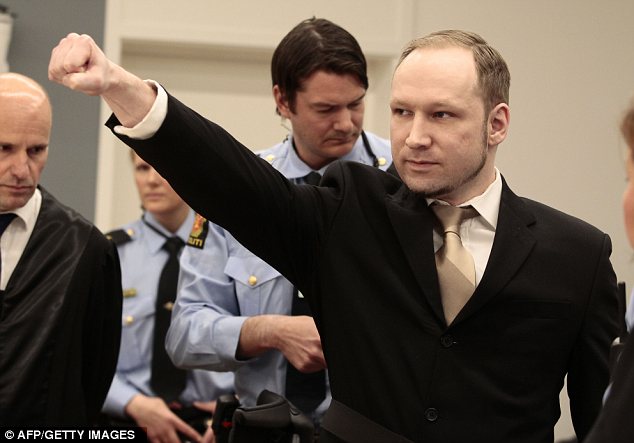
They still won’t call him a terrorist. Anders Breivik remains a “right wing extremist gunman” and, with some concessional nod of late, an “anti-Muslim fanatic”. I feel that the trial is projecting his views in a circular light where despite what he has done, the emphasis will be on the statement made during the defence. It will work subliminally, for those he killed were not specifically Muslim targets. This would push the general sympathy idea and divert his motives.

He has displayed arrogance throughout. As a report says:

Norwegian killer Breivik breaks down as film of his hero Vlad the Impaler is played (but stays stony-faced as court describes way he slaughtered 77).

He smirked several times as the cuffs were removed, put his right fist on his heart then extended his hand in salute. “I do not recognise the Norwegian courts. You have received your mandate from political parties which support multiculturalism,” Breivik told the court after refusing to stand when judges entered.

“I acknowledge the acts but not criminal guilt as I claim self defence,” he added, seated in front of a bulletproof glass wall.

His self-defence was against “Muslims”.

The patch on his uniform


The Norwegian police plan to bring his mother Wenche Behring to the witness box because Breivik said during interviews:

“I just hope my mother is not there. She’s the only one who can make me emotionally unstable. She is my Achilles heel.”

They courts believe that seeing her will “reduce the killer to a quivering wreck”. This is ridiculous, for she has already stated that her son suffered from paranoid delusions five years ago. Why was he not treated for it? The insanity plea might work. And he might well be her Achilles heel.

All killers suffer from some psychological issues, and the ‘lone murderer’ or a group of terrorists being brainwashed is part of how the enemy is played on their minds subconsciously.

It is the job of the courts and the police to conduct the proceedings. I am surprised that such ‘motherly’ intervention is being made public. We are not dealing with a juvenile court. The man went on a killing spree, his acts are recorded, he has admitted to it. What more do they want to know? That he watched a Muslim running a store and it affected his mind so much that he decided to attack innocent people?

He is a terrorist, and not just Norway but all the western powers should treat him as such.

Also from my archives:

They don’t have terrorists in Norway?
Did Hindu or Islamic Fundamentalism inspire Oslo’s Terrorist?


7.11.11

Sacrifice Sublime


I sacrificed the moon last night. A pale moon tethered to the sky. I drew the curtains. But as my eyes were preparing to adjust to the dark, light penetrated through the shades. The moon was replaced.

We do not know it, yet everyday we sacrifice a bit of something. We call it adjustment, tolerance, compromise. Above all, we call it love. We give of ourselves, the sons of Ibrahim are the vulnerable emotions within us.

I celebrate love. So, Eid Mubarak...


- - -
Love came,
and became like blood in my body.
It rushed through my veins and
encircled my heart.
Everywhere I looked,
I saw one thing.
Love's name written
on my limbs,
on my left palm,
on my forehead,
on the back of my neck,
on my right big toe…
Oh, my friend,
all that you see of me
is just a shell,
and the rest belongs to love.

- Rumi

- - -

And for those who are limited to and by ritual, my thoughts on Getting your goat.

11.8.11

Afzal Guru: No Noose is Good Noose

Every few months the Afzal Guru mercy petition is brought out for airing. This time the government has advised the President to reject his plea. Everybody likes a nice linear structure, and no one better than the Times of India.

Guru, along with some others, was accused of plotting the audacious attack on Parliament on December 13, 2001 in which a group of jihadis came very close to wiping out India’s political brass. The aggression almost provoked an Indo-Pak war, with India mobilizing troops along the border to force Pakistan to cut its support to terror groups.

This is plain over-the-top dramatic. Where are the points about how a group can enter Parliament? Let us also not forget that Professor S.A.R. Geelani was arrested for being part of the “group of jihadis” but had to be released. Do read some detailed posts I had written.

And here is the precious sanctimonious ‘TIMES VIEW’ that ends in a typically foolish manner:

As a philosophy, this paper is opposed to the death penalty. One of the very few exceptions we make is with terrorists—when guilt is beyond the shadow of a doubt. Guru execution will take weight off Cong back

Sure, TOI knows all about guilt. Or is it more keen on easing the onus on the Congress?

It will be interesting to see some turncoat behaviour, too. I am particularly curious about Dr Farooque Abdullah’s stand. Back in 2006 he had said:

“You want to hang him? Go ahead and hang him. But the consequences of hanging him must also be remembered. One of the consequences will be... we have paid the price of Maqbool Butt’s hanging by the judge who was shot in Kashmir. Those judges will need to be protected like anything.”

Judges have been shot at in courtrooms by goondas and the underworld too. And people in the public eye in controversial cases are always at risk. That is the reason our country has Z or is it “Zzzzz” security.

He also said the nation would go up in flames. This is the language Bal Thackeray uses all the time, and of course everyone just indulges him; some even feel he is right.

There are too many questions and I will reproduce one of my earlier pieces in full:

Get real about Mohammad Afzal  
India would not have got Independence had hanging served as a deterrent to terrorist activity. Our freedom fighters like Bhagat Singh, Chandrasekhar Azad, Rajguru -- all dubbed terrorists by the British who ran this country -- were responsible for the killing of innocents as part of their strategy; their target was never innocents.
Therefore, please let us not make the Mohammad Afzal very real dilemma into a frikkin soap opera. I have given my point of view in the blog of 29.9.06 (Why should Mohammad Afzal be hanged? ), but these ‘human’ stories should be left out for the moment. Afzal’s son, apparently, tried to tie a rope round his neck…his mother said something about him trying to feel the pain of his father. Sorry, the kid is seven and I am aware that children exposed to such extreme trauma do grow up fast, but this is no time or occasion for pop psychology.
We do have the other side where the widow of a CRPF jawaan, killed in the Parliament attack, who was posthumously awarded the Ashoka Chakra has threatened to return the medal if Afzal is not given the death sentence. No time for blackmail too.
Time to stick to the bare essentials:
1. The Congress (that has suddenly got chicken) now says they are against clemency; the BJP has always said so; the Shiv Sena…who the heck cares for it…Wait a minute. Political parties cannot decide on this issue. It is solely Presidential discretion.   
 2. Afzal is an Indian. It is clear we believe Indians are not capable of heinous acts on their own. As his lawyer Nandita Haksar pointed out, despite the apex court having acquitted Afzal of charges of belonging to any terrorist organisation, he is still referred to as a JeM (Jaish-e-Mohammed) operative.
3. Why the hell has the Hurriyat Conference’s Mirwaiz Umar Farooq taken up the issue of Afzal death sentence with the Bush administration in New York and sought their intervention towards seeking clemency for him? Does he not understand that the US is one of the biggest ‘civilised’ terror factories? Can we not handle the issue ourselves? This will send out the wrong signal to the Indian government.
4. A group of concerned citizens had written to the prime minister in December 2004. They had put forth a few pertinent points:

  • -The prosecution produced 80 witnesses. None of them even mentioned that the four persons accused of conspiring to attack the Parliament have any link to any illegal or banned organisation. All of them were acquitted of charges of belonging to a terrorist organisation.
  • -If Afzal was a surrendered militant how would the Pak-based JeM use him?
  • -His confessions were made under conditions of torture and the police made him implicate himself before the media.
  • -One of the other accused, Prof. S.A.R. Geelani, was framed on the basis of forged documents and fabricated evidence. After his acquittal, he has been speaking out and giving details about the conditions under which prisoners in the high risk cells are kept. The National Human Rights Commission instead of investigating the allegations closed the case filed by Mr Geelani on the ground that the jail authorities have denied the charges.

What do you expect jail authorities to do?
No one expects an emotional response. These are practical issues that need to be addressed. And for those who have accused me of bringing in other cases, like the Bombay riots, the authorities are doing it all the time. Giving examples of what happens in Pakistan. Get real. Pakistan is a different country now.
I am interested in India. Aren’t you?

9.6.11

M.F.Husain: Heaven can't wait...

There's no looking back
M.F.Husain has taken off on his paint brush into the other world. Age 95. Dead. Obituaries are tricky. I think about the ceiling of his house; he had sketched stars – black on white. I sat on a chair waiting for him to turn up. He did not. His wife said no one knows when he comes and when he goes. I disliked him, anyway, and my conversation would not have been about him walking without shoes.

He was surrounded by women, the kind we rather disparagingly refer to as society dames. What could he find so entertaining, forget enlivening, about them? For them he was Fame. At one of their homes I saw a painting by him that was unspeakably sad. Fine crystal shone below it on a mantelpiece. I smirked. Then one day many years later I saw shards on the floor…and experienced the sadness of broken crystal.

Husain, for reasons I have been unable to fathom, continued to look like an arriviste, despite all the celebrity, the money and the artistic talent. We all perceive art in different ways – for me he was more skill than soul, and not many possess that kind of skill, the adhesive-like hold on the imagination of the artistic fraternity.

Curiously, I got a note yesterday from a person of the rightwing persuasion questioning me about his portrayal of nude goddesses that I had tried to explore in an earlier piece. This is what he became known for – not the works, not the ideas, but the controversies. He was restless, but not a gypsy. He was the nomad who had luxurious homes everywhere he went. It won’t be much different now.


duniya ne hum pe jab koi ilzaam rakh diya
hum ne muqaabil us ke tera naam rakh diya

ik khaas had pe aa gayi jab teri berukhee
naam us ka hum ne gardish-e-ayyaam rakh diya

- Qateel Shifai
- - -

Here is an old piece I had written in my Rediff column of October 27, 1997, well before they started stoning galleries where his works were displayed:

The unmaking of a maverick

M F Husain has a major problem. If we start with this premise it would be far easier to approach his persona. And the problem lies not with what he is, but what he is seeking to be.

Today, few talk of Husain as an artist – he is either the showman, the maverick, the risk-taker and, finally and conclusively, a product. His market value is under discussion rather than his palette's wild guesses and sometimes calculated conundrums. It is very likely that he feels trapped and is now seeking to assert his independence. No artist in his right mind would rush from one canvas to the other to show the onlookers the process of painting, as Husain claims to have tried to do. But, at this point in time, he is not in his right mind. He is on a binge to negate his art by harking to his hoarding-painter days of relative freedom. The days when he could paint the other icons of cinema, without having to worry about whether his unshod feet would gain celebrity status.

Husain' painting on the Mumbai blasts
The very concept of being a celebrity can be difficult to handle, its reality even more so. Husain's position as a product has to do with his being many other things. As a showman performer, he is expected to toe the classic 'I pretend, therefore I am' line. This includes massive image-building. But the man about whom it was made shows all signs of not being at peace with himself. The result is whimsical behaviour. The charitable will call it maverick moods.

But why would a man already on the pedestal want to be a maverick? It cannot be to get attention. Not a genuine desire for experimentation either, so the possibility of his sense of boredom at being 'known for being known' cannot be ignored.

To this end, the artist has begun taking risks, not so much with his work but with his reputation, which has been the cause of most of his ecstasy and all of his anguish. Kierkegaard put it beautifully when he analysed, "It lays a prodigious burden on a person to have to support the weight of everyone's eyes." Even a Husain work is merely a work of Husain. Snapping the chain with his offbeat acts, he has in effect put the ball in the court of his 'audience', the subliminal message being, "Since you have made me, you might want to unmake me. But before you can do that, I will do it myself."

Therefore, the new Husain is essentially the old one trying to come out clean, but not without attempting to kill two birds with one stone – by hankering after his freedom and at the same time (and perhaps because of it) making sure that the public does not run after someone else. This is the hallmark of a celebrity. Or an insecure man.
- - -

Updated in new post here

12.4.11

What I would do to a rapist...

  • Castrate him? Spit in his face? Report him to the police? Would I have the courage and the presence of mind to do any of these when he has trampled on my body and my self-worth?

I am regurgitating these questions because they must be, especially if you read the letter I got in response (reproduced at the end). No one will sit in at Jantar Mantar for an 18-year-old who was raped in Delhi and then when she cried for help was again raped by those helping her. Our Home Minister was concerned about Delhi culture before the Commonwealth Games and roads and potholes. Has he looked into this culture?

I have already stated how wary I am about the media reportage of rape. Some cases do gather momentum, but the TV channels use them to project themselves as ‘saviours’. That is the reason I was hesitant to watch No One Killed Jessica. The other day I watched it on television and it was not as sensational as the promos made it out to be; I do not know whether it was heavily edited, but the journalist character who initially refuses to cover a ‘soft’ crime later becomes this grand do-gooder when she shamelessly takes over the ‘story’ peppering the urgency with invective.

On an earlier occasion during a love-making session when she gets a call, the hard-nosed hack gets up to leave. The guy asks, “What happens to me?” And she says, “Fly solo.” This was considered bold. We are such an immature society that a woman talking to a man she is intimate with speaking like this is seen as bold. More importantly, what was the point: to tell us that she does manage to get laid despite being a bazooka professionally? Or was it to contrast with the rape case she was taking up to give it to the big guys?


It is always about big guys. The small people and crimes against them don’t make us sit up and think.

But can rape, an intensely personal crime, be adequately covered? That is the reason for the queries at the beginning from a piece I had written on August 20, 2004.

I can only reproduce it with the same headline to express how I feel even today:

Castrate him? Spit in his face? Report him to the police? Would I have the courage and the presence of mind to do any of these when he has trampled on my body and my self-worth?

Would I kill him? Would I want to see him killed? These are cold questions confronting me because in one week I have had to contend with two faces of such brute behaviour.


Were I a slum-woman in a small town in India, would I have lynched a rapist? This is precisely what happened in the Indian city of Nagpur on August 13. 400 women stomped into the courtroom where dacoit Akku Yadav was being tried for murder and extortion; they knew he would be let out on bail. Such was life in their locality – he would walk into houses, drag women out and rape them. This was not lust. It was an assertion of his clout.

Why did these women take ten years to get rid of him? I do not know what snapped. That day they walked into the courtroom, threw chilli-powder at him and, as he was rubbing his eyes, they stoned him and stabbed him to death. Can I see myself as part of such a group? Does bonding in a sisterhood lessen one’s personal pain? Does every woman react to rape in the same manner?

We all have emotional scars which we bear in the silence of our hearts. What we lay bare are the tombstones that pronounce the demise of a part of ourselves. A lone woman speaking out becomes a chaalu cheez. The fact that this was a group has given it a different dimension altogether. The public display will at some point ghettoise them. What will happen to the young girls who would want to go to school, find jobs, get married?


Activists have applauded these “incarnations of Durga”, the goddess of redemption. I am scared that this could set a precedent. The courts in small towns may start believing that they do not have to play a vigilant role and the women can fend for themselves. Should every woman carry chilli-powder now? After she has been overpowered and humiliated, will she have to forget about the pain and the shame, and fumble to find that mirchi? And then gather the strength to kill her molester?

I would not be able to do that. I remember this vignette from an Indian play: the intended rape victim takes out a gun from her bag and makes her tormentor cut off his penis. Then she throws some money for his taxi fare and hands him her handkerchief to staunch the blood, mocking him with a “Thank you, I liked it”. I’ve never shied from calling myself a feminist, but I just could not connect with this.


Then, do I think it appropriate for a rapist to be hanged? Dhananjoy Chatterjee, who was the first person in nearly a decade to face the death penalty in India, refused to accept his crime. As his end drew near he listened to bhajans and read religious texts.

People are saying that capital punishment does not act as a deterrent, and as if to prove this, there has been a spurt of reported rape cases. Far worse, re-enactment of the hanging episode has become a new pastime; in one such case, a 12-year-old girl died while playing with a noose round her neck. So, has the punishment served its purpose or has it become some kind of melodrama that will spawn dialogue- baazi and amateur mimicry?

If I were the mother of Hetal, Chatterjee’s 16 year-old victim, I would have wanted the creep to live and suffer. Instead, today in his village he is seen as a martyr. Before he was taken to the gallows his family had threatened to commit mass suicide and had to be provided with police protection.


There are many such potential “heroes” roaming the streets. I was once at a beach resort in South India and a group of very young men kept passing crude comments. I got up from my deck chair and went up to the worst of the lot and tried to lecture him a bit; he started blowing cigarette smoke in my direction. That is when I lost my cool and punched him in the face. The rings on my fingers left red blotches on his cheek. But he held on to his ciggy, his machismo. Although I did leave some money, in case he needed first aid, I returned to my hotel room and cried. For a few months I even gave up wearing those rings. All I felt was remorse and guilt; at no point did I feel elated.

And that was, in comparison with the enormity of rape, a minor incident. We tolerate many such little offences in our subcontinental bazaars – elbows nudging breasts, bottoms being pinched. I begin to wonder whether our bodies are really our own. And just as I feel desperately low, I hear news of a young Muslim woman living near Kolkata being forced to marry her rapist, when the judge made that the condition of his release.

What would I do to a rapist?

(Farzana Versey)

- - -


This is the letter I had received in response. It sucks...

"Dear Versey:

This is in regard to your article you wrote. You were raped!!! whoa! and the rapist is about to be released. At the end you wrote that "What would i do to a rapist?". So i sujest that you should try to get over it and don't get confused. If you really like that guy you can always marry him. One of my friends married her rapist 17 years back. Now she has 3 kids and so she is living a happy married life now apart from the routine quarrels of husband and wife."

I find it strange that people cannot understand even the most straightforward writing. Worse, this guy had the audacity to expect a reply to let him know if I found his letter pathetic.

3.12.10

Rishtey mein Lord Ram hamare baap lagte hain?

It is lecture time. “The interest of ordinary Muslims in new India lies in embracing modernity,” says Minhaz Merchant. The headline of the editorial page piece in The Times of India is ‘Educate, Don’t Appease’. It assumes, therefore, that only the uneducated are appeased and the white knights like Mr. Merchant are not.

I will tell you how they are. In his own precious words:

As a group of visiting senior Muslim clergy from Ayodhya, with wisdom born of great learning, said recently to Swami Shri Swaroopananda Saraswati, the highly respected Shankaracharya of Dwarka: “Even though our religions are different, we share the blood of the Hindus.” The Shankaracharya replied gently: “That makes our Lord Ram your ancestor as well.”

Very well, we are family and all. Then, rishtey mein Babar is also daddy dearest to Hindus, no? And most certainly Emperor Akbar? After all, he was married to Jodha bai and used to rock the cradle with Krishna’s idol, at least that is what they showed in Mughal-e-azam. So, if you want to play ball, then you have to be on the same court. You can’t just lob it up in the air.

The author goes on to state:

This is not just about genealogy – it reflects India’s embedded religious diversity.

Sure. The TOI used this picture with the headline, ‘Reinforce the tolerance that unifies’.


Tolerance has to be mutual, even though I dislike the word tolerance. You cannot have one idea of god and a stereotype of another religion paying obeisance to that god and call it diversity.


I had written about just such a narrow vision in the article Mainstream Terror:


It is interesting that while the urban elite has taken over religious celebrations and consumerised it, they use the ‘backward’ idea to drive home the point of India’s colourfulness. It almost seems like they are sitting away and cheering at a spectator sport.


My real issue, though, is how the Muslim clergy and the shankaracharyas are considered the only wise folks around worth quoting. Does the author not talk about modernity? Then why is he appeasing religious heads?

Grow up and get your priorities right. It is shameless and insensitive that this piece was written as a prelude to the December 6 Babri Masjid demolition’s 18th anniversary. Was that appeasement or modernity?

8.2.10

I told you so...

The Shiv Sena and Shahrukh Khan have "climbed down" a bit, without altering their "ideological" positions. So, the SS is not interested in doing anything to interfere with the release of 'My Name Is Khan' and the actor won't take the war of words further. How convenient.

Anyhow, I said this would happen a few days ago in 'News Meeows -23'.

The new news was in yesterday's papers. One would imagine TV debates that are aired live to keep up with fresh news. Instead, we had the same things regurgitated. The usual shouting to emphasise nothing.

A few noticeable points:

* A studio audience is not the "aam junta".
* Dissent is not some tutored youth, who believes Shahrukh has done so much, standing up to say they would all go and line up to watch the film ("Come on guys, let us show them," he said). It is called falling prey to hype and following trends.
* Konkona Sen Sharma saying, "But arts and sports must be exempt from all this, no?" is the sort of bubble some people wish to protect. Why only arts and sports? There is a world outside also, no?

Did no one read the papers that morning? If they did, why did they not discuss the fact that there was a 'truce' of sorts.

Neither the SS nor Khan is standing for any ideological position so let us not even get there.

5.2.10

Chidambaram and the voice

Home minister P Chidambaram is now getting the hang of it. There could be a one of us types in the 26/11 attacks.

“There was a handler in 26/11 whom we have known for long, or suspected for a long time, could be an Indian. That is something we have known for many, many months now... he goes by the name Abu Jindal, but he is not Abu Jindal, that is not his real name. We cannot get a finger on who he is, unless we get a voice sample. And they (Pakistan) won’t give us a voice sample.”

What? Is there some technical device through which you can figure out an Indian voice? Is it is the accent? Then, don’t forget the questions that were raised about the speech patterns of Kasab and his Pak handlers.

Chidambaram replaced Shivraj Patil as Home Minister following the attacks. If they were aware of this for long, and they asked for voice samples, then how did they put it to the Pakistani establishment? There are several other factors, so why would the voice be the deciding one? If they hinted at something, don’t you think the Pak authorities would go to town about it?

More importantly, are we so dependent on Pakistan to provide us with clues?

Now that PC has brought it out in the open, it would be interesting to watch another drama unfold. Did they keep quiet because of the elections and not to 'hurt' a certain section of society?

Incidentally, unlike our reverend home minster, this blogger had raised this point and mentioned it right here on December 1, 2008, five days after the attack:

I know the authorities are coping with several things right now, but has anyone traced the whereabouts of this Deccan Mujahideen group, whatever it is? I mean, we manage to trace crank callers and spam too. This is important. Because they were misleading our security and intelligence agencies.

And where is the Indian Mujahideen? Just wondering....

If you’d like my exclusive peek into the private debate that took place between Pakistan Interior Minister Rehman Malik and India’s Home Minister P Chidambaram regarding the 26/11 attacks and missed it earlier, then go for it.

20.3.06

Mumbai - Sin City?

Is Mumbai safe? The recent rape cases have once again highlighted the issue. But, how can you call it sin city?

I have trolled through those very lanes they are now talking about. The article I reproduce below based on one such encounter still makes me shudder. What if I had not been cocooned? What if I were in those very streets?


Trading places

I don't know if Mona is a prostitute but I do know she has not forgiven me. Every time I think of her, and it is often, I feel guilty about having a bank account, of doing things that others cannot do. But while these are dull aches, with Mona it's different. There is a stinging slap.

Mona came into my life with a loud curse. In the dead of a summer night, I spotted her in a by-lane of Colaba (a hub of Bombay), hurling abuses into the uncaring darkness. I was scouting around for interesting people for a night story. She was looking for some food.

We seemed made-for-each-other. I bought her a meal and we got talking. It hadn't been an easy life. Childhood lasted till the age of 10. After that, she was physically abused by her brother and brother-in-law. She was from a well-placed family. Soon, her soul was torn to shreds. She lost faith. She lost sight of where she was going, and found her way into the streets.

When I met her, she was angry; there were needle marks on her hands. Then she took me further into the lane, muttering all the while, "I have a baby." There, lying on the footpath was a black child. "Yes, the man was a nigger." She said she was not a prostitute. "Look, if I were a whore, do you think I would be dressed like this? Do you think my breasts would sag?"

In less than an hour, I had tried to capture eternity. In a fraction of this time, she had gobbled up her meal. Before I left, she asked me my address. I scrawled it on a piece of paper. She kissed my hand, "You are my friend," she said.

The story was published, with Mona as the grand finale. Two days later, she tuned up at the office, sozzled, screaming, "I'll kill her!" I wasn't there. The next day, I made it a point to be around. It's not everyday that people want to kill you. When she arrived, I took her to an inside room and asked her what the problem was. I got her a cup of coffee. She was misled by someone who couldn't read straight who said that I was out to get her. I brought out a copy and read out every word, explained what it meant. I repeated her quotes to her, including this one: "I don't sleep around with men. I don't need sex. I only need to feed my baby and myself." And she had spoken all this in perfectly intelligible English. Now she merely nodded and again took my hand, Though she refused to admit she was on drugs, she agreed to get herself cleaned out.

I called up a friend who was working at the rehab centre. But Mona was no more interested. She started giving me stories about the terrible times at such places. She started coming when I was away, barging into cabins. She had only to walk towards the washroom and there would be a fright. What if she had AIDS? What if she was diseased? Almost everyday, I'd get a report of her goings-on.

I wanted to give her clothes and my colleagues warned me that this would become a habit. The only thing I could do and she wouldn't let me, was to get her into a centre. "It's boring," she said. Her manner became difficult. Once she interrupted my conversation with the production manager with an arrogant wave of her hand. He just had to stop. Another time she insisted I take her into another room. She was in pain. She took off her clothes and showed me all the bruises, "They beat me up, they do it all the time." We were almost friends and it wasn't even fair weather. I had never felt so helpless before.

While everybody around was aware of the embarrassment she was causing me, few knew about the agony. Till date, I don't know where I went wrong, if at all I did. But somewhere along, work and concerns got mixed up. She became another woman. She could have been in my place, I in hers.

How would I have responded? What could my expectations have been? Isn't it possible that all she wanted was someone to talk to, and her aggressiveness was merely a means of getting my initial attention, accustomed as she was to being ignored as any other drunken hussy? How could I put myself in her shoes?

(
http://news.rediff.com/style/nov/10farz.htm)