Showing posts with label atheism. Show all posts

4.5.14

Sunday ka Funda

A committed atheist was on a trekking holiday when he became lost in some dense woods.

A large angry bear, with ten starving cubs back home and claws like kitchen knives, suddenly emerged from the undergrowth.

The atheist screamed in terror, turned and ran. The bear was quicker however, and after a long and desperate chase eventually cornered the atheist in a gully.

The exhausted atheist sank to his knees, shaking.

The bear, seeing that its prey was trapped, moved slowly towards the petrified man, drooling. The bear was drooling too.

The atheist lifted his head, with tears in his eyes, and uttered the words he thought he would never say in all his life: "God help me..."

With these simple three words, a blinding flash of lightning lit up the sky. There was a deafening crash of thunder. The clouds parted. A brilliant light shone down. The forest fell silent. The bear froze still, in a trance. The atheist stood gaping, transfixed.

A voice came loud from above. Louder than twenty AC/DC concerts all happening at the same time. We can safely assume this voice to have been the voice of a god of some sort.

"You atheists make me seriously mad," boomed the god, "You deny me all your life. You tell others to deny me too. You put your faith in all that bloody Darwinian airy-fairy scientific nonsense, and then what a surprise - you get lost because you can't read your stupid map, and now you're about to get eaten by an angry bear all of a sudden you're on your knees snivelling and begging for my help?......... You must be joking..."

The atheist looked down, realising that he was not arguing from a position of strength.

"Okay, I take your point," said the atheist, thinking on his feet, while he still had them, "I can see it's a bit late for me to convert, but what about the bear?... Maybe you could convert the bear instead?"

"Hmmn... interesting idea..." said the god, thinking hard, "...Okay. It shall be done." At which the brilliant light dimmed and vanished; the clouds closed; and the noises of the forest resumed.

The bear awoke and shook its head, a completely different expression on its face. Calm, at peace.

The bear closed its eyes, bowed its head, and said, "For what we are about to receive, may the Lord make us truly thankful, Amen.."


From: Analogies on learning

---

I have reproduced the story above without any intention of hurting religious sentiments, least of all that of atheists...

19.5.11

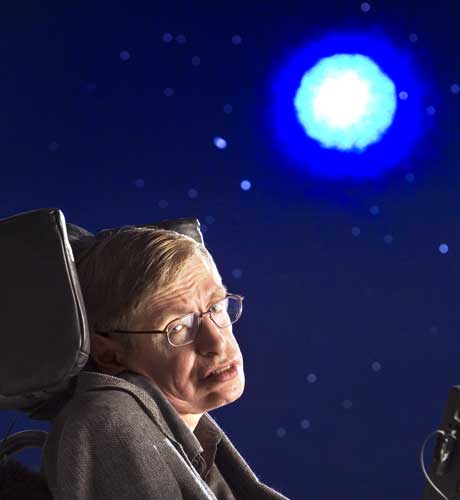
So, Prof. Hawking, how about hell?

Stephen Hawking says something quite ordinary and there is a reaction. The battle between science and religion is old and makes little sense. Although a non-religious person, I really don’t get excited about monkeys or the Big Bang theory. Does that mean there is a teeny-weeny bit of hope that I might be ready for some Edenesque idea or whatever the counterparts? To make it simple, I do not rule out possibilities, which is a scientific attitude.
In fact, most seekers who go to religion do so as an experiment. The main problem I have with Hawking is the statement that has been doing the rounds:

“I regard the brain as a computer which will stop working when its components fail. There is no heaven or afterlife for broken down computers; that is a fairy story for people afraid of the dark.”

This is facile in the extreme. While the brain may be likened to a computer, what about the software? There are several of those and they can be loaded whenever we want as per our requirements. The failure of the computer is technical, not philosophical or psychological. A brain-dead person, or one who suffers cardiac failure for that matter, is the end of life. It does not end the possibilities for the living.

Hawking’s problem is to see religion as a fairytale. It isn’t. Outside of organised religion, there are very many stories, and I have no idea how he concludes that these stories are for those who are afraid of the dark. By saying so, he assumes that death is dark and not as much of a happenstance as his scientific beliefs are trying desperately to convey. I wonder what he has to say about science fiction. It is hypothetical, it creates larger than life heroes with ‘god-like’ abilities. The scientist himself is considered some sort of miracle because he has survived despite a debilitating disease. Of course, it is science that makes him accessible to the world, but when he is applauded for his willpower, what is the scientific basis for it? Where does the urge to live against odds come from?

I am most certainly not alluding to a belief system, but to the philosophical dimensions beyond a computerised brain. It might be a wicked idea to posit the gravitational aspect of Newton’s discovery with the enticement of a serpent. It could have been an orange. Why did it have to be an apple?

It would be interesting to add here that almost all ‘religious’ fairytales are up for scrutiny on a regular basis and hypothetical questions are asked of them. It is true that the vast majority is made up of blind believers, but are there watertight compartments about scientific theories? Have they not been debunked or proven wrong?

I wonder why there has been no mention of hell, which comes as a package deal with heaven. Stephen Hawking should know that the devil is in the details.

7.9.10

Relief from belief

Stephen Hawking is baulking at the wrong evolutionary tree. He may choose gravity over God to rationalise the creation of the universe, but how does one explain away religion? Faith cannot be exclusive of creation, and it has provisions in it for the idea of destruction as well. Elemental and human factors come together to prop up holiness ...

Society gives no breathing space to those who do not believe in anything of a sacramental nature.

--> Full column at Express Tribune:

http://tribune.com.pk/story/47277/relief-from-belief/

17.4.10

Star-crossed Borders

Star-crossed Borders
by Farzana Versey

Inside the well-rounded cosmopolitan atheist persona of Shujaat Rizvi, there was a Pakistani nationalist and Islamist waiting to come out.

I turned out to be the catalyst, unfortunately, for this ‘homecoming’. Today, when I sound a bit wary about cross-border alliances, I have reason to believe that even if you share a faith, the political dimensions leap out like dragons.

Sania and Shoaib’s saga became a matter of precarious acrobatics; there are many others that cannot even venture into the circus arena as static cable wires, phone lines and meetings die slowly. More importantly, they bring out certain prejudices that we do not know we possess. Our earlier conversations about Sartre and Sinatra came unhinged as it soon turned into a battle of, and for, national and religious identity.

The day I landed in Islamabad, Shujaat decided to take me for dinner. We sat across from each other, a flickering candle between us. It was a mellow moment. “Would you have ever married a Pakistani?” he asked.

We were not young. I was newly single, hammering the nail on the coffin of a marriage gone wrong; he was a confirmed bachelor.

I had never thought about people as countries, but apparently that baggage had gone along with me. “Perhaps...” I muttered, afraid even of hypothesis.

“It is easy to get you a Pakistani passport and even an ID card. All that can be arranged.”

“I said I did not mind marrying a Pakistani, I did not say I would live in Pakistan.”

“This is a better place. You can walk with your head held high. You don’t have to suffer during communal riots. This is an Islamic country. There is no pretence.”

He was curious about the Muslim women in India. When I told him about the relative freedom of movement, at least among the urban, educated woman, and cross-religious alliances, he flared up. “I do not think Indian Muslims can get equal status by marrying their women to Hindu men. It is nauseating to imagine...”

He could not understand that relationships were not based on religion. “With such westernised and modern views, do not tell me that the man would say Islamic prayers before, after and during their intimate moments.”

Shujaat’s knowledge of this aspect was based on biased news and stereotypes, mine on experience. His prism only showed him a Muslim utopia. Was this about the scriptures or nationalities?

“If you don’t have a problem about nationalities, then why would you not live in Pakistan?” he queried.

“I cannot live even in America.”

“I think your attachment to your country is like a bad habit. Like smoking it can cause cancer. I am sure Muslims in your country would feel the same.”

It was a curious exchange at many levels – he appeared to be testing me personally and politically. Rather than a candlelight dinner, it seemed like Roosevelt’s fireside chat to his people via radio.

He had been active in student politics and his ideological leanings were leftist. He was clear that if he married an Indian, they would have to live in a Muslim country. It surprised me, for he was educated in the West and had worked outside too. In fact, during his stay in the US, he came close to getting involved with an Indian woman.

“Not just an Indian woman, but a Brahmin one. There was this desire to have an affair, a short affair.”

“So, would you not become impure?” I asked, since he often alluded to my cultural impurity.

“This would not be about love but hate. It is like war. You don’t love the land you occupy.”

This was territorial, whichever you looked at it – geographically or psychologically. We drifted apart, never to meet again, characters leaving the stage empty for more biases to resound.

- - -

This is my column in The Express Tribune, Pakistan, dated April 17. It was a special exception after the first Guns and Lollipops, which they wanted for the launch issue on Monday, April 12. My scheduled column day is Tuesdays.

They omitted to add the following footnote in the current column, at least in the Net edition:

Some portions in this piece are from my book ‘A Journey Interrupted: Being Indian in Pakistan’.

- - -


Results of the blog poll:

Are cross-cultural marriages...

A political statement - 3%; A secular statement - 10%; A chance to discover another culture - 17%; A recipe for disaster - 10%; If not planned, then just 2 like-minded people getting together - 53%; Why marry when you can be a tourist or commentator?! - 21%

17.10.08

On and off - 5

Not on…

The Kerala government confirmed two Muslim police drivers were removed from BJP leader L K Advani’s convoy during his visit to the state but the state’s home minister Kodiyeri Balakrishnan clarified,. “No one was kept out intentionally. There were also four Hindus who were taken off.’’


Slamming a statement made by external affairs E Ahamed criticizing the removal of the Muslim drivers, Balakrishnan said the Muslim League leader’s view was in contrast to the country’s secular values.

Wow. Look who is talking about secular values. If we are so darn secular, then please whenever there is a bomb blast do not mention the religion of the ‘alleged suspect’, okay? Don’t say things like Muslim ghetto or Christian locality. Don’t talk about how Muslims are like this and like that. If you can’t, then stuff your holier-than-thou moral stance.

It seems hundreds of cops were deployed. How many Muslims were in that group? One is compelled to ask only because of what has happened. Otherwise, who cares who protects these politicians? If Mr. Advani is going around giving lectures on secularism, then the right signal would have been to retain those two Muslim policemen.

On…

A judge has thrown out a Nebraska legislator’s lawsuit against god, saying the Almighty wasn’t properly served due to his unlisted home address. State senator Ernie Chambers filed the lawsuit last year seeking a permanent injunction against god.


He said god has made terroristic threats against the senator and his constituents, inspired fear and caused “widespread death, destruction and terrorization of millions upon millions of the Earth’s inhabitants”.

I love this guy Chambers. In one smart move, and I don’t care whether it was intentional or not, he has made god answerable. A god with no fixed address. A god that can reside anywhere in anyone and therefore can cause all the ills he accuses the respondent of.

In a sense it is a most democratic suit. No individual based on specific affiliation can be blamed. Even the god is non-generic.

Chambers conveys that if a country refuses to call itself atheistic, then he has a case. As he stated, “The court itself acknowledges the existence of god. A consequence of that acknowledgment is recognition of god’s omniscience. Since god knows everything, god has notice of this lawsuit.”

Touche.