Showing posts with label column. Show all posts

9.5.12

Footnotes from the ledge

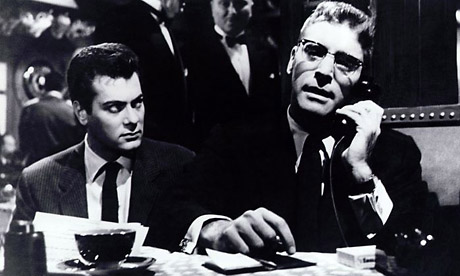
From the film 'The Sweet Smell of Success'

Years ago, a web portal I wrote for in the nascent stages of news and views on the Net in India, decided that it needed a footnote for its columnists. I was accustomed to ones that simply said I was “a freelance journalist” (I crack up when I read “independent columnist” – independent from what, of what, by what? Is that not to be taken for granted?) to the smart “refuses to sit on the fence” (it worked against me after 11 years of continuous writing of that column when I was told I was too independent and don’t take briefs!) to a phrase taken from my blog: “has a healthy disregard for objectivity”.

So, back to that e-portal. As some of you know, I could not imagine ‘writing’ for anything that did not scrunch in my hands. I did not even have a computer. One day, out of curiosity, I was at a friend’s office and casually mentioned this column. We reached the destination and as I scrolled down on my discovery trip, I reached that precious footnote. It was in red, italicised. It said that I, FV, was an “iconoclast”.

I froze. Images of me as Che Guevara flashed on several T-shirts. This was serious, and after a few seconds I was pretty much on the floor laughing, and ROFL was not yet known to us. From that vantage position where I had to look my iconoclastic best, I asked my friend whether he agreed with me that it was a stupid idea; he did. And made it sound more ominous: “It might appear as though you are saying it.”

This is the problem. It is more likely that publications decide. However, the newer lot ask you to send “two-three lines describing yourself”. I once wrote a horribly cheeky one and was told it did not go well with the content.


Sealing my fate!
When I became a serious op-ed addict during college, I recall reading pieces that were written with care for both language and thought. Some were ponderous, no doubt, but many were challenging. For me, this is the purpose of a good edit piece. There was space enough to explore ideas, and not the need to compress because there has to be place for ‘likes’, ‘share’, ‘send’. I understand this is the way to connect, but when some publications ask you to send SMSes to say whether you liked or did not like the column, it is a bit much. The writing becomes another product. Unfortunately, these days it often is.

But I did not know who those writers were. Celebrities and those from other fields had not taken over the business of holding forth on what they were doing. This does not work as ‘inside’ information or adds any authenticity, for they too are writing for an audience and have their own biases.

Do readers care about the qualifications of the columnist? It is a bubble theory. It looks good until you prick it. And the pricking is just giving it a good look-over.

However, mostly the footnote works as a promo for people in different professions. I had once taken a swipe at someone mentioning how his CV exceeded the word limit. It was, therefore, good to read on the ‘Self importance of names and titles’ in Pakistan’s Express Tribune as to how the whole description business has gone overboard. When I was writing for them, I had half a mind adding, “The writer has a degree in Vampirism from the University of Dracula”. (Incidentally, third-person descriptions are supposed to look objective; they make me feel schizophrenic.)

Quite a few publications have these long rambling bottomlines, and most of their columnists are so darned third-degreed, all from the best universities. A good university ideally teaches you to explore, not flaunt knowledge.

We never read any mention of a degree from Gujranwala or Chhatisgarh. Reveals our colonial mindset and, dare I say, adds weight to the publication's reputation. They could probably have a roll-call of Oxford/Cambridge/Harvard types, all with halos. If they can take global roundabouts and quote Greek mythology in Latin phrases with a slight nod to desi lingo, then chances are that more people will notice because snob and blob value go together. They are like the always-open KFC outlets.

The other peeve regarding "X is a former something or the other" reveals our absolute obeisance to the past. Instead of wondering why s/he even at the prime has been rendered redundant, it imbues the individual with the gravitas required of a know-it-all. Much like a divorce might make a discussion on marriage legitimate. If the 'formerhood' has been achieved after much toil, then it works like a tiger's head poking out of the wall.

Now, chances are that if the writer were not a "political economist" or some such and just another bloke with something to say, a piece questioning such self-importance would not have gone through the thinker's pose of editorial discretion.

PS: I posted the last three paras at the website with a footnote that said “~A former ET columnist with several degrees of separation”. It’s still awaiting moderation after hours! (Finally published after 12 hours.)

© Farzana Versey

1.8.11

The over-the-top Pakistani press


A Pakistani columnist decides that “introspection is not as fashionable as Roberto Cavalli shades” and goes on to pen an ode to all the brands he can think about, not to mention referring to his country’s foreign minister Hina Rabbani Khar as HRK. Is that a trendy take on SRK, Shahrukh Khan, or Her Royal Kink? My views have already been expressed.

Masood Hasan’s column in The News lacks a sense of propriety and proportion. So much like outsized shades, isn’t it? These are the same ‘liberals’ who will take up for a Veena Malik whose contribution to foreign policy was to be cooped up in an Indian reality show. Take a look at the canapé-level arguments:

“Let’s get one thing straight. One dresses for the occasion. Anyone recall Angelina Jolie’s ‘designer’ outfits on her many visits to the Afghan camps? There is a time and place for all things. I think HRK didn’t quite get that right. She has many things going for her but maturity and a sense of balance seem to be virtues that Pakistan’s new foreign minister does not care about much.”

Angelina Jolie did quite the opposite with a devious purpose, by playing up stereotypes. There is also a huge difference between camps and a country. Ms. Khar was a visiting minister to India, a nation that is home to several flagship stores of international labels.  

“While she must have spent an enormous amount of time choosing her wardrobe and accessories – she has a talent for accessories as a gushing designer confided last week, one wishes there were men or women who could have briefed her on how she must conduct herself – but this is unlikely in a country where ‘yes sir, yes sir, three bags full’, is the most successful strategy.”

This tells us a good deal more about the gossip Mr. Hasan has his antenna up for rather than the minister’s conduct. The important thing is not how she was accessorised, but whether she made any false moves in her speeches. The way one conducts oneself depends on behaviour and not on what one wears. Unlike the President Asif Ali Zardari who referred to Sarah Palin as gorgeous in an official meeting, there was nothing remiss about the way Ms. Khar projected herself. She was indeed briefed, but about Pakistan’s political position that she reiterated. Perhaps the “yes sir, yes sir” types are not as adept as spotting labels as Mr. Hasan is.

The dear gentleman is doling out epithets with a double-edged sword. He calls Indian diplomats suave, but adds what can only be considered an Omar Sharif-like standup act. He states:

“The Indians thus dress so simply that you can mistake them for minions whereas they may be billionaires. They go to work in loose sandals and creased trousers or faded jeans but sit and make strategic decisions that run into billions of dollars and have the power to change the direction of their huge country. Simplicity is not a put on like our constant bowing and scraping to the Maker without any meaning or sincerity. Our rulers and high stake rollers live in mansions of glory. Indians richer than their counterparts here live in modest homes. Retired generals there live in small houses or high-rise flats.”

One understands the inherent feudalism in Pakistani society, yet one fails to comprehend the blinkers the writer wears, either while writing or when he visited India. Has he heard about the Ambanis, the Tatas, the Birlas, the Godrejs, the Premjis, the Narayan Murthys, the Reddys? Has he read about their private jets, their parties, their weddings, their lifetsyle, their homes, and of course their accessories? Our ministers often refuse to leave their bungalows even after their term ends and retired generals take their time retiring. He is clearly basing his “loose sandals” observation on something from R.K. Narayan’s books, or perhaps referring to some of the older politicians who prefer to dress in traditional wear, such as the dhoti or the mundu. Rest assured, they are not trying to identify with the common man, for they get into their limited edition vehicles too and have a neat collection of real estate and jewellery.

If there is anyone who reveals caste and class consciousness it is the writer. He obviously does not understand the implication of the term minions. It is insulting that he thinks Indian leaders could pass off as vassals only because of what they wear. Perhaps he was just served his rack of lamb marinaded overnight by a member of the staff who he treats like a minion.

One does not know whether Ms. Khar read up on India, as he admonishes, but he does not seem to have done so. Instead of telling us what he expected out of the discussions, he decides to make a list of the lady’s wardrobe ‘malfunction’. Indeed, Indians went overboard in noting her couture with unbecoming awe and Pakistanis with derision. The internal politics of her tax evasion is a matter that ought to be discussed and resolved by the people and her party. Her shoes have got nothing to do with it. Why should a foreign minister tell India “my country is struggling – with terrorism, suicide bombers, law and order, the Afghan problem, a poor economy and so on but that we would prevail if there is peace”? Mr. Hasan seems to be suffering from a perennial mai-baap hangover due to Pakistan’s helplessness with regard to the US.

Had she highlighted the details that are not a secret anyway would the honourable columnist step down from his pedestal and permit her the indulgence of accessories? Or would he expect her to be dressed up as a ‘struggler’? America is going through its worst debt crisis. What are its ministers supposed to wear? As one who has visited Pakistan a few times and seen both its elite and its interiors, I do not see how drawing attention to the social ills would take the peace process forward. Has Masood Hasan spoken to the law enforcement people, the Afghans, the terorists, the very poor, the suicide bombers and asked them how exactly they view the peace process?

What did he expect from this meeting when there have been others that brought nothing? I guess it would be expecting too much from someone who, while dissing the “lollipops”, spends considerable time reading up on the shenanigans of the “fash frat”. It is a pity that he feels Pakisanis have egg on their face. I suppose it is inevitable if all you concentrate on is the chinks in the chick’s armour.

30.11.10

Pakistani circus comes to town!

A Pakistani commentator has come up with a Pavlovian response to how Indians salivate over Pakistan’s misfortunes and are not all smelling of roses. To make this rather simple point, he moves from the dog in the science lab to sci-fi to Biblical metaphors.

Ejaz Haider’s column in The Express Tribune mentions his educational qualifications – a seemingly mandatory thing these days in some publications – which should tell us that he is all grown up and doing tickety-boo. So well in fact that he expects “scientific inquiry”, unlike aforementioned dog, from Indians in the World Wide Web. He forgets one basic tenet of the W word, and that is anonymity and the possibility of fake Indians and fake Pakistanis faking emotions to elicit fake critical faculties of columnists who are educationally well-hung.

His one-line tenet is that Indians pounce on any Pakistani for “putting things in a (sic) perspective”. He believes that his country is masochistic because while Indians can openly be critical of Pakistan, Pakistanis cannot do so in Indian newspapers. I think he should do a bit of research on internet behaviour. As I have already stated, Indians and Pakistanis rarely appear as themselves. Pakistani commentators are quite coddled in India, even if they write about some sidey actress and Nwaaz Shrif’s hair implant. All those Pakistan diary type items often talk the usual lingo of exotica which makes it rather charming. The same applies to Indians who discuss “daily life” or Bollywood or “peace initiatives”, the latter being the biggest-ticket event.

Before I am accused of doggie behaviour, I must add that Mr. Haider has rather magnanimously acceded that India does have its moments:

India has its strengths, without doubt. We need to emulate them, no gainsaying that either. But for Indians to embark on an exercise, every time a whistle is blown, to prove India is the best thing to happen this side of Eden is to ask for willing suspension of disbelief at a level that defies even disbelief.

Just a bit of semantics here: When you defy disbelief, you are a believer. Ergo, suspension of disbelief ought to be a dribble of saliva.

He then comes to the point:

There have been comments upon comments in this newspaper by Indians about, among other things, corruption in Pakistan. Something like the 2G scandal in Pakistan would have given the Indians a field day. Try placing a comment on the Radia tapes, a scandal which, alone in its spread, is enough to eclipse Pakistan’s collective scams over 63 years, or even offer to write on it in an Indian newspaper, and you would know what I am saying.

One moment. Corruption is endemic to our societies. However, it is a huge exaggeration to say that in 63 years Pakistan has not had a scam of this dimension. Is the reference only to the monetary aspect? How many tapes have been ever released about Pakistani politicians or Pakistani military leaders? India is also a larger country in every way. I don’t understand the need to compare and sound so insecure about being ‘eclipsed’ in this field. Having said that, who has stopped any Pakistani from writing about the scandal in a Pakistani paper? Why must a Pakistani write about this in an Indian newspaper? It might be noted that part of the scandal is the blurring of it in the mainstream media, so even if a Tutu columnist tried, s/he might not get in edgeways.

A few days ago I was asked by the people concerned when I would resume my ET column and the next sentence mentioned the Radia tapes. I was surprised that no one had written about it and when I said that I had already had my say on the subject, they told me they’d like to use a shorter version. I agreed, provided I could edit it myself and it would clearly state that it is an abridged version. It is still not up. It is about several lobbies, as I have often critiqued in both the Indian and Pakistani media about both India and Pakistan and several other societies.

However, while Pakistani newspapers might publish some views, are they open to ALL views? I have faced criticism for other opinions about ills in Pakistani society as I do from Indians. And, most amazingly, one reviewer of my book ‘A Journey Interrupted: Being Indian in Pakistan’ even mentioned that I had misused the hospitality! Pakistan or Pakistanis had not sponsored the book nor had India or Indians or even my publisher. This was an insult to the several Pakistanis I had met and they were the first to rubbish such a thought; it only revealed that when you talk to and quote real rebels, people who have been imprisoned, literally or otherwise, instead of part-time jingoists, you are not quite ‘with it’. These remarkable people are considered outsiders even today by their own smart-ass commentators.

On the flip side Pakistan, and India, choose their favourites. Interestingly, these ‘vocal critics’ become the flavour of the ‘opposite camp’. So, my criticism of certain aspects about Arundhati Roy sounds offensive to Pakistanis! Talk about co-opted cocoons.

Of course, Mr. Haider is all praise for the Indian’s pride in the state, unlike Pakistanis who talk about doomsday. That’s because they have been hearing the Americans go on and on about a ‘failed state’ so often that they feel like doing a little mirror job. But, when optimistic Pakistanis see the good side, they are considered wimps and fools. Besides, questioning the status quo is always good.

Finally, Mr. Haider sounds quasi ominous and forgets grammar:

Meanwhile, I have said India and Indians a number of times here; the circus is about to hit town!

I am sure you have told us: the circus is about to hit town. The problem is that having said it so often, we mistook the messenger for the message.

PS: When you assume Pavlov’s dog is on your mental leash, it can turn out to be quite a bitch.

15.9.10

Salman Khan vs Pakistanis in India

Before questioning Salman Khan about speaking to Pakistani news channel Express 24/7, since they have blocked Indian channels, the Shiv Sena should first ask why Veena Malik is to participate in 'Bigg Boss' or Wasim Akram and Rahat Fateh Ali Khan can judge reality shows.


This is not the main argument against Salman. As we have not had any major attacks later, we are stuck on 26/11. He said what some of us wrote about right then about the hype "because elite people were targeted. Attacks have happened in trains and small towns too, but no one talked about it so much".


He is right.

--> Full column at Express Tribune:


7.9.10

Relief from belief

Stephen Hawking is baulking at the wrong evolutionary tree. He may choose gravity over God to rationalise the creation of the universe, but how does one explain away religion? Faith cannot be exclusive of creation, and it has provisions in it for the idea of destruction as well. Elemental and human factors come together to prop up holiness ...

Society gives no breathing space to those who do not believe in anything of a sacramental nature.

--> Full column at Express Tribune:

http://tribune.com.pk/story/47277/relief-from-belief/

10.8.10

Abstinence and egotism

Now that we know Muslims can just do it, courtesy Junoon’s Salman Ahmad, how are believers to manage abstinence? You forsake food, water and other bodily needs for a month and transform into a seraph rather than a siren or a rake.

This sort of austerity is disturbing. On a trip to a Muslim country I was told that even stores that stock pork products to cater to their foreign clientele would continue to do so but behind curtains; the same applies to restaurants in malls where they put up a screen. It is utterly debasing. Why must people who want to eat be made to feel guilty? Do Muslims who stay away from food spare a thought for the jobless in shanties lying on cardboard sheets on stone floors, for whom going hungry is not a matter of option?

It isn’t only about Islam. Hinduism too loves good abstainers. Each day is designated for a god and people fast depending on which deity makes their tummies rumble the most. Christianity relies a great deal on suffering. Mother Teresa’s emphasis on a beautiful death denied people medical facilities. Let us not forget the irony of holy men who perform miracles that produce Rolex watches out of thin air! The Jain devotee who wishes to get initiated into sainthood has to pull out each hair from his head. Years ago when a diamond merchant’s son decided to give up the material life, his family spent crores of rupees on the celebrations and threw precious stones along the route. No one thought of building a hospital or a school. Self-denial is desperate for an immediate halo.

I am not dismissing the believer’s need to follow rituals, but why make a public display of it? Just as flaunting ostentation is déclassé, making a show of abjurance is equally gauche and rather hypocritical if you have a post-sunset a la carte menu. Look around at discussion boards where there is much talk about appropriate cohabitation timings. In this context, Salman Ahmad’s ideas easily qualify him to be a televangelist advising people on how the religion is “good, awesome and great”. His film called Islam sexy. The contextual explanatory analogy is weird: “Westerners talk about ‘Africa being sexy’ to dispel the commonly held image of a region and a people who are mired in pandemic diseases like HIV and Aids, extreme poverty, despair and violence. It’s a way of showing the other side of Africa just as I’m trying to show another side of Islam which is tolerant, thought-provoking and modern.”

If westerners refer to Africa as sexy, they are sick to the bone, the bones of the poor Africans they capitalise on. This is what happens when you use the paradigm of religious and cultural beauty and sell it to the Occident. We can be amused by such flaccid attempts for they posit themselves against cruel fundamentalists. Given that human beings do not lead uniform lives, these guys can turn around and justify perversions too. Despicable as it may sound, we have instances of human sacrifice and virgin blood being offered in several faiths to appease gods. Denying one person dignity and life is used to add to another’s potency — sexual or as power play.

Gandhi, who mastered the art of abstinence, had the luxury of publicly ‘experimenting with truth’. The point is: were those at the receiving end mere guinea pigs? It is worth ruminating that each time we deny ourselves something, it is a choice we make that most cannot. Abstinence is, therefore, just a bonsai version of indulgence.

- - -

Published in Express Tribune, August 10, 2010

3.8.10

Spit and polish

When David Cameron came to a shining India and spoke of a common culture, he failed to mention the problem Britons have with paan. Coloured drool and the stiff upper lip just do not go together.

Who amongst us has been immune to the charms of the paan, whether we partake of it regularly or on rare occasions? Our paanwallah gets cult status as he applies choona to the betel leaf and expertly adds aromatic supari and gulkand, folds it, sometimes piercing a clove to set it. The shop down the road is an economic leveller as people from all strata wait for the triangle to work its magic and melt in the mouth. There is delicious sinfulness as the lips are aflame with a touch of crimson. Can we forget the wickedness of Waheeda Rehman dancing to “Paan khaaye sainyan hamaaro” alluding to the aftermath of the mulmul kurta with red-red splotches? Indeed, there is also a palang tod paan intended to transform local libidinous Clark Kents into Supermen.

Cameron stuck to the safe areas of the India Britain wants — whitewashed with Shahrukh Khan and Sachin Tendulkar. Against these detergent and wax-work heroes, with slovenly guile he pitted Pakistani terrorism. What surprised me, though, was his reference to common food. The UK is into the chutney Mary sort of Indian cuisine that has fallen prey to the British palate where even a nargisi kebab tastes like shepherd’s pie. Except for those execrable pricey British-Indian restaurants, you won’t find the English significantly enamoured of our food. Heck, they hate our smells.

It isn’t surprising then that the prime minister studiously avoided any mention of how the Brent Council is planning to spend a good £17,000 to educate people of Indian origin against paan spit and will fine offenders with £80. The local councillor had said, “Paan staining is unsightly and contributes to a negative image that Wembley is dirty and rundown, which can lead to increased levels of crime and anti-social behaviour. By working together with the police and the local community we are confident that people will think twice before spitting on our streets.”

Ah, there goes the salivating bubble of David. ‘Our streets’ must not be messed up by ‘those’. I must admit that when I read this report I was secretly thrilled. It was like hitting back at the Raj, akin to a civil disobedience movement, the paan stains like graffiti written with blood. I have seen these people create their own world right there, and you can’t tell that you are not in India when you are in Wembley or Southall. It is an almost satirical recreation of India and paan represents it so well.

I understand hygiene, I understand image, but how can a place that is dirty and rundown increase levels of crime? Is this British wishful thinking to ensure that those with impure antecedents do not intrude elsewhere and are shown their place? Why would the Gujaratis and Punjabis create havoc in their own homes? Some of them have expressed colonised disgust over the spittle, but most lead pretty ordinary, hardworking, isolated lives. They aren’t waiting to be knighted. No Curry King lives there.

Cameron’s 90-strong contingent, the largest since 1947, appeared to be the neo East India Company with a designer logo. He did the IT sector, the business community, cited the heroes, and dissed the neighbour. He could have been Lord Mountbatten patting the young punks of globalisation. Of course, he’d take our ones with close shaves. Their walls look like the Victoria and Albert Museum, not paan spit. They are ready to form their separate state of Indian illusion with western monogrammed cooperation.
- - -

Published in Express Tribune, Auguest 3

6.7.10

Mukhtaran and Meena

How did a rape victim become an icon and why? Is Jamshed Dasti a stand-alone, callous bloke trying to use pressure and clout to stifle justice or is he representative of the pugnacious social structure? Mukhtaran Mai’s bravery is a personal one, I am afraid. There has not been a spurt of such court cases; it has not sensitised people at the ground level; it has not resulted in understanding of what rape, especially gang rape, conveys.

Meet Meena. She heard the screams. Her husband lay in a pool of blood. Before she could do anything, the men had pounced on her. After some time she managed to drag herself and get help. She then went to file a complaint. The cops tittered, looked at her breasts above her pregnant belly and said: “Doodh pila de”. She yelled out helplessly. Months later, life was still miserable, now with an incapacitated husband and fear. “They barricaded most of the area. If I left the hut for long they’d break it again. It was so bad that we had to defecate inside on sheets of paper and I’d carry the excreta and throw it on the other side, which was a swamp,” she said.

I was sitting with her far from the cold floor, but her story was chilling. She was indirectly caught in a fight between two builders. Her husband worked for one. The rival hired a goonda gang. This was cosmopolitan Mumbai and they were only earning a living. Until that day, a day that she had to leave behind even as she went looking for work and visiting the police station. Justice was being scraped out painfully; it could not be brandished in bold letters.

Does it all end after the devastation of riots, militant attacks, wars? No. Brutalisation is only the outer manifestation. Women become double victims — first of the actual battle and then of the ideology. In the days when sati was a sanctified institution, the motive was to save women from marauding enemy armies. But, what was being protected —their lives or their sexuality? We have heard about victims marrying their rapists. These are literal demonstrations of masculinisation of power.

Jamshed Dasti’s ‘compromise’ formula is based as much on the tribal laws that forced Mukhtaran’s rape. She was the price they had to extract for another’s ‘sin’. The urban politician is using a similar yardstick and, much as his views are reprehensible, there are often coteries that take over a symbol to showcase their concern for the co-existence of feminism and tradition. Mukhtaran has been hawked like fusion cuisine.

She has become a cliché for injustice and, ironically, even more exploited. The value system and marketing machinery are patriarchal. The victim woman who fights, becomes a canonised caricature, so beloved of the Wsest and the westernised, leaving little room for the voiceless. It is appalling that we cheer when a case gets international exposure. Our media gives them the exotic version when in those countries date rapes, incest and teen pregnancies are a common occurrence. How many of their victims are seen as icons?

Had Jamshed Dasti been worried about the international repercussions he would have shut-up. He is concerned about the local constituency. For all those disparaging him, yes, he is for real. If we look deeper, then he is what many surrounding us are about, including women who accept the status of trophy wives and state, “It’s okay if my husband goes here and there as long as he comes home to me at the end.”

If we have said or heard this and not given it a second thought, then Dasti’s crime is not very different from ours.

- - -

Published in The Express Tribune, July 6th, 2010.

18.5.10

A Kashmiri Victory?

Had Dr. Shah Faisal's father not been killed by “unidentified militants”, he would have been just another exam topper. It is a tragedy that such a Kashmiri is being showcased as the ‘other’ face of the region. This is pigeonholing and Shah Faesal is consolidating the viewpoint. He says he wants to show the world that Kashmir does not have a monopoly over the enterprise of terrorism. Even if we ignore the curious choice of words, there is still the issue of his being hailed as a hero for the wrong reasons.

Dr. Faisal is the first from the province to top the Union Public Service Commission 2009 examinations. This ought to be cause for concern and not celebration. And how has he transformed “a hurdle into a moment of opportunity”? Like him, several people survive with the scent of death after losing members of their families. This ongoing devastation has been prevalent since the past two decades. While he was giving interviews, there was a gunfire battle and two civilians and two security personnel were killed in Kupwara, where his father was murdered in 2002. There are many little kids who have seen their parents being shot dead. Some are poor and get sold for a pittance in the jihad market; some have the blood congeal in their memories.

When Faisal says, “I had only two choices — to be bogged down or to stand up and face the challenge”, he forgets that living behind closed doors in curfew streets that prevent essential supplies from reaching does not pose a challenge. When a boy is caught in a skirmish over flag-hoisting, he does not get bogged down. He just does not understand what is going on. These are wounded people living with shrapnel and solitude.

It is sad that instead of pursuing medicine, he opted for the Indian Administrative Service. “I felt that I could not have made a change by being at a hospital and wanted to work with the government.” Doctors are needed, not bureaucrats. What can a young person who has just cleared his exams hope to achieve in the government? Party equations change every few years, files pile up. One might deem his stance to be idealistic, but it is the opposite. He could have gone with his medical kit and expertise to the rural regions or to inaccessible places.

In the past so many decades no one has managed to bring about any change. If he is sending out a message, then that message will only reach the bosses in government. He will be made their slave and their symbol: the good guy whose father got killed by the bad guys. Faesal’s father was a teacher and there is no information about his ideological stand. This is the position that suits the powers and makes it convenient for them to assume that the victim was pro-establishment.

They like to give pacifiers, so Faesal has a good chance of getting a prime posting. Late last year a woman shot down a Lashkar-e-Taiba militant, who wanted to marry her, by grabbing his rifle after a four-hour hide-and-seek challenge. Rukhsana Kausar told the media, “I thought I should try the bold act of encountering militants before dying.”

She was made a special officer with the Jammu and Kashmir Police Force. She had never used any arms before and said she just mimicked what she saw on television. Without any training, she got a sop. No one seems bothered that such rewards can demoralise those who are deservedly awaiting a promotion.

The zeal to consecrate anyone who can be remotely seen as an enemy of militancy legitimises the false belief that terrorism is the norm and these chosen ones are the exceptions. Shah Faisal’s misfortune, as well as his achievement, is personal and not political. However, by being co-opted as the ‘other’ face, heroes like him end up unwittingly offering the other cheek.

- - -

Published in Express Tribune

4.5.10

An Indian Spy in Pakistan

An Indian Spy in Pakistan
by Farzana Versey

May 4, 2010


Is it just a fantasy to portray Madhuri Gupta as a hysterically vengeful mole? One has to be particularly naive to believe that spies can compromise a nation’s security, especially in a world of hackers and satellites that can count the number of hair in a politician’s ears. Opinion pieces and reports on the Indian diplomat case have been chauvinistic, besides being fairly lame.

Had Gupta not been “lonely and frustrated”, would she be less dangerous? Why did the government need to call her on a pretext rather than just summoning her? Did she really want to get back at her seniors for ill-treatment? Did her colleagues desire a piece of the action too? If she is being framed, then it makes no political or tactical sense.

Foreign offices do not possess strategic information about defence matters within the home country. The real issue appears to be the creation of an undercover subculture and obfuscate the role of well-entrenched intelligence agencies in India and Pakistan. It became amply clear when there was a minor whimper that the spy drama might affect talks between the two countries at the Saarc Summit. The dialogue was to be a placebo, but this ruse came in handy.

While newspapers have been giving us examples of ‘honey traps’ from history, they haven’t bothered to emphasise recent examples. Remember Kashmir Singh who returned home after 35 years in Pakistani prisons and revealed that he had been a spy for Indian military intelligence? He got himself circumcised before venturing across the border, brushed up on his Urdu, ate beef and fasted during Ramzan. He was paid Rs. 480 per month till his arrest. He chose not to reveal more and changed his stance but, surprisingly, there was no further probing.

Human rights activist Ansar Burney was all treacle about how his release symbolised efforts by India and Pakistan to normalise relations. “Never before have we seen an Indian prisoner being escorted in a flag car of a minister,” he said. Why did the spy sound as though a favour had been done? Why did he return to a “hero’s welcome”?

Sarabjit Singh, who has been given the death sentence, was in one version a drunken farmer who crossed over by mistake. He later said he had gone to Pakistan 17 times, which means he was given to making the same mistakes. In another version, he was forced to confess, which is not unlikely. But he was also arrested in five bomb blast cases. We are left confused over whether espionage work entails such activities as well. He also told the Pakistani Supreme Court that he was a RAW agent. There are several innocent fishermen who get thrown off to the other shore and are arrested.

M.L. Bhaskar in ‘An Indian Spy in Pakistan’ mentioned the names of some of our defence officers who were in jail - he got this from a Pakistani official during his own stint in a Pakistani prison. But does the External Affairs Ministry speak up for these fishermen as they did in Sarabjit’s case? Are such special instances chosen at random?

In Gupta’s case certain information has been “lost”. In a digitalised world where you cannot erase even memory cards and hard disks completely, this sounds suspicious.

What is even more alarming is a news item that stated, “Officials said they were also questioning the RAW station chief in Islamabad, R K Sharma, to see what he knew and what he had picked up from her.” India has a RAW station chief in the Pakistani capital? Is an ISI chief positioned in Delhi? Should we be amused and refer to these as confidence-building measures? The real cause for worry is not the espionage, but the behind-the-scenes manoeuvres where the mole is a mere marionette.

- - -


20.4.10

Jaswant and Tharoor

Jaswant and Tharoor
by Farzana Versey

April 20, 2010


You had a stand-up comedian in your midst and you did not even notice. The beauty of Jaswant Singh is that he is so subtle he makes a snake look like a rope and even manages a rope trick or two.

Why did he tell Pakistanis that the Quaid-e-Azam was secular when they have to mention their religion in most documents? Transforming Jinnah into a sound byte was perfect timing. He threw a pebble in the puddle and asked you to see yourselves in it.

On the other hand, Shashi Tharoor is less ambitious. All he does is use his fingers to type 140 characters to announce to the tweeting world that visa rules must be relaxed because not everyone is a terrorist, knowing well that such a comment is patronising.

The two gentlemen might appear as different as chalk and cheese in demeanour and politics, but scratch the surface and you’ll get more surface. You will find no ideology. There is product placement.

Let us go beyond it. How many people have bothered to think about why Jaswant Singh stayed for years in a party whose manifesto right from the start has been to construct a good temple for the nation to pray in? He gave the spiel about his hands being tied. It was, in fact, perfect synchronisation and chances are that he was responsible for his own martyrdom. The BJP asked him to quit; the RSS, known to be the big boss, made it easy for him. They issued a diktat to infuse fresh blood. The main motive was to ensure that L.K.Advani was out and Modi became lord of the inner ring. Jaswant would remain the preserved heritage site.

After cribbing, “I am being treated like Ravana” (the epic demon king), he let his son contest and win elections for the same party and walked into the Sialkot sunset as a knight in shining armour. He chose to appeal to the larger enemy to lessen the heat on the lesser enemy.

Now he has got together with a band of boys, former Pakistani and Indian leaders, and this consortium of “collective wisdom’’ plans to find solutions to the Kashmir and water-sharing issues. This is seriously funny stuff. Is this the honourable Rajput of old Mughal courts or Birbal trying his smart act?

Tharoor’s honour rests on pretending to be the outsider who wants to change the way things work, when he does not even know how they work. As minister of state for external affairs he had nothing important to say about attacks on Indians in Australia or about immigrant issues in Britain.

He represents the complete disregard for diplomacy by making the right noises where action is needed. The social networking is not a device to connect him to the citizens but to get ‘followers’. It is a westernised feudalism. As an imported denizen from the grand UN, he thinks he is breaking the rules and shunning the typical.

What he has actually done is exposed the face of the dumbed down politician with a ‘just back from the sauna look in my open pores’ facile frankness. It is the deception of form that is disturbing. Both these men are the management gurus of politics. They appear to operate on their own terms when in reality they have their corporate images in place.

It works well with a segment of Indian society for whom facets are only a measure to rate diamonds with. Criticism is a mere tinkle of glasses and a huddle of whispers. Nuances are unexplored. Shashi Tharoor’s squeaky clean image has got a bit muddied, but that won’t affect him.

Suddenly, the prodigal became the man who had something to hide. It was a closet crucifixion. He may be a loser in the battle for stakes but, as with Jaswant Singh, his trickery is the treat.

- - -
Courtesy Express Tribune

17.4.10

Star-crossed Borders

Star-crossed Borders
by Farzana Versey

Inside the well-rounded cosmopolitan atheist persona of Shujaat Rizvi, there was a Pakistani nationalist and Islamist waiting to come out.

I turned out to be the catalyst, unfortunately, for this ‘homecoming’. Today, when I sound a bit wary about cross-border alliances, I have reason to believe that even if you share a faith, the political dimensions leap out like dragons.

Sania and Shoaib’s saga became a matter of precarious acrobatics; there are many others that cannot even venture into the circus arena as static cable wires, phone lines and meetings die slowly. More importantly, they bring out certain prejudices that we do not know we possess. Our earlier conversations about Sartre and Sinatra came unhinged as it soon turned into a battle of, and for, national and religious identity.

The day I landed in Islamabad, Shujaat decided to take me for dinner. We sat across from each other, a flickering candle between us. It was a mellow moment. “Would you have ever married a Pakistani?” he asked.

We were not young. I was newly single, hammering the nail on the coffin of a marriage gone wrong; he was a confirmed bachelor.

I had never thought about people as countries, but apparently that baggage had gone along with me. “Perhaps...” I muttered, afraid even of hypothesis.

“It is easy to get you a Pakistani passport and even an ID card. All that can be arranged.”

“I said I did not mind marrying a Pakistani, I did not say I would live in Pakistan.”

“This is a better place. You can walk with your head held high. You don’t have to suffer during communal riots. This is an Islamic country. There is no pretence.”

He was curious about the Muslim women in India. When I told him about the relative freedom of movement, at least among the urban, educated woman, and cross-religious alliances, he flared up. “I do not think Indian Muslims can get equal status by marrying their women to Hindu men. It is nauseating to imagine...”

He could not understand that relationships were not based on religion. “With such westernised and modern views, do not tell me that the man would say Islamic prayers before, after and during their intimate moments.”

Shujaat’s knowledge of this aspect was based on biased news and stereotypes, mine on experience. His prism only showed him a Muslim utopia. Was this about the scriptures or nationalities?

“If you don’t have a problem about nationalities, then why would you not live in Pakistan?” he queried.

“I cannot live even in America.”

“I think your attachment to your country is like a bad habit. Like smoking it can cause cancer. I am sure Muslims in your country would feel the same.”

It was a curious exchange at many levels – he appeared to be testing me personally and politically. Rather than a candlelight dinner, it seemed like Roosevelt’s fireside chat to his people via radio.

He had been active in student politics and his ideological leanings were leftist. He was clear that if he married an Indian, they would have to live in a Muslim country. It surprised me, for he was educated in the West and had worked outside too. In fact, during his stay in the US, he came close to getting involved with an Indian woman.

“Not just an Indian woman, but a Brahmin one. There was this desire to have an affair, a short affair.”

“So, would you not become impure?” I asked, since he often alluded to my cultural impurity.

“This would not be about love but hate. It is like war. You don’t love the land you occupy.”

This was territorial, whichever you looked at it – geographically or psychologically. We drifted apart, never to meet again, characters leaving the stage empty for more biases to resound.

- - -

This is my column in The Express Tribune, Pakistan, dated April 17. It was a special exception after the first Guns and Lollipops, which they wanted for the launch issue on Monday, April 12. My scheduled column day is Tuesdays.

They omitted to add the following footnote in the current column, at least in the Net edition:

Some portions in this piece are from my book ‘A Journey Interrupted: Being Indian in Pakistan’.

- - -


Results of the blog poll:

Are cross-cultural marriages...

A political statement - 3%; A secular statement - 10%; A chance to discover another culture - 17%; A recipe for disaster - 10%; If not planned, then just 2 like-minded people getting together - 53%; Why marry when you can be a tourist or commentator?! - 21%

15.4.10

Guns and Lollipops

He licked his index finger as he turned the pages of my passport. He had to merely stamp the page to say that I had returned home to Mumbai.

The man at the immigration desk seemed to be in no hurry. He looked up at me over his gold-rimmed glasses and asked, “Who is in Pakistan?” That had not been my destination, so I could not comprehend his query. “Do you know people there?” he persisted.

“Yes. Why?”

“You made so many trips…”

“London, too,” I said.

“So, how is Pakistan?” He enunciated the name, loud and clear.

I shrugged.

“Tell me, good or bad or what?”

He was humouring me, his lower lip, pink and wet, against his dark skin glistening with summer heat. Confusion would have turned to anger. I was in my country with my blue passport, three booklets pinned together.

“They are really like us only?”

“No. Worse,” I said.

His paradigm had no place for worse or better. It was either good or bad. Gun or lollipop. My name is whatever and I am not a terrorist. He stamped the page and, from his high seat, motioned with his head that I could go.

This had never happened before.

It shows that a Pakistani connection married to elitism is anathema. My thick passport that ought to have been a sign of globalism reduced me to a pampered poodle stretching at the leash.

I could imagine the immigration officer in the auditorium watching the utter humiliation of a Bollywood star made to grovel for approval by the ice-candy man, Karan Johar. I can see those pink wet lips smiling as he sees the awkward walk and the man going down on his knees out in the open because he has to pray. Religion is placed prominently in the narrative of My Name is Khan.

While my immigration officer would have stood for an autograph for Shahrukh Khan, he would not have let Rizwan Khan past his eagle eye. Rizwan, who cannot sell lotions and face creams, is made to sell the Muslim moderate. The story uses disability as a device to cunningly convey fake innocence.

Beneath the ostensible garb of post 9/11’s continual angst lurks a more real danger that seeks to heighten the uncomfortable relationship between Indian and Pakistani Muslims. We have reached such a stage that each time an Indian Muslim bats straight, creates award-winning music, or says something secular, there is jubilation. Intellectuals gather along with maulanas to applaud that we were saved in 1947. The idea of a generation far removed from partition, using that event as a yardstick not only to judge another country but one’s own position, raises the question of self-esteem.

Recently, I met a Sindhi family. We got to discussing food and Pakistani cuisine was mentioned. I seemed to have a lot of knowledge, so they asked, “Are you Pakistani?” No, I snapped. They responded, “Oh, but we are…our grandparents were born there and lived there and came to India later. So we qualify as Pakistanis.”

Why were they confident and why was I not? At a discussion Mahesh Bhatt had mentioned that most of his Indian Muslim friends, even the famous ones, tried hard to assert their Indian identify when they were in Pakistan. He turned to me and said, “I suspect you did the same on your visits.” I did, but not as much as I do in my own country. There I was asserting my otherness; here in India I have to assert belongingness. It is all about loving lollipops, is it?

22.12.09

Global Bubble of the Revivalist

Maverick: Global Bubble of the Revivalist
by Farzana Versey
Covert, December 15-30

Those who left have it good. While Prime Minister Manmohan Singh wants them to return home as “brain gain”, the right-wingers have been lauding them for precisely the same reason with an additional halo – the global revivalist.

In one of the fancy social satsangs at the altar of Mammon the luminaries wanted to know where Hindus figured on the world stage. There was no talk about India. It is precious, then, to talk about marauding Mughals and Christian missionaries. Does this not amount to merely following those notorious footsteps, the only difference being monetary power added to spiritual piffle?

Has anyone tried to understand how in those hundreds of years of occupation, India did not become a Muslim or a Christian nation? Those Hindus who converted to certain sects, like Bohras and Ismailis, are among the most educated and successful people in the country today.

In the world of the freshly-minted sophisticated anti-secularist, such details do not matter. To this mind the restoration of a hotel must be seen in the context of the Somnath temple which rose after each fall. It deviously disregards the fact that the rebuilding has been carried out by the management that has also generously set up a non- religious Trust to rehabilitate those who were affected in other areas as well. The global clock-turner is busy patting his back over restoration of places of worship and landmark sites, but there is absolutely no concern about resurrecting the ordinary citizen’s right to livelihood and dignity.

Listing the achievements of expatriates is typical of this tunnel vision. Of the few that become entrepreneurs or have prominent careers, there are thousands who perform ordinary tasks. Many have entered those western countries illegally or gone through agents after a lot of effort. Instead of wondering why this happens, this neo world citizen with a limited cultural baggage is basking in the reflected glory of achievers who had to go elsewhere to make their fortune and earn their fame because their homeland did not nurture their dreams.

The Knights and Nobel laureates refer to their Indian roots only when there is a bit of exotic drama required. How can they be considered a part of revivalism of ancient culture? Would they identify with the dubious idea of taking religion to new lands? They are on Forbes power list because of how much they influence society. Osama bin Laden is sharing space, too. If some build temples, then there are others like Swraj Paul who donate to the London Zoo. They pay huge sums to political parties in their adopted lands to get leverage for themselves and not their faith. It is quite simply business acumen and social opportunism at work. It has got nothing to do with keeping the flame of any potential Ram Rajya alive.

Yoga and levitating gurus is old hat and has little to do with healing powers and more to do with hype. It did not start with the new revivalists but old hippies. Being honoured and having festivals celebrated work as totems for ethnic minorities who may indeed possess talent. But, as Venkatraman Ramakrishnan made it amply clear, his “nationality is simply an accident of birth”. He would not want to be hailed as a global Hindu hero or be placed on the same pedestal as ashram evangelists.

In the excitement over the well-heeled, fossils of accruing mutual fund culture whose high-walled existence is no better than ghettos, the revivalist boasts that his religion is the only one that does not have a history of massacres. Loss of memory means ignoring the past of what some rulers did to demolish Jainism from South India between the 8th and 12th centuries, and the contemporary history of the Sikh carnage, the Mumbai riots and Gujarat genocide. To clothe these in the garb of a global phenomenon that has risen from the suffering of centuries is skulduggery and hypocrisy.

Perhaps it might do them well to ponder over a small fact that those Hindus who are today a part of the White House clique have been appointed by a half Muslim, half Christian.

Shall we call such resurrection a case of appeasement since delusional apocalypticism can only be a mirage?

15.8.09

The Indian Colonisers of India

Maverick: The Indian Colonisers of India
By Farzana Versey
Covert, Aug 15-31

I miss those days. They would exclaim, “Oh, Indian!” and all you had to do was blush and give them some spiel about the Taj Mahal, rickshaw pullers, Tanjore paintings, the Kama Sutra. If you dressed the part, with hippie beads and prints dyed in colours designed to fade, then you had it made. You were just the sort of stuff George Harrison would pull strings with.

I miss those days. Today, India at 62 has become a cosmetic surgery miracle. Now when they exclaim, “Oh, Indian!” you must sound world-weary because jet lag is a part of your life. The princess-pauper act won’t wash anymore. You are seen as a triumph because of amnesia. Look, they say, she has gone through so much and yet come out trumps.

Talking of which, Fareed Zakaria had informed them that when he used to visit home in the 80s Indians did not show much interest in “the important power players in Washington or the great intellectuals in Cambridge. People would often ask me about Donald Trump…He symbolized the feeling that if you wanted to find the biggest and largest anything, you had to look to America.”

This is hyperbole, a trait that westerners find so charming, especially in the new improved India. It is another matter that Donald Trump represented nothing more than an apartment tower, a few good women and a toupee. We continue to be mentally colonised by the US, mainly because of the franchisee deals, but it was the British Virgin king who managed to get in and became worthy enough for a Vijay Mallya to emulate.

However, to pass the test of the nouveau Indian you need more than allegiance to a pint of beer and a frequent flyer card. In fact, you don’t need to announce who you know, but how much you know about who you don't know. A mouse click is your key to education.

When Nandan Nilekani quits Infosys to join the government, he announces, “I will be going to lead a programme to give identity to every Indian. But today I am losing my identity.” With this self-effacing comment he is no different from those who claim to do something for the country. In martyr-deadpan tone, he says, “I’m supposed to work with 600 government departments knowing fully well that no two government departments get along with one another.”

This is the mature brash, fired in the kiln of hubris. It has to be accepted. Our prime minister concurs: “I sincerely hope that in due course we can enlarge the involvement of intellectuals in governance.”

While it is true that some of our bumpkin type ministers were counter-productive, is there any guarantee that those with education and resources will truly make a difference? For being a co-founder and co-chairperson of a company for 28 years, the new India is expected to blindly accept the sagacity of such intellectuals.

When Rajiv Gandhi brought in Sam Pitroda, the results were evident in small towns where PCOs sprung up. It may not have been a revolution but it was something that people in those places needed. This same man will now probably head the Vedanta University, spread across 6000 acres of land, that will have research wings and Olympic style sports complexes. Who is this for? We are getting more and more elitist and brushing the dirt under nuclear submarines.

The public figure patriot is one who knows how to shrug with panache. Shashi Tharoor stands with hand on heart while the national anthem is being played because that is what he did in America. He forgets he is contesting an Indian election, but his goof-up is forgiven. He now represents the external affairs ministry. However, those buying plastic flags will be taken to task because it is an insult.

The airlines are losing money, yet Narendra Modi spends Rs 90,000 a day on flights.

It isn’t that all was well earlier. We had the ‘India is Indira’ times, but we also had an alternative. These days even dissent has become upwardly mobile. People throw shoes at ministers and not slippers. The minister smiles beatifically because, as they say in the west, s**t happens. This time the “Oh, Indian!” isn’t a smirk directed at the literal. Freedom’s just another blurb designed for the Oscars.

2.7.09

Awards Knights and Knaves

Maverick: Some reflections on genuflection to the West
By Farzana Versey

Covert July 1-15


She was the dark horse. Yet, she made it. She won by some 47 per cent. The mainstream newspaper decided they wanted to know a bit about the Indian woman. Not the whole of her. Just her butt.

The benchmark is not our temple sculptures, but Jennifer Lopez. Why? Because those mute sculptures are not selling you anything; a Hollywood star is. The perfect bahu who dresses like one at home suddenly begins to show off cleavage and back and biceps sweeping along the red carpet. Our saree is not considered chic enough until a foreign model walks it in with an ungainly stride. I won’t even get into our designers and their Fall collections.

We play along with the Western archetype of beauty and brains and pop nationalism, too. Had an ‘authority figure’ been pontificating about poverty in one of our academic institutions, he would be considered just another jholawalla; the tweed jacket makes for a brilliant contrast and, strangely enough, additional clout.

A serious academic analysis is not the same as making it to one of the lists. We have these lists of most beautiful, the sexiest, the hottest, with no room for cultural differences. Dictators make it to the Time magazine list as do peaceniks. Sometimes, a homely girl from Sunday Mass manages to catch the eye of a maverick international director.

One would think that the underdog is having her day. It is quite something else – about how achievement is measured today. There was a time not too long ago when you had to do something in your field, maybe even sleep with the enemy, but that too was counted as occupational hazard. These days, you can just use your fingers. Whether it is to make the right phone calls or send text messages.

For all those who get into patriotic paroxysms over cricketers not being around to receive their Padma Awards, and they ought to be there, it certainly does not qualify as an insult. The insult is when these awards are given to special people with special strings being pulled. It is the sarkari mentality.

Actress Rekha refused a Lifetime Achievement award because she said it conveyed that all her work was behind her and she wasn’t quite done yet. This ought to have been seen as a tantrum. Instead, the organisation changed the name of the award to accommodate her whims.

Can anyone respect such accolades?

The other strategy, exceedingly wicked in intent, is when encomiums are showered with dollops of magnanimity, the sort that conveys the little people are being given their crumbs of the pie.

Nujood Ali was one of the recipients last year of the annual Women of the Year Awards, sponsored by Glamour magazine and L’Oreal, that pays tribute to women who have made major contributions to entertainment, business, sport, fashion, science and politics.

What was her achievement? Being a Yemeni child bride who refused to marry a man thrice her age. It is a bit dicey to accept at face value that a kid who was abused went to court. The people responsible for handing these awards ought to know that a 10-year-old is not a woman. Why don’t they pick up some Hollywood teen star who has been abused and fought back, and there are numerous examples? She is from none of the fields mentioned. What if the media had not made her into a celebrity?

It is a source of discomfort to watch such unabashed exploitation, that too under the garb of honouring the person. Does she represent true woman power? Would she influence people? Or become just another puppet touted by the fashion industry? Is there a catch – show me your hair?

Unlike the other prominent award winners like Tyra Banks for charity, Hillary Clinton for inspiring generations of women and actress Nicole Kidman for her work with the UN Development Fund for Women, Nujood Ali was a mere totem of the veiled young girl.

And with Barack Obama’s patronising acceptance of the hijaab there will be several more such honours flashily telling the world who is boss. For every knight, there has got to be a knave.

2.3.09

Angst and the Alpha Male

Maverick: Angst and the Alpha Male
By Farzana Versey
Covert, March 1-15


Never understood this coming-of-age stuff, especially if it refers to that which is regressing if not regressive. Why would we need a reinvented Devdas who is trying to find a balance between his two selves – one that he has escaped to and one he is shackled by? How different is he from the fast-driving, pub-crawling yuppies? Is urban feudalism too a patriarchal construct?

The problem with films like Dev D that supposedly snip out the floss is that they in fact romanticise the dark alleys. Pornography, MMS clips, shagging, drugs, self-destructiveness are put on a pedestal. While the older versions had an almost Krishna-Radha-Meera sort of triangle, with the courtesan interestingly essaying the role of the pining woman, this new version has the Delhi belle as a full-blown slut willing to spend quality time with a good-for-nothing spoilt brat.

Even the love of his life is shown as a sexual adventuress only because she carries a mattress to the field for a roll in the hay. And, then, sick of his ways, moves on. As does the other woman. But, do they get sanctified for their conflicts? What I find disturbing is that we do not have any exploration about female angst. They remain two-dimensional characters whose clear-cut choices appear bold but are in fact tailored for them by society. It is still about the ‘hero’, even if he is a loser. A woman doing what he does and going through those internal pangs would have been deemed neurotic and hysterical. She would be in a psychiatric ward and not guzzling vodka.

This elevation of alcoholism forces the women to play the role of props. Even Sanjay Leela Bhansali, when he made a film on the same subject, had said that an alcoholic can be a beautiful human being. Tell that to the woman in the slums who pays for her spouse’s booze or the socialite in the skyscraper who smiles through insults to maintain grace under pressure.

We have a tendency to deify men who have been rejected and then behave as though the world owes them their marijuana and damn-you attitude. This Dev has also been called an idealist. What is he idealising about? The virginity of a lover whose nude pictures he craves for or the neatness of his drink or the rawness of his sexuality? He is just another punk from Paharganj, a mimic of the backpacker tourist who has come to India to seek nirvana, in his case from a rich family and poor self-esteem.

All through cinematic history you will find that tragedy queens die, tragic heroes become martyrs. It is not angst, but narcissism. There is nothing to beat the ego of a man on the Cross. We can easily hate the brawny guys, but the real danger comes from these hidden marauders. They are the eternal cribbers who declare in sepulchral tones, “I am going to die.”

A personality profile of such a man would be that he is most likely a hypochondriac, a one-line philosopher, and emotionally rootless. He feels let down by the world. He will blame his mother for giving him birth and his father for being the other man in her life. He hates his wife/lover for taking away a part of him. This character is guilty of being alive so he is busy yelping about imagined self-inflicted crimes.

This is a shrewd move. If he is not a knight in shining armour, then he does not have the responsibility of trying to save anyone. His motto is “Use me” -- the stuff they write on garbage bins.

Little of his guilt has to do with morality. By the very act of having suffered at the hands of cruel fate, he seems to have exalted himself. Women watch helplessly as he goes on with his childish games. He never quite rids himself of his oral obsession which manifests itself in drink and talk, both of great assistance in creating a simulated suffering.

For all his obsession with death, he is really striving for immortality. He takes his time dying. So how relevant would he be in today’s times? Such characters, and people, are not a reflection of the new age but a nod towards the renaissance cave man.

6.2.09

The golden mean and the go-betweens

Maverick: The golden mean and the go-betweens

By Farzana Versey

Covert, Feb 1-15


It’s time for ideological palm-greasing. The very same industrialists who were weeping over terrorism a couple of months ago are now propping up Narendra Modi as the leader at the helm.


But, are we sitting in judgment only because we are talking about prominent people, when we are well aware that bribery is a part and parcel of everyday life – even our own?


Why must we get so uptight and upright over such backing, when we are a country of middlemen? Have we, even in our daily lives, got things done without the services of a well-wisher, a balancing force?


If today you know of some obscure people, it is because they have paid to become known. As P.T.Barnum, the public relations biggie, said, “The bigger the humbug, the better the people will love it.” So, the wannabes get to hobnob with the cream of society, many of who are of doubtful merit, and the impression given is that, look, we believe in equal opportunities, we don’t care about who is who. Few are honest as an advertiser was in one of our respected financial papers, when he stated clearly: “Wanted person experienced in the art of ‘lubricating’ top executives in banks.”


Isn’t this a regular occurrence? Can any of us get any work done without paying for it in cash or kind? Does the middleman not make life somewhat easy, just like the blackmarketeer at a cinema hall, the helpful peon at a government office whose only demand is chai-paani and the high-ranking official, who miraculously provides water in drought-prone areas because the private sector, which he publicly claims to hate, provides him with a brown paper packet?


Why get into this serious area of moral accountability? Births, marriages and deaths, all need someone to make the passage clear.


Social workers are go-betweens of another kind. They act as buffers between good and evil. They also get catapulted into the forefront of a movement or sit in air-conditioned offices of corporate honchos, sipping herbal tea and demanding donations.


Demanding has become a normal practice. If you are a beleaguered soul seeking justice or merely have a case in the courts, the black-robed ravens swoop down on you. The ‘names’ charge a neat 50,000 rupees for a one-page consultation. Some straightaway ask for a cut if it is a property matter.


Real estate agents are another bugbear. Forget what they promise you. Just watch the gleam in their eye as you sign on the dotted line and they get their two per cent commission.


The doctor sends you to a specialist; the specialist parcels you off to a bigger guy; the cut at the end could be in lakhs. While the general physicians have to make do with weekly luncheons that pass off as conferences, the ones with fancier degrees get all-expenses-paid trips abroad sponsored by pharmaceutical companies. How does it affect you? Your friendly doctor will insist you use those medicines which might be infinitely more expensive.


The media cannot be absolved. It is the most in-demand profession. Hacks who have managed to re-word a press release a few times on a certain topic are called experts and invited on junkets to hold forth on the subject. Academicians enjoy similar elevation, based purely on the number of footnotes in the paper they present.


God has not been spared. When you go shopping for a guru or a saint, you are looking not so much for solace as for a nice middleman. Everyone knows that the Real Thing is somewhat confusing, an abstraction, and understanding this entity can get time-consuming, besides taking a toll on your brains. So you deposit your searching soul at the feet of a holy one and leave it to him/her to pass on your messages, requests, and complaints to God. Along the way you drop some money into a donation box or sprinkle ghee into fire or slaughter an animal, depending on what you are told to do. This is not to appease any Higher Power, but to make your earthly messenger feel that something is being done.


When two sides have a dispute, it is the ‘agents’ who get away, pleading quite truthfully that they are merely caught in the middle.

5.1.09

It is only small change

Maverick: It is only small change

By Farzana Versey

Covert January 1-15


In a few days Barack Obama will be formally anointed as king of the jungle. It is a good way to start the year that has made democracies realise how fragile they are, how hypocritical, how very against the principle of voice to the voiceless.


We spent a large part of last year getting overwhelmed by the complete reduction of the concept of change.


It reminded me of the elections of 2000. I was in the heart of Bush territory; the whole process seemed like a reality show. Participation in democracy in the US is essentially about how much TV you watch, which channels and how the performances are rated. Interestingly, at the time ‘Survivors’ was being aired, the show where strangers are on an island together. As each act unfolded, there was a new challenge and a fresh dramatic moment. There was familiarity with one another’s habits, reactions, needs, but is it possible to understand the character of the people forced to share space for a specific purpose?


Initially I was baffled by what American television could dish out. But then you realise that it is not only the media that makes a joke out of human emotions; people too are designed to belittle and reduce themselves and others. Transpose this to the current elections. It was essentially about surviving the test in the mirror. Race, gender, ageism became questions Americans had to face in the linear mindsets that stratify its melting pot into red and blue states. How much more isolationist can politics get?


It was sheer voyeurism for the debates were ‘organised’ challenges; the public just waited to see who would become the first ‘castaway’. It is spellbinding to watch the transformation of people into characters with distinctive identities, and the evolution of identities distinct from the ones they started out being.


Islands are the worlds people live in and respond to; how they do so has little to do with them and a great deal to do with others. The environment affects the participants so that they change: friends became enemies, diverse people get together for convenience, and opinions are altered all the time.


Hillary Clinton who was rubbishing Obama in crucial aspects of policy and ideology willingly struck a deal with him. One assumes her opinions have not changed for it would reveal a lot about her ideological commitment. What does this tell us? That we often just go along, and being judgmental does not come in the way of political expediency. “The times they are a changin’”, as the song goes, but Time carries with it values and they are dissipating.


As always, the American media went into overdrive. What should have been a microscopic examination became the view from a helicopter to take aerial shots of an ongoing adventure. By that yardstick, is the winner truly a winner? Social psychologists reveal that success in the work-a-day jungle depends more on interpersonal skills than on technical competence. In the same breath, there is a belief that the bottom-line is to ‘get them before they get you.’ These are contradictory ideas. How can you form a team if you see every person in it as an opponent?


The winner is then somebody who, at the very last, clinched the deal not due to the qualities he possesses, but because he knew how to take advantage of the play of human emotions. It was not self-confidence, but just the sort of bluster that makes others be on their guard. Survival is all about manipulation.


One commentator on the ‘Survivor’ show had said: “The winner should be presented as a flawed hero who improves, and takes the prize to everyone’s surprise and delight.”


This seems most plausible for it is about catharsis. People had waited for months to see who would survive and how. They had their favourites, but they also knew that the larger game is predetermined.


The public does not choose the winners. It chooses the losers. Those who survive stereotypes and do not fall into the limited trap of vox populi perceptions walk away to another challenge.


Survival is not about the fittest. It is only a fitting reply to the wanton ways of those who remain undecided. ‘Change’ is a great anthem for fence-sitters.

4.12.08

Style kosher of the natty neta

Maverick: Style kosher of the natty neta

By Farzana Versey

Covert, December 1-15


Elections are not about braving the cold, heat, dust, old age, ennui to cast your vote. They are about politician-watching.


The young must give way to the old, we wail. We have no new names to pull out. All are the babalog of big men, and the occasional woman. Our attitude towards the young turks, a term that ought to make us smile at the irony when applied to these novices, is superficial. Look at them, we say, they at least look presentable in international conferences.


The flapping, translucent dhoti has given us many a moment of suspense, unless it swayed round the legs of a well-spoken ‘old boy’ from a touted alma mater who knew how to work his way with expensive toys that squeak and squawk.


Today’s politicians are chic, well-to-do, educated, or at least have some pretence to it, and seem to prefer Bordeaux to battle.


This is not a sudden development. We have had stylish people in public office, and even during the Independence Movement. Then came a period of couture drought. Netas decided that if they had to hide so much loot they had better not look as though they were hiding it. So they dressed down as kisans, chaprasis, the kind of people they pack into trucks. Some did tog themselves up as local goons, but that is because they were local goons.


When did the change take place? And why? Is it visible to the naked eye? Who benefits most from it?


This so-called style has been the unique contribution of those who can stay in power irrespective of who is in power. They represent the ‘cashy’ face of society that the respectable business communities feel safe about.

“Fund-raisers” are not renowned for political merit and their purpose is to play goodwill ambassadors. However, the moment the money dries up, their power too dwindles. Fortunately, the concept of allegiance is as dry as their martinis.


Besides, the new breed of ‘public servants’ are bosses in their personal business ventures, or successful professionals. It can be safely assumed that being well-heeled such a person could be trusted with party funds. However, the game is quite different. Rich they may be, but 60 per cent of the amount that is collected for party or election purposes goes in the dear MP’s pocket.


Of course, they won’t give you that impression. Élan is something they can project with ease since they know the business of surviving in pimp land. Touch feet, open doors, be part of the exclusive club where sycophancy pays, and no one complains.


The paraphernalia is important. Earlier going around in an Ambassador car was looked on as a necessity. Now, your humble leader will get into a BMW, even talk knowledgeably about its merits, and flaunt his assets – nifty suit, pricey haircut, and things that constitute the good life. Fundamentalist leaders too talk about their love for cigars and champagne. Golf is their sport, and vacationing abroad a regular occurrence.


Is hypocrisy finally dead? That is one way of looking at it. But why do they suddenly change track when it is election time? In the rarefied circles that they move in they continue to talk about globalisation and the liberal economy, yet they do know that life does not begin and end at Malabar Hill and Golf Links. There are Malegaon and Karol Bagh to be dealt with as well. So, they become ‘accessible’. Huge hoardings and full-page ads appear where they flaunt their own sincerity. If they are lucky, then a bunch of their friends will laud their efforts, not only regarding stray dogs that made life miserable when they went for their evening constitutional, but also how the sincere gentleman provided clean drinking water to the residents of Chinchpokli or Muzzafarpur. They have probably never heard of these places; it just sounds good.


I don’t know whether it conveys arrogance or plain ignorance. For those of us who can afford nonchalance, it surely makes life seem beautiful if you don’t have to hear a politician talk and let him flaunt his baubles instead. As for the unwashed millions, even the hick-town politician does not care about them. He is too busy getting his dhoti starched.