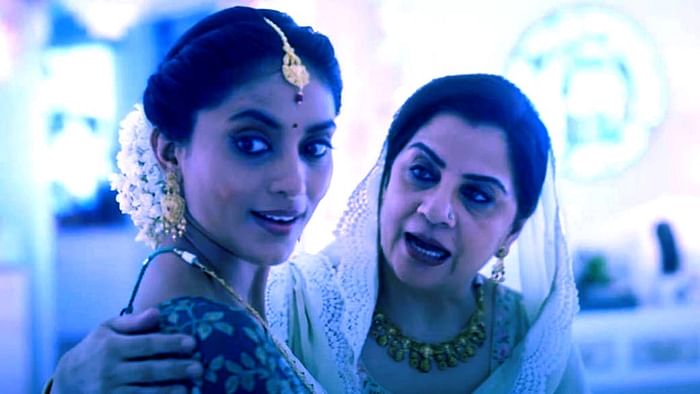
15.10.20
Tanishq Ad and the Conscience Market
16.8.15
The lion and the vultures
I'll be honest. I found the moral high ground on the Cecil the lion story hyperbolic, and in many ways a pretence. And it had nothing to do with it overturning the fairytale where the ogre is the beast. There was just too much of reductionism going on — of race, of bestiality, of the hunter as sinner.
The American man who killed a lion in Zimbabwe became a villain everywhere; to boot, a white with a whiter smile. One news report even spoke about how it was discovered that the killer of Cecil "turned out to be" an American dentist. How was this a discovery or of any consequence?
Hollywood's avande garde voice and general conscience-keeper was so riled that she even posted the address of Dr. Walter Palmer's clinic. It became just another, what we Indians call, jungle raj.
It is important to question such trophy killing. We need to forget one ism to favour another in some cases, so not all animals are equal and indeed we would need to understand that animals in the wild play a different role. However, if we are going to talk about sensitivity, then why is it that we don't ever evince any such sensitivity when we see stray dogs rounded up in municipal trucks?
Now, there are Cecil memorabilia. It is not an environmental consciousness initiative but a commercial enterprise. Is Cecil the first one one to be ever killed? How did the "local favourite" become the pop favourite globally? Can people really tell one lion apart from another?
Instead of buying mugs and other paraphernalia with a lion face, perhaps we should all just stop visiting zoos, which is where the animals are slowly reduced in stature and where we learn how to recognise that what's behind a cage should be naturally game outside of it.
20.6.15
Whose yoga is it, anyway?
After this Yoga Day is over, nobody will give a damn about it, neither those promoting it nor those opposing it.
As we celebrate the occasion on June 21, it becomes evident that unlike the rest of the world, for Indians it is not only about physical wellbeing. It takes a very simplistic mind to suggest that the sudden interest in yoga is about health. If that were the priority, then our health infrastructure would be revamped and several other cures propagated.
Perhaps those who perform their asanas and deep breathing might have gone about it as they always do but for the added burden of being made the keepers of a cultural heritage. This becomes more potent when you have to deal with what appear to be enemies of yoga. Supporting yoga today is also about patriotism.
"Yoga is the best soft power of India," said external affairs minister Sushma Swaraj. Inherent in the statement is the belief that we can colonise others with it, and indeed with so many other countries adopting it it is possible to indulge in such delusion, especially where the West is concerned.
The same goes for the prime minister. When Narendra Modi suggested to the UN to institute a day celebrating yoga, he was claiming heritage, capitalising on the foreign interest, and appealing to the NRI community by taking care not to use Hindutva evangelism and spoil their case in their adopted lands.
More than culture, it is an assertion of patent rights. Our foreign obsession often takes us to our own cultural moorings only after they've been accepted overseas, largely by the whites. Do we hear about blacks and yoga? There is no way that the foreigners enamoured of yoga are doing so solely due to its physical benefits. They like the exotica that accompanies it — the incense, the spiritual poses, the history and the mythography of finding the self from the navel to the seat of all desire at the base of the lower back, as the kundalini rises.
Added to this is the guilt that they are taking over yoga. There has been much debate for years about the appropriation. This is not quite true for Indian gurus from Maharishi Mahesh yogi to Deepak Chopra made money overseas and gained currency in the land of their origin because of their famous clientele overseas. There might be a few mom & pop type yoga stores, but it is more likely that it is preferred to be first experienced in its 'natural' environment.
The truth is that yoga has been chosen for special attention simply because it is a thriving industry, and not because India wants to culturally invade the world or the minorities. However, the 'yoga is anti-Islam, anti-Christianity' lobbies come in handy because the majority of middle-class Indians, avaricious as they are, like a moral core to justify their greed.
With the subtle implication that this is an ancient art form that needs to be protected and propagated, they feel assuaged. They carry history in their aspiring to be nimble forms.
It was bad enough that certain Muslim groups and individuals started talking about how yoga is anti-Islam, but it is even worse to see the ridiculous attempts to co-opt other Muslims. Photographs of maulvis and people wearing burqas and skull caps holding their noses and contorting their bodies just make it appear like the farce it is turning out to be.
It started with this nonsense about how Muslims can't do the surya namaskar because in Islam you are not supposed to worship any form. Not everybody who does yoga worships the sun or the moon or anything. Why even bring this up? This gave Yogi Adityanath just the kind of opportunity he waits for:
"Sun is the source of life giving energy. Whoever thinks Sun is communal, I would like to humbly request them to drown themselves in the sea or they should stay in a dark cell."
These Muslims deserve his idiocy that misinterprets their intent and even communalises the sun. At the other end is Sakshi Maharaj who called himself a true Muslim and Prophet Mohammed a great yogi. Some others said namaaz is like yoga.
Some Muslims asserted that they are not supposed to say 'Om' while doing deep meditation, and somebody suggested they could replace it with 'Ameen'. You really do not need either, and if yoga is all about health then just get on with it. By creating a controversy, bigoted Muslims have just played into the hands of the other bigots, and made themselves into a laughing stock to be 'saved' by the likes of Baba Ramdev.
Christians too have objected because yoga is "not compatible with Christianity". An event organized by drug rehab NGO Kripa is in trouble because many from the community believe that Fr. Joe Pereira is more like a Hindu yoga guru. A parishioner said, "...yoga is not Biblical. If a priest wants to organise something, he should do it within the framework of the Christian world."
Everyone seems to want to score points.
Mr Modi, despite all the criticism the event has generated, has used what has always been there to garner more attention for himself. He wants to ensure that this occasion gets into the Guinness Book. Large contingents will be out, including police personnel and bureaucrats.
A yoga instructor at the class for public servants was quoted as saying:
“They heard it on TV, and they are running toward the yoga. The prime minister is the king. If the king does something, that is very effective. And this time, our king is doing yoga.”
School students who anyway are expected to participated in Physical Training (PT) classes are being brainwashed. Is this about general wellbeing? One politician, whatever be his motives, seems to have got it mostly right. Karnataka Social Welfare Minister Anjanaiah said:
"Yoga is for lazy people, especially people belonging to well to do families. They do not have time for exercise in the open including taking a walk...People should ask their children to indulge themselves in playing outdoor sports including running and long walks instead of yoga."
Have you seen a poor person practise, much less discuss, yoga? Yoga is essentially for the angst-ridden elite looking for reprieve or the neo-enlightened who think it is a non-invasive body cleanser. Very few use it as an alternative to medicine. And now with the supposed renaissance, it has become a symbol of political opportunism camouflaging as culture. Forget yoga, we need a new culture.
--
The Taliban has now objected to Pakistanis celebrating the occasion, so many events have been cancelled. An earlier piece I wrote on Pakistan on an Indian spiritual trip
25.1.15
Obama, Modi and Chemistry
The media, and the public that views TV, reads newspapers and is connected to social media, are all agog by the display of camaraderie. Does this in any manner indicate change in Indo-US ties? How good is it really for India?
That does not seem to be of any immediate interest. We are all lapping up trivia. It began the moment an invitation was sent and accepted. To the run-up we were told how roads would be cordoned off, how the four-layered security would work (including 12 dog officers arriving ahead of the visit to sniff out danger).
Obama's office sent out the message that there should be no terror attacks during his trip or there "would be consequences". There was no statesman-like no terror at any time before or after. This sort of arrogant and insensitive statement set the tone for what is clearly modern-day slavery where bonhomie buys acquiescence.
Narendra Modi broke protocol and went to receive Barack Obama. Images of him with the President and the First Lady after they alighted have sent the BJP supporters in a frenzy. Had this been the President of Nepal or Fiji Island would they feel as elevated?
Personally, I do not like over-familiarity between political leaders in the public space. It is less about warmth and more a public relations exercise. Both are conveying a message to their international constituencies.
Their lunch menu became news. Planting a sapling became a huge moment. And tea became "chai pe charcha", which Modi had used during his election campaign. He is apparently still campaigning.
At the joint press conference, Modi referred to the US president as "Barack". He spoke about chemistry between them. One is surprised he did not quote from Linda Goodman's sun signs to establish just how compatible they are.
The BJP had opposed the Indo-US nuclear deal during Manmohan Singh's tenure. Today, Modi and Obama have taken this even further. Modi informed us that the US would be an ally in defence. He parroted the terror line. If the US is so confident about its defense, it would not bulldoze other countries.
The so-called largest democracies are really about both wanting to play Big Brother. Sometimes it is good. Mostly it is not and proves to be a nuisance to others.
As I write this, the droning sounds continue on TV. The breathless, "Oh my god!" tone of the anchors seems to convey they've never seen an American President with an Indian Prime Minister feeling so jolly good before. For them, I have a few images from Barack Obama's previous visit.
And Obama cancelled his proposed visit to the Taj Mahal to visit Saudi Arabia to condolence the death of the king. Joe Biden was already attending to that. Here, the Hindutva bhakts we already speaking about how the Taj was a temple once. Should they not, then, see it as a rejection to their claims, if not of this ancient heritage in preference for a dead Arab King?
21.1.14
Fuzz and Feminism
Why can't they just leave women's body hair alone? From Cameron Diaz to American Apparel, they are being intrusive.
To think that the Hollywood star has discovered feminism via down under is a bit much. She is selling her book, and just like propping up the smooth skin is a big ticket there is a market for fuzz when these views come pregnant with adjectives. It is almost always "shocking images", and about being raw.
If Lower East Side Manhattan is going to curl up with embarrassment over a clothing store that shows mannequins in transparent lingerie showing off pubic hair, then it has little to do with reluctance to accept the natural.
If natural is what we want, then why restrict it to hair on the privates? Where is the fuzz on legs, arms, face? Where is the pigmentation, the natural contours of the belly, the hip? You can't create a woman, or a mannequin, to look like a stereotype and then talk about how liberating it is not to depilitate.
American Apparel's statement is:
"We are a company that celebrates natural beauty...We created it to invite passerbys to explore the idea of what is 'sexy' and consider their comfort with the natural female form."
For all the liberating talk, they are telling women that it is okay, that this is sexy, and they ought to just lie down and be comfy. It is such a magnanimous gesture that girl power will rush to buy the stuff. It happens to be the Valentine's Day window display, much in advance. Those women who have made the horrible decision to get themselves into a pre-pubescent stage have enough time to redeem themselves and grow it all back, so that when their boyfriends or spouses get these itsy-bitsies gift-wrapped for them, they can 'fit into' the role that the show window wants them to. All this, including celebrity endorsement, amounts to talking down to women.
The New Age man is always ready to experiment, therefore he would probably walk into American Apparels and imagine a fresh from mother earth sensation.
Also, do notice that the hair is dark, very dark. Why are there no red heads, blondes? Does 'nature' and its connotations imply only a shade that is perceived as belonging to the untamed? Is this not racism?
Somebody has called the display retro. We might have a pop version, a blues version, a nirvana version.
Cameron Diaz has a chapter in her book titled 'In Praise of Pubes' where she asks, "Do you really want a hairless vagina for the rest of your life?" Had this been a serious question, one might have attempted an answer. There is some merit in bringing it out in the open, but she refers to pubic hair as "pretty draping" and "mysterious". She obviously knows what evolutionists or creationists, depending on how she swings, intended it to be, if not god her/himself. What if some do not find it pretty?
She says such hair is like having a nose. The comparison ought to have been with nose hair. Will the big studios like to see poky little hairs sticking out from every part of the body? More importantly, where does one stop at grooming or start?
The idea behind grooming anyway amounts to interfering with what is available material. From head to toe, we meddle in the affairs of the body. It could be to please others, but to a large extent it is also what we are comfortable with. One is not contesting how social brainwashing might affect us, but will those using such images to get us back to basics show us a complete picture where nothing at all is groomed, and not just the sexual organs?
Whichever way you look at it, the obsession is with the female form. Clean-shaven men are seen as metrosexual. Clean-shaven women are now deemed unnatural. From grooming too much to now not grooming, we are sought to be objectified.
This is a private matter between us and our bodies. Do not tell us what to do behind the fig leaf.
© Farzana Versey
31.8.13
Dunkin' Donuts and Oprah
What is wrong with the Dunkin’ Donuts ad campaign by the Thailand franchise? That a female model is covered in dark chocolate, has hair done up in a certain way that makes it appear as though she is black? There have been the usual noises about insensitivity. We are not discussing Trayvon Martin here or people of colour being denied access to space and opportunity. The product is clearly using a particular palette, just as people might paint their faces in shades of, say, the national flag during sports or cultural events.
It took me a few seconds to find this other image by merely searching for white chocolate. If we have a problem with a dark product sold by a ‘black’ model, why don’t we have issues with a white product marketed by a white model? Godiva’s white Kit-Kat has chosen a stereotype, too.
Some reports have pointed out that the pink lipstick stands out and looks bizarre. Advertisements are about drawing attention. It seems like a simple aesthetic placement if we look at the logo. Pink is also about candy, so this is a form of association. A shocking shade would stand out on anyone. What about Naomi Campbell in the ‘drink milk’ promos where she sported a white moustache? What about her posing in those starkly contrasting pictures with Kate Moss?
Dunkin’ Donuts has apologised for this ad, but the owner of the Thai franchise has called it “paranoid American thinking”. It would appear that there is some guilt and discomfort by others regarding portrayal of blacks and racism. On the one hand, campaigns flaunt black is beautiful —another pigeonhole, as I analysed here – and then there is this chariness.
Recently, Oprah Winfrey ‘outed’ a racist salesperson she had encountered in a Zurich mall who told her that the bag she wanted to buy was too expensive. Oprah does not live in a ghetto; her riches are well-earned. She is recognised almost everywhere. Perhaps if she went
to Harlem incognito and tried to purchase a costly thing a black salesperson might draw attention to the price tag. Would that qualify as racism? If not, then what could be the reason? What sort of stereotypes are manifested here?
It is more a matter of hierarchy, or perception of it. I can give a few examples.
• Several years ago, I went into a store in London to pick up some brandy. The woman at the counter snapped, “Not that, it is too much money.” She was of Indian origin and from her deportment and manner looked like a recent immigrant. Between anger and amusement, I figured out that this was something that she could not afford. It was projection. I was a visitor whose cart was filled with goodies. In some ways, she felt slighted and the only manner in which she could to respond was to see that emotion mirrored in someone else.
• In India, one sees even backpackers – white first, then black – given preferential treatment while one is shopping. Although it is more likely that as tourists they are “just looking” and I am the real customer they will earn from, the hierarchy revolts against it. I have walked away quite often after waiting for the shopkeeper to attend to me. However, if there is another Indian who is perceived as less ‘valuable’, then the focus is on me.
• When I took out a $100 bill to pay for a snack at Universal Studios, LA (I didn’t have enough change), the Hispanic cashier almost sniggered, “You got lotsa money, eh?” If that wasn’t bad enough, the black gentleman who was part of the tour group said, “For this much I’d get a full meal at McDonald’s.” Would these be considered racist comments? I did not think so then and I don’t believe so now in hindsight. It is about where we are and who we are dealing with. Cultural baggage is relative.
Covered with dark chocolate or whipped cream, or lips painted a shocking pink, one’s identity is a stereotype too. Unless maliciously used to segregate, it makes better sense to not be numbed by how others perceive us.
© Farzana Versey
11.8.13
Where is Dawood Ibrahim?
It is the sort of truth-or-dare query that is good for a game. I have been watching promos and there are special 'Shoaib' moments to market the film. What is interesting about it is that the character is based, not so loosely, on Dawood Ibrahim. This is not the first such film, but it has one of the mainstream actors essaying the role. So, does 'Once Upon A Time In Mumbai — Dobaara' have anything to do with the recent spurt of reports on the underworld don?
Perhaps. You switch on the television and on surfing channels you realise how reality and fiction meet. It begs the question: Is it okay to glorify a character, ride on his notorious fame, and find that the news stories are just adding to the hype rather conveniently?
We are all lapping up the stories — news and fiction. The lines are blurred.
Looking for Dawood has an absurdist quality. This time, it started with Pakistan Prime Minister Nawaz Sharif's "special envoy for improving relations with India" (a bizarre portfolio, to begin with) Shahryar Khan. He said:
"Dawood (Ibrahim) was in Pakistan, but I believe he was chased out of Pakistan. If he is in Pakistan, he should be hounded and arrested. We cannot allow such gangsters to operate from the country."
Mr. Khan, for whatever it is worth besides obviously covering up, seems to be concerned about his country. He is not interested in anything beyond that, and most certainly not to help India.
On what did he base his statement? As I've said and what has been reported quite often, Dawood Ibrahim's Karachi residence was revealed in the Pakistani media. The Indian media has all too shamelessly carried interviews with him for years from his "unknown" locations. A scoop seems more important than any other consideration.
The same applies to some politicians and cops. The fact that D-Company, as well as a few other underworld groups, operate with such impunity should be a clear indicator that the intent to get hold of Dawood is just not strong enough, despite all talk. It does not speak too well of our Intel agencies, given that India has fairly good relations with the UAE, where he was a public figure appearing on Indian TV channels.
The argument is that he was not dangerous enough then. Now the situation is different.
How different it is is borne out by the reaction of the Ministry of External Affairs (MEA). Its spokesperson, Syed Akbaruddin, told the media:
“Like you, I too have seen these reports which have been attributed to a senior official of the Pakistan Government. As you are aware, the 1993 Mumbai Bomb Blasts dossier has never been closed by us. Therefore, now that we have received more information about it, we will not rest till those responsible for the 1993 attacks against our citizens in Mumbai are brought to justice, wherever they are. We will continue to pursue this quest.”
What is wrong about this statement?
• The Indian Ministry depends on the Pakistani envoy's offhand comment calls it "more information".
• Is the March 1993 attacks dossier not closed, although several people were arrested and sentenced, only to get Dawood? This does not quite sound plausible, for Dawood's family resides in Mumbai and he continues to operate his businesses that we get to know about from intelligence sources.
• This is not under the purview of the MEA, but I'd like to emphasise here that those who were targeted and killed in the riots of 1992-93 are also citizens of India. Is there even a dossier on that?
• The MEA is supposed to act in concert with our sources and not what Pakistan chooses to dish out.
It is not surprising that the Pakistani diplomat did not stand by his initial words. As a report said:
However, he later did a complete U-turn on his statement by telling an Indian television channel that he had never known where Dawood lived and his earlier statement was just reflecting what the Pakistani media has been reporting in the past.
The BJP did not want to be left out, so Shahnawaz Hussain declared:
“Thus, the Government of India should pressurize Pakistan. The whole world should put pressure on Pakistan that Hafiz Saeed and Dawood Ibrahim should be handed over to India. Only after that there is any point of any dialogue. Till they don’t get a strong message from India, Pakistan’s morale will not be down. The time has come now that Pakistan’s politician has admitted that Dawood Ibrahim is in Pakistan, why isn’t the Government of India putting pressure?”
Whenever a Pakistani official says anything, please wait. He has denied it, so our responses look foolish. For all we know, the statement could have been a red-herring that exposes how we respond. Across party lines, it appears that we are completely dependent on the Pakistani version.
Why would they hand over Dawood to India? Even Portugal has made it clear that India has to follow the terms of extradition with regard to Abu Salem, another gangster. Dawood would not leave any trace of his involvement. 'Masterminds' don't. So, except for his illegal activities, not much action can be taken.
The BJP should think before talking. It has been 20 years since those bomb blasts. They were in power. What did they do to pressurise Pakistan? Was it not Atal Behari Vajpayee as prime minister who initiated bus services and other measures to mend ways with Pakistan despite 1993?
These hot-air responses have no basis in pragmatism. It is only to add noise to the standard 'war-like situation', each time there is a border incursion or killing of soldiers. Instead of discussing the whole process of covert actions at the border, and how the huge deployment of forces does not seem to inhibit infiltration, we just end up with ridiculous dramatics. (The Chinese manage to cross the border, but it does not get us as agitated.)
The worst was probably a TV channel asking viewers to vote via SMS on whether they thought there should be a war against Pakistan. This keeps the media running and is an advertisement for itself rather than consideration for dead soldiers, the country, or the citizens. There is money involved. Just as there is money involved in keeping the search for Dawood Ibrahim in the news.
While it helps in marketing, it also sanitises the obvious commercial interests and political wishy-washiness.
© Farzana Versey
---
Also:
Waiting for Dawood
Mumbai blasts and selective justice
3.6.13
Tea with the Nazi
He still sells. Anger sells. It has buyers. However, are they "Nazi lovers"? A bit simplistic.
You must have already read about the JC Penney tea kettle that looks like Hitler and the reactions to it. They were forced to remove a billboard, but the damage, or publicity, had been done.
Those who probably did not need a kettle right then rushed to purchase it. Some are selling the $40 steel piece online for four to six times the price. It has become an investment.
The description of the kettle is that one can see the “handles as Hitler’s hair parting, with the lid being his moustache and the spout a Nazi salute".
Is this only about imagination or was it deliberately designed as such? A report quoted JC Penney from its Facebook page, “You won’t be able to stop yourself from whistling at us when you see this billboard off the 405 Freeway in LA!!! If you find it safely shoot us a pic if you can.”
Why would anyone want to whistle at a kettle? It seems obvious they knew what they had — whether by design or by chance. If it was the latter, then clearly it was a whoa moment and the kettle went right up there to claim its Calvin Klein moment.
It was a stripping of both sensitivity and political correctness. I wish they had gone along, for it would reveal facets of how we as a society treat history in a contemporaneous setting. Unfortunately, the page was removed and the Penny people said, “If we had designed it to look like something, we would have gone with a snowman or something fun.”
Given the sales and the bidding, it seems this is people's idea of fun. I do not agree it is about love for the Nazi leader or the Nazi credo, though. There are many souvenirs available. And the ideology, for whatever it was worth, is not quite dead if we extend it to the 'superiority of the race' theory. In almost every part of the world, there are groups that believe they are superior or better than others. These might span from religion to socio-economic policies, trend-setters, divas, the rich and in some ways the poor, who by virtue of their disenfranchisement are beyond the system.
Californians are known to be quite liberal, so it was surprising that the kettle billboard was forced down by its residents. Is anti-Nazism a way to assert liberalism? Isn't such a badge of 'we are more liberal than the rest' itself an assertion of superiority?
Let's talk about fun, then. It is possible that the buyers merely like something that has curiosity value. Some might enjoy 'Hitler' boiling, which says a lot about Nazism as a psychological phenomenon that has nothing to do with a specific ideology.
We aim darts. There is road rage. We need magnets and stress balls to keep ourselves in check. We use voodoo dolls and burn posters and images of hate figures.
Is this peaceful? It reveals our hate. Quite naturally, there is the value dimension of what is generally considered good and evil. However, the fact that good has traditionally been known to triumph over evil means that it went into battle. It gave a good fight and had its hands bloodied.
When we use figures like Hitler and Gandhi as opposites, we forget the nuances of how non-violence too chooses the self-destruction of a people. The leaders in both instances are safe. Incidentally, images of Gandhi too have got into trouble, because people don't like their heroes tarnished, when there is a whole industry that fools people by selling themselves as Gandhians.
Were JC Penney to use a look-alike of, say, Martin Luther King there would be opposition. Yet, people will use fridge magnets and other knick-knacks with his image. The same goes for pop celebrities. But, there is less of a reaction to a Marlilyn Monroe being used to sell products, and this also should bother us. Why do some people become public property and, only due to their profession, their memories can be treated with scant respect?
And, no, I don't see Hitler in that kettle. It looks like Chaplin to me.
© Farzana Versey
19.5.13
Sunday ka Funda
“The biggest guru-mantra is: never share your secrets with anybody. It will destroy you."
— Chanakya
I do not suppose the makers of Coca Cola gave much thought to this. But the ingredients of the fizzy drink have continued to be a mystery. Now with a book on the subject and another person with inside knowledge of a later version, the secret is back in the news.
The Coke guys insist that the special recipe is well-hidden in a vault in Atlanta. It is a bit stupefying that with so much scientific activity that can break down compounds and recognise complicated chemicals this should remain an enigma. My guess is that the Coke guys are protected legally, and the white coats in the labs perhaps decided to keep quiet.
We are not talking about a mocktail that has specially been whipped up. This is mass produced stuff. Chances are that if you kept a glass before people, they might not be able to tell the difference. I can't.
Reminds of an amusing incident. I was at a coffee shop some years ago. Aamir Khan was at the adjacent table. He ordered a Coke. At the time he was endorsing Pepsi and the interesting ads had the tagline, “Yehi hai right choice, baby, ahaa..." I had avoided looking towards him until then, but at that moment in an impulsive reaction I turned and probably glared at him for the deceit. He just smiled and changed his order!
Because Coca Cola is a huge conglomerate with a believable brand, the ones who are outing it will never be taken seriously . Though it is not the USP of the drink, the fact that nobody knows how it is made gives it an edge. The rumours only add to it...
“If you reveal your secrets to the wind, you should not blame the wind for revealing them to the trees."
— Khalil Gibran
10.12.12
The Big Bad Ad
The US ad for Virgin Mobile appears to have made light of a crime: rape. The obvious question would be - are there no limits to sexism? But, then, we reduce the argument.
“Having just seen, for the first time, the Virgin Mobile US advert which has upset many today, I agree it is ill-judged. Although I don’t own the company [it is owned by a US firm, Sprint Nextel], it carries our brand.”
Will anyone unsubscribe to Virgin Mobile or its US partner Sprint?
Now we come to the business of advertising. Why would a festive occasion like Christmas be transformed into something Gothic? Does it subliminally appeal to consumers, who probably become less sensitive to social propriety in their fervour to buy, and that as a result everything becomes an object?
That is something we should ask ourselves.
29.9.12
Bollywood’s Killing Fields
5.9.12
Aamir Khan: Only a matter of Time
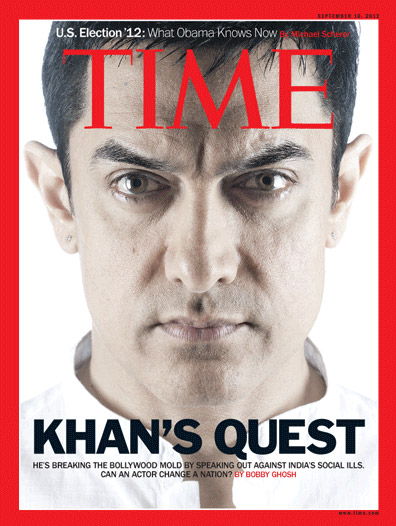
It is not the fact that Aamir Khan is on the cover of the September issue of Time magazine that is as important as how he is projected.
Recall how our beauty contest winners won with that finale answer about their idol being Mother Teresa? The purpose was a clear need to sell beauty products to the huge Indian market. Once that was achieved, we had the Bill Gates-Warren Buffett philanthropy where our industrial bigwigs were lectured about the art of giving, something they had mastered thanks to income tax exemption to channelise black money. Publicly aired social consciousness is only a part of this.
The extracts from the Time story makes it seem as though the Indian population is a willing hostage to one actor.
The blurb itself sets the tone:
"He's breaking the Bollywood mould by tackling India's social evils. Can one actor change a nation?"
Would they say the same about Hollywood stars who speak on social issues or take strong political stands? India’s social evils have great demand for a hungry media, at home and outside. For the outsider, this obviously has some exotic appeal.
"Now, with his groundbreaking TV show Satyamev Jayate (Truth Alone Prevails), he has dispensed with commercial considerations to indulge his conscience. With it, Khan has taken on the mantle of the country's first superstar-activist.”
Has he dispensed with commercial considerations? We have been through it here before. The conscience does not gather a herd. What does being the first superstar-activist mean? There have been films from years ago that raised social issues - Duniya Na Maane, Do Bigha Zameen, Mother India. These were not a candyfloss look at farmer suicide, widow remarriage, dowry, poverty. And I am not even talking about regional cinema and parallel cinema.
The piece is obviously a paean when it says:
“It's a ballsy move, and potentially jeopardizes his status as the beloved idol of millions.”
If anything, it has got him a new audience, the sort that attends rallies by Anna Hazare or Sri Sri Ravi Shankar’s Art of Living sessions. It is utterly patronising to read that the show tackled subjects that “are precisely the sorts of harsh realities from which many of Khan's fans seek escape in his movies”; it probably works for this group.
If anything, the actor fancies that he does films that have a message, whether it is Lagaan, Rang de Basanti, Taare Zameen Par, Mangal Pandey, Peepli Live. He makes a point to go on a road show as a ‘messenger’.
"Can a movie star affect the mores of a nation of 1.2 billion? It might just be possible in India, where a national obsession with cinema, unparalleled in the world, gives popular actors an influence beyond the imagination of Hollywood scriptwriters.”
Such a limited understanding. There are places where cinema halls have been shut down. Films are banned. If the national obsession is an escape, then it applies to realistic cinema too, for that reality is not mirroring what people go through, but what characters go through. Cinematic projection of such truths is like sharing misery with others, if we really wish to look at films in that manner.
Hollywood actors use a particular issue and take it to a forum to push for change. One may be cynical about their motives, but the public does not assume they will bring about change.
“Whatever Khan chooses to do next in his quest for grace, there's a good chance it will lift India a little closer to what he - and fellow Indians - would wish their country and society to be.”
This is just so weird. It builds up an individual as a messiah, that too on a personal “quest for grace”. India has several dreams and different people have different dreams. This certificate of granting one person the keys to the kingdom is so feudal. I wonder why Time magazine did not make him wear a maharajah turban in the cover picture. Or, perhaps contemporary maharajahs just look intensely into the eyes of the camera.
(c) Farzana Versey
- - -
The rest of my pieces on Satyamev Jayate are here
2.9.12
Musical Snares: Sur-Kshetra
![]() |
| Himesh-Atif: No war this? |
May I ask Asha Bhosle ji why are only some Pakistanis allowed to be our guests and others are not? While Raj Thackeray is busy acting out his job profile of politics, I do wonder about the politics of commerce.
The promos of the music reality show Sur-Kshetra have been on air for weeks. Raj chose the press conference to hit out. That too with this statement:
“Would Veer Savarkar have endorsed Bhosale’s decision to collaborate with Pakistani singers?” alluding to the family’s “loyalty to the freedom fighter”.
Veer Savarkar is of little relevance here. It is Ms. Bhosle’s comment that is:
“Maharashtrians believe in the mantra of Atithi Devo Bhava (the guest is god)…Nationality is of no importance, we are here to praise talent. As a human being, I believe in being nice to everyone.”
I have been watching Ashatai judging the just-concluded Indian Idol and loved her beyond her singing. There were contestants from several parts of India. She never felt the need to dispute Raj Thackeray’s barbs about Biharis, UPites and others. And why is she asserting her Maharashtrian identity?
So, when Raj rebuffs her with, “Is this ‘Atithi Devo Bhava’ or ‘Paisa Devo Bhava’?” there is some truth in it.
Let us call this Indo-Pak trade instead of soft-focusing it as music has no boundaries. And, yes, there is hierarchy where even some Pakistanis are allowed. I have mentioned this earlier that while Sheema Kermani, actor-dancer-activist (and she says so without obfuscation) invited an Indian dancer to Pakistan, she was not granted visa. A fairly well-known Pakistani in the entertainment industry surprised me by saying, “Some are favoured.” He gave up on a co-project with some Indians because of the problems. All is not as good as the marketing fellas will have us believe to raise their TRPs.
![]() |
| Abida & Asha; Mota maal/baal. Pic TOI |
And Asha Bhosle is now a big part of it:
“I don't like politics...I don't understand it. I love Maharashtra and I am a Maharashtrian. I am a singer....I understand the language of music.”
Music, and sports, have entered the political space. I just saw a promo of the same show where one contestant was praised for her singing and keeping the Indian laaj. Sur-kshetra is promoted as a battle between two clearly demarcated sides – contestants and judges. Why is Asha tai playing naĆÆve not to understand that this is Indo-Pak politics? Has she been invited to perform there? Should it not be mutual for a level-playing field?
Do we not have singers and actors of the 'calibre' of Veena Malik? Or that expressionless wonder Ali Zafar? Our music directors meet their singers in Dubai. How many of them have reciprocated? For those in denial or with poor memories, read Jagjit Singh and Abhijeet's views on this.
I love Iranian cinema, Japanese poetry, Spanish dance, and literature, music, art from several places. These are personal choices. So, if I love Pakistani musicians, it is again in my individual capacity. It is intriguing, though, that we want to highlight differences in an area where they ought to be solved – diplomacy – but come together where we do not need to. Pakistani music has not reinvented sur and taal. It follows the Hindustani gharanas, the raagas. Even Sufi music goes back to Amir Khusrau, and was he Pakistani? He wrote in Farsi and Hindvi.
If music is beyond politics, then why do artistes project themselves as ambassadors of their countries and act like activists? Talking of peace on a public platform is also activism.
This televised musical peaceful co-existence is just banking on emotional love-hate that Indo-Pak ties thrive on.
So, it is true. Money has no language, no country. And no culture.
PS: The battle on the show pits Indian Himesh Reshammiya against Pakistan's Atif Aslam. The super jury is Asha Bhosle, Abida Parveen and Runa Laila, the 'illegal immigrant' Bangladeshi or a buffer?
(c) Farzana Versey
23.6.12
What an Ikea, Sir ji
I like furniture with sharp edges. Not the best choice as you end up getting poked. It is the clean lines that appeal to me. Rounded and moulded appear artificial.
My room has everything made to order. Except a work chair and a holdall. It was created according to my specifications, which have changed.
That's the point. That's why we cannot snort over Ikea's move to invest $1.9 billion spread across 25 stores in India. We may not need some Swedish all-purpose standard designs, but it is adaptable.
Besides, there are already Italian furniture stores in most cities. They are expensive and use leather that is hardly conducive for our climate.
Will Ikea pose a challenge to Indian stores? To an extent. I've been to their outlets and, except for a mini easel to place my notes, I have not purchased anything from there. But I can see how it might entice people who are not snooty. Why, some of them too might stop by, pick up some things and add their designer touches.
Regular furniture stores, at least in Mumbai, are not user friendly. I once landed up in Malad in what looked like a nice shop. As what I wanted was not available, I was asked to visit the godown. After jumping over an open drain, I entered a smelly room. A sofa was patted and dust clouds formed in the air. "Imported," said the sales guy.
"Why is it so dirty?"
"Antique finish."
Great. It was worse than the shop in Chor Bazaar that made an antique roll-top desk. I still have it. The wood is sturdy and it holds everything. It even has secret chambers where I keep the menus of takeaway joints. Now that would qualify as a secret if I ordered food for guests and passed it off as mine!
I am sure Ikea will have some such secrets.
Indians who know about sleeping on the floor or on khaats still get excited about futons. Outsiders have cannily caught on that we are penguins and will even buy ice cubes.
4.6.12
Manufacturing the Greatest Indian
It does not matter. We live in iconic times with iconic figure who did iconic things and deserve iconic status through iconic surveys. So, the question for a survey (TGI) “Based on an internationally acclaimed format by BBC held in 22 countries” is “Who is the greatest Indian after Mahatma Gandhi?” It is no surprise that it is a media-propped poll and “the initiative is to select that one great Indian after Mahatma Gandhi who is the most influential, iconic & inspirational and has impacted your life”.
There could be quite a few or perhaps none of the fifty names mentioned. But why is Gandhiji the cut-off date? I can understand the use of a term like “post-Independence”. If he is the benchmark, then what are the variables by which we are to judge industrialists, sportspersons, actors, scientists, musicians, activists or even politicians? Do they have to be ‘Gandhian’? If not, then does it not nullify the yardstick of the chosen iconoclasm?
Besides, how do we define an Indian as great? Due to their origin or their contribution to what is the ‘essential’ India, and that may be far removed from those featured here?
| Indira Gandhi |
It is ironical that Indira Gandhi, who had declared Emergency, shares the space with Jayprakash Narayan, who bitterly opposed it and suffered for it? The acquisitive business people stand along with the ones who gave it all up.
| Vinoba Bhave |
How do we judge? Will the general pool reflect how people feel, and I am not taking into account those that cannot vote by giving a missed call.
The media partners will have a good time. They will be in charge of the decision-making process. Primetime and newsprint will bring you the ‘news’, and then there will be analyses. As for the token of the title, there will be comparisons and whoever makes it will in some way be given a Gandhian rubdown.
The India that existed and flourished in the past does not exist. The India where discoveries were made, art and literature flourished, and political strategy was as crucial as swordsmanship, that India does not exist in the finger-wagging and tapping world. How can they say your vote counts, when they have already decided on the broad spectrum of who matters?
The luminaries are pretty much great in their fields, but what was relevant in say the 50s does not apply to those who came in later. Is there no difference between scoring a hundred tons and working among lepers? Is there no qualitative difference between a Dr. B. R. Ambedkar and a Kanshi Ram? How does Atal Bihari Vajyapee feature for being loved by both admirers and opponents, when that is how politics works?
Achievements are now propped up by commercial interests as they were probably ideologically exaggerated in the old days. Today’s greatness rests on success; yesterday’s on making inroads.
Is Mahatma Gandhi in any way a unifying force? The symbolism of the name is, of course, canny marketing. But it leaves one wondering as to whether the greatest Indian – whoever she or he may be – will also be one who has been truly great for India. If so, then what aspect of India? Ask no questions. A pedestal awaits. Your vote will give you a chance to be part of the icon factory.
(c) Farzana Versey