Showing posts with label indo-pak. Show all posts

16.8.14

In Conversation: India and Pakistan


Often, the most meaningful things are said in the simplest manner. One must, therefore, appreciate this effort to get Indians and Pakistanis to talk. The premise is basic – we have phones, they have phones, so telephone. I warmed to it immediately.

But, will this bring people on both sides (we are not even speaking about the two nations) closer together? This was a ‘controlled’ atmosphere, and even if comments were not censored it was understood that the conversation was to be light. What we see is one reality – the coffee shop or corner store one. The young even on campuses are politically aware and most certainly come with a bagful of stereotypes about the other. It does not negate the awareness about Bollywood, cricket, or food. Yet, all of these can be politicised on the day there is a clash of films, a match or a culinary competition.

Take that delightful moment when the Indian girl asks her ‘friend’ in Pakistan, “Do you like Salman Khan?” and the latter replies, “No. Why?”, the Indian says, “Then we can talk!” It is humorous, but in the subtlety is embedded conditionality. Or, the fact that the Pakistani is portrayed as thinking he holds on to a deep, dark secret for being a fan of Sharukh Khan.

The makers have also matched the profiles of the people they partnered, dude with dude, accent with accent; in a way it helps to bring out the commonalities but it also conveys that communication is limited to ‘people like us’.

It was cute when the Indian girl speaking to a Pakistani who wants to visit Jaipur tells her, “Main bol deti hoon inse (I’ll tell them to do something)”. Or, when the Pakistani young man asks the Indian when he will visit Pakistan and he says, “Sir, aap mereko visa bhejo tau main nikal jaoon abhi kal ka kal (if you send me a visa I am ready to leave rightaway).”

This is all tongue-in-cheek swagger, which makes it an astonishing little outing. In fact, after having written these couple of paras, I am feeling guilty for nitpicking. This is what charm offensives do!

Love it…just don’t take it as the whole truth:


13.11.13

Let us meet? Another Indo-Pak moment...

Milne do. Let us meet. This is how the peace narrative of India-Pakistan relations go. Some of us have expressed reservations, emphasising how diplomacy is imperative and cricket, films, culture should not intrude or override political considerations.

Peaceniks are nice people. I am not sure about movements at any time, for they too become political if not commercial enterprises for certain media groups to use people-to-people contact for just making music, quite literally. One does not need to assert peace if the intention is purely cultural.

However, I do know that families are separated, and it is not only due to the Partition, although that is the most heart wrenching memory because it divided the country and, to an extent, the people. I do know how getting visas for people who can spot the sliver of a river or peek at trees across the border are torn because of such divisions and acrimony. These are not the ones who will go via Wagah.

While I wait for that, I cannot deny that this short by Google is indeed a warm recognition of the soul of what were once 'one people':

Google Search - Reunion from Google Pakistan on Vimeo.


---

This is far more important than the hype over our Home Minister P. Chidambaram being in the same room as a Taliban leader Mullah Abdul Salam Zaeef at a non-government function.

11.8.13

Where is Dawood Ibrahim?


It is the sort of truth-or-dare query that is good for a game. I have been watching promos and there are special 'Shoaib' moments to market the film. What is interesting about it is that the character is based, not so loosely, on Dawood Ibrahim. This is not the first such film, but it has one of the mainstream actors essaying the role. So, does 'Once Upon A Time In Mumbai — Dobaara' have anything to do with the recent spurt of reports on the underworld don?

Perhaps. You switch on the television and on surfing channels you realise how reality and fiction meet. It begs the question: Is it okay to glorify a character, ride on his notorious fame, and find that the news stories are just adding to the hype rather conveniently?

We are all lapping up the stories — news and fiction. The lines are blurred.

Looking for Dawood has an absurdist quality. This time, it started with Pakistan Prime Minister Nawaz Sharif's "special envoy for improving relations with India" (a bizarre portfolio, to begin with) Shahryar Khan. He said:

"Dawood (Ibrahim) was in Pakistan, but I believe he was chased out of Pakistan. If he is in Pakistan, he should be hounded and arrested. We cannot allow such gangsters to operate from the country."

Mr. Khan, for whatever it is worth besides obviously covering up, seems to be concerned about his country. He is not interested in anything beyond that, and most certainly not to help India.

On what did he base his statement? As I've said and what has been reported quite often, Dawood Ibrahim's Karachi residence was revealed in the Pakistani media. The Indian media has all too shamelessly carried interviews with him for years from his "unknown" locations. A scoop seems more important than any other consideration.

The same applies to some politicians and cops. The fact that D-Company, as well as a few other underworld groups, operate with such impunity should be a clear indicator that the intent to get hold of Dawood is just not strong enough, despite all talk. It does not speak too well of our Intel agencies, given that India has fairly good relations with the UAE, where he was a public figure appearing on Indian TV channels.

The argument is that he was not dangerous enough then. Now the situation is different.

How different it is is borne out by the reaction of the Ministry of External Affairs (MEA). Its spokesperson, Syed Akbaruddin, told the media:

“Like you, I too have seen these reports which have been attributed to a senior official of the Pakistan Government. As you are aware, the 1993 Mumbai Bomb Blasts dossier has never been closed by us. Therefore, now that we have received more information about it, we will not rest till those responsible for the 1993 attacks against our citizens in Mumbai are brought to justice, wherever they are. We will continue to pursue this quest.”

What is wrong about this statement?

• The Indian Ministry depends on the Pakistani envoy's offhand comment calls it "more information".

• Is the March 1993 attacks dossier not closed, although several people were arrested and sentenced, only to get Dawood? This does not quite sound plausible, for Dawood's family resides in Mumbai and he continues to operate his businesses that we get to know about from intelligence sources.

• This is not under the purview of the MEA, but I'd like to emphasise here that those who were targeted and killed in the riots of 1992-93 are also citizens of India. Is there even a dossier on that?

• The MEA is supposed to act in concert with our sources and not what Pakistan chooses to dish out.

It is not surprising that the Pakistani diplomat did not stand by his initial words. As a report said:

However, he later did a complete U-turn on his statement by telling an Indian television channel that he had never known where Dawood lived and his earlier statement was just reflecting what the Pakistani media has been reporting in the past.

The BJP did not want to be left out, so Shahnawaz Hussain declared:

“Thus, the Government of India should pressurize Pakistan. The whole world should put pressure on Pakistan that Hafiz Saeed and Dawood Ibrahim should be handed over to India. Only after that there is any point of any dialogue. Till they don’t get a strong message from India, Pakistan’s morale will not be down. The time has come now that Pakistan’s politician has admitted that Dawood Ibrahim is in Pakistan, why isn’t the Government of India putting pressure?”

Whenever a Pakistani official says anything, please wait. He has denied it, so our responses look foolish. For all we know, the statement could have been a red-herring that exposes how we respond. Across party lines, it appears that we are completely dependent on the Pakistani version.

Why would they hand over Dawood to India? Even Portugal has made it clear that India has to follow the terms of extradition with regard to Abu Salem, another gangster. Dawood would not leave any trace of his involvement. 'Masterminds' don't. So, except for his illegal activities, not much action can be taken.

The BJP should think before talking. It has been 20 years since those bomb blasts. They were in power. What did they do to pressurise Pakistan? Was it not Atal Behari Vajpayee as prime minister who initiated bus services and other measures to mend ways with Pakistan despite 1993?

These hot-air responses have no basis in pragmatism. It is only to add noise to the standard 'war-like situation', each time there is a border incursion or killing of soldiers. Instead of discussing the whole process of covert actions at the border, and how the huge deployment of forces does not seem to inhibit infiltration, we just end up with ridiculous dramatics. (The Chinese manage to cross the border, but it does not get us as agitated.)

The worst was probably a TV channel asking viewers to vote via SMS on whether they thought there should be a war against Pakistan. This keeps the media running and is an advertisement for itself rather than consideration for dead soldiers, the country, or the citizens. There is money involved. Just as there is money involved in keeping the search for Dawood Ibrahim in the news.

While it helps in marketing, it also sanitises the obvious commercial interests and political wishy-washiness.

© Farzana Versey

---

Also:

Waiting for Dawood
Mumbai blasts and selective justice

11.1.13

India and Pakistan – a Perpetual War: Decapitation vs. Capitulation


Are India and Pakistan at war? If we take a pragmatic view, then there has never been peace between the two nations. Does this translate into war? Should crossing the border, killing soldiers, infiltrating be treated as war during peacetime?

On January 8, the Pakistani army killed two Indian jawans, Lance-Naik Sudhakar Singh and Lance-Naik Hemraj. It was made out to be as though they ambled across, fired at the two, beheaded one and took away the head as trophy or proof. But this wasn’t a random act. The mainstream media has largely been talking in terms of “giving them a bloody nose” whether it is stated explicitly or implied.

Combat across the Line of Control (LoC) where both countries are involved does not amount to “diversionary manoeuvre to push infiltrators into J&K”, especially if the Intelligence Bureau was aware of it.

Winters in Jammu and Kashmir were generally considered as downtime for infiltration, the snow making it difficult for such incursion. If the IB had tipped off the Army, why were there no adequate pre-emptive steps taken? This is where it gets interesting.

False peace

Pakistan has, expectedly, denied any such killings. But what has the Indian government done? It termed it “provocative action”. The Indian Army also called it “grave provocation”. If the ceasefire is not respected, it is beyond provocation. This is not some game.

Foreign minister Salman Khurshid said: 

“I think it is important in the long term that what has happened should not be escalated…We have to be careful that forces ... attempting to derail all the good work that's been done towards normalisation (of relations) should not be successful.”

Who are these abstract forces that want to derail the peace process? Unlike in most countries that have a dispute, here peace is the Damocles Sword that hangs over the heads of India and Pakistan. It is ridiculously forced and caters primarily to the commercial and elite classes that gain points at seminars and encourage exchange of artistes to uphold a common heritage. If the heritage is common, why do we need clones?

Has any treaty been signed without ho-humming about the Kashmir issue? No. So, let us accept that the two governments are not interested in peace or a solution to Kashmir. We treat such casualties as collateral damage for a non-existent détente.


The two sides have taken position – away from the border – and ironically both are using the same excuse: non-state actors. This is particularly perplexing, for after the 26/11 attacks in Mumbai India had categorically blamed the Pakistani government and finally its ‘non-state actor’ Ajmal Kasab was hanged to death. This time, Home Minister Sushil Kumar Shinde has suggested that the mastermind behind those attacks, Hafiz Saeed, was seen having a chat with people across the LoC and therefore the Lashkar-e-Toiba could well be responsible.

How, then, can we blame the Pakistani government for being in denial? If this is an act of terror, then no government will accept the blame, even if there is complicity and jihad training camps.

Besides, between different versions of truth and lies, facts become the casualties. According to a Reuters report

“The body of one of the soldiers was found mutilated in a forested area on the side controlled by India, Rajesh K. Kalia, spokesman for the Indian army's Northern Command, said. However, he denied Indian media reports that one body had been decapitated and another had its throat slit.”

The theory of provocation assumes that needling is part of our respective foreign policies.

4.1.13

Is Miandad a threat to Indian Nationalism?

Why should a former Pakistani cricketer not get a visa to visit India? The obvious reason is that his son is married to underworld don Dawood Ibrahim's daughter.

I am not a proponent of Aman ki Asha, and his trip is not a part of it. To suggest that the Indian government is doing so as some kind of détente is ridiculous. We have celebrities visit us, and work here too, including cricketers.

Isn't his connection with Dawood Ibrahim sufficient?

Doesn't anyone realise how strange this sounds? If, as is the practice meted out to most criminals, he is on top of the 'wanted' list, should the GoI not have asked the Pakistani government to question Miandad years ago when the marriage and wedding plans were flaunted openly and our media and senior officers went to Dubai and returned with nothing, except wedding pictures?

We won't even get into the subject of the Sharjah matches where celebrities were spotted on the stands with him. Some later claimed they were under pressure to do so. This is just too convenient. The underworld financed Bollywood for a long time, and they were happy to be his guests.

There is a lot of hair-splitting over nomenclature. From don to terrorist. The March 1993 bomb blasts ring out clearly in people's minds.

Has the Indian government managed to arrest him? Why can we not take responsibility? Dawood Ibrahim is an Indian. His family lives in India. In Mumbai. His brother was to contest an election. Everybody seems to know where he is, but there's no hurry to arrest him.

It is fairly common knowledge that everyone,from the cops to politicians, maintain a rapport with the underworld. It's been this way from the days of Haji Mastan, Varadarajan Mudaliar, Chhota Rajan (his Ganesh pandal in Chembur was a great draw and his brother produced films, including 'Vaastav' loosely based on his life), Dawood and the later entrants.

All of the big ones escaped the legal rap. The great encounter specialists depend on informants from rival gangs. It is a relationship beyond convenience, though.

Since there is so much discussion about 'shame', why are we as Indians not ashamed that such blasts took place? Where are our Intelligence agencies? We should be ashamed that even Portugal wants its extradition of Abu Salem reverted because they don't think he is getting justice! We should be ashamed that our cops don't have proper ammunition and facilities. On a tangential note, on New Year's Eve, due to special bandobast, policemen got two packets of biscuit each for a 12-hour shift.

I will not under any circumstances let the popular idea of terrorism overtake other crimes. By trying to make Dawood into a Pakistani stooge - something we already know was exposed by their magazine and not our security agencies - we completely ignore the killings of others, during the riots that preceded the bomb blasts (no luxury of 'action-reaction' terminology permitted here), during police shootouts, and by the gangs that operate under a different guise these days.

If we have problems with Javed Miandad visiting India because of familial links with Dawood, then we'd like to consider stopping all diplomatic ties and peace efforts. These tantalising attempts in cricket, music and trade reek of political hypocrisy.

Also, it is time we cleared our own dirt. The 1993 blasts culprits were arrested, compensation given in quick time. The victims of the riots preceding are still waiting for justice.

Does the Indian government want Dawood Ibrahim for that, too? In fact, it just might be an idea, considering his influence.

The reason the Opposition has dragged in this visa issue up is simply because we need a 'war-like' situation with Pakistan at all times. They seem to be doing rather well on the field in the current ODI series, so we can't display painted faces patriotism. The next best alternative is throw a loose cannon. It won't hit the target as it is not meant to, but will bring out the nationalist in every 'sporting' Indian.

PS: Imagine if Pakistan's Interior Minister Rehman Malik turns around and says, "Send us a dossier. We don't even know whether Javed Miandad lives here"!

© Farzana Versey --- Picture: Javed Miandad with Mr. Clean Sachin Tendulkar.

2.9.12

Musical Snares: Sur-Kshetra

Himesh-Atif: No war this?

May I ask Asha Bhosle ji why are only some Pakistanis allowed to be our guests and others are not? While Raj Thackeray is busy acting out his job profile of politics, I do wonder about the politics of commerce.

The promos of the music reality show Sur-Kshetra have been on air for weeks. Raj chose the press conference to hit out. That too with this statement:

“Would Veer Savarkar have endorsed Bhosale’s decision to collaborate with Pakistani singers?” alluding to the family’s “loyalty to the freedom fighter”.

Veer Savarkar is of little relevance here. It is Ms. Bhosle’s comment that is:

“Maharashtrians believe in the mantra of Atithi Devo Bhava (the guest is god)…Nationality is of no importance, we are here to praise talent. As a human being, I believe in being nice to everyone.”

I have been watching Ashatai judging the just-concluded Indian Idol and loved her beyond her singing. There were contestants from several parts of India. She never felt the need to dispute Raj Thackeray’s barbs about Biharis, UPites and others. And why is she asserting her Maharashtrian identity?

So, when Raj rebuffs her with, “Is this ‘Atithi Devo Bhava’ or ‘Paisa Devo Bhava’?” there is some truth in it.

Let us call this Indo-Pak trade instead of soft-focusing it as music has no boundaries. And, yes, there is hierarchy where even some Pakistanis are allowed. I have mentioned this earlier that while Sheema Kermani, actor-dancer-activist (and she says so without obfuscation) invited an Indian dancer to Pakistan, she was not granted visa. A fairly well-known Pakistani in the entertainment industry surprised me by saying, “Some are favoured.” He gave up on a co-project with some Indians because of the problems. All is not as good as the marketing fellas will have us believe to raise their TRPs.

Abida & Asha; Mota maal/baal. Pic TOI


And Asha Bhosle is now a big part of it:

“I don't like politics...I don't understand it. I love Maharashtra and I am a Maharashtrian. I am a singer....I understand the language of music.”

Music, and sports, have entered the political space. I just saw a promo of the same show where one contestant was praised for her singing and keeping the Indian laaj. Sur-kshetra is promoted as a battle between two clearly demarcated sides – contestants and judges. Why is Asha tai playing naïve not to understand that this is Indo-Pak politics? Has she been invited to perform there? Should it not be mutual for a level-playing field? 

Do we not have singers and actors of the 'calibre' of Veena Malik? Or that expressionless wonder Ali Zafar? Our music directors meet their singers in Dubai. How many of them have reciprocated? For those in denial or with poor memories, read Jagjit Singh and Abhijeet's views on this

I love Iranian cinema, Japanese poetry, Spanish dance, and literature, music, art from several places. These are personal choices. So, if I love Pakistani musicians, it is again in my individual capacity. It is intriguing, though, that we want to highlight differences in an area where they ought to be solved – diplomacy – but come together where we do not need to. Pakistani music has not reinvented sur and taal. It follows the Hindustani gharanas, the raagas. Even Sufi music goes back to Amir Khusrau, and was he Pakistani? He wrote in Farsi and Hindvi.

If music is beyond politics, then why do artistes project themselves as ambassadors of their countries and act like activists? Talking of peace on a public platform is also activism.

This televised musical peaceful co-existence is just banking on emotional love-hate that Indo-Pak ties thrive on.

So, it is true. Money has no language, no country. And no culture.


PS: The battle on the show pits Indian Himesh Reshammiya against Pakistan's Atif Aslam. The super jury is Asha Bhosle, Abida Parveen and Runa Laila, the 'illegal immigrant' Bangladeshi or a buffer?

(c) Farzana Versey

17.8.12

Rethinking Asylum for Pakistani Hindus

Crossing over. Pic; India Today

What has made 250 Pakistani Hindus want to seek asylum in India? The obvious answer is that the community is persecuted. Hindu girls are kidnapped, raped, forced to convert to Islam and marry Muslims. This is true, as true as Muslim girls being kidnapped, raped, and forced to marry men they do not wish to be with. The only difference is that there is no conversion. Criminal law for all citizens of Pakistan is the same, and it falls short in execution where women’s issues are concerned.

The law does not protect minorities. The Blasphemy Law is ridiculous, for it assumes that non-Muslims will run down the Prophet or the Quran, although it must be understood that Muslims too have been arrested for the same.

However, I’d like to know why it is only Hindus who are looking to move to India, and why now? Christians are treated no better; Ahmadis suffer; Shias are killed. Only a small fraction of extremists is involved in such persecution and holding the country to ransom. We do hear Pakistani leaders talk about minority rights, and either they do nothing about it or have to suffer the consequences.

The Hindus who arrived here got visas for pilgrimage. Did they plan not to return, or was it an idea that germinated in their minds later? Do all of them belong to a group? Mass asylum – although this really isn’t all that large a number – is sought with some pre-meditation. Did the Indian government know about the plans?

The opinions are contradictory. Some say they are seeking refuge here because they are afraid. Others are emphatic they will return. Yet, voluntary organisations have rushed to help them the moment they crossed the border. Were they intimated about it?

India Today states:

NGOs, lawyers, professors and artists have stepped in to bring relief to the 113 Pakistanis, living in a refugee camp in the national capital. They have arranged for food, sanitation and even education for them.

Human Rights Defence secretary general Rajesh Gohna said, "We have moved the application for extension of visa for them and now we are going to meet the chief visa officer on the first (December 1). Our group could go there along with their representatives. We will request the government of India that their visas should be extended and long-term visa should be granted to them and subsequently citizenship should also be granted to them."

Are those who are here the persecuted cases? If they are being helped on the basis of actual experience, then the human rights organisations must file specific cases.

I am afraid that do-gooders these days also have political agendas. In their enthusiasm, they might take away from these Pakistani Hindus their homes and livelihood only to make a point.

At the camp. Pic The Hindu

Art of Living guru Sri Sri Shankar too met these Pakistanis at the camp. He runs a franchise operating in Pakistan. Has commercial gain superseded his concern for all these years? He visited the country a while ago. Did he listen to the woes of the Hindus? Did he approach the Indian government for assistance?

A PTI report of August 11 gives another picture:

"It would be wrong to say that Hindus or Hindu families who have crossed over to India were no more willing to go back to Pakistan," group leader Rajesh Singh said. The Hindus from Pakistan have come to India to pay obeisance in the Hindu historic temples located in Amritsar, Indore, Haridwar, Rishikesh and Delhi but not for asylum," he said, while dismissing as "rumours" reports of exodus of Hindus. "In fact, none of the Pakistan-based Hindu families could afford to live in India while leaving their ancestral houses and set up behind in Pakistan," he said.

250 of 4.3 million Hindus do not constitute an exodus. So, are there only practical considerations? Certainly that is the major reason. Since most are based in Sindh, it is rather obvious that it was a factor in their not moving to India during the Partition or later. It has been 65 years. How many tried to return to India? Were they denied licences to run their businesses in Pakistan? Don’t they hold jobs? I am speaking purely at the practical level. Indeed, there are fewer temples than there were in 1947. It is not the Islamists who have targeted those. They were mainly demolished as illegal constructions. There is rarely any mention of the celebration of Hindu festivals, including Ganapati visarjan.

A minority in a religion-based majority state is at a disadvantage by default. In principle and practice there are some things they have to accept and have done so. Therefore, Justice Bhagwan Das had taken the oath of office in the name of Allah. It seems absurd that the momins would want those they consider ‘kafirs’ to utter the name of Allah at all.

Returning to those who have arrived in Indian, an anonymous voice has been quoted:

"If Indian government throws open the doors for Pakistan based Hindus, they would flock to India," he said, adding that they felt life would be much easier here especially when they have to marry their children.

Again, it is a practical consideration.

India as refugee haven is a bit of a delusion. If these Hindus who have crossed over are provided for, despite being illegal immigrants (should that happen), and they are granted quick citizenship, it will raise questions about several Bangladeshis who have been living here for decades and should have become naturalised citizens and are not.

Would political parties be as enthusiastic had Muslim refugees decided to land up here and seek asylum? There are many more Muslim families who are separated. If persecution is the yardstick, then Pakistani Muslims are right up there.

The reason I bring this up is simple: It is not merely a humanitarian story. It is politically charged.

The global censure for its failure to protect minorities appears to be pinching the Pakistani regime. The 250 Hindus who recently arrived in India were briefly detained at the border by Pakistani authorities. They were allowed to enter India after signing a commitment to return, and told not to criticize Pakistan while in India.

Why did the Pakistan ask them to sign documents stating that they would return? Would the government not wish them to go away? Or do they fear a diplomatic impasse? That is unlikely. The Pakistani establishment has never expressed concern about such niceties. Is it really afraid of international repercussions when the concern is diplomacy and little else? Is Pakistan looking for lamb to feed the fundamentalists? Going by figures, and the different kinds of communities and sects targeted, this is unlikely.

Pakistan is a helpless spectator. If you have visited Hindu homes and met Hindus, or for that matter other minority groups there, they are not Islamised. I was at a friend’s home and her help wore a Gujarati style saree and a bindi. Shopkeepers run their businesses, their identities rather obvious. Sikhs, of course, stand out because of their turbans. If anything, it is the poor Christians who due to the menial tasks they are relegated to perform are disparaged. People don’t like comparisons, but think about how we treat “bhangis”.

Is the Indian government going to capitalise on this or play safe? Minister of State for Home, Mullappally Ramachandran, had said:

"All such Pakistani nationals who have come to India on group pilgrimage visa will have to return to Pakistan... within the visa validity period or the short extended period allowed in specific cases."

Since then, there are attempts to approach the authorities, mainly by making it into a TV show. The Hindutva parties will benefit the most. This should be pause for thought. Just as Indian Muslims, or even most Muslims in Pakistan, are urged not to fall into the rightwing trap, the same applies to Hindus, in Pakistan or in India. The ruling party should not bite the saffron bait and act in a hurry. It is dangerous, for Pakistan might want to swoop down on just such an opportunity and offer asylum to Indian Muslim victims of riots only to score points.

I understand that people are concerned, but let us look beyond the concern. How many of the Hindus were asked to “Go back to India” by the general Pakistani population? If it is fundamentalists we are talking about, then this is not what they want. This is what they do to draw attention to their shaky ideology.

I would not want to leave home. Think about those people too, the ones who are not part of this group of 250. In fact, think of mass exodus of Christians, Sikhs, Shias, Ahmadis. This will not be a reversal of Partition, but one more.

If we paid heed to the larger picture we’d not be feeding off a group of pilgrims.

(c) Farzana Versey

16.6.12

Indo-Pak Peace on Crutches

Is hatred a handicap? Can't you move with it? In fact, people keep alive ideologies and patriotic zeal, the killer instinct in many competitive fields because of just this feeling of hatred and opposition.

Is 'Aman ki Asha' merely using emotive appeal?

It is good that the disabled will play together. But there will be one team that will win. If we say it's the game that matters, then in this case it is probably a concession.

Let us see it as an exchange programme. Not everything must be marketed as an Indo Pak peace initiative.

I wonder if soldiers from both sides who've become handicapped in the course of battles would not make more sense. Who'd understand the importance of peace more than them?

3.4.12

Million Dollar Men: Asif Ali Zardari and Hafiz Saeed


The Ajmer Sharif Dargah in north India has become for politics what the Wagah border is for peace activists.  It is just so much melting wax and withering flowers.

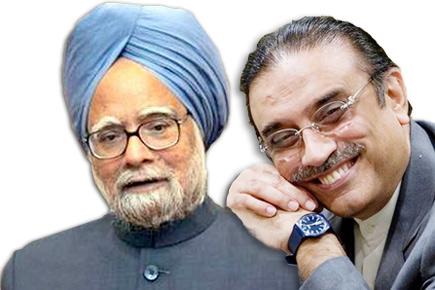
Pakistani President Asif Ali Zardari is to pay a visit to the shrine on what has been touted as a “personal” trip. Given his position, it is quite natural that Indian Prime Minister Manmohan Singh would ask him to join him for lunch. Now, when these two countries meet for any meal, there is a slow fire burning and a pot boiling in the background. You can see what is cooking, but the people at the table do not seem to have a clue.

We are still at the stage where the sophomoric question is: who should make the first move? Many moves have been made, in wars, by insurgents, through signed pieces of paper, with hugs, blasts, dialogues. These seem to have fallen on the head without anyone making the first move. Instead, the friendly country far from the neighbourhood has decided to do something about it.


The United States of America has put Hafiz Saeed, the leader of Jama'at-ud-Da'wah that was declared a terrorist organisation by the United Nations in December 2008, up there as the big dish. A little problem here. You don’t get him. He is just an item on the menu. You have to hand him over to the great master chef, Barack Obama, and in return take away the $10 million bounty offered by the U.S. for any information on him. No one quite knows what Mr. Zardari plans to pray for at the dargah, but it certainly isn’t a huge amount of money this time. As for Dr. Singh, he is a clean man with clean thoughts and, anyway, he does not have Hafiz Saeed. He can demand that he be handed over, is the chorus. Pages and pages have been exchanged over the Mumbai attacks of November 2008.

We need to look at this a bit carefully. India and Pakistan do not perceive Saeed in the same manner, and the simple reason is that they cannot. They are two countries with different compulsions. Saeed has been the mastermind behind those blasts. Ajmal Kasab, the hit man and the last guy standing, became the fall guy. In terms of a criminal act with the evidence he would be culpable. How does one gauge the extent of input by a mastermind? Osama bin Laden did not go out and attack anyone, yet he was the hunted. If we go by this logic, then the U.S. President must take responsibility for the killings of all the civilians in unprovoked wars.

The reason for bringing this up is the crucial element of American convenience. It would be facile to believe for a moment that the US is concerned about India, even though Obama said it has not forgotten the Mumbai attacks. It remembers at an opportune time. The present Zardari-Singh meeting is not terribly important, except to discuss the same old things. I also do not believe that the US bounty will suddenly make terrorism an issue. It has always been an issue.

The American establishment is only making sure it gets a sneak preview. While peace between the two countries is whimsical, the state of unrest has helped outsiders a great deal. This bane has been a boon for them, for a huge world population can be managed, if not colonised, by the simple expedient of posing as a saviour figure.  It simply does not understand that terrorism in these parts is feeding off angst. It is playing on sentiment.

To put it simplistically, for the West the Mumbai attacks showed India as a rich country and Pakistan as a few men in dinghy. Good old David Headley, Hafiz Saeed’s video maker and map drawer, managed to get a visa to India and do his recce trips as a US citizen. They have him there. Do the two countries have the courage to ask America what exactly it is doing with him?

Hafiz Saeed is roaming free. His December 2011 rally against NATO killings turned out to be bigger than that of most politicians. This was not in some small town, but in Lahore, where he turned the ‘war on terror’ on it head by urging the Pakistani authorities to revoke its cooperation. Whether anybody likes it or not, there are many Pakistanis who support his organisation, Difa-e-Pakistan. Political pragmatism would make it imperative to be on his side, because at least with regard to NATO he is expressing the prevalent sentiment: “In 10 years of war that US has fought in Afghanistan, Pakistan actually lost more than the invaded country.”


Afghanistan has been a sore point with mainstream Pakistani politicians from the time of the influx of refugees during the Afghan war to the Taliban entering the plains and attacking just about every group of people. The splitting of hairs over ‘good Taliban’ and ‘bad Taliban’ has in fact blurred the lines. In the popular imagination, the U.S. is to blame for it. The audacious move to assign ‘guardian angels’, troops to watch over their sleeping comrades “against possible attacks by rogue Afghans” after an American soldier Sergeant Robert Bales killed sleeping Afghans, amounts to playing victim.


Pakistan is caught between these two victim-aggressors. It is willing to risk drone attacks, but the authorities probably believe that the rightwing within might come in handy. The view that Pakistan wishes to create communal tensions in India works symbolically to the benefit of Pakistan and India should disabuse such notions actively. If Pakistan wishes to destabilise India by hitting out at its totems of economic progress, then why would it want to do trade with India and why should the Indian government encourage it?

If India believes that the Inter Services Intelligence (ISI) is behind it all, then does it make any sense to ask Pakistan to hand over Hafiz Saeed or to even try him? More importantly, if India believes that all acts of terror emanate from Pakistan, then is there any purpose in pursuing peace? Peace does not merely mean no war. It conveys a sense of confidence and trust. Neither country trusts the other.

This leaves a large opening for America, and it never fails to appear. The farce of a $10 million bounty will be played out in salons rather than in Islamabad or New Delhi. This is a huge bait for Pakistani liberals and expats to fill the U.S. coffers during the run-up to the elections. The money will be in trust, without it being spoken of in such clear terms, and the well-wisher Pakistani lobbyists will buy peace. America knows this only too well.

The obvious question would be: Aren’t there more prominent Indians in that country? Rich Indian immigrants are keener on being American; they do not have to prove their innocence, unlike Pakistanis. This is a major difference.

What has this got to do with President Zardari meeting Dr. Singh? If one is to understand some of the ‘peace’ proponents, then India is doing a subtle America without the bluster. The lead opinion piece in The Times of India had this gem:

“Clearly, Zardari has stolen an imaginative moment from the bitter-sullen history of India-Pakistan, by asking to come to pay his respects to a cherished and much-beloved saint across the Indian subcontinent. It shows what we, despite the horrendous Mumbai attacks of 2008, are still capable of. Perhaps the Pakistani president will seek forgiveness for those attacks and pray that both countries can move on by jointly erasing the scourge of terrorism. God knows, there are more people killed in Allah’s name in Pakistan today than elsewhere in the region.”

This is so full of Pat Robertson type evangelism, with its penance and forgiveness tone, that one wishes that all SAARC meetings are held at the shrine. In fact, such ‘private’ visits only reinforce the belief that we in South Asia will always mix religion with politics.


Taking such peace talks further is a piece in The Hindu jointly written by former Foreign Secretary of Pakistan Humayun Khan and former Foreign Secretary of India Salman Haidar:

“Peace within the region is an essential requirement for India to continue on its upward path. It must make renewed efforts to convince its neighbours that it poses no threat to them. It still has to fully convince them that it is ready to honour their independence and separate personality.”

How can such a thing be proved? India is fighting movements within almost as much as Pakistan is, with probably fewer casualties. The emphasis on economic progress, in fact, diverts attention away from political instability. There is no doubt that India being the larger nation has to respect other nations, but their sovereignty depends on how they manage contradictions within. Bilateral peace has little to do with this.

“To further allay apprehensions, discussions could be initiated on relocation of forces along the border and on regular meetings between chiefs of the armed forces and of intelligence agencies. The need for better understanding between the two militaries cannot be over-emphasised, because the security syndrome in Pakistan is the major obstacle in the way of progress.”

Do the armed forces act independently? They don’t. Besides, there is a difference between armed conflict and terrorism. Terrorism does not take the regular route. While Pakistan has to deal with the army as possible government, India has to handle the politicisation within the army. How they talk to each other matters little when compared with how they operate inside their own countries.

Dr. Manmohan Singh does not have to worry about the Indian armed forces posing a threat to his position. Asif Ali Zardari has to every minute of the day. A little prayer at the dargah will not change that. What he might get by way of benediction is a new eureka motivation: blame the existence of Hafiz Saeed on newbie willing to sup with Islamists Imran Khan for the moment. Wasn’t seize the day an all-American novel?

(c)Farzana Versey

Published in Counterpunch, April 4

- - -

Image of Asif Ali Zardari and Dr Manmohan Singh courtesy Open magazine

17.3.12

Pakistan on an Indian Spiritual Trip

The guru in Pakistan

I stood in the sun, eyes blinking. On that dry Delhi summer afternoon of parched throats and heat without sweat, I was waiting in the queue outside the visa collection window of the Pakistan High Commission. People started exchanging notes. The moment they discovered I had been there before, the questions were rapid: Do you have family there? What are the good places to visit, shop, eat? Are they like us? I became a Pakistani expert, until I saw someone watching me with a bemused smile.

He was a tall lanky man with longish hair that he kept pushing behind his ear in a rather effeminate manner. In that line of nervous people waiting to know whether they had been granted entry, he seemed supremely confident. “So, you’ve been to Pakistan before?” he asked.

“Yes, of course,” I said, now that I was the ‘source’ the group around us had made me into.

“Is this your first time?” I asked.

By way of explanation, he opened a file. The sun was beating down and there was just too much light to read. I shrugged. “Many times,” he said. “For how long do you plan to stay?”

“I’ve applied for a month again, let’s see. And you?”

“Six months.”

“What? Do they give a visa for six months?”

He had a boyish grin that did not quite go with what he was about to tell me:
“I teach.”

“Oh, ok…” I was not sure if asking anything more would be deemed proper. He held up that file again.

“Actually, I teach the art of living.”

When spoken, it sounded like he was teaching Pakistanis the fine art of going about with their lives. But, obviously, he was a tutor with the Art of Living Foundation.

"Do you know about it?"

"Of course. They let you stay there for this?"

I must admit I was envious because of my own experience with visas. I was fairly certain then that there was a spiritualist inside me waiting to come out.

I got my passport and, unfortunately, just then he was called to furnish some papers, so no contact details were shared. If only I had looked at the file he had opened for me. Perhaps, he did not wish to make a public display.

I was curious then as I am now about how in a supposedly Islamic country there was enough space for such quick fix spiritual solutions. I met a few local soothsayers, too. One particular palmist was very popular in Karachi; people would go in their cars and stick their hands out. It sounded like a takeaway joint, only bizarre and fascinating. My friends took me there, but he wasn’t around on that day. The fact is that despite the Islamisation, these kinds of activities have been prevalent.

I recall this now because Sri Sri Ravi Shankar, the founder of the Art of Living Foundation, visited the country recently. I am amazed at the manner in which his trip has been portrayed in the media. ‘He is going to teach the Taliban to de-stress...this is a peace mission’, they say.

Quite naturally, he is not going to let go of this opportunity to appear as more than a soul spa. So he said:

“All those who fight have fear and concerns; they want to feel valuable. Our techniques give them a sense of well-being and calmness, and once the inner calmness happens, the feeling of wanting to fight and the urge for revenge disappears.”

Why has he not tried that in India? We have terror groups, criminal gangs, separatist organisations. He has met some, but will he dare to approach them to stop taking revenge? Can anyone imagine the Taliban members doing a breathe in-breathe out?

This is nonsense only to project the guru as someone with a higher purpose, and a vague Taliban rather than real criminals come in handy. Besides that, he is treading on dangerous ground by getting involved in politics:

“We want to talk with the Taliban in Pakistan. We’ll go in with an open mind, to find out who they are, their problems and their intentions—that has always been my approach.”

He is talking about the ‘we’ of his organisation, not as an Indian. I am surprised that there has been no objection to this. Even ministers who appear in studios with people who are considered enemies of India are lambasted. Those writing anything positive about Pakistan are questioned. And here we have this man talking about an “open mind” regarding the Taliban.

And how are the Pakistanis taking this? Do they not complain about their nation being run over by the Taliban?

At the time of the Lal Masjid incident when Islamabad was supposedly under siege, there were Pakistanis in deep meditation at the Art of Living Foundation, not to solve the country’s problems or shut them out, but to detoxify their indulgences. There are 5000 such people. It is part of one more salon trip.

Sri Sri Ravi Shankar’s mission is possible because he is not interested in really doing anything. If that were the case, then the government as well as the Taliban would have found ways to keep him away. His is a commercial venture, catering primarily to the elite or to those among them who want to ‘help’ others through pop philanthropy.

There is nothing more to it than this. However, it just does not sound important enough. After all, this is Pakistan. Both Pakistanis and the guru need to make it seem like ‘peace’, one of the most abused words in the Indo-Pak context. It takes on the pugnacity of a war-like situation.

This is the guru’s hope trick and ticket.

(c)Farzana Versey

4.2.12

Mani and Hafiz: Truth or Bare?

I understand that when a politician is on a private visit to a country, he does not speak on behalf of the country. Mani Shankar Aiyar, by virtue of being a former diplomat based in Pakistan, is knowledgeable about the country. It seems that he has lost touch with it, and even his home country.

Sitting on a panel discussion in a studio in Islamabad, he was confronted by Jamaat-ud-Dawah chief Hafiz Muhammad Saeed through a phone link:

"Giving India MFN-status is not correct in any manner because there are already big problems that haven't been resolved, including the Kashmir issue. At this moment, the dams being made by India will create a crisis in Pakistan."

This is the man considered the mastermind behind the Mumbai 2008 attacks. His position would not be much different.

It is Aiyar's comment that is typically on a limb:

"There are some persons like Hafiz Saeed in our country who do not want things to move forward but thankfully the ordinary people want our ties to improve. We can improve our relations irrespective of what his (Saeed's) opinion is. We want him to be caught and taken to a terrorism court."

By getting into this same-same maze, he is in effect implying that the Hafiz prototypes in India are against any ties with Pakistan.

We do have a consolidated saffron terror in place, but it is essentially and rather tragically targetting people within the country.

It is pertinent that a couple of days prior to this studio peace, a piece of news which has much to do with Hafiz Saeed went largely unnoticed. The amicus curiae, advocate Raju Ramachandran, told the Supreme Court that Ajmal Kasab was not part of a larger conspiracy for waging war against the nation.

As reported:

'Maintaining that the prosecution has failed to prove the case against him beyond doubts, he told he bench that his right against self-incrimination as well as his right to get himself adequately represented by a counsel to defend himself in the case have been violated during the trial.'

Kasab said he was brainwashed like a "robot".   

What would Mr. Aiyer's position be? Does he believe that brainwashing takes place only in the area of terror? This is where we need to look at the scenario holistically.

Saeed's opinion is not an isolated one and neither is it restricted in both countries to fringe elements.

There are two crucial segments.

1. The overtly nationalist middle class that believes that an enemy gives credence to identity.

2. Those who take what appears to be a cynical view that

a) the terror industry is over-rated
b) peace through confidence building measures does not do away with insecurity. These placebos cannot and are not meant to address diplomatic issues.

Almost all politicians have spoken about such initiatives and gestures. Does anything tangible come out of it?

In the Islamabad studio, it was Hafiz Saeed who spoke honestly. Mani Shankar Aiyar is being hailed for his brave move in confronting him, when he was just aiming aimless darts.

Perhaps he might like to see the large queues outside the High Commissions in India and Pakistan to understand how difficult such 'private' visits are for those he is claiming to speak on behalf of.

31.7.11

Sunday ka Funda

“He who cannot give anything away cannot feel anything either.”

- Friedrich Nietzsche

Does not giving away anything mean being uncaring? Is it not possible that the feelings are inside, too afraid to be expressed?

Giving away is, of course, more likely about giving. Whether in love, or friendship, or the extended groups we belong to. It is also about giving the benefit of another’s existence. How often we deny that. To people. To our surroundings. To others. And by doing so we just add to the morass of time lost.

Today’s song is about the tricks of time. The film Anmol Ghadi had an inanimate character – a timepiece, a gift that that is a reminder to the separated lovers who later face each other in ways quite different from when they first met about that 'precious moment'.

When India and Pakistan are on another binge of ‘peace’, this film is a telling example of the denial I mentioned. Made a year before the Partition, it was banned in Pakistan after the 1965 war. Its main actors Noorjehan and Surendra had two nationalities by then – Pakistani and Indian. For over four decades it was not shown in the country where the actress-singer was as huge a star as she had been in India. So, Pakistan was denying one of their own her heritage. She was dead by the time it was re-released.

The song itself is sublime because of its subtle rendition. There is torment rather than tears. A couple of lines can be applied to the two nations torn apart:


barbaad main yahaan hoon
abaad tu kahaan hai
bedard aasmaan hai ...

(Ruined am I
But unscathed you are not too
How merciless is the sky)

Awaaz de kahaan hai – Anmol Ghadi


Movie: Anmol Ghadi (1946)
Singer(s): Noorjahan, Surendra
Music Director: Naushad
Lyricist: Tanvir Naqvi

28.7.11

The Hina Factor: Pakistan’s Wicked Ploy

Oops, you did it again! Krishna and Khar


This is Asif Ali Zardari’s shrewdest move. Sending Hina Rabbani Khar on what amounts to be the equivalent of cricket diplomacy. This is not meant to be a sexist comment. She pretty much sailed through the India test by fire even as Pakistani intellectuals and the media have been rubbishing her ever since she was appointed to the post.


What are the dynamics here? It seems impossible to disregard the references to what she wore, how she looked and spoke, and it is a tad stupid for well-traveled Indians to comment on her designer labels as though they are not exposed to these. If anything, they look a bit awestruck even as they seemingly reduce her to superficials. The Times of India decided to tread carefully and mentioned our foreign Minister S.M.Krishna’s necktie, as though it were mandatory to give him equal sartorial time.


Zardari’s victory is that he knew the attention would be diverted from important issues although he had said that giving a 34-year-old with little experience the plum assignment was “a demonstration of the government's commitment to bring women into the mainstream of national life". There is no contradiction in his mind that the mainstream is the elite. He is sending out a few messages here: our societies are obsessed with the façade of economic progress, so let us dress the part even if we are dependent on foreign aid. A report had said that Richard Holbrooke was keen that she was given more responsibility. As foreign affairs minister she does not need to know what happens in the bastis. Does Rehman Malik, the Interior Minister, know? She has to convey Pakistan’s intentions, which is an easy job to do because India already knows it. As she said in a television interview, when questioned about her meeting with the Hurriyat leaders before her official itinerary, that this was the “stated position of Pakistan”.


Rather smartly, she also took the age issue head-on and said it was a matter of how one sees it. She has been an elected MP and served two terms as junior minister that helped her “learn on the job”. This sounds like a simple statement. Think about it, though. The head of our government is not elected; the woman running this country has no experience; the youth leader has been learning on the job for years now with the added advantage of dynasty. If we decide to look into our own backyard, Ms. Khar’s debut would appear like quite a masterstroke.


So, what is it about her that has riled Pakistanis? A former envoy, Zafar Hilaly, had been dismissive: "Asif Ali Zardari clearly does not want a heavyweight in the job. Hina will play the role and say her piece; but I don't think anyone is expecting anything significant from her."


He should know that no minister can do anything significant with India. We have been playing a carrot-and-stick game for years and will continue to do so. All paperwork, statements and dossiers will be cosmetic offers.


There are derisive put-downs that she is just a rich spoilt woman from a feudal family. This comes from the media; most of the owners and editors are rather well-off and have other businesses and most certainly give the time of day to social butterflies. In fact, some noted writers have made a career of carousing for the Chanel chicks. They seem to have forgotten that none of their prominent leaders has been a grassroots person. Zardari is himself a greenhorn with a shady history. What about Benazir Bhutto? What was her experience except to belong to a political family? Jemima Khan had dismissed her  as "The Kleptocrat in an Hermes scarf" (my rejoinder was here), completely forgetting her own posh Goldsmith girl days. What is Imran Khan’s experience that some people think he’d, be a great prime minister? One will not question the political experience of military leaders because they rule either by coup or from the coop.


Professor Pervez Hoodbhoy added some perspective but a bit harshly: “In a male dominated culture, she will be derided as no more than a pretty face. This would be true even if she was hard-as-nails and an exemplary negotiator. She will also be the object of jealousy within the PPP, where sycophants know that the boss decides and suck up to him. How forcefully Khar is able to present Pakistan's position as foreign minister remains to be seen. Although she was selected for her docility rather than bold originality, there could always be surprises."


How many Pakistanis, forget politicians, have expressed a position that is boldly original on matters of foreign policy? Any national psyche makes it incumbent for people to believe in certain aspects; much of it is inherited baggage. If she is to push Pakistan’s position, that too with regard to India, how can she be original?


Before her visit, a report had quoted an unnamed observer who said, “It is well-known that Pakistan's foreign policy is in the hands of agencies, not the foreign minister or even the President. Hina will have a tough time proving that she is not just a puppet. I don't think anyone is going to forget that her roots go back to the Musharraf administration."


This goes in her favour. Pervez Musharraf conducted the biggest PR exercise in India during the Agra Summit although it ended rather badly. He became a martyred hero, so the connection is her silent trump card. Again Zardari, who it is suspected could get close to Musharraf again in one of those opportunistic alliances that his father-in-law was so adept at, has played his cards well.


And for those who are talking about maintaining the status quo, that is what Indo-Pak relations are about. That or months of sulking. The outcome is, as expected, simplistic. India and Pakistan have agreed “on the need to strengthen cooperation on counter-terrorism including among relevant departments as well as agencies to bring those responsible for terror crimes to justice”. This is worth a yawn although it gives sufficient grist for several yarns.


The confidence building measures (CBMs) will be another Samjhauta – compromise. You take some missiles out of the way, but that does not prevent the threat perception and the real threat. It is not about whether either country decides to attack, but how much it feels the need to defend itself. This is never overtly at the government level. We have coined the phrase “non-state actors” just to make sure that foreign ministers can “agree” without having a clue as to what is happening behind their backs. The intelligence agencies have to deal with the headache, unless they are the headache.


The Line of Control will now be accessible for travel and trade. Is this a big leap forward when the economies of both sides of Kashmir are not really bullish? As regards travel, residents of Kashmir are anyway given visas more easily.


In general terms, trade opening acts as one more people-to-people initiative.


By far her entertaining the Hurriyat leaders at the Pakistani High Commission before meeting our foreign minister  - while deemed undiplomatic and a kick to protocol - was her real moment. Tutored she was, but she made it seem like the most natural thing to do. India and Pakistan are just two nations. Emphasise Kashmir and you sit on the TNT bomb. To keep it simmering has proved to be the most lucrative aspect of Indo-Pak politics. CBMs are just loose change.


- - -


Also published in Countercurrents

19.4.11

'Trump'eting and 'Singh'ing

Donald Trump loves America so much that he wants Libya. And China too if he could get past the noodles and fake Rolexes. There was a time when many wanted Donald Trump. Today, in his respectable avatar as a “serious” Republican candidate, he is making rather outrageous comments. No, I don’t have a problem when he says, “this country is a laughing stock throughout the world”, for he assumes that the United States has got the power and ought to use it not to better itself but to get the better of others.

It is his rather facile attitude that makes one wonder what all the fuss is about Sarah Palin.


On Libya

“Look at Libya. Look at this mess. We go in, we don't go in, he shouldn't be removed, we don't want to remove him, we don't want to touch him, but he should be removed. Nobody knows what they're doing on Kadhafi. I'd do one thing. Either I'd go in and take the oil or I don't go in at all. In the old days, when you have a war and you win, that nation is yours."

I am tempted to at least accept his upfront stance. Nobody asked the American administration to go to Libya in the first place. If anyone has to do anything to or with Col. Muammar Gaddafi it is the other political leaders and how the people decide to act. He is pummelling them, but the situation would have been not as bad without outside interference.

Trump has inadvertently revealed that it is all about oil and not to save the poor citizens. Talking about the old days, he need not go very far back in time to figure out that the US went to war with countries it had no skirmishes with. It just landed up there when two other countries or two factions within a country were fighting, or of course to look for weapons of mass destruction or to find a man in a cave or a caveman. None of these qualify as victories because the local people have been most affected. And none of these nations belongs to America even after the ‘win’.


On China

“If you look at what China is doing, they're stealing our jobs, they're taking our money. They're then loaning our money back. It's amazing. They're making all of our products. They are also manipulating the currency that makes it almost impossible for our companies to compete with China.”

China is, undoubtedly, a canny competitor. But the jobs have not been stolen. It was the US that decided to outsource jobs to get cheap labour. If China is manipulating currency and doing a trade yo-yo, then it is merely using sharp business tactics. The US economy has suffered due to the jugglery of its own companies and the policies of the government. Naturally, foreign investors will move to where they get returns. China is not taking American money, unless Americans are choosing to invest there.

And what American products are being made by China? They manufacture cheap stuff of their own or imitations of Swiss watches, German gadgets, Italian mosaic work and even Indian artefacts. Ever heard about Chinese American apple pie? Or Apple?

- - -

Another case of putting the carriage under the horse is Indian PM, Manmohan Singh.

On five things he’d like to achieve with relations to Pakistan:

“Five would be too much. Well, if I can succeed in normalizing relations between India and Pakistan, as they should prevail between two normal states, I will consider my job well done.”

He cannot mention five things and then he wants normalcy. What is normal about these two countries individually, anyway? How would he define it when there are separatist movements all around? What is the yardstick for normal states to be considered normal vis-à-vis each other?

Such obfuscation is not new, but it would have been way better had he mentioned five specific things, even if he said cricket or sweets or films or exchange of camels, because he would certainly not talk about defence issues, Jammu and Kashmir, nuclearisation, prisoners, infiltration, Headley, Rana, Kasab, Raw, ISI. Nope.

So, how do we achieve this normal state between two normal states when the real issues are not addressed? I understand that on a flight to Kazakhstan, where the query was posed, it might not be prudent to go into details, but we have been in denial or employ dithering tactics.

And dear Mr. Prime Minister, this is about India and not you and how “well done” your job is. Is it at stake or is it steak?

4.4.11

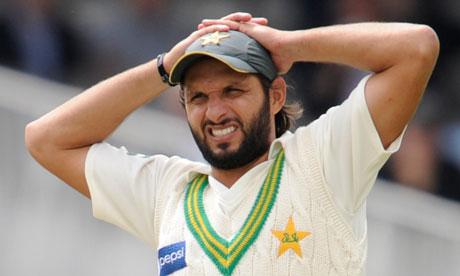
Shahid Afridi vs. Veena Malik in Big Goss


Pakistani captain Shahid Afridi has hit out at India and the Indian media. It is amusing, so let me present here an imagined conversation between him and Veena Malik in Big Goss. Parts of the report with his comments are interspersed:

"In my opinion, if I have to tell the truth, they (Indians) will never have hearts like Muslims and Pakistanis. I don't think they have the large and clean hearts that Allah has given us," Afridi said during a talk show on Samaa news channel when he was asked about relations between the two countries.

Veena Malik: “Shahidji, how kaan you say this ji? After so much afat we are making out here. Allah is not your jaagir and Allah has made my haat large and clean so I can put lots inside and also make it look like bright Taj Mahal.”

Shahid Afridi: “Mohtarma, aap kuchch na kahe tau hi behetar hoga. (Ma’am, it would be better if you did not say anything) You are insult to Pakistan, to Muslims, to hearts and all parts.”


Veena: “Haan, haan, apni zaat pe aa gaye na? Mard hote hi aise hai. (Yes, yes, you are showing your true colours. Men are like this only)”


Afridi: “Tau Ashmit kya cheez hai? (So what is Ashmit Patel?)”


Veena: “Dawnt get personal. Ash-mit has only shown bigness of haat and also its cleanness. He knows me and my Allah wary vell.”

"It is a very difficult thing for us to live with them (Indians) or to have long-term relationship with them. Nothing will come out of talks. See how many times in the past 60 years we have had friendship and then how many times things have gone bad," he said as the audience in the TV channel's studio applauded him repeatedly.”


Veena: “Fast of all, it is more than 63 and half years. I know all figures, ask Mohammed Asifji. Frandship is two sided, if you temper one side of ball and rub on ground, then frandship will be balled out.”


Afridi: “You made big bang only for publicity. Apni match-fixing par thoda tawajjo dijiye. (Concentrate on your own match-fixing)”


Veena: “I am bold and open…”


Afridi: “Now stop. Don’t go further. Bilkul Indian film star jaise talk-shauk kar rahi hai aap. (You talk like an Indian film star)”


Veena: “Ji, becaaz I have mammary. All our banda used to come here only…Mran Khan, Wseem Kram, Shwaib…sab Bollywood ke khwaab dekhte they ya Bollywood ki hairoyenon ke. (Imran Khan, Wsaeem Akram Shoiab would all dream about Bollywood or its heroines)”


Afridi: “Their women are after us, did you see any of us with pouches?”


Veena: “Woh tau aapka problem hai na? (Isn’t that your problem?)”


Afridi: “Yuvraj lekar ghoom raha tha aur pregnant aurat jaise vomit kar raha tha. (Yuvraj was walking around with it and vomiting like a pregnant woman – the reference is to an initially unfit Yuvraj and his paunch)”


Veena: “But than he plad so vall. Sab ki chonch chup kar di. (But then he played so well, he shut up everyone’s beak.)”

"We don't want to fight with each other but a third country – everyone knows which one it is - is trying to spoil our relations. (This country) is taking advantage of Pakistan and wants to take advantage of India. I don't want to go into details but these people will not let us come together," he added.


Veena: “Now dawnt blame Siri Lanka.”


Afridi: “Suniye, you don’t know cricket or politics, aap acting hi karein. (stick to acting)”


Veena: “Agar acting kar sakti tau role mil gaye hote. (If I knew acting then I would have got roles)”


Afridi: “So even you agree that Indians don’t have large hearts?”


Veena: “Nawt at all. It is large haats that even though I kanaut act they give me prime tam. Why no other country is coming in way of my relationship with India?”


Afridi: “Because outside India and Pakistan nobody knows you.”


Veena: “Saare jahaan ke log jaante hai (everyone in the world knows me), not only crickatting world. If you were bold like me you would name the mullahs who are spoiling relations.”


Afridi: “I said other country.”


Veena: “So I am also saying other country. Mullahvi.”


Afridi: “Aap ko tau Allah bhi…(With you even Allah…)”


Veena: “Dawnt be jealous of jarnail knowlej I own, theek hai ji? (Don’t be jealous of my general knowledge, okay)”

Asked about the Indian media's coverage of the Pakistani team during the semifinal with India at Mohali on March 30, Afridi replied: "The Indian media has a very negative approach and very negative thoughts. The people may not be like that but I think the media had a very dirty role in spoiling relations between us and India. Our media, which is criticised by people, is hundred times better than theirs," he said.


Veena: “I am making vawes in Indian media, no nagatiwe proach, no nagatiwe thot. Media is making me have good relations with all Indians. Pakistani media puts me in front of camera with some bearded man.”


Afridi: “And if India will put you in front of their bearded man you will jump with joy…”


Veena: “They don’t have those types.”


Afridi: “Amitabh Bachchan hai na.”


Veena: “His beard is designer and awerybody knows from paaon to sar (head to toe) I only like designer.”

Afridi also criticised Interior Minister Rehman Malik for warning the Pakistani team not to get involved in match-fixing and Indian cricketer Gautam Gambhir, who vowed to dedicate victory in the World Cup final to victims of the 2008 Mumbai attacks. "I think they were both very stupid comments by Rehman Malik and Gautam Gambhir...I wasn't expecting this from Gautam...This is all politics, what do you know about who carried out the Bombay attacks?" he said.


Veena: “Rehman ji and I are both Malik and Malik and only we know inside of match-fixing.”


Afridi: “Whole world is involved. It was bad for our morals.”


Veena: “Ab ismey moral kahaan hai? (Now where do morals come into this) Be bold and crejiss like me.”


Afridi: “That I can see. Boldness is not about upper stuff…”


Veena: “Dekhein, aap hadd paar na karein. (Look, don’t go beyond a limit)”


Afridi: “I am only saying outside you can be bold in dress and Rehman Malik was bad for moral with e.”


Veena: “Vot English is this, hain? Moral tau hmm…mmm…haan ‘M’ se shuroo hota hai…(Moral starts with, well, ‘M’)”


Afridi: “Ji. Hum ending ki baat kar rahe they. (Yes, I was talking about ending)”


Veena: “Pakistaniyon ka yehi prowblim hain. End ka sochte hain. Pichur abhi baaqi hai dost.(This is the problem with Pakistanis, they only think of the end. The picture is still to go on)”


Afridi: “So why did Gambhir want to dedicate to victims of Mumbai attacks?”


Veena: “He said for finals ji, and we were not playing, tau don’t do fikar. Indians have large haat that’s why we did not reach final.”


Afridi: “They did it for themselves. It is all politics.”


Veena: “Aap cricket kheliye, yeh kaafi hoga. Theek hain, ji? (You play cricket, that will be enough, okay?)”


Afridi: “Aur aap India mein hi rahe. (And you stay back in India)”


Veena: “Tau phir Pakistan ke crikaters ka kya hoga ji? (What will become of Pakistani cricketers then?)”


Afridi: “Badey dil se kaam chala lenge, ji. (We will manage with our large hearts)”

- - -

End note:

I'd like to add that I received a few congratulatory emails and text messages from Pakistanis after the semis as well as the finals. I was confused. I don't want piece, I want the whole ji.

(c) Farzana Versey
- - -


Updated: April 5, 6.30 PM:

Shahid Afridi is now walking with his tail between his legs. He did not say all that…er…he did not mean all that…ho-hum.

I have uploaded a video. It really does not make much of a difference. But his clarification comes to an Indian channel – NDTV – whereas he gets the applause in Pakistan.

“I have enjoyed my cricket in India and I love Indian people. Don’t take my comments negatively. I have always got a lot of love and affection from Indian fans. And I request the media to play a more positive role and not waste time on such trivial issues. The media makes a big deal of small issues. It is shameful. I have always done my bit to improve Indo-Pak ties but sometimes you say something and it is interpreted the other way. I have been quoted out of context.”

His answers were direct. What context was not there? This should just teach us about not going haywire about cricket diplomacy and players doing their bit. Perhaps he’d like to ask one of his own predecessors, Aamir Sohail, who had objected to his comments.