Showing posts with label activists. Show all posts

3.9.13

Front page rage

There was a knock on the door. A young man stood there assuring me, “Don’t worry, I am not selling anything”. Great. So, why was he here?

“I am a working professional.” He paused, waiting for the information to sink into what he might have perceived as the pyjama-clad brain. I played along with the “pressure-cooker is about to whistle” harried look, although the whistling part can be deemed misogynistic. He smiled. “Actually, a few of us are trying to do something.” I twiddled my thumb, just to underscore how important he was.

“You know there are so many senior citizens hanging around…”

The shock on my face had no impact on his terminology. The smile was still in place. “We want to do something.”

“Like what?” I finally broke my silence.

“Oh, we will collect funds.”

And he said he was not selling anything? Of course, I was not going to help his part-time activist and fulltime arrogance. Who the hell has given these people the right to land up at our houses, and assume that we are not aware and do not ‘do anything’? Only because he was dressed well, “cool” really, the watchman allowed him in and did not even alert me on the intercom. The youth movement has figured out that you send your smart men and women and they will be acceptable.

This was not the first time. What I was perturbed about is this fellow telling me about what happens in my locality (senior citizens don’t hang around, and they are not looking to be fed) without giving any information about himself and those “few people” who have decided to save others. I had no inclination for a conversation, pissed off as I am with this neo-activism everywhere. But, who are these people? What organisations back them? How do they disburse the funds, and who is accountable for all this? If at all they want to approach people, they ought to first provide this information in writing.

And, no, don’t come anywhere near my door. For, as far as I am concerned, you need to be saved from your delusions.

---

Speaking of which, The Times of India today had a front page story with the headline: “Bikers harass fashion stylist in auto at Malad”. The unnamed stylist did not go to the police to register a complaint against these men who passed lewd comments, but she allowed her friend to post the picture she took of these guys on her cellphone.

It is sad I even have to write a disclaimer to say that obviously I do not condone such acts by these louts. But here, I have said it, so can we move on to some questions?

How does this qualify as a front page story? If it bothered her – and it would – why did she not go to the cops? If they do trace these men after seeing the photograph, on what grounds can they take action based on some newspaper report by an anonymous person? It is also interesting that she noted that one of the guys was wearing a “BMC uniform”. Being a municipal worker as opposed to her stylist profession obviously makes the story more palatable to the urban youth.

The story continued on the inside page with snippets from the social media. One word leaped out: pepper spray. Women need to get out of the house with pepper sprays. Why this sudden interest? A few days ago, DNA carried a report about a social worker-socialite who wanted to donate pepper spray cans. Clearly the target was the slick urban young women who could fit it like a lipstick in their bags. The samaritan had decided to name it after herself, and added that having spoken to some people they were willing to pay for it. So, it could turn out into another business venture?

If women wish, they can just add some water to pepper powder and fill aerosol spray bottles with it. There is no need to market it. Women in Delhi two decades ago used to wear ‘porcupine’ clips in their hair to ward off men in public transport. In other cities too similar methods have been employed by women when they could. While women need legal protection and security, let us see it as a necessity and not buy into this culture of paranoia.

The lewd comment story must have gained enough mileage. The TOI, after giving it front page importance, had another report on Page 6: “Father strips, assaults 15-year-old girl, held”. It had about four short paras. No rage. The man is an alcoholic and unemployed. His wife does odd jobs. They do not figure in the elite concern. Whistling men on bikes get us more agitated.

Curiously, the same paper carried this on Page 12:


Same paper, same day, a senior woman editor wrote an Op-ed titled, “Don’t Make Her Lose Her Face”…the subhead: “Because the raped woman isn’t the one who has to be ashamed”. Oh, get over it already. You say don’t make her lose face, as though she cannot decide on her face and everything else, and then add this “ashamed” bit, like an afterthought. It just sounds horrible, because we are taking over and deciding not to shame her.

---

Shame is having a good time. Asaram Bapu has finally been arrested and here are the two bits that are highlighted:

  • He will be in the same cell as Salman Khan was in for hunting black bucks. 

In effect, the media is equating rape with such hunting and also giving this fraud godman celebrity status.

  • That he passed the potency test on the first round.

He agreed to it despite initial reservations and then did so because he said that the body is only mortal. There is more than meets the eye. He has a huge number of followers, including women, who took to the streets to support him. A man in his 70s who comes out flying with flying colours in potency gets validation. After all, he is also a healer of sorts, so this is an advertisement for his prowess. His superhuman qualities.

The only thing that is always impotent is rage.

©Farzana Versey

---

Also: Re-examining sexual violation - Asaram Bapu and five men

15.7.13

A Mirage called Malala

A Mirage called Malala: Another Daughter of the East? 
by Farzana Versey, CounterPunch, July 15

Had Edward Snowden exposed the dirt of the Taliban, he would have been standing behind the lectern in New York at the UN hall on Friday, July 12.

The contrast, and irony, is stark.

  • A young man is hounded by the government of his country for exposing its sly mechanism, of its covert war against the whole world, not to speak of its own citizens. He waits at an airport in Russia that had fought a war against Afghanistan, which was backed by the CIA.
  • A teenager’s birthday was officially declared Malala Day by the United Nations. She addressed a well-heeled gathering in the United States that was one of the two countries to oppose the UN Convention on the Rights of the Child; the other was Somalia.

Malala Yousafzai’s speech had a captive audience. 

Malala at the UN - Pic The Guardian

They wanted a cinematic moment. The gooseflesh groupies, including the mainstream media and urban Pakistanis, were not interested in going beyond the script of her address. They became the protectors of a girl who they could not protect in their own country. The legal imperative is not even considered to fight such cases. What bothers them is their pretty position would be threatened and questioned.  

Politician or puppet?

If we are to treat her as just a courageous 16-year-old, then perhaps we ought to disregard her role as activist. She cannot be hoisted as a symbol of resistance as a cocooned marionette.

In the very first sentence, Malala said it was an honour to wear a shawl of Benazir Bhutto. This was a political statement. From being a victim of the Taliban, she appears to be a “mind-controlled victim” of the elite. Like Benazir, Malala’s power comes from being wronged. Nobody will deny that they indeed were. However, the dynamics of power play are not about the literal, and this the souvenir dealers do not wish to understand.

When she was being treated at the hospital in Birmingham,  President Asif Ali Zardari visited her wearing a coat with a lapel that had her photograph on it; to honour her, he pledged $10 million for girls’ education to UNESCO because “sending girls to school was the best way to combat extremism”. While Malala’s school in Mingora, in the Northern region of Swat, was renamed after her, the President did not offer this money to a local organisation. To get legitimacy, it would appear the issue has to have global appeal.

The Interior Minister at the time, Rehman Malik, was quoted as saying:

"Until terrorism is over, she will continue to have security until we feel she is OK. You never know the circumstances, what will happen. The Taliban might be zero tomorrow. Still [while] we think or successive government feels she needs security, it is of no issue, to be honest, because she has become the icon of Pakistan, she has stood against terrorists and Taliban and she has become an icon for the education of young girls.”

Why do many Pakistanis refuse to see this as a convenient ploy by the leadership to put the onus on iconoclasm to deal with the issues, knowing well that this would work only as a mirage? Where are the political initiatives to tackle terrorism? Benazir Bhutto too supported the Taliban regime in its initial years to ensure that her position was not threatened. The progressive discourse overlooks the fact that she did not expunge any law that was anti-women.

Ever since she was shot at by the Taliban, the cheerleaders have expressed cursory concern for the “other Malalas”; the sidelight is brought out only as a nervous tic. Malala too made a nodding mention of her friends, now forgotten by everyone. They were also shot at, but not as grievously. Where are they? Are they protected? Any school named after them? No one seems to notice that despite her environment, she managed to learn, to seek peace, and to take on the militants.

The omission of any inspiring contemporary figure in her speech was startling. Yet, she managed to please the activists when she spoke about “hundreds of human rights activists and social workers who are not only speaking for their rights, but who are struggling to achieve their goal of peace, education and equality”. 

Students in Mingora (Pic: Pak Magazine)

It would have been politically incorrect for her to add that her sponsors and their allies not only kill civilians in the regions they occupy, but also employ child soldiers. In an earlier piece, I had raised these points: Is this courage or just canny marketing by consumerist consciences? Do we even pause to think about the consequences of creating or supporting such vulnerable ‘revolutionaries’? …Just think of the kids the US forces fought in Iraq and then took them captive to Abu Ghraib. Think about them in the Maoist Army in Nepal, as human shields in India’s Naxal groups, of them in Israel, of stone-pelting Palestinians now holding guns. These are representatives of their countries, not fringe groups.

Malala even sent out a message of forgiveness for the Taliban using time-tested figures: 

“I want education for the sons and daughters of the Taliban and all the terrorists and extremists. I do not even hate the Talib who shot me. Even if there was a gun in my hand and he was standing in front of me, I would not shoot him. This is the compassion I have learned from Mohamed, the prophet of mercy, Jesus Christ and Lord Buddha. This is the legacy of change I have inherited from Martin Luther King, Nelson Mandela and Mohammed Ali Jinnah. This is the philosophy of nonviolence that I have learned from Gandhi, Bacha Khan and Mother Teresa.”

This is what Barack Obama says. This is exactly what the West, specifically the US, has done with its neat division of good Talib, bad Talib. Besides, as America is due to exit from Afghanistan in 2014, it will have to deal with the Tehrik-i-Taliban Pakistan (TTP). Whoever drafted Malala’s speech was taking no chances, even carefully omitting Hinduism, aware that it is a touchy issue in Pakistan where the infidel is associated with the idol-worshipping faith more than any other.

Besides, what change did Jinnah bring about? His major contribution was before the Partition and in helping to formulate the idea of Pakistan. He did not live to watch it veer away from the avowed secularism he hoped for. Malala recalling Mandela and Gandhi seems like a staple politician-beauty pageant fortune cookie moment, but Bacha Khan? He did not want to be with Pakistan and had specified that he should be buried in Afghanistan, to retain the purity of his Pashtun dream. Violence of thought is not something to be shrugged off.

Who is educating whom?

Like the caricature of the Taliban frightened of a girl with a book is simplistic, the catchphrase at the UN that day –‘Education First’ – is restrictive, especially when you consider the number of school dropouts in the West. But American kids willingly emptied their kitties for a charity that turned out to not only misuse the funds, but also mislead. Greg Mortenson, a Nobel Peace Prize nominee, who wrote the bestselling ‘Three Cups of Tea: One Man’s Mission to Promote Peace ... One School at a Time’ set up the Central Asia Institute charity that funds schools in the Balti region. President Obama made a handsome donation, and the book compulsory reading for the forces in Af-Pak.

However, the greater crime, as I wrote in the Counterpunch article Fabricated Philanthropy was “one by default – of whitewashing the image of the US administration, even if to a small degree. It has come to light that he was not kidnapped by the Taliban. In one of the photographs of 1996, his so-called kidnapper turns out to be Mansur Khan Mahsud, a research director of the FATA Research Center.”

Those who oppose religious factionalism that the Taliban propagates have been using religious arguments against militancy. Certain clerics had issued a fatwa against those who targeted the girls; the liberals did not know how to negotiate this similarity. Pakistanis have lived with their Islamic laws, so they cannot ignore the mullahs.


Such lounge activists do not take on the Taliban or the government. They merely participate in the usual candlelight vigils and sex up the debate with their passive-aggressive act. Quite reminiscent of what Madonna did soon after Malala became a talking point. At a concert in Los Angeles, the singer had said, “This made me cry. The 14-year-old schoolgirl who wrote a blog about going to school. The Taliban stopped her bus and shot her. Do you realize how sick that is?” As reported: “Later in the show, Madonna performed a striptease, during which she turned her back to the audience to reveal the name ‘Malala’ stenciled across it.”

When Malala mentioned the problem of child labour, it did not strike her that she is now even more a victim of it, albeit in the sanitised environs of an acceptable intellectual striptease.  

© Farzana Versey

---

Do read Our Guns, Children's Shoulders

25.12.12

Beyond 'Theek Hai': A Brother, the PM and Media Mischief

Nothing has moved me as much today as the words of the brother of the Delhi gangrape victim. Here are a few quotes from the report:

•“It is like the life we had a week ago never existed. Every day is now passing by in a flash. When I switch on the TV or log on to a social networking site, I see these emotional outbursts about Damini, Amanat, Nirbhaya (the names some media organisations have given the victim). It’s hard to digest that this is my sister they are talking about."

•“I thought the channel in question had got my sister’s name wrong, because they said ‘Damini’s condition is deteriorating’ — they addressed her like that. I was reassured from the first day that our names, my sister’s name would not come out. I was furious."

•“Every two hours, there is a new rumour. On social networks, celebrities and many friends flash her obituaries every night. For them it is just an online status they correct in two hours. At the same time, media channels say she has had a two-hour conversation, she has walked, she has smiled, she has hugged UPA chairperson Sonia Gandhi."

It is easy to join the hype and the popular outrage. I felt a bit out of place. But, this young man's words confirms my belief that the media does more harm than good.

He, however, does not completely dismiss the protest movement. But, has it not brought even more fear in his life?

- - -

Read the papers, and suddenly rape cases stare you in the face. This is not sensitising, but is likely to numb people.

Prime Minister Manmohan Singh came on TV and gave a short speech. People know the precise time - 2 minutes, 15 seconds. Had it been longer, would it change anything?

He became the butt of jokes because a news wire service forgot to edit out his post-speech words "Theek hai". It gave the impression that the PM was saying all is well.

>“Since the team got delayed because of the traffic diversions and the heavy equipment, they were unable to set up a teleprompter for the PM,” a source said. The PM’s address was uplinked directly to TV channels with the “theek hai” comment that went on air. Later, news agency ANI clarified, “A question to ANI’s cameraman was inadvertently broadcast by some news channels as we fed the PM’s message. The lapse was rectified.”<

It does not seem inadvertent. The media is upto mischief, especially when the news is hot.

Yet, one has got to be particularly stupid to see disembodied words nullifying the main speech.

But, stupidity is just a click away. It transforms into concern.

So, if you are concerned about security of women, then the government is meeting you halfway. Write to the Justice Verma Committee directly. I know it will deflate the efforts of 'petition' waalas. But this is what you can do:

24.12.12

Diary from Raisina Hill: The voice of a 17-year-old

(This is a fictitious account that I would have written if I were young and at Delhi on this day) 

 
I live in Delhi and have already been to President’s house and Mughal Gardens. But yesterday, I heard my friends from college were going to protest. I know that girl got raped badly and is fighting for her life. How is the paper calling her ‘Nirbhaya’, fearless one? Don’t they understand she must have been so frightened at the time? It frightened me. I travel by bus. Papa wants me to become independent and not use the family car. My brother and sister are five and seven years older. I know the criminals should get punished forever. Why are police never around? And why are they calling it ‘Shame’. One lady even wrote that raping with penis is different from raping with iron rod. I find this shameless. Why are they calculating? I get angry with this.

Last night I sat to watch news on TV and chatted with Bhaiyya and Didi. I saw big crowds, people saying this is Tahrir Square and Tiananmen Square. Earlier they used to say we were like Singapore and Shanghai. I am getting confused. Then those cops brought out water cannons, put big yellow fences and even ran with lathis. The TV people said the students also threw stones and damaged property.

How do we know whether they were students? And from Delhi? I began to feel stupid that I was not there. They were saying this is voice of India. My voice was not there. Didi, Bhaiyya, Mummy, Papa, even our driver Sohanlal and maid Sumitra were not there. They are also India. How all these big actors become voices of India? Anchors were shouting that no one cares, that the President didn’t come out to meet these people. But who are these people? Why did Swami Ramdev want to come here? If he is concerned about rape, why does he not speak out against all those dirty acts in ashrams and madrassas and churches? Why does everybody want to take to the streets? Annaji, Arvindji, all fighting for the common man, but surrounded by famous people.

I read somewhere that those who don’t support the protest live in ivory towers. We live in Kalkaji. Both of my parents work. We went to good schools and colleges, but are taught the value of work. Didi did part-time voluntary work in an orphanage; she is now an intern at a government hospital. Bhaiyya is studying to be a lawyer, but he helps out at a friend’s CA firm. I wanted to be a journalist. Now I am not sure. The papers are full of stories I already saw on TV or read on social sites. If I join a TV channel, what will I do? Run from one place to another and get people to scream and shout and I will also scream and shout and feel important? Didi was giggling when she was looking at something on the computer. It was about Kanchan uncle and Barkha aunty, and who was on whose side at Raisina Hill. Everyone liked to say Raisina Hill. There is no hill there. Anyway, why should TV and media people be on anyone’s side and why should we, the people, have to be fed this ‘news’? If this is India’s voice then why are different news waalas talking different things about what should be one voice?

They are saying this is reporting from the ground, this is reality, we must get real. We who are not doing anything are elite types. How do they know the youngsters protesting are not from elite families? I know some who went there. They are very rich and many don’t even read papers. I saw their Facebook walls with photos from the site. I don’t want to lose their friendship and I wanted to click ‘like’, but what is there to like about someone running, some climbing electric poles? One dude even removed his shirt. He looked kewl and I like him. Am sure many girls will. He will become popular. Will that girl in the hospital bed know all this tamasha is for her? How will she feel? 


Our parents taught us to be careful. Now some aunty on YouTube was shouting (why are they always shouting? Is this what they mean by being voice of India?) that women can go out anytime, anywhere, wear what they want, it is their right. I want to ask mummy why I can’t wear short skirts and have a curfew time. But then Bhaiyya has to also follow some rules. If he took out his shirt, he has had it. Once he kept a few buttons open and was going out. Mummy gave him such a firing. He will get angry if I say this, but he wanted to look sexy. Papa told him nicely later that it looks vulgar and no girl gets attracted to this. So, we have restrictions.

Now they say it means we don’t have independence. As far as I know, all of us made decisions about what subjects to choose, what professions we want. We wear clothes of our choice – skirts (but not so short that we have to think twice before bending), jeans, salwaars. We have friends and our parents never stopped us from going to their houses or inviting them. Didi has a boyfriend and he is from another caste, another city. So, now someone will again say we are elite. Raveena Tandon is not? Farhan Akhtar is not?

It is true men behave badly in public places. They have no right to. Some girls carry sharp clips in their hair from Mummy’s young days. So in 20-30 years it has been like this, not only in Delhi. I read this article where the words “rape culture” was used. What is culture about it? I asked Didi. She said it is not proper use of word. What is culture, I asked. I know, but I wanted her opinion. She said culture is art and also how each society is different and unique in dress, food, behaviour. So, how can anyone talk about rape culture as though it is part of life?

Why are they protesting when they say people want rights? They are asking for strict laws. Why don’t they file cases? I see so many times youngsters don’t even help out elderly people to cross the road. If they have so much time and energy to protest, they should form groups and do police work. The government has now apologised. But can politicians be on buses to see who is a criminal? The law has to be strict. For everyone. In Mumbai’s Marine Drive some years ago a cop raped a girl inside the chowkie and the residents were more worried about their reputation.


People are saying how dare peaceful protestors are called mobs. All mobs become unruly. They are called ‘lumpen elements’. Go to Kashmir. Go to the North East. Go to small towns.

Who is the leader of these protestors? In a year’s time I will be able to vote. I will be able to choose a candidate, a political party. I cannot do that with these protestors. They want justice. I also want justice, not for one case, but for all cases. Even today, I am seeing protestors versus police. Then, how can we ask same police to change? People are saying it was spontaneous. How can you have posters and flags and all that just like that?

One uncle was proudly saying he has not missed any protest and is sorry he cannot be in Delhi. Just imagine, he thinks he is a proud Indian because of this and all who don’t agree are not Indian. Then people at Azad Maidan, at Ramleela Grounds are most Indian. Why are the other politicians not at the protest, the big people like Shri Adbaniji or Shri Modiji or Mayawatiji or Mulayam Singhji or Mamata Bannerjeeji? Political parties are talking against each other. So, who is the real voice of India?

Please don’t judge those who don’t come out in the streets. Don’t ask ladies to take cabs with woman drivers only because of rape cases. One day you say women should choose what they want. So, let them decide what driver they want. Don’t create fear.

I am very sad I could not be with some of my friends, but I am also happy that I will one day really fight for justice. My Bhaiyya will. My sister will. My maid Sumitra fights everyday to make her children grow up and not be poor. Her daughter goes to school. No one from her basti went to the protest rally. They did not even know about it. They don’t have smartphones and Facebook accounts. One day they will. And they will ask to be treated equally in offices, not only men and women but irrespective of gender. They will put photos of achievements, not screaming and shouting. And I will ‘like’ that.

Sohanlal and Sumitra are also voices of India. Can you hear them?

(c) Farzana Versey 

---

All images: MSN

1.10.12

Lahore's Shahid Bhagat Singh


What do names of places mean? Is it an honour? Is it a sop? Why has Pakistan woken up to name a square in Lahore after Shahid Bhagat Singh? This has nothing to do with India. There was no Pakistan then. Bhagat Singh is, therefore, as much Pakistani as Indian.

Pakistani rights groups and members of civil society have demanded that the place in Lahore where freedom fighter Bhagat Singh was hanged should be named after him to commemorate his role in the movement for the independence of the subcontinent. Speakers at the rally described Singh as one of the pioneers of the struggle for an independent subcontinent.

So, what has this got to do with the present? The activists held a candle-light vigil (yes, one more) to get this done. These people are promoting themselves as anti-establishment, which is a bit strange. The freedom struggle had different dimensions. If they want to remember the place where he was hanged, then try and recall where so many public murders take place in Pakistan today for upholding values. He was hanged in 1931 along with Rajguru and Sukhdev, the latter two seen as satellites in both countries.

One cannot give it a nationalistic or even a religious or regional bias, for Bhagat Singh was quite publicly an atheist. This might seem unusual in Islamic Pakistan, but they have honoured a courtesan (real or imagined, no one knows) Anarkali with a tomb and also Malik Ayaz the slave-lover of Mahmud of Ghazni in bustling Lahore. As I have seen both, it gives an interesting insight into how history can lie in a corner without disturbing new conservative ideas.

The place most prominently in the news last year was Abottabbad, named after Major James Abbott who founded it. Kim’s Gun is, of course, named after the character from Rudyard Kipling’s novel.

I had a rather emotional moment when I visited the mausoleum of Allama Iqbal. We still sing “Saare Jahaan Se Achcha” written by him for ‘Hindostan’, but he is theirs. It is just so difficult to explain these apparently minor aspects that have made a home in our hearts.

It is true that as societies change, they want to sometimes wipe out the past. But we still remember places by their old names. I get particularly irritated when people say, “Oh, it will always be Bombay for us” about the city being renamed Mumbai. These same people refer to Beijing (originally Peking), Myanmar (Burma), but have problems adapting to our own cultural name changes – Chennai (Madras), Kochi (Cochin), Bengalaru (Bangalore), Odisha (Orissa). Many of these were in fact merely mispronounced by the British, so why do we get attached to bad inflections?

In cases where people have contributed to society, I do understand the need for commemorating. We have far too many Gandhi chowks, roads, memorials and those named after the Nehru family. That is the reason I was a bit jubilant when Mayawati performed her megalomaniac act. But are there no other ways to honour people?

Will Pakistanis discover the virtues of Shahid Bhagat Singh only because there is a chowk named after him? People don’t discover the past by walking down streets. The young depend on books, and those should give a true picture. And adults carry baggages that have to be lightened. 

(c) Farzana Versey

2.9.12

Musical Snares: Sur-Kshetra

Himesh-Atif: No war this?

May I ask Asha Bhosle ji why are only some Pakistanis allowed to be our guests and others are not? While Raj Thackeray is busy acting out his job profile of politics, I do wonder about the politics of commerce.

The promos of the music reality show Sur-Kshetra have been on air for weeks. Raj chose the press conference to hit out. That too with this statement:

“Would Veer Savarkar have endorsed Bhosale’s decision to collaborate with Pakistani singers?” alluding to the family’s “loyalty to the freedom fighter”.

Veer Savarkar is of little relevance here. It is Ms. Bhosle’s comment that is:

“Maharashtrians believe in the mantra of Atithi Devo Bhava (the guest is god)…Nationality is of no importance, we are here to praise talent. As a human being, I believe in being nice to everyone.”

I have been watching Ashatai judging the just-concluded Indian Idol and loved her beyond her singing. There were contestants from several parts of India. She never felt the need to dispute Raj Thackeray’s barbs about Biharis, UPites and others. And why is she asserting her Maharashtrian identity?

So, when Raj rebuffs her with, “Is this ‘Atithi Devo Bhava’ or ‘Paisa Devo Bhava’?” there is some truth in it.

Let us call this Indo-Pak trade instead of soft-focusing it as music has no boundaries. And, yes, there is hierarchy where even some Pakistanis are allowed. I have mentioned this earlier that while Sheema Kermani, actor-dancer-activist (and she says so without obfuscation) invited an Indian dancer to Pakistan, she was not granted visa. A fairly well-known Pakistani in the entertainment industry surprised me by saying, “Some are favoured.” He gave up on a co-project with some Indians because of the problems. All is not as good as the marketing fellas will have us believe to raise their TRPs.

Abida & Asha; Mota maal/baal. Pic TOI


And Asha Bhosle is now a big part of it:

“I don't like politics...I don't understand it. I love Maharashtra and I am a Maharashtrian. I am a singer....I understand the language of music.”

Music, and sports, have entered the political space. I just saw a promo of the same show where one contestant was praised for her singing and keeping the Indian laaj. Sur-kshetra is promoted as a battle between two clearly demarcated sides – contestants and judges. Why is Asha tai playing naĆÆve not to understand that this is Indo-Pak politics? Has she been invited to perform there? Should it not be mutual for a level-playing field? 

Do we not have singers and actors of the 'calibre' of Veena Malik? Or that expressionless wonder Ali Zafar? Our music directors meet their singers in Dubai. How many of them have reciprocated? For those in denial or with poor memories, read Jagjit Singh and Abhijeet's views on this

I love Iranian cinema, Japanese poetry, Spanish dance, and literature, music, art from several places. These are personal choices. So, if I love Pakistani musicians, it is again in my individual capacity. It is intriguing, though, that we want to highlight differences in an area where they ought to be solved – diplomacy – but come together where we do not need to. Pakistani music has not reinvented sur and taal. It follows the Hindustani gharanas, the raagas. Even Sufi music goes back to Amir Khusrau, and was he Pakistani? He wrote in Farsi and Hindvi.

If music is beyond politics, then why do artistes project themselves as ambassadors of their countries and act like activists? Talking of peace on a public platform is also activism.

This televised musical peaceful co-existence is just banking on emotional love-hate that Indo-Pak ties thrive on.

So, it is true. Money has no language, no country. And no culture.


PS: The battle on the show pits Indian Himesh Reshammiya against Pakistan's Atif Aslam. The super jury is Asha Bhosle, Abida Parveen and Runa Laila, the 'illegal immigrant' Bangladeshi or a buffer?

(c) Farzana Versey

6.6.12

Muslim puberty and marriage

A 15-year-old Muslim girl is permitted by the high court to marry.

Forget the level of maturity of our grandmothers who did not make a choice, but managed. This news report throws up several questions, not so much about the judgment as the reactions to it. How are we supposed to respond? The obvious answer is anger, revulsion, and to bring out the old bogey of the Uniform Civil Code.

Here’s the judicial verdict:

“According to Mohammedan Law, a girl can marry without the consent of her parents once she attains the age of puberty and she has the right to reside with her husband even if she is below the age of 18....,” a bench of justices S Ravindra Bhat and S P Garg observed while accepting the minor’s plea to let her to stay in her matrimonial home.

The mother had filed a petition saying that her daughter was kidnapped. While accepting the girl’s statement that she was not and she had made the choice, the bench clearly added “she has the option of treating the marriage as voidable, at the time of her attaining the age of majority, i.e. 18 years”.

Can we take one judgment in isolation and assume that girls of this age in the Muslim community will get married?

Her choices are being protected on both counts. And on the basis of the law. This is being ignored to buffer a one-dimensional narrative. The judges used the existing Muslim Personal Law. And they have also empowered the girl to change her mind, which will nullify the marriage. This is a huge thing. I wish we got out of our safe zones and saw this in perspective.

It is particularly surprising that the noises will be mainly from the liberal activists. This is ironical, for it is this same segment of the educated elite that opposed the ‘Protection of Children From Sexual Offences Bill’, that said “no person below 18 years will have the legal capability to give consent for engaging in any kind of sexual activity”. They held forth on how young teenagers should be permitted to make their sexual decisions and not be demonised.

Madhu Kishwar, founder of Manushi, had said:

“Do we want to start punishing young people for premarital sex? Do we want them to start wearing chastity belts? The authorities have gone overboard in removing the age of consent for those between 16 and 18, especially in a scenario where young people are getting sexually active at an early age. This is stupid and goes against the child.”

Yes. Such a statement was made. How many of them would approve if their children were sexually active outside marriage at that young an age?

If you can choose to have sex – and as I mentioned in my piece then it can mean subtle force, date rape, peer pressure – then you might be in a position to choose to live with a partner legitimately, is my devil’s advocate argument.

Instead, the modern Muslim is once again out in the open airing a ‘uniform code’ modernism that ignores the Personal Laws in other religions. Let us not forget that there will be opposition from other faiths equally, if not more, and they have their patriarchal constructs well in place where women’s property rights, right to inheritance, to matrimonial rights are questionable.

There is a lobby that keeps the ‘interpretation of Islam’ alive. It is to promote leaders from the clique. Who will interpret Islam in the right manner, and what is the right manner? Aren’t there several interpretations that work or try to within different societal frameworks? This is not even germane to the discussion, but it seems to be hugely important.

I wonder why when we seek uniformity where religious laws are concerned, we barely pay heed to the ‘secular’ criminal laws where no uniformity is applied. Check out statistics for Muslim prisoners.

The digression apart, it is not about being pro early marriage, but about not taking up for one aspect and negating the other without a thought. My position on the sexual consent age bill and this is not dichotomous. As I had written:

Much of India still believes that sexual activity is also about emotional intimacy. Young people are not automatons. That is the reason we have abolished child marriage, which these activists agree is important to get rid of. Did society not insist that the age of marriage be raised to 18, and rightly so?

I realise that not taking the tried-and-tested liberal Muslim path is rife with the usual labelling. I am not the person to decide, and neither are all of those expressing disgust, and we will not be affected legally or socially.

Regarding this case, it will be made into a hothouse plant to beautify the moderate Muslim landscape.

- - -

You might like to read the other post in full: Young love on a leash?

4.6.12

Manufacturing the Greatest Indian

Do we know about who is the greatest Indian before Mahatma Gandhi?

It does not matter. We live in iconic times with iconic figure who did iconic things and deserve iconic status through iconic surveys. So, the question for a survey (TGI) “Based on an internationally acclaimed format by BBC held in 22 countries” is “Who is the greatest Indian after Mahatma Gandhi?” It is no surprise that it is a media-propped poll and “the initiative is to select that one great Indian after Mahatma Gandhi who is the most influential, iconic & inspirational and has impacted your life”.

There could be quite a few or perhaps none of the fifty names mentioned. But why is Gandhiji the cut-off date? I can understand the use of a term like “post-Independence”. If he is the benchmark, then what are the variables by which we are to judge industrialists, sportspersons, actors, scientists, musicians, activists or even politicians? Do they have to be ‘Gandhian’? If not, then does it not nullify the yardstick of the chosen iconoclasm?

Besides, how do we define an Indian as great? Due to their origin or their contribution to what is the ‘essential’ India, and that may be far removed from those featured here?

Indira Gandhi

It is ironical that Indira Gandhi, who had declared Emergency, shares the space with Jayprakash Narayan, who bitterly opposed it and suffered for it? The acquisitive business people stand along with the ones who gave it all up.

Vinoba Bhave

How do we judge? Will the general pool reflect how people feel, and I am not taking into account those that cannot vote by giving a missed call.

The media partners will have a good time. They will be in charge of the decision-making process. Primetime and newsprint will bring you the ‘news’, and then there will be analyses. As for the token of the title, there will be comparisons and whoever makes it will in some way be given a Gandhian rubdown.

The India that existed and flourished in the past does not exist. The India where discoveries were made, art and literature flourished, and political strategy was as crucial as swordsmanship, that India does not exist in the finger-wagging and tapping world. How can they say your vote counts, when they have already decided on the broad spectrum of who matters?

The luminaries are pretty much great in their fields, but what was relevant in say the 50s does not apply to those who came in later. Is there no difference between scoring a hundred tons and working among lepers? Is there no qualitative difference between a Dr. B. R. Ambedkar and a Kanshi Ram? How does Atal Bihari Vajyapee feature for being loved by both admirers and opponents, when that is how politics works?

Achievements are now propped up by commercial interests as they were probably ideologically exaggerated in the old days. Today’s greatness rests on success; yesterday’s on making inroads.

Is Mahatma Gandhi in any way a unifying force? The symbolism of the name is, of course, canny marketing. But it leaves one wondering as to whether the greatest Indian – whoever she or he may be – will also be one who has been truly great for India. If so, then what aspect of India? Ask no questions. A pedestal awaits. Your vote will give you a chance to be part of the icon factory.

(c) Farzana Versey

30.4.12

Young love on a leash?


When I read the media quoting activists, especially on the issue of teenage sexuality, I think there is often too much effort in an attempt to sound ‘progressive’. The latest is a ‘regressive’ law:

Under the special law proposed in the freshly revised "Protection of Children From Sexual Offences Bill”, no person below 18 years will have the legal capability to give consent for engaging in any kind of sexual activity. This flies in the face of the general law, Indian Penal Code (IPC), which recognizes 16 as the age of consent for girls.

The Bill in its original form, as introduced last year in Parliament, did not contain any such contradiction. In keeping with the definition of rape in Section 375 of IPC, the Bill, envisaging special safeguards for children, expressly said that where "penetrative sexual assault" is committed against "a child between 16 to 18 years of age, it shall be considered whether the consent for such act has been obtained against the will of the child or the consent has been obtained by use of violence, force ..."

I believe that many young people get into early sexual intimacy due to curiosity, peer pressure, not to speak about hormones. How consensual are these experiments, then? Young girls can be forced into consenting – with the promise of being part of an adventurous group, or of commitment.

The law has to only try and sound empathetic, but even then it had concentrated on “penetrative sexual assault”. Does deleting the clause make it tough on young love?

Madhu Kishwar, founder of Manushi, said:

“Do we want to start punishing young people for premarital sex? Do we want them to start wearing chastity belts? The authorities have gone overboard in removing the age of consent for those between 16 and 18, especially in a scenario where young people are getting sexually active at an early age. This is stupid and goes against the child.”

You refer to the person as a child and want the right of adults. Premarital sex can take place later, given the delayed marriage age among women. At 16, it is not a question of chastity belts but whether they can be responsible. Much of India still believes that sexual activity is also about emotional intimacy. Young people are not automatons. That is the reason we have abolished child marriage, which these activists agree is important to get rid of. Did society not insist that the age of marriage be raised to 18, and rightly so?

And may I ask how many of them would approve if their children were sexually active outside marriage at that young an age?

Is the problem only because the law would involve the parents should such a situation arise and bring them infamy?

Another comment is this:

“We know of instances where boys between 16 and 18 have been sent to jail for consensual sex with a girl. The new law is highly regressive and will result in an increase in such instances and also make it dangerous to engage in physical relationships. This, in turn, will lead to a rise in risky sexual behaviour. The health risks increase for girls, while boys will be threatened with jail. No gender will benefit.”

If indeed a regressive law will result in more such instances, then it could apply to so many other laws, and only proves that the youngsters are out to prove something, to rebel. As for risky sexual behaviour, the lack of knowledge is astounding. Among the people who are rounded up by the cops, the problem is due to use of public space. If the parents are so open-minded, would they leave the teenagers alone in the room at home? Do people, even adults, seek permission and ensure safe sex? Premarital pregnancies, abortion and misuse of pills are not age-restricted.

Psychiatrist Dr Harish Shetty is being facile:

“Age of sexual contact has gone down remarkably and the adult-child is a reality. It refutes the changing times and is a denial of the current reality. Taking away the provision of consent puts a heavy price on any attempt at sexual exploration by kids in their late teens. If a 19-year-old boy has sex with a 17-year-old girl, will you put him away in jail?"

Let us bring a current example in mind. A 14-year-old girl was murdered. Her parents are prime suspects because she was reportedly intimate with her servant. It is said it was a case of ‘honour killing’. They used every attempt to divert the attention of the cops; even got medical evidence changed. Would the law have intervened to put the boy in jail? Or would the parents have wanted to protect their name and do what reports have said they did?

There are far too many questions that we need to ask ourselves instead of pushing for a liberal agenda that might make young people more vulnerable to believe about rights in a superficial manner.

Shanta Sinha, chairperson of the National Commission for the Protection of Child Rights (NCPCR) believes:

“Penalizing such activities will only add to the confusion. The law can be used against both boys and girls. Anybody, from parents to neighbours, can complain to the authorities, who will, in turn, take action against the youngsters. As a result, something very natural will now become distorted, secretive and unacceptable. This will have consequences for how we organize our society and relations between boys and girls.”

How many rape cases are reported when the girl is underage? Do the parents bother? Are they not afraid of what society will say despite the girl being a victim? So, how can anyone say that people will complain? If we wish to empower our young, then it is by taking them into confidence. It is true that on paper the law criminalises sex before 18, but parents and neighbours have looked down on such acts without legal intervention. Girls, especially, are beaten up not only by cops but by their own families even if they are as much as seen with boys.

Real life is not chick lit or a Karan Johar film.

(c)Farzana Versey

15.4.12

Right Said Modi...

This time Modi is right. Why target only Gujarat and not othet states? His adminstration could be using diversionary tactics, and while one size does not fit all in matters of justice, there's got to be a trial room for everyone.

The Narendra Modi government on Friday moved the Supreme Court and sought an independent probe into encounter cases in all states in last 10 years, while venting its ire at Mumbai based human rights activists accusing them of focusing only on incidents in Gujarat. To press its case, the Modi government said, 'It is a matter of record and cannot be seriously disputed that between 1998 and 2000 special squads of Bombay Police ‘cleaned up’ (the expression then used) about 300 strong Bombay underworld dons with an average of 100 encounters a year'.

Having recorded their version, I'd like to know if the Modi government is using this as justification? Is there no difference between underworld dons and people arrested at random? The use of the term clean up reveals the modus operandi. Is the Gujarat government conceding such a possibility?

As far as details are concerned, it is spot on:

The Gujarat government argued that 'The Bombay police went by the Israeli strategy of ‘eye for an eye’ and ‘tooth for a tooth’ as was being unofficially claimed then. Officers who undertook this operation 'clean up’ were feted as super heroes and even immortalized by films.

They still are. From 'Shootout at Lokhandwala' to the supposedly more realistic 'Black Friday', the cops are the heroes to the anti-heroes. Interestingly, you cannot tell the difference.

Around the time-frame mentioned, a few of these officers would routinely pose for pictures with their 'kill'. It was and is a known fact that, besides being feted in the media, promotions are largely dependent on the quota of bodies.

The underworld has primarily operated from Mumbai and their close connections span across drug lords overseas, intelligence agencies, politicians, industrialists, film financiers, and the media.

The arrest of Jigna Vohra in the J.Dey murder case due to what has been played out as professional rivalry had to do with two rival gangsters.

Arun Gawli, the "daddy" of Byculla could contest elections from jail. Politics is not just a refuge for these gangsters but a logical move.

The cops rarely get the big guys. It is a tacit arrangement.

So, if we keep the peeve of the Gujarat government in mind, then indeed Maharashtra and other states need to be given the same treatment.

However, outside of the partisan stance of activists and human rights organisations, is Narendra Modi willing to accept that encounter killings did take place and the criminal officers were transferred?

If yes, then the Supreme Court can pull up the other states and alongside take this as an admission to similar culpability in Gujarat.

We have Modi's word for it, although he hasn't quite said it.

(c) Farzana Versey

26.10.11

NGOs, Kiran Bedi, the Media: Who’s the ‘farest of them all?


Kiran Bedi is indeed wrong, but when media persons sit to judge her it is a bit of a laugh. Clearly, they do not look in the mirror.

Instead of seeing this as an opportunity to question all sorts of voluntary agencies and their modus operandi, we have a situation where a person is pinned down for wrongdoing without a backward glance at how the whole NGO business works, often with the media’s involvement.

Kiran Bedi has been fudging her bills, where she charged inflated amounts from her hosts. The main source was airline tickets. She would travel by economy class, that too at a discount because of her gallantry award, and charge business class fares. We now have these sanctimonious NGOs tell us that they took it at “face value”. Most NGOs send the tickets themselves. So, why did they let her use her travel agent? And what sort of auditing departments do they run? The reason for keeping quiet is not that they were afraid of Ms. Bedi’s wrath – they obviously did not mind shelling out Business Class fares – but because their finances will lead to many question marks.

This is my point. The media and certain activists have taken a convenient yo-yo stand on the Jan Lokpal Bill campaign. They propped him up and were completely besotted by Team Anna. After they were done with the photo-ops of the caps and the fasting and dancing, they realised that there were chinks in the armour. No one was interested in the deeper questions – it came down to superficial put-downs.

Let us get this fudging business clear. Kiran Bedi has admitted to it and says she will return the excess money that she wanted to use for her own NGO. Where do the NGOs get this kind of money that they can afford to invite people from different cities for seminars? I have often posed this query when we rubbish other institutions. Do you know that most of the activists themselves travel Business Class, stay at fancy hotels, and order the best food – for what? To gupshup about the state of the nation, the homeless, female foeticide, dowry, terrorism, communalism?

Check out the number of people who have left their high-paying corporate and bureaucratic jobs to “serve the nation” or, “become useful members of society” or, “fight communalism”. They could do all of these by continuing to work. The reason is that activism has become a paying proposition. Have you seen the huge ads put up in newspapers inviting you to attend some conclave or the other? Is it affordable or even appropriate to shell out this kind of money on overheads? Besides government grants, there is a good deal of foreign sponsorship and donations from industrial houses. While the international ‘intervention’ often comes with some amount of side-effects (pushing of substandard products and services clubbed with the do-good, feel-good stuff), some of the Indian business black money that is not stashed away in banks abroad is routed to charitable organisation, with income tax exemption.

Why does the media not raise a voice about this? Has the media ever questioned journalists who attend these same seminars? Oh yes, the same journalists who give inflated bills to their accounts departments for their travels and hotel stays and “related expenses”. Journalists who sit at the desk and make phone calls but charge taxi fare for the quotes. Journalists who try to get tickets and freebies because they think they are in a position to ‘arrange something’. Journalists who do not have to spend a paisa at restaurants and spas because they just might mention it, in passing, in their next column. Journalists who give us scoops that are fed to them by interested parties or who conduct sting operations that are again paid for by interested parties.

Of course, it is not only the media at fault, but also those who host such talks. Corporate India’s ladies who lunch get a big high when they invite a person who can indeed talk and add to their resume. They flash such people as trophies to display their own worth as ‘aware citizens’. That some media people are doing their evening show with this group should be an eye-opener rather than a can-opener.

If, as some commentators wish to know, why people from public office enter the fray late in the day to become part of NGOs, then one might wish to ask them why they have timed their queries now and not for all these years. Do they ponder about it when they go on government-sponsored junkets?

The problem is that this whole Anna Hazare campaign has been a sham, and revealed more shams both on the inside as well as on the outside. It showed us how the ruling party and the opposition got to pay politics; the arrests also reveal a lot about those who got away without a scratch to their reputations. It is rather disingenuous of Digvijay Singh to say that if Kiran Bedi can offer to return the money, then every bribery case can be closed by saying the bribe-taker will return the money, including, A. Raja.

This is some gumption. A minister in the government of India is caught in a scam of frightening proportions and another government person uses this as an analogy. He is also quite gung-ho about such a thing happening at the highest level. The 2G Spectrum scam is not just about bribes, but also about how the nation was taken for a ride with the government, big industrialists and lobbies involved. It is about how the government functions and not merely who took how much. This case has come under scrutiny; many others do not.

If political agencies get a chance, they try to co-opt the activist groups. Most are willing to go along because it is the easy option. In some cases where they need the government to act, it does become a crucial mutual involvement. Therefore, if a political party invites activists, and they fudge figures about travel expenses, then what will the political parties do? Why not question the complete lack of balance by media groups? One can understand individual commentators taking a particular position, but why do they blatantly follow the newspaper/TV channel line? Where is their independence? Those who talk about objectivity should really look in their own backyards. There is favouritism everywhere and the media indulges in it as much as politicians, and the ‘activist’ role of the media should also come under scrutiny.

Tavleen Singh, Indian Express columnist, while raising some important points, makes a rather shocking comment:

“My own observation is that many NGOs working in India appear to be funded by organisations bent on ensuring that India never becomes a developed country… In order for India to become a halfway developed country, we need new roads, airports, ports, modern railways and masses more electricity. In addition, according to experts, we need 500 more cities by 2050. The odd thing is that the NGOs who oppose steel plants, nuclear power stations, dams and aluminum refineries in India never object to the same things in China.”

Is this the definition of development, and the only model? As I have already said, many NGOs do have an agenda, but not only if they are funded by organisations that do not wish to see a developed India. By this logic, Gujarat should have no NGOs. And why must Indian NGOs object to what happens in China? Has the Indian government opposed the self-immolation of Tibetan monks and nuns in support of the Dalai Lama’s return? Has the BJP done so? Has the media done so?

Forget the NGOs for a while. Think about how these plants were to come up, who was to be uprooted and how it would affect the environment. If this development is only for those setting up factories and making India technologically advanced, then why are we still the hub of western-powered outsourcing? Are the NGOs involved here?

Why absolve the fat cats of business only to hit out at the NGOs unless they are specifically playing dirty? How many media people have taken free jet rides, attended fancy wedding functions abroad and written glowing accounts of them? Will they be sanctified as the facilitators of development? Or do they need to get closer to the seats of such power or perhaps such development? These are trick or treat queries. Ask them we must, for there is much beyond Kiran Bedi, whose banshee persona was in fact given a boost by the media when they needed her sound bytes. They were birds of a feather, until she was grounded.

The still-feathered ones have taken wing and are giving us a bird’s eye-view.

(c) Farzana Versey

Also published in Countercurrents

- - -

My earlier related piece on such superficiality: Kiran's Dance, Illiteracy and Symbolism

14.10.11

Is Prashant Bhushan The Fall Guy? Or A Foil?

Bhushan and the goon (TOI pic)

What was the TV channel doing while “goons” thrashed lawyer Prashant Bhushan at his chambers in the Supreme Court when he was being interviewed? The people at Times Now continued filming so that they could replay the images and their newspaper could have a front page with a pictorial strip and talk about how “FREEDOM OF EXPRESSION TAKES A BATTERING”. (Note: In the photo above it is Bhushan who is grabbing his assailant's collar, so what is the channel/paper upto?)

Can you imagine how convenient it is for the media to claim to be upholders of freedom of expression? This is what happened for those who don’t know. Prashant Bhushan is one of the key members of Anna Hazare’s team. However, he apparently has talked about plebiscite in Kashmir and was therefore attacked. So goes the story.

A few facts:


  • Certain sections of the media have propped up the Anna campaign without any thought about the consequences and made a hero of a febrile mind.
  • Anna had initially expressed admiration for Modi; the Sangh Parivar was also quite happy with this crusade because it helped in the anti-Congress movement.
  • Prashant Bhushan is not a Sanghi, and in fact the Sangh has issues with Anna now. Their own guy is on his yatra.


Times Now jumps in (or up) at the opportunity to convert corruption into communalism. Or at least make them walk in tandem. So, if Prashant Bhushan is essentially the guy who should be talking about the Jan Lokpal Bill, where does Kashmir azaadi fit in? For TRPs, it works. You manage to send careless whispers to some small Hindutva group like the Sri Ram Sene, the same ones that were gifted pink panties by ‘liberals’ on Valentine’s Day because they said it was against our culture. Waste of panties, but never mind.

So, what was all this about? Sheer timing. Mr. Bhushan was being interviewed by a channel that has supported the anti-corruption jamborees, but is not known to be supportive of Kashmir in any form. The tactic is to draw attention to the ‘azaadi’ aspect. It does not matter that it is one person’s views, a person who has nothing to do with Kashmir.

It polarises rather shrewdly by saying, look, we are calling these guys goons and discussing freedom of expression…would they do the same in Kashmir, take those stone pelters to task, those terrorists, those jihadis?

We have seen the main anchor here quake before Balasaheb Thackeray, so we know where they are coming from.

Bhushan has said, post the fisticuffs:

"This is an organisation which needs to be socially boycotted and perhaps banned by the government. Such an organisation has no right to exist legally. Sriram Sene is known for its goondaism and unprovoked assault on unarmed people. This is their trademark which they had showed in Bangalore when they beat up many boys and girls outside some restaurants and pubs. They have been known to beat up girls who wear skirts.”

Bingo! Where goes freedom of expression? This sort of thing happens in parts of Kashmir too by fringe elements. Is Prashant Bhushan going round in circles or is he getting trapped in one? Is someone pushing him unwittingly for a ban in J&K?

"They were shouting something about Kashmir but did not bother to discuss anything with me.”

What were they shouting? There are recordings. Or are the Times Now microphones of such bad quality? And why would they discuss anything with him when their purpose is obscure?

There is no way he should have been beaten, no way in which they ought to have managed to get into the chambers and no way others should have watched while it happened. The shameless TV guys should be arrested together with the Sri Ram Sene ones. Will they become witnesses and be able to recount what those guys were shouting against? How will they justify their standing around and not intervening?

“There should be legal proceedings but certainly not violence against the members of the organisation.”

There is physical violence and there is the violence of voyeurism. Bhushan is a victim of it as well as, I am afraid, a predator. If this is comparable to Hitler’s storm troopers, according to him, then Anna’s ‘peaceful’ drama was designed for a similar reaction. It is to incite people without any specific goal.

The Kashmir comment falls into this category. One does not have to reiterate that this is what the Kashmiris have been saying for years. Every part-time activist feels it necessary to whip this out as a trump card and take away from the genuine grievances of the people. The Kashmir issue is becoming top-heavy with every other ‘concerned’ person landing up there to get a slice of the action.

Team Anna should stick to what it is best at. Drink honeyed lime juice served by Dalit and Muslim children.

29.8.11

Kiran’s Dance, Illiteracy and Symbolism

Kiran Bedi as performer


After the fast-feast, there are bound to be leftovers. They make for an interesting peep into the psyche of the performers and the spectators. There has been much shock expressed over Kiran Bedi’s ‘ghunghat’ dance at the Ramlila rally.

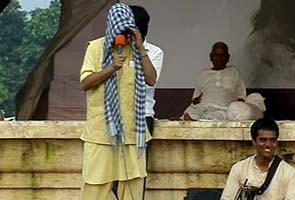
Bedi then moved on to theatrics and enacted what she said was how politicians behaved. Bedi pulled a scarf from the neck of a young activist on stage, wrapped her head with it and proceeded to mock MPs.

"You remove one mask, then you find another one, and then another. They change words according to time and place. Never trust them," she said.


What is the objection to? That she poked fun at the MPs or that she enacted this parodic scene? Despite my antipathy towards the whole movement, I fail to understand how this alone reduces her stature. Her calling this act a “game-changer” is a bit too delusionary, but at what point in time has there been no drama in this rally?

When Anna Hazare came on the music reality show “Little Champs”, he too sang a few lines of Gandhi's favourite bhajan “Vaishnao jan to”; Arvind Kejriwal asked the kids to come to the rally and give a boost to the ‘andolan’. Many singers and actors did. This was the nature of the movement. Ms. Bedi was just playing her part.

Does anyone recall Asma Jehangir and company singing in a television studio on one of those ‘aman’ programmes? Street theatre is very much about activism. Did not Sushma Swaraj dance, and was the objection to her doing so essentially relegated to tarnishing the image of Gandhi’s Rajghat?

Bedi as cop

The problem with Ms. Bedi’s stance is that she, who claimed to be the dissenting voice against any authority, is now calling herself a mere soldier. She is not even that and seems more like Anna’s nurse.

During the 1984 anti-Sikh riots there were pictures of her, lathi in hand, fighting the mobs. It was an iconic image that has stayed with some of us. But in later years, even as she was honoured as a ‘supercop’, she was accused of being a publicity hog.

Let us not forget that she has endorsed a detergent to show how to clean dirt. Whether we agree with her or not, this is what has been embedded in the public mind.

As for her opinion on politicians, is not the Jan Lokpal Bill fighting against the system’s version?

What I am trying to say is that she is pandering to type and not going beyond the script because it is the best option. As for her saying that our leaders wear masks, wasn’t Atal Behari Vajpayee called the “mukhota”?


Only because some of us – in fact many of us – do not agree with the Anna caravan, I do not see any reason to respect politicans as a reaction. We must respect Parliament and the Constitution. Individual ministers are known to be venal as are individual activists.

This brings us to the other leftover issue. Actor Om Puri got a whole lot of mileage for landing up slightly tipsy and making a speech where he called our ministers illiterate:

“I feel ashamed when an IAS or IPS salutes a "gawar" who is a Neta. We have more than 50 percent ‘gawar’ Netas. Don’t vote for them.”

It has resulted in much semantic knowledge of what really “gawaar” means. Is it crass, or lack of knowledge, or just illiterate? How does it matter? Is this the first time anyone has said this about our politicans? Did not Amitabh Bachchan, a neta once, call politics a cesspoll?

Om Puri in the last couple of years has shown that you may be literate and educated but you can still be crass. Literacy does not imbue people with decency or common sense. If anything, he has insulted the very aam aadmi, the considerable numbers of unlettered people that constitute the Indian population and who this Team Anna is claiming to be the voice of.

Political leaders have been quick to trot out numbers of MPs and their degrees. I remember a forward that was sent some years ago listing out Manmohan Singh’s impressive CV. What does it mean when it comes to the real world of steering the country outside the ‘economic progress’ bubble? How has the educated Narendra Modi fared with the common people? Did not the rustic Lalu Prasad Yadav, who was seen as a standup comic, gain respectability only after he was invited by the posh management institutes to lecture?

What is most amusing is that many of these foot soldiers, by putting their foot in the mouth, are only making Anna seem more saintly than he is. They are the shoulders he can happily fire the non-violent gun from. And to think that some people believe that the elite dislike Anna because he is a poor villager. Oh sure. Had he not been legitimised by candle-light, these barfers would not have been supporting him. Isn’t he too a “gawaar” and we do have a former top police officer saluting him? What a circle within circles. If this is not politics, then what is? Or shall we say politicans trussed up for the kursi, with the readymade words, “We think it will be better to fight from within the system”?


Talking of leftover matters, I wonder why there isn’t much noise about the symbolism of two little girls offering Anna his first drink to break his fast – one was a Dalit, the other a Muslim, we were informed. I can imagine the communal harmony waalas applauding. I find it revolting. As though it is okay to drink from the hands of Dalits and Muslims. The only symbolism here seems to be the poor souls make for good water/message carriers; they cannot be the fount from which wisdom and change can spring.


End note:

Why has Rahul Gandhi been silent? It is the most sensible thing to do. The visible face of the country is the prime minister. By letting him manage with his core group is a smart move. Rahul, once he is anointed, will need the Mr. Clean image. That is probably his only USP.

28.6.11

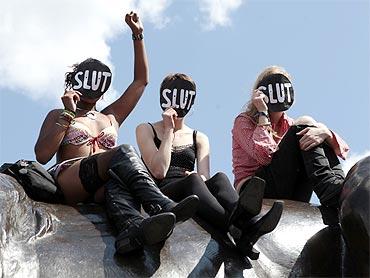
Will Ramdev Join The SlutWalk?


I’d like to know how many of these women who are promoting the SlutWalk in India are bothered about sluts. Spend a day as a slut, a whore, a sex worker and then tell us what it feels like to be called a slut after servicing upto ten men in a tiny cubicle behind a dirty curtain. Yes, you want to bring awareness to India, then don’t ride on the name of a group of women who don’t wear masks or carry placards saying they are sluts. For them it is bloody work and the only means of earning. And most of them do not dress up in fancy dress even when they have to lure men for their keep.

Some of them should get together and protest against this group of pampered pop activists and prick their bubble.

Women, feminists and others, have been writing about their bodies, about sexual exploitation, about objectification. So, why is the SlutWalk being heralded as something that has finally arrived in India, like some colonial hangover after a rave party?

I thought I’d give this major happening a pass because what does it say that one has not said before? But the people responsible and those opposed are gearing up for it. To sufficiently localise it, they have added ‘besharmi morcha’ to the terminology. What does it convey? That, yeah, we are shameless and so what?

Someone said, oh, cut out the crap about rural women, as long as it works for some. It works for the very people who already don’t give a damn, will dress as they wish at their lounge parties and ask for “Orgasm on the beach’ from a bartender who has seen more cleavages than cognac bottles. It will work for the teen brigade that is looking for a heart-stopping, heavy-breathing cause that is in your face but does not need much work. It will work for a certain kind of feminist who is discovering her ‘ism’ and a walk won’t hurt.

It is true that women are often derided for what they wear, but it is disturbing to see westernised clothing as representative. What about hipster sarees and backless cholis? How many of the girls/women will be dressed in everyday clothes and not hot pants and short skirts? Because this is making it into a garment association and women are objectified even in the workplace not because of what they wear but who they are – talented, confident and achievers. Their achievement is stimulus enough to taunt them.

The SlutWalk is not only about rape, but while Bollywood films of the 80s often had courtroom scenes where a lawyer raised sexist questions, art-house cinema has not been much different – what about ‘Bawandar’ that was based on the Bhanwari Devi gang-rape case? The protagonist was asked: “Were you wet?” She had her ‘odhni’ covering her, but her head was not lowered. Finally she said, looking straight into his eyes, in her dialect, “A woman gets wet when she is intimate out of choice, but when it is forced on her she bleeds.”

It is sad that we begin to be thankful for small mercies, so if someone takes on the ‘challenge’ of portraying a true story, we shower hosannas. But think about it. The rape in the movie was depicted quite graphically. Then at the police station the cop is shown smelling the victim’s ‘ghagra’, swirling in it and finally masturbating. There is also the lasciviousness of the MLA who asks the culprits whether they enjoyed it or not. All this in the name of realism.

Do the Dilli billis know about these aspects? How grounded are they in such real issues and what about the already educated men in the BMWs who commit date rape? What about marital rape and the silence of emotional rape?

Now we have Baba Ramdev who has made the accusation that the cops had plans to rape his female supporters at the Ramlila grounds rally. It is pretty disgusting the way women are used all around. There are several cases where such things happen, but in an open ground with the ruling party watching and seeking electoral brownie points? Isn’t it surprising then that he chose to dress as a woman to escape? Has he ever commented on the Nityanand type swamis and their antics captured on camera? Or the godman who sold pornographic CDs of young boys and girls against the exotic backdrop of the Varanasi ghats and of his wife too with deity pictures in the background? Does Baba have anything to say about these?

The Slutwalk is a minor tic, but today when everyone wants to be a concerned citizen, it could turn into a movement. I won’t be surprised if some media group joins in to sponsor the event. After all, we do have beauty pageants that already flaunt the female body as an example of empowerment. The ramp is the precursor of the SlutWalk. No one calls it ‘besharmi’ because these girls are trained by ‘experts’ and Mother Teresa protĆ©gĆ©es in diction and clichĆ©s. They speak up for causes ranging from global warming to education. Not one of them has spoken up for the real slut. The whore. The sex worker. The woman who works by getting fucked. Really.

If on the appointed day they can walk and show solidarity for those women, then these hawks can tawk.

- - -

(c) Farzana Versey