31.1.16
The court of yarns
As I was about to enter the court building, it seemed as though life had stopped. I couldn't move. One side of my sandal had given way. I'd have to limp. I chose to pick up the sandal and pull out the dangling sole. Quite nonchalantly I wore it back. That's when I heard a short laugh. A lawyer. I smiled back.
"Affidavit? I'll do."
"No thanks," I said.
Suddenly, as if the silence had been broken by a click of the heel, I found about six men in coats offering to notarise and legitimise any form I'd give them.
It was a sad sight. These men (no women were around) had earned a law degree. Yet, they were reduced to hawking their services in the streets. Think of the disparity between the uncertainty of their jobs and the famous lawyers with their well-appointed chambers earning in lakhs for just a one-hour consultation.
I stood near the lift and asked where I'd get the stamp paper. "After one hour," said a man chewing paan.
I decided to go up, anyway.
It was dark on the floor. "Kya?" I turned around. A peon wanted to know what I wanted. "Aadha ghanta baad," he said. It was progress. From one hour my wait had reduced to half. There was a room to the left. I stood at the door. A big-built man in a white bush-shirt smiled. "I am looking for stamp paper. May I wait here until they open the counter?"
He invited me in and motioned towards the chairs near the windows. It was bright, so bright that every speck of dust on the tables was visible. For the next 30 minutes, I watched.
Plastic chairs were stacked over one another and some staffers sat on them in their stacked state. Umbrellas were opened to dry, even though it wasn't raining. The sweeper began work, and dust flew leaving a temporary cloud of smog.
There were lockers with names of lawyers. One of them entered. There was a picture of a deity on his locker. He bowed before it. Then he brought out his papers, locked it again, and bowed before the image once more before sitting down to open the files.
This was repeated by at least two other lawyers while I was there. One of them, after performing his religious duty for the day, did not seem too happy with my presence. I might have intruded into his private space, and although I had tried not to gawk, I'm sure even a sideways glance would have bothered him.
It was nearing 10 o'clock. I went to the counter. "Five more minutes," said the woman. I went back to my window-view seat. The room had filled up, everybody was working, yet there appeared to be slumber in their air. It reminded me of holiday afternoons of my childhood where everybody was busy reading, knitting, playing cards, or just snoozing.
I realised it was past ten. There was a queue at the counter. This was unfair. Would I have to go and stand in line after having waited this long? No. I was asked to go to the other side. The task completed, I returned to that room and sought out the gentleman, a clerk, who had let me sit there. "Any problem?" he asked.
"No," I said. "Just wanted to say Thank you."
He shook his head all around and spread both his hands and said, "Work done? Good, good."
I stood near the lift. A board in Marathi read, "Thooku naye." Do not spit. The peon made a fixing lightbulb-like gesture. "Neeche nahin jaata." No lift to descend.
With sole-less shoes I started on my way down. The staircase walls were peeling, the steps were dirty. As I reached the ground floor, I was shocked. There were commodes and a flush tank. Hay and cardboard were spread around. These must have been the toilets. A woman was sweeping. She kept sweeping into the spot and from it. I waited on the second-last step. She saw me and gestured that I could pass.
In less than an hour I had experienced without barely any verbal exchange the lives of a few — from their worship to the way they drank their tea, from the dust on their files to the sweat on their faces, from umbrellas drying to eyes squinting at the sun. Lives we pass by everyday without pause for thought.
And to think that all I needed was a stamp paper that would certify an identity.
1.1.16
Whatever will be, will be
![]() |
| The star in the new year night by Eugen Bracht |
I could not find the right curtains at three stores. If three stores that are known for their nice curtains do not have what I need, are my needs difficult to fulfil? Or are they catering to a template of expectations?
They showed me red, red in its many shades. They showed me brown, brown that covered distances from beige to the darkest wood.
Rust, I said. I wanted rust-coloured curtains. This? And they showed me a pink, faded and jaded. No, I said. Rust. Their faces were question marks. "Rusting is the common term for corrosion of iron and its alloys, such as steel." How could I explain this when it is not what I ever thought about when the colour rust danced before my eyes?
I rummaged through piles. Nothing. I left. With a few things, but not what I had set out for. There are always a few things that act as placebo, but placebos work only if you are looking for an ailment, not a cure.
The rods were empty this morning, like bare branches. I stared at the brass holder glinting in the sunlight. And then I remembered. The old curtains. Cleaned and ironed, lying in some draw. I am not good with putting up curtains, but I was on a stool, craning my neck and trying to find the fixing places. See? I don't even know the terms.
They are up now. Old. Familiar. Yet new. No dust, no stains, no wear and tear. I look at them with new eyes. Isn't that what a fresh start should be about?
* * *
I have skimmed through the newspapers and surfed past channels holding forth on the year that was. It is a necessary ritual, with some lame attempts at humour.
I recall how years ago as an active media person, I too would write a column or do a feature on the new year. There was the roundup, the people who matter, who don't, what was said, what was done. There was much enthusiasm. Today, with the surfeit of minutiae passing for information and insight, all I can find is regurgitation.
This, alas, is unlikely to change because the dispensers of trivia believe their audience can only handle bite-size bits and the latter shrug believing the dispensers can only dish out this much. They live in a happy compromise.
* * *
A lot has happened around the world.
Donald Trump being able to think he will be President of the United States of America is not only about his temerity but the licence a large enough section of Americans has granted him. He exists because there is perhaps a felt need for him.
Then there is Hillary Clinton who said that Trump is ISIS's best recruiter after he said he would not allow Muslims into America. If one was being paranoid, the other seemed to convey that Muslims hurt by such a move would naturally be inclined towards ISIS. This makes Hillary sound worse. Transparent hate is way better to deal with than such covert projection of stereotypes.
In the days following San Bernardino, the top search phrase was "kill Muslims" on Google. It would be interesting to find out who was looking for such details, and what it might reveal.
Muslims continued to make news, much of it because a bunch of them terrorised the world into believing that they represented 1.6 billion people. It couldn't be their marketing skills, for they were killing Muslims too, mainly Muslims. In fact, it is Muslims who are fighting them on the ground.
In India, it was the cow. Some suggested that the cow should be honoured as the Mother of the Nation, and this was in all seriousness. Cow urine was sought to be used as disinfectant in hospitals; it is already an ingredient in the Patanjali range of products by Baba Ramdev, a yoga guru who has the government of India as his patron.
Narendra Modi continued with his magical version of prime ministership by using the flying carpet jet to see what other countries have been upto so that he can tell Indians what he can do to become like them so that they can become like us with Make in India. It's as simple and complicated as that.
He made a 'surprise' visit to Lahore on December 25, which happened to be Nawaz Sharif's, Jinnah's, Vajpayee's and Jesus' birthday. Much was made of it as a move forward towards peace. It is more about showmanship. The people crave for such visits on both sides. Unless they are permitted such "drop in" moments, peace will be a word on paper erased and rewritten many many times according to the whims of the politicians.
* * *
To wind up for now, I am not cynical about the new at all. I welcome it. I only wish that we did not feel the need to kick out the old. Is there any assurance that the new will not be mere varnish?
Last evening, on my way home I stopped at the end of my lane where the fruit vendor's cart stands. I like pineapple, especially if they are sliced and ready to eat. I do not pretend to enjoy hard labour, and don't find it exciting to cut and chop. He had strawberries too. "They are too bright," I told him. "Stobry aisa hi hota hai (strawberries are always like that)," he said. I gave him an angry look, "Do you think I am buying strawberries for the first time?"
He did not look chastised, and for some reason I liked that, that certain defiance in his eyes. He is a young man, maybe just out of his teens. For him strawberry is upward mobility, the shinier the better.
A beggar woman with a baby held at her hips stood there. What does one do? He gave her one piece of the shiny strawberry. I fished out some money and gave it to her.
As I walked towards home, I saw her sitting on the pavement. She beamed and waved at me, lifting her son's hand to do the same. I waved back and reached my gate with a strawberry smile.
A Happy New Year...may you all find a reason to smile.
14.5.13
Of Garbages and Kings: LBT
I called up the provision store to check if they will renew their strike tomorrow against the Local Body Tax. “We'll know by this evening." I decided to order a few things. Last week, many of us were caught unawares. There was some talk about LBT, but as it was restricted to Maharashtra and was not about FDI or any global issue, it did not make major news.
The traders were willing to take the losses to fight one more burden of tax. As one of them told DNA, “Everyone is aware that the more the number of tax-collecting government departments, the more the corruption. So now, with the introduction of LBT, most traders will end up giving indirect bribe to one more babu."
Who benefitted from the strike? The big players - malls. Reports mentioned the surge of footfalls in the supermarkets. Even those who are not regular supermarket shoppers might now be enticed into 'everything under one roof', where the trolley is an empowering force, and the sight of other shoppers with goods laden atop one another creates a subconscious demand.
The independent stores had understood this even before the strike. For example, I have several choices within just five minutes from where I live. My regular store walla knows it. His clientele is eclectic - from some famous names to the clerk in an office, and everyone in-between. He is a call away, and if the bags are heavy, one can trust the delivery guy to enter the house and deposit the goods.
What is his USP? Customer service. He has not yet tarted up his shop, for most people rely on home delivery. The daughter of an expat friend who visited recently was shocked when she discovered that some of her friends here could also get toilet paper at their doorstep. This is truly Mumbai where the consumer is king.
If the shop does not have something, he knows I'll call up someone else. So, he says, "I'll get it." It could be ice-cream, talcum powder, or fruits. He has never added a markup or service charge for any of these.
There was a bit of romanticisation of 'kirana' stores when the FDI discussion came up. That was just a reaction, for no one calls them kiranas anymore. The owners are mostly third generation slick guys, and in some cases women, who are computer savvy, and don't sit behind a cash counter all day. They are on the go, interested in trying to procure new goods, figuring out the new tastes that people are experimenting with.
One does not have to go to a speciality bakery to get multigrain bread or a variety of cheeses. The fancy organic outlets charge you for walking on granite tiles, but I can get my Indian diet bhel and homemade soya sticks instead of some Polish cracker that has the details of the packaging in Arabic! I can even return open packets, unlike some posh nature shops.
And the guy remembers exactly what our orders are like. So, if I say tissues, he knows which brand.
Last week, in an ironical twist, I ran out of garbage bags. According to the rules in my part of the city, the municipal truck comes every morning and all the waste should be in black bags. The person who regularly cleans the stairways and compound of the building collects it. This has made life infinitely easier for those who earlier had to take the waste bins and topple the contents into a huge drum-like container. Some people would not even care to put a lid on their garbage and it would spill over, only for the 'safai karmacharis' to have to manually pick it all up. The bags are infinitely more humane.
This digression is to highlight garbage. A strike will not stop people from generating waste — we eat, throw out old packages, bottles. Also, think about the wastage in the stores. What we read in the newspapers are huge numbers of so many crores lost in business (it also means loss to the government in prevalent taxes). But food grains and perishable dairy products and the like would need to be discarded.
Maharashtra is going through a drought and this seems like travesty. What about the poor who depend on rationed grains, oil, kerosene, sugar?
The government thinks that traders don't show their true sales figures. Traders say the government wants just more under-the-table money. It is likely that since traders operate on a cash basis, there could be some hidden assets, but most packaged goods anyway are sold at MRP rates. The traders have got their benefits, much like doctors/chemists get from pharmaceutical companies, prior to selling.
Some might think this is an elitist attitude. I am conscious of it, but that does not negate genuine concern. In fact, it made me aware that there is something called a handkerchief, which I had forgotten about due to my dependence on tissues. And for all the noise against plastic bags (quite legitimate given how people dispose them carelessly) the big one was cut at the top and fit in quite nicely into the garbage bin.
As I write this, I have not yet checked whether the strike will not begin again tomorrow. Why did they take a break? Because of Akshaya Trithi - an auspicious day in the Hindu calendar. There were ads in the papers enticing people to buy precious jewellery without any down payment.
If only the clerk and the domestic help could buy essentials in this manner.
© Farzana Versey
7.11.12
What do women get at dargahs?
| Haji Ali Dargah as we see it from outside |
Everybody seems to have been to or wants to visit dargahs. All it takes is a fatwa for the excitement to peak. So, when news came in that women will not be permitted in the Haji Ali dargah, there was no pause for thought. First, a bit from the Rediff report quoting Rizwan Merchant, trustee of the Haji Ali Dargah Trust:
“Women are not allowed inside the sanctum sanctorum of the dargah. If Islamic scholars have issued a fatwa, in accordance with the Islamic law of Sharia, and have demanded that women not be allowed in dargahs, we have only made a correction. They can read their prayers, do namaz and offer shawls and flowers. All that we are requesting to our sisters is not to enter inside the dargah.”
But the decision to restrict women from entering the innermost part of the shrine has not gone down with a women's group, the Bharatiya Muslim Mahila Andolan. "The shrine trustees told us the restrictions were imposed after a woman came inappropriately dressed last year," said Noorjehan Safia Niaz, founder, BMMA, calling the decision unIslamic.
I doubt if this is the sole reason. But I also do not see how demanding the right to visit some grave becomes a case of Islamic misogyny. How many women saints have shrines dedicated to them? Will the Sufis stand up and explain this, please?
Worse, the man selling agarbattis way out of the dargah area ticked me off for not covering my head. The visit was unplanned, so over my respectable kurta I had a thick flannel poncho, it being winter. He said, “Khuda ke darbar mein aakar itna bhi nahin maalum ibaadat ke bare mein?” (Coming to the house of god, don’t you know how to express faith?) I was really angry. I didn’t wish to nitpick that this was not the house of god, unless one refers to god’s omnipotence. But I did tell him, “Sar par dupatta odhne se ibaadat badhti nahin hai.” (By covering my head with a scarf, faith does not increase)
(c) Farzana Versey
28.5.12
Half Truths: Satyamev Jayate (Doctors in trouble)
This time, the host cut down on the vicariousness and concentrated on more information. However – yes, there is a clause – for much of the show the emphasis was on how people are forced to take medicines when they do not need any. One particular example was of a man who flashed a packet of ORS and said that he could have been cured of his diarrhoea and vomiting with this at Rs. 15 instead of the few thousand he spent at two different hospitals.
There are such cases. But ORS is available over the counter or can be prepared at home. What if people start thinking that since most doctors are going to fleece you/mislead you, it would be better to self-medicate? What if it indeed turns out to be a serious illness?
The solutions were simplistic. Go to a chemist for generic medicine and you save money. This is for drugs that are expensive and for major illnesses. What about those we take for common ailments?
It would have been topical had the show also brought up the recent case of a poor man whose wife was denied admission to a hospital after an accident and his sorry tale of running from one to another to another till she died.
The tale of a village in Andhra Pradesh where all women had their uteruses removed should have been seen from the population control perspective rather than medical malpractice. Someone is responsible at a higher level; this cannot be doctors just wanting to make women sterile to earn money.
It is perturbing to know that India spends only 1.4 % of its budget on healthcare. And it was good to see the efforts made by some to use the pay-in-advance scheme, where the poor and the rest can benefit based on their capacity.
The racket and the treatment are two different aspects. Aamir Khan, it is being said with much appreciation, grilled the Medical Council of India (MCA) chief. All he managed was a schoolmaster version of extracting a promise to behave. Taking away licenses from doctors for malpractice is all very well, but how many doctors do we have with regard to ratio of population? Many people still visit quacks. Then, there is the ancillary industry of homeopaths and ayurveda, and these days they are all meshing.
I only hope that we don’t see a spurt of ‘actions taken’ and then the lull. This is an ongoing problem, a tragedy of our country.
- - -
Let me share something I had written earlier about exposing a doctor:
A few years ago I had followed up a case of neglect that could have led to death. A wrong blood group diagnosis prior to surgery. In a chawl at the far suburb of Ghatkopar in Mumbai resided this lower middle-class family; they put all their papers and trust before me. It was late night when I left them.
Next morning I decided to meet the doctor. I entered the clinic and after a very long wait his wife, also a doctor, told me he was not in town. It was a lie for the fruit vendor outside had in fact given me the exact address and also confirmed his presence.
When I went out, I told him he wasn’t in. “Aisa kaise ho sakta hai? Hum ne khud dehka aatey hue aur unki gaadi bhi yahaan hai.” (How is it possible? I saw him enter and his car is still there.)
It was raining outside. I crossed the street and lay in wait, hoping for something. Nothing. The showers were getting incessant and I was drenched. It must have been the time of a blink of an eye when I saw THE car get out of the gate. I couldn’t move. Where would I? How? It was a helpless situation. I left. An hour later a colleague from a magazine told me that he had got a call from the doctor, he was a nice man, very influential. The message was that I should keep shut.
I did not.
What happened? Did the family get anything out of it? No. Except that they had raised their voice. No action was taken despite their case being put before the medical council.
Slowly, it was almost forgotten…a year or so later I was shocked to read that this doctor had been given some award by his own fraternity.
The media today has a greater reach, more influence. It should use it as a weapon against offenders and act as a shield for those who need protection.
As for me, that scene still haunts me of a car that escaped and the rain that wouldn’t stop. It haunts me that I could do nothing. Absolutely nothing.
9.5.12
Footnotes from the ledge
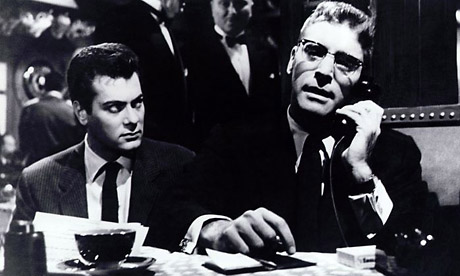
| From the film 'The Sweet Smell of Success' |
Years ago, a web portal I wrote for in the nascent stages of news and views on the Net in India, decided that it needed a footnote for its columnists. I was accustomed to ones that simply said I was “a freelance journalist” (I crack up when I read “independent columnist” – independent from what, of what, by what? Is that not to be taken for granted?) to the smart “refuses to sit on the fence” (it worked against me after 11 years of continuous writing of that column when I was told I was too independent and don’t take briefs!) to a phrase taken from my blog: “has a healthy disregard for objectivity”.
So, back to that e-portal. As some of you know, I could not imagine ‘writing’ for anything that did not scrunch in my hands. I did not even have a computer. One day, out of curiosity, I was at a friend’s office and casually mentioned this column. We reached the destination and as I scrolled down on my discovery trip, I reached that precious footnote. It was in red, italicised. It said that I, FV, was an “iconoclast”.
I froze. Images of me as Che Guevara flashed on several T-shirts. This was serious, and after a few seconds I was pretty much on the floor laughing, and ROFL was not yet known to us. From that vantage position where I had to look my iconoclastic best, I asked my friend whether he agreed with me that it was a stupid idea; he did. And made it sound more ominous: “It might appear as though you are saying it.”
This is the problem. It is more likely that publications decide. However, the newer lot ask you to send “two-three lines describing yourself”. I once wrote a horribly cheeky one and was told it did not go well with the content.
When I became a serious op-ed addict during college, I recall reading pieces that were written with care for both language and thought. Some were ponderous, no doubt, but many were challenging. For me, this is the purpose of a good edit piece. There was space enough to explore ideas, and not the need to compress because there has to be place for ‘likes’, ‘share’, ‘send’. I understand this is the way to connect, but when some publications ask you to send SMSes to say whether you liked or did not like the column, it is a bit much. The writing becomes another product. Unfortunately, these days it often is.
But I did not know who those writers were. Celebrities and those from other fields had not taken over the business of holding forth on what they were doing. This does not work as ‘inside’ information or adds any authenticity, for they too are writing for an audience and have their own biases.
Do readers care about the qualifications of the columnist? It is a bubble theory. It looks good until you prick it. And the pricking is just giving it a good look-over.
However, mostly the footnote works as a promo for people in different professions. I had once taken a swipe at someone mentioning how his CV exceeded the word limit. It was, therefore, good to read on the ‘Self importance of names and titles’ in Pakistan’s Express Tribune as to how the whole description business has gone overboard. When I was writing for them, I had half a mind adding, “The writer has a degree in Vampirism from the University of Dracula”. (Incidentally, third-person descriptions are supposed to look objective; they make me feel schizophrenic.)
Quite a few publications have these long rambling bottomlines, and most of their columnists are so darned third-degreed, all from the best universities. A good university ideally teaches you to explore, not flaunt knowledge.
We never read any mention of a degree from Gujranwala or Chhatisgarh. Reveals our colonial mindset and, dare I say, adds weight to the publication's reputation. They could probably have a roll-call of Oxford/Cambridge/Harvard types, all with halos. If they can take global roundabouts and quote Greek mythology in Latin phrases with a slight nod to desi lingo, then chances are that more people will notice because snob and blob value go together. They are like the always-open KFC outlets.
The other peeve regarding "X is a former something or the other" reveals our absolute obeisance to the past. Instead of wondering why s/he even at the prime has been rendered redundant, it imbues the individual with the gravitas required of a know-it-all. Much like a divorce might make a discussion on marriage legitimate. If the 'formerhood' has been achieved after much toil, then it works like a tiger's head poking out of the wall.
Now, chances are that if the writer were not a "political economist" or some such and just another bloke with something to say, a piece questioning such self-importance would not have gone through the thinker's pose of editorial discretion.
PS: I posted the last three paras at the website with a footnote that said “~A former ET columnist with several degrees of separation”. It’s still awaiting moderation after hours! (Finally published after 12 hours.)
© Farzana Versey
17.3.12
Pakistan on an Indian Spiritual Trip
| The guru in Pakistan |
I stood in the sun, eyes blinking. On that dry Delhi summer afternoon of parched throats and heat without sweat, I was waiting in the queue outside the visa collection window of the Pakistan High Commission. People started exchanging notes. The moment they discovered I had been there before, the questions were rapid: Do you have family there? What are the good places to visit, shop, eat? Are they like us? I became a Pakistani expert, until I saw someone watching me with a bemused smile.
He was a tall lanky man with longish hair that he kept pushing behind his ear in a rather effeminate manner. In that line of nervous people waiting to know whether they had been granted entry, he seemed supremely confident. “So, you’ve been to Pakistan before?” he asked.
“Yes, of course,” I said, now that I was the ‘source’ the group around us had made me into.
“Is this your first time?” I asked.
By way of explanation, he opened a file. The sun was beating down and there was just too much light to read. I shrugged. “Many times,” he said. “For how long do you plan to stay?”
“I’ve applied for a month again, let’s see. And you?”
“Six months.”
“What? Do they give a visa for six months?”
He had a boyish grin that did not quite go with what he was about to tell me:
“I teach.”
“Oh, ok…” I was not sure if asking anything more would be deemed proper. He held up that file again.
“Actually, I teach the art of living.”
When spoken, it sounded like he was teaching Pakistanis the fine art of going about with their lives. But, obviously, he was a tutor with the Art of Living Foundation.
"Do you know about it?"
"Of course. They let you stay there for this?"
I must admit I was envious because of my own experience with visas. I was fairly certain then that there was a spiritualist inside me waiting to come out.
I got my passport and, unfortunately, just then he was called to furnish some papers, so no contact details were shared. If only I had looked at the file he had opened for me. Perhaps, he did not wish to make a public display.
I was curious then as I am now about how in a supposedly Islamic country there was enough space for such quick fix spiritual solutions. I met a few local soothsayers, too. One particular palmist was very popular in Karachi; people would go in their cars and stick their hands out. It sounded like a takeaway joint, only bizarre and fascinating. My friends took me there, but he wasn’t around on that day. The fact is that despite the Islamisation, these kinds of activities have been prevalent.
I recall this now because Sri Sri Ravi Shankar, the founder of the Art of Living Foundation, visited the country recently. I am amazed at the manner in which his trip has been portrayed in the media. ‘He is going to teach the Taliban to de-stress...this is a peace mission’, they say.
Quite naturally, he is not going to let go of this opportunity to appear as more than a soul spa. So he said:
“All those who fight have fear and concerns; they want to feel valuable. Our techniques give them a sense of well-being and calmness, and once the inner calmness happens, the feeling of wanting to fight and the urge for revenge disappears.”
Why has he not tried that in India? We have terror groups, criminal gangs, separatist organisations. He has met some, but will he dare to approach them to stop taking revenge? Can anyone imagine the Taliban members doing a breathe in-breathe out?
This is nonsense only to project the guru as someone with a higher purpose, and a vague Taliban rather than real criminals come in handy. Besides that, he is treading on dangerous ground by getting involved in politics:
“We want to talk with the Taliban in Pakistan. We’ll go in with an open mind, to find out who they are, their problems and their intentions—that has always been my approach.”
He is talking about the ‘we’ of his organisation, not as an Indian. I am surprised that there has been no objection to this. Even ministers who appear in studios with people who are considered enemies of India are lambasted. Those writing anything positive about Pakistan are questioned. And here we have this man talking about an “open mind” regarding the Taliban.
And how are the Pakistanis taking this? Do they not complain about their nation being run over by the Taliban?
At the time of the Lal Masjid incident when Islamabad was supposedly under siege, there were Pakistanis in deep meditation at the Art of Living Foundation, not to solve the country’s problems or shut them out, but to detoxify their indulgences. There are 5000 such people. It is part of one more salon trip.
Sri Sri Ravi Shankar’s mission is possible because he is not interested in really doing anything. If that were the case, then the government as well as the Taliban would have found ways to keep him away. His is a commercial venture, catering primarily to the elite or to those among them who want to ‘help’ others through pop philanthropy.
There is nothing more to it than this. However, it just does not sound important enough. After all, this is Pakistan. Both Pakistanis and the guru need to make it seem like ‘peace’, one of the most abused words in the Indo-Pak context. It takes on the pugnacity of a war-like situation.
This is the guru’s hope trick and ticket.
(c)Farzana Versey
22.12.11
Character Assassination
This is a real note I sent years ago. A colleague had entered my name for a short story competition by the British Council. I was not terribly enthusiastic about such events, but since it required imagining, it was par for the course. I thought nothing about it and since I was not accustomed to writing for a reason, I wove the words at a leisurely pace.
A tap on my shoulder and a thick envelope served as reminders that I paid no attention to. The date of submission was gone. I folded the sheets of paper and put them in the envelope – the address and stamps were ready. My friends were still enthusiastic. I quickly grabbed a page from my diary and wrote down the note:
What else could I say? I am not good with formal letters. Besides, it was succinct and happened to be the truth. The cat in the story had died. Obviously, I had killed it. Yet, its death was a departure, a turning point.
Recently, an Indian media house gave an award to a novel and the jury used a curious phrase for its choice: one of the reasons was “for its non-judgmental attitude to the characters”. How does a writer not judge a character when s/he has created it? This is not immaculate conception. You sweat over it, love it and get suffused in it, for however brief a time. The judgement lies in the nature of the relationship. The writer is the initiator and woos the character. It is possible that the character might mirror the writer. Introspection is also judgement. You are pronouncing a verdict on your thoughts and feelings.
Any objectivity would be forced. The character is because you are.
Back to my old story, I had written it for myself. In those days, there was no audience I was seeking or speaking to.
A few days later, rather uncharacteristically, I got a note from the British Council. It said, and I will rely on memory and promise not to exaggerate, that indeed I had missed the date of submission and rules would not permit my work for consideration. However, my accompanying note was rather interesting and caused much amusement and they could not but let me know that although the story would not be included in the competition, it was noticed.
I wondered whether dead cats could lick the cream.
10.8.11
Oh, Man!
After going through a battery of tests – I so love the phrase, it seems more important than just saying “many tests” – and letting the guy fill up three vials of blood, I have to go through this altered persona. Had he not poked the needle into what I think is feminine skin and flesh, and looked into my eyes as he took down details, eyes that I think are womanly, and then there was the rest of me, not to forget my name that would rarely conjure up a man, not even a metrosexual?
They had to send the samples for a recheck. So, hello, hello, I asked the lady over the phone, when will it be ready.
She asked, “Name?”
I told her.
“Okay…here, male?”
“Is that the report?”
Could my blood have a new gender?
“What male?” I refuted.
“It says F, male.”
“No.”
“You are not F?”
“I am, but not male.”
“Then what?”
I was given a choice. Imagine that!
“Female,” I said in my most demure voice.
“Oh, I will have to make a new printout. Reports ready tomorrow.”
These technical assistants would make good prƩcis writers.
So, today I went, and even dabbed a reddish gloss on my lips, and my blouse did have a sort of interesting neckline, just enough. I wore slacks that clung to me. And I wore open sandals to show my feminine feet. It was probably unintentional, but the subconscious is a killer.
After paying up for the three vials of blood, the receptionist said, “Are you only F?”
“No, I am more.”
“Then is this your report?” She went out to read all the stuff that was supposed to be tested. I said yes, yes, yes.
“Okay. Male?”
“What? Look, there was a mistake and I had told them and they said they had made the changes. FEMALE.”
“Changed, changed. Must be.”
I just took the file and reached home. The pages were neatly typed, the sections demarcated – low, high, normal range. I could not figure out most of what it said. Just as I was about to close it, my eyes spotted the column that said “Sex”.
“Male.” Typed clearly. On all the pages.
It’s no big deal, but I wonder why I have started slapping my thighs and laughing at my own jokes. My aim is still pretty good, though.
1.5.11
Joy Maharashtra
The success of Maharashtra is that the Gujaratis have been such an intrinsic part of it and not just financially, although that is a factor. Mumbai is undoubtedly the fulcrum. It isn't the heart of the state; it is the pair of legs - toned, sleek, long but with calves that curve with mischievous intent, and as the legs cross you get a peek into what it has always wallowed in. Basic instinct.
Of course, Maharashtra is more, and I can think of so many memories.
My Puneri sarees bought from a small shop in Lakshmi Road, often the local nine-yard one that I'd use to get extra pleats as well as add to the choli blouse, buying bhakarvadi, riding the Deccan Queen, eating at Dorabjee's, picking up Shrewsburry and ginger biscuits from Kayani's Bakery and watching 'Ghashiram Kotwal' on its last legs with the original cast as a guest of Dr. Mohan Agashe, who just minutes before he was to perform the lead role of Nana Phadnavis was sitting at the ticket counter.
There was the Osho Ashram and long before I went in, I had watched a man in saffron robes meditating with open eyes at the park- limpid eyes that could be meditated upon. I was called back and returned to the real world of Maganlal chikki saved from Lonavla.
There was the village in Mahad where I had gone with some NGO, and we sat in this huge room on a frayed chatai with men in white topis discussing important matters. We spent the night at a nearby guest house and heard dogs barking. In the village there was a beauty parlour and many young women wore sunglasses; their hair was braided and tied with colourful ribbons. I saw the puppet makers, the dancers, the women who cooked in the light from gas lamps.
There was me hitching a ride on a truck because there was no public transport beyond Uran to get to the rehab place in the interiors where I wanted to pay a surprise visit.
There was the meal of thick chapattis with dry dal and garlic chutney, sitting on the floor with women who were once sex workers.
There was the government circuit house that smelled of old jasmine strings worn by the women who had danced for our fat cats the night before. And then there was fried eggs with soggy toast at 6 PM overlooking the lush greenery that only the privileged can afford.
There was a cinema hall in a small town where we could sit anywhere. No popcorn here but hot batata vadas and chaha (tea).
Tea. Cutting chai that is cooked till it looks mean and dark and is then offered in a saucer, the better if it is chipped.
There was Satish at Ganeshpuri who trapped aliens from Mumbai at the bus stand but introduced me to the cheapest and most delicious thali. There was me ordering poha, palak, roti and puranpoli and shrikhand along with 'rice plate' only to realise that rice plate had almost everything. At night he lustily danced to religious music. His plea was to get him a chance in Bollywood because he could shake his pelvis like Mithun Chakraborthy. He was stuck on Disco Dancer.
There is Bollywood. Nothing comes close and nothing can be further from it. Like Dharavi, it has a little of everything and everyone. It lives on other people's dreams. It lives for the day but will outlast the years without growing old.
I open the cupboard and spot the green and maroon saree and can feel the jostling of people in Dadar where I bought it from and the taste of dahi misal I had eaten later at TT Circle still lingering in my mouth . I touch the soft cotton fabric and it has my history woven in it. The history of a day that doesn't fade.
14.3.11
The Interview
How does it feel to get into the mind of someone, I am often asked. The answer is always: Challenging. Almost all of my one-on-one interviews have been rather intense. It is two people in a room, not unlike the relationship between a psychiatrist and a ‘patient’, except that the roles can and do get swapped. It is amazing how much you discover about yourself in the very nature of the queries you pose. Even after all these years, I like to have some questions ready; there on I take off from the response I get.
Then, a Pandora’s Box opens, and the treasures could be precious memories, newly-formed opinions, or skeletons, and there have been occasions when the person has broken down or felt elated or got angry because what had remained submerged suddenly spurted out. The catharsis was not expected. I still recall this woman quite literally jumping on the sofa I was sitting on, her rage barely contained. It was a large house filled with antiques. Should I leave or leave her alone? The answer came in the form of tears - mine. I sat there, plunging my nails into the upholstery. She had calmed down and reapplied her makeup. There was a smile on her lips and her long fingers touched my hand.
One thing I know. If you are not honest, you won’t get honesty. It may sound strange but I have met honest politicians, or at least whatever was discussed was done so honestly. Recently, I had to make a sort of list of the interviews I have done and the range includes industrialists, gangsters, people from films, academics, science, sports, activism, feminism, theatre, writing, media, astrology, psychology, sexology, religion. These are what may be called ‘names’ in their respective fields, but there have been very many others who were interviewed on themes. It could be a story on beggars or eunuchs or nuns. (Me: “Sister, what do you fantasise about?”)
How much of oneself enters into the subject’s voice? It depends on how the interview has progressed. I do not buy into the theory that one must not express an opinion in an interview. I spend a minimum of an hour and besides the words recorded there are the background sounds and images and my own voice.
“I was looking for your voice,” said a writer-colleague about my book. “It was there throughout but I found it most evident in the section with interviews.”
“But, they were speaking.”
“Your questions were what created this chain and sometimes you’d just move on, almost impatient!”
It was a perceptive observation and quite true.
So five months ago, in October, when I got a call from Khaleej Times (UAE) asking for an interview, I did not at the time know anything about the media there. “Why,” I asked.
“Because of your book.”
“That’s been around for a while,” I said.
“Yes, but it will be interesting for our readers and we will also talk about the other issues you write about.”
She told me she had been “warned” that I was very particular about whether she had really read any of the stuff and promised me that she had and will read more before we met.
I walked into the hotel lobby where we were to meet. My foot was recovering from a fracture so it was in a stopgap air cast. I would have been easily identifiable although the white slacks did cover the pumpkin green cast. No, she did not spot me. I just went up to the lone young woman sitting there in a hijaab. We moved to the coffee shop and the first thing she said was, “I was told you are a veteran.”
“Hmm, well, yes, I guess so…”
“You don’t look…” and the thought trailed off.
I told a media friend from that part of the world about it and asked how one was supposed to look like a veteran and why did I not, and he was quite exasperated, “A normal person would take this as a compliment.”
The interviewer was honest. I could sense it. There were questions about inspiration, the book, my political views, the process of writing, and some fun queries. It went on for over an hour. I did not want a photographer around. Now, I don’t have a portfolio and I took a few self-timer pictures. It shows.
I got a small shock when I saw the paper (it was in the main section and not the supplement and was duly announced in an earlier page). The low-resolution image had been blown up. I immediately knew what had happened. It helps being a ‘veteran’. Most of the quotes had not been carried and it must have been a last-minute decision. People who know informed me that my views are not always ‘proper’, so they had to temper it. Why could they not use a long blurb, instead? It was also referred to as a new book, but again my friend said, “Some people think Anna Karenina is a new book.”
The problem is that if you have been an interviewer for long, you do tend to be understanding: People at the desk only know that chop means chop from anywhere, including have an abrupt end without any context. I was particularly distressed about discovering that I do not read. I do not read maniacally other people's views on the subject I am working on. It does interfere.
This is one more aspect to note. I research a person only to an extent that I know the background or the specific topic of expertise. In my case, I have already spoken quite a bit, written a lot, there are reviews, so rather unfortunately a good deal of that seeped in and the interviewer’s fresh queries and my replies went wasted, except about how the book happened which I have not spoken about yet. Heck, she should have asked me about favourite fragrances or something and there would be more words rather than the grainy picture.
But you know what? Most people don’t care for what you say or how you think. For them a big picture is the big picture. So, text messages were exchanged about how I was in the news. I found it embarrassing, which is why I held back until now. Because now I can see the humour when an acquaintance who does not have any interest in writers or writings had held the paper against the lamp in a Chinese restaurant and said, “Man, I did not know you had been mainlining. You look like you’ve been out of rehab.”
“Hrmph, so has Lindsay Lohan. And I am a veteran.”
- - -
The interview is uploaded on 'A Journey Interrupted blog' here.
Yes, there is a scanned image and I have never mainlined or mainstreamed for that matter!
29.10.10
The blonde on webcam
It is obvious that she is talking to a known person. Maybe a husband, a boyfriend, but most certainly someone with whom she is intimate. There did not appear to be any obvious intimacy. She would not have chosen so public a place and there would be people who’d understand her language. I understood her language, in an unspoken manner – the language of distance, of pain, of pining, of sexual tension. It was evident as she inadvertently pulled out the headset and the male voice could be heard on the speakers; she plugged it in quickly, as though it were a cigarette butt left burning.
She did not say any goodbye. I only heard a sigh as she snapped close the laptop. She wore a skirt with a misaligned hemline and stilettos; her blouse clung to her tiny frame and her hair suddenly seemed too much, too big for her frame, for her face, for her body. It was like a camouflage for her person, since for a long time that is all I saw of her.
She went to the cash counter to pay and the jerkiness of her hand movements as she fidgeted in her purse and insisted that she did not need a bill even as she grabbed it and then ran her fingers through her hair, pulling out the tangles, almost straightening it, those curls now needing to be tamed into relaxation…she might go out for a drink and let the slight headiness weaken her senses or she might retire to her room somewhere and recreate the conversation. I can hear her voice in the breeze as it blows gently and then creeps in between the fronds with a whoosh sound that falls silent as maybe a leaf falls into a whisper.
She’ll find that breeze echoing in her room and envelope her body.
13.8.10
My iPhone’s got a headache
In what has been described as an unscientific but fun study, it was claimed that iPhone users have more fun than other smart phone users. And it was the women who managed that figure of 12.3. I understand simple figures, preferably full; on a bad day half would do. But what is ‘.3’? Is it one- third of a man? Probably the iPhone manages to attract just this much in the 13th potential target. I am just guessing. Women, unless they are on the phone, usually prefer to put it away in their bags. Depending on the trend and the choice any woman exercises, the level of the bag could be from somewhere near her waist to her hips; if she is using a short-handle one it might skirt her knee, and if it is a clutch then it would brush against her thigh. The third part of the man that gets enamoured would have to be in that range.
Is that a hit? Does not some level of attraction start from the top? Do these phones naturally give out vibes, irrespective of where they are?
Come to think of it, this could be quite serious. When I first went to buy the phone it was raining that September day as I, with much trepidation, entered the service provider’s store. They said it was ‘out of stock’.
“Oh, really? I have already called your head office and they have directed me to this place. Hang on, let me call.” I called someone and told her that I was a loyal client and they had promises to keep.
I think someone liked Robert Frost. They asked me if I could wait, it might take long.
While I waited, not like regular folks on those fake happy-looking red benches, but at the desk of one of the executives, I kept fidgeting with what now seemed like an antique handset. Thoroughly bored, I turned around and found a rather large man watch bemusedly at what must have been my huge handbag.
“You are waiting for an iPhone?” he asked in a heavy American accent from a posh expat mouth.
He told me the story of his iPhone and how the screen had frozen. “You must be a Mac person,” he said.
I had never seen a Mac, let alone used it then. But it seemed that to be an iPhone person you had to be a Mac person; not just a Mac person, but an Apple person, for he went into a detailed discussion about Apple. I kept ‘hmming’ with interest. I can sometimes look quite intelligent, so it helps.
Impatient as I was, I was already being initiated into the sexual rites of possessing an iPhone. He decided to give me a tip. “When you touch the keypad don’t let your thumb hit the key, just touch it above the letter. Gently.”
The guy who brought me the black box did not look like he could be gentle with anything. I asked for the instruction manual. “No, it’s all there.”
“Where?” I asked.
He shook his head. My saviour had gone into some secret dungeon to see if his phone had thawed. I discovered that smart phones don’t need manuals; they need men.
I departed carrying what I thought was just a spiffier version of a cell phone. Little did I know that I had been given one with no sex appeal. All it ever did was dial numbers only because I had touched it at the wrong place; it slipped from my hands, which made it mandatory for me to use a cover. Oh, it’s a dominatrix leather one, make no mistake, with a strap, a button and even a steel ring that could pass off as a handcuff. I guess all this was subliminal.
It was happening without any attempt on my part. A lot more was supposed to happen, and it did not.
So, what is it about the iPhone that the Blackberry and the Android do not have? They are smart; they can connect you to anyone anytime. And I was in fact planning to buy a Blackberry. Did my iPhone realise it was the second choice and therefore decided I did not deserve to be imbued with special magnetism?
If this survey is just a flippant foray into gizmo territory, then think about another one a year ago. It wasn’t even a poll; it was an analysis by Strand Consult who don't think we, the users, are particularly smart:
"When we examine the iPhone users' arguments defending the iPhone, it reminds us of the famous Stockholm Syndrome--a term invented by psychologists after a hostage drama in Stockholm. Here, hostages reacted to the psychological pressure they were experiencing by defending the people that had held them hostage for six days."
I have never defended the iPhone; if anything, it has to make excuses for me. I don’t even use it well enough and I have not upgraded it. So, where is this hostage drama? I like it because it does some things and don’t because it does not. This bunch of consultants has the audacity to declare:
"In reality, the iPhone is surrounded by a multitude of people, media, and companies that are happy to bend the truth to defend the product they have purchased from Apple."
I purchased it from my phone company. It did not matter whether Apple or Pears had produced it. There is no need to bend the truth for no one cares about what I have in my hand as I breathe into the phone while talking to them. I use the camera a lot and it accidentally creates the most amazing pictures. And until I tell anyone, no one will know how just a little shake of its booty can produce art.
If I get something that I like more, I will go for it. I am not into smart phones, really. But I would take one-third of Steve Jobs, if only my iPhone did what it was supposed to do.
16.7.10
Fighting feet
I screamed, as though the scream would untwist the foot, get me up from my knee. I was only slipping further, the foot twisting even more. I had nothing to hold on to except the bed. I tugged at the blanket like an urchin tugging at someone’s sleeve. I finally managed to sit on the floor, legs stretched out. With a great deal of effort I got to the edge of the bed and slowly slid up and wept into the pillow. It felt strange. Just minutes ago I had opened my shopping bag and was admiring my new pair of shoes. When I had tried them they fit like a dream and I walked on air. Is this irony? Co-incidence? Or just another fall?
I know people fall. And this is hardly the stuff of Greek tragedies, pardon the mixing up of nations and metaphors. I had been on a high the past few days. I was treadmilling, bicycling, walking, sweating the hell out of myself, and I deserved those new shoes. An Iranian lady had helped me select them with facial expressions and delicate movement of hands. Our unspoken language made me feel good as she pointed me out to her whole family and they all smiled as though I looked like a bottle of Shiraz.
Minutes later, I was fragile glass. I had to manage the night with Deep Heat, which comes in spray form. Its sensual warmth penetrated my feet that ached uncharacteristically for the cold comfort of numbness.
Next morning brought a new pain, the pain of realisation of pain. Feeling pain is one thing. Realising that pain exists outside of feeling is quite another. Pain becomes an entity. It has its own dynamics, its own reason, and it chooses its victims carefully.
X-rays showed two broken bones. “Femur?” I asked the doctor, trying to sound knowledgeable about my body. “No, this is another bone.” He did not name it. There were two – they could be twins or they might be different. He did not think my bones needed names. The nameless bones were cracked. I imagined some fine piece of crystal on a mantelpiece with two cracks. Fractured feet. I needed a cast.
Before we could get to it, I asked the ortho if it would hurt. “Just a little,” he said. I either like a lot or nothing. I said, “Why must it hurt?” He smiled quizzically. I told him to give me local anaethesia for putting on a plaster. He was not amused. The new-fangled things are neat. He just kept winding what looked like an ordinary bandage, the soles touching his chest; for a while my soles could hear his heartbeats – I think on my feet! He was touching the wound gauze with water, pat-pat-pat, and the wetness set the plaster. I was amazed at how a simple bandage got so fixed to my feet. Now I can knock on it and it won't open any door. It is shut so tightly that no air can enter. It’s upto my calf because the pain travels. It must have chalked up quite a few qualifier miles.
I was out in a wheelchair and it felt like a stretch limo. If only I had a gown with a fur stole and a hat with ostrich feathers, I might have been in quite another age. The momentary charade of the imagination has now been replaced with a walker as I limp my way within the four walls. I see images on the walls, picture windows, the river, a beautiful table set for fine dining and the scent of jasmines as white as the cast on my leg. I think of sheesha, cinnamon flavoured, the smoke rings creating a haze, and I think how walls have doors and windows and yet we can see pictures on them without looking out. And I thank such moments for thoughts, for people, for strangers who make all this possible.
I don’t need glass slippers; my feet are glass.
15.4.10
Guns and Lollipops
The man at the immigration desk seemed to be in no hurry. He looked up at me over his gold-rimmed glasses and asked, “Who is in Pakistan?” That had not been my destination, so I could not comprehend his query. “Do you know people there?” he persisted.
“Yes. Why?”
“You made so many trips…”
“London, too,” I said.
“So, how is Pakistan?” He enunciated the name, loud and clear.
I shrugged.
“Tell me, good or bad or what?”
He was humouring me, his lower lip, pink and wet, against his dark skin glistening with summer heat. Confusion would have turned to anger. I was in my country with my blue passport, three booklets pinned together.
“They are really like us only?”
“No. Worse,” I said.
His paradigm had no place for worse or better. It was either good or bad. Gun or lollipop. My name is whatever and I am not a terrorist. He stamped the page and, from his high seat, motioned with his head that I could go.
This had never happened before.
It shows that a Pakistani connection married to elitism is anathema. My thick passport that ought to have been a sign of globalism reduced me to a pampered poodle stretching at the leash.
I could imagine the immigration officer in the auditorium watching the utter humiliation of a Bollywood star made to grovel for approval by the ice-candy man, Karan Johar. I can see those pink wet lips smiling as he sees the awkward walk and the man going down on his knees out in the open because he has to pray. Religion is placed prominently in the narrative of My Name is Khan.
While my immigration officer would have stood for an autograph for Shahrukh Khan, he would not have let Rizwan Khan past his eagle eye. Rizwan, who cannot sell lotions and face creams, is made to sell the Muslim moderate. The story uses disability as a device to cunningly convey fake innocence.
Beneath the ostensible garb of post 9/11’s continual angst lurks a more real danger that seeks to heighten the uncomfortable relationship between Indian and Pakistani Muslims. We have reached such a stage that each time an Indian Muslim bats straight, creates award-winning music, or says something secular, there is jubilation. Intellectuals gather along with maulanas to applaud that we were saved in 1947. The idea of a generation far removed from partition, using that event as a yardstick not only to judge another country but one’s own position, raises the question of self-esteem.
Recently, I met a Sindhi family. We got to discussing food and Pakistani cuisine was mentioned. I seemed to have a lot of knowledge, so they asked, “Are you Pakistani?” No, I snapped. They responded, “Oh, but we are…our grandparents were born there and lived there and came to India later. So we qualify as Pakistanis.”
Why were they confident and why was I not? At a discussion Mahesh Bhatt had mentioned that most of his Indian Muslim friends, even the famous ones, tried hard to assert their Indian identify when they were in Pakistan. He turned to me and said, “I suspect you did the same on your visits.” I did, but not as much as I do in my own country. There I was asserting my otherness; here in India I have to assert belongingness. It is all about loving lollipops, is it?
13.4.10
3 Readers in Search of a Writer
X, Y, Z belong to three nationalities and do not live in their homelands. We first ‘met’ on the page and the monitor screen. I was a byline. There was communication beyond that, but I remained a Person Who Wrote (PWW).One day I met them in person. It was not the first time I was meeting readers, but the first time I was meeting such disparate people within a span of days in one city.
X and I had the longest correspondence and talks and he knew quite a bit about me; he also knew what was not there. In effect, I came away feeling like a curiosity that had been satiated. I was still the writer, the metaphor for a person. I was familiar but that sense of familiarity was black on white. I never became grey or blue or red or pink…and if I did it was as a ‘colourful’ character. The writer became a character. If my blood had been drunk it would have only congealed into ink.
Y is a new recruit! We exchanged only two notes; the first time he was ticking me off because I had written something about his area of expertise and he felt I was wrong. I said I was right about my right to be wrong, and he agreed. So, we were okay. Then, we met. It was nearing sunset and I was dying to look at the sky in all its flaming brilliance. I sipped iced tea; he stuck to Earl Grey. It was an amazing chat, completely metaphysical, and he did what I often do – drew various patterns with his hands on the table: pyramids, squares, other shapes to highlight a point. I don’t know when exactly, but he mentioned a personal incident from my life in passing. I immediately reacted, “How do you know?” He laughed, “You wrote about it!” I did not expect that as someone new he would have read this. More importantly, those pyramids and squares, so meaningful in our debate, now became me. I was also an atom, a molecule, something you brought to the table. I was a PWW.
Z knew me from my book, primarily. He had written a few times, and had got fairly acquainted with my work. He invited me home and I would have met his wife and child, but it was too short a notice. So it was dinner at a club without them. Fun insights about his life, about the diaspora. He asked little. Towards the end of the meeting, he said, “The moment I saw you, I said this is F. Frankly, if you were not what I had imagined, I would have been devastated.” Again, I was the writer, except that he had imbued me with the flesh and blood of his imagination. Yet, the imagination was about what I wrote. During the conversation he had said, “I see you as completely liberated…” I paused. I knew what he meant. As an Indian woman writing on certain subjects I am seen as a bit of a rarity, especially the language I use. In fact, I am told it has little to do with my nationality. I am bold and far too upfront even by normal western standards. Z was, like many others, projecting that onto me as a person.
The parting shot, just before I left, was most amusing and interesting. “But, you can also be quite frightening. There is a divinity about you that seems to go contrary to that other image.”
I chortled. I began to think of a halo around me, but again it was either as a writer or as an imagined person going a bit against that which he said he had also thought about.
It has made me contemplate about whether I want to be seen as just that. Recently, I did not write for a while. One of the reasons was, as I mentioned in Who moved my bubble?, to unwrite myself.
From being a curiosity, a pattern made on the table, an imagined entity, a bagful of words seeping out on the sand, leaving small little imprints and occasionally metamorphosing into crabs clinging to what will be washed away.
Even more importantly, in this supposed bonfire of the vanities I was in fact trying to reclaim my person. I realised only later that although I knew all along that these three people are hugely accomplished in their fields, have interesting experiences – professional and personal – by seeing them see me as only a writer, was I not seeing them only as readers? The difference is that I know them from what they say or do; they know me from what I write.
What sort of synergy is possible in such sharing? It also makes me wonder whether there can be any equitable understanding. Different perceptions aside, does the reader not have the upper hand? S/he can see you as you are, as you could be, as you may not be, as they think you are, as they want you to be, as they hear you are. There is no room for factual analysis at all. Strangely, the subjective makes you into an object.
I used to crave the company of people who had not read me. One friend would boast that she had met me without having read a word and wanted to stay away from my writing as much as possible to see the real me.
As the friendship evolved, she often remarked, “You are so transparent. I can read you like a book.”
18.10.09
Gubernatorially Yours
So, when one fine day I got an email from the ambassador of a certain country my first reaction was 'troll'. He had talked about an exchange of ideas, had given his personal email address and phone number.
I did what protocol demands and wrote back to say thank you and blah. But, remember, ideas had to be exchanged? I waited it out. What was the worst that could happen if I called? Someone would have a good laugh? I'd like that. For anyone to go to such trouble just for a little laughter would tell me a lot about the state of that mind. But I digress.
I dialled the number and it was a foreign accent. I relaxed a bit. Caution did not leave, though.
"Who am I speaking to?" I asked uncharacteristically and impolitely.
"Er...who would you like to speak to?"
"Ok. It's like this. I got a letter from someone saying he wants an exchange of ideas. "
"Oh..." (How was he to remember that?)
"So, do you?"
"One moment. Who do you wish to speak to?"
"My name is FV. Are you...hmm...excellen..." Damn. I was supposed to say "Your" but the PA who had sent the attached note had said "His". So, my tongue was in this conflict zone between His and Yours and how can he be your?
"Yes," he said simply. "My name is X. Now I recall."
"Yes. But you know how it is. I thought you were some crank," I said with a straight face he could not see.
"I perfectly understand. Even in our profession we have to be careful. "
"I was not worried, just wanted to be sure. What ideas do you want to exchange?"
"I read you but want to understand the mind. We must open all channels. I have worked in Y country and know it is important."
"Let me be honest. I write only what I want to. But I can exchange ideas. "
"Exactly. You tell me when."
"Yes. Your Excel..."
"Excellent!"
(The initials used here are fictitious and any resemblance to characters with similar initials is purely fictitious.)
30.9.09
Toilet Paper Tigers

My most memorable loo story is at Madame Tussaud’s. A Canadian woman accosted me after I came out of the facility with, “Are you Indian?”
“Yes.”
“Oh, I am surprised. I did not know Indians flushed…”
“What?” I gasped as I stood near the wash basin.
“I hear that Indians do it in the street.”
“Who told you?”
“My brother – he is a professor and has travelled to India.”
“It seems there is a lot left to his education.”
On the way down (she insisted on not letting go off me), she tried to tell me about yoga and other such exotic stuff and then she took me to a group of people – her family and friends. I was beginning to feel like an exhibit. She introduced me to her father. “You know dad she is from India…”
My anger was simmering, so I addressed the gentleman: “Sir, are you not surprised that I do not pee in the streets?”
There was a group of Sikhs at the next table and one sardarji gave me the most beautiful balley-balley smile.
A few years ago, there was a report of an Indian who wrote to the municipal corporation in Mumbai demanding that licences of five-star hotels be revoked because commodes in their washrooms have only tissue paper and no water.
In his letter of complaint, he said: “The absence of water jets and bidets is unhygienic and also against the Indian lifestyle. Even in foreign countries and at international airports, they have Indian-style toilets to suit Indian tourists. However, shockingly, in Indian five-stars we don't get such a facility even though we pay high prices…If you need to clean up, you either have to get into the bath tub or climb on to the wash-basin, which, as you will appreciate, is quite inconvenient. We are Indians. We prefer water over tissue. So we should be given the option by these hotels.”
While I find the idea of anyone getting into the bathtub or the wash basin to clean up after ablutions disgusting, I know that it is a major scatological issue that can divide the world. Who will tell you this aspect of Indian culture? The jug is a huge obsession. Increasingly, handy sprays are used. In Pakistan they call them ‘Muslim shower’, and I wonder what religious significance it can have. It spurts out water just as anything else.
I confess to being a diehard ‘water baby’. My earlier travels overseas used to be filled with dread. The first time I boarded an international aircraft, I sat cross-legged for most of the nine-hour journey. But thirst and hunger cannot be kept at bay…so I could not continue to pretend I was Sharon Stone for long. I stood in that tiny cubicle that planes think are conducive to bowel and bladder movement and discovered the power of invention.
Sight-seeing trips, especially at sites like museums, usually have long queues in the ‘ladies’. I always believed women were cleaner, but seeing sanitary towels carelessly dumped outside bins and tissue rolls on the floor, I am not too sure.
Indians, however, can be quite terrible themselves. The use of water does not necessarily mean that everyone is hygienic. At Indian airports, there is a bucket overflowing, the taps are open and the floor is a mix of urine and water. The seat is often muddy, the reason being that those fools squat on that with their dirty footwear. How they manage the feat is beyond me.
A friend told me that one should not sit on the seat. “Just pretend to, a few inches off the seat and finish it off.”
If you look the ‘westernised’ type then the attendant – oh, we have those here too – will hand over a bit of toilet roll to you, and when I say bit I mean a bit: it is exactly a six-incher. And then when you return, to your embarrassment, you are handed another six-incher to wipe your hands.
Of course, the great put-down is to say something has been used as toilet paper. Dolly Parton once said, “My aunt in Knoxville would bring newspapers up, which we used for toilet paper. Before we used it, we'd look at the pictures.”
Ah, and I look at meself in the jug of water?