Showing posts with label places of worship. Show all posts

4.1.14

The Pontiff's Closet


What do you think about Pope Francis being chosen Best Dressed Man of 2013 by Esquire? When the magazine says, "Pope Francis's sartorial decisions have subtly signaled a new era (and for many, renewed hope) for the Catholic Church", it is jumping the gun. As religious head, he has certainly proven to be immensely likeable. He is discussed for his symbolic gestures, and they might not alter perceptions but do send out signals about a modernistic way of looking at social mores.

However, I believe that a best dressed tag does not quite reward these gestures, much less comprehend the nuances that might get lost and possibly lose track of what is being symbolised.

Mark-Evan Blackman, assistant professor of menswear design at FIT, has been quoted as saying:

"His mode of dressing really does reflect the mindset behind it. I remember when John Paul II was buried in those opulent bright red shoes. When the current pope was elected and chose not to wear the red shoes I thought that was very reflective of his approach to being a person functioning in a role."


Every position comes with a set role, and the only dissonance possible is in terms of interpretation. That does not alter the inherent nature of the role. For true believers, the red shoes were not an impediment to their faith, just as the discarding of them will not be.

Ann Pellegrini, Associate Professor of Performance Studies & Religious Studies at New York University, goes over-the-top:

"The humility of his garments offers a way to visibly display his theological and material concerns for the poor. This Holy Roman emperor really does have new clothes."


While it is true that the Pope has been "approachable" and "humble" — though such a station is supposed to be about humility and subservience to god, is it not? — a reality check is needed here.

I am not a Catholic, or a practising believer in any organised faith system, but being surrounded by several streams of theological thought it is obvious to me that devotees, especially those unfortunate enough to be poor and homeless, do look up to pomp and splendour. It is their means of escapism. And, dare I say, hope.

Unlike the well-heeled and the educated, they do not marvel at church spires and stained glass windows, nor do they appreciate the fine filigree work of the Islamic architecture in mosques, nor the fine motifs in Hindu, Jain, and Buddhist temples. But, the sheen of the altar, the sanctum, the idols does affect them. The brighter these are, the more dewy-eyed they get. This is not about materialism, but to experience what they do not possess. It is an egalitarian moment for them, for it renews their faith due to its obviousness. They seek no evidence of the power of an aura beyond what is evident, even as some of us might rationalise.

In fact, Esquire is doing just that. Yet, quite ironically, it is performing papal sort of duties by anointing the Pope with a grand gesture that contradicts the purported purpose of rewarding him: austerity.

© Farzana Versey

22.10.13

The pose and the mosque


Why was Rihanna posing for pictures at the Sheikh Zayed Grand Mosque in Abu Dhabi? Some are likely to titter over the accusation of "inappropriate" or “indecent pictures” that made the officials ask her to leave. Nobody is bothered about one simple fact: she was told to leave before she posted the photographs online. She was going against visitor protocol prior to the religious one.

However, one cannot nitpick about some things, such as when model Claudia Schiffer had Islamic verses on her dress at a ramp show. Indeed, there was a reaction to that as much as there was to Madonna using Sanskrit shlokas in a song or images of the Virgin Mother or the Buddha being commercialised.

But, every place has its cultural requirements, and a place of worship is not meant for 'posing'. I include politicians and celebrities doing so at various shrines, seemingly in a fit of adept fervour, but in reality to get mileage and publicity.

She was on a tour in the UAE, so clearly she must have seen people in various kinds of clothes, including western wear, at her performances, in her hotel, at clubs. These include women from some Arab countries. So, why did she have to mimic a veil, by wearing a hooded jumpsuit?

If anything, this is offensive. This makes some people laugh at 'indecent' (put in single quotes). She, in fact, appears to be smirking at some of the other women. It is insensitive, and insensitivity is indecent.

3.10.13

Secularism and shit

Have we exhausted all options that political parties are fighting over who spoke about sanitary facilities first? If this is a necessity, then go and build those toilets instead of throwing up nonsense.

In his now familiar style of useless rhetoric, Narendra Modi told a group of 7000 students in Delhi:

"My image is that of Hindutva but I'll tell you my real thinking. I have said in my state: pehle shauchalaya, phir devalaya (toilets first, temples later)."


It is not his image that is the problem, but his fake attempts to wipe that image when and where it suits him. Addressing a young audience in the capital is different from repeating these words before the RSS, the Vishwa Hindu Parishad and his own party, the BJP.


Will Modi say this in Ayodhya? Will he say this while talking to the sadhus who blessed him at the Maha Kumbh? Will he make this into an electoral issue and expunge any reference to temples? Will he be able to sell this idea at the woo-the-minority rallies and add other places of worship too?

It is not only Hindutvawadis who need to use the facilities.

He further stated:

"I define secularism as nation first, India first. Justice to all, appeasement to none. No votebank politics - a poor man is a poor man, where he prays is immaterial."


Why is this only about the poor? The majority that lives in the rural areas have figured out how to use waste as manure. He knows that the poor do not vote if they are promised toilets. They first need something to eat before they can digest it. They need water, they need jobs, they need healthcare, they need electricity, they need roads. They are not looking for a special place to take a dump. Not until their other needs are fulfilled.


And they really do not spend an inordinate amount of time thinking about where they can pray. They just raise their hands when they want rains, and they fall to the ground when they want the earth to sustain them. They do not need temples or mosques or churches.

Justice is not only about toilets. Modi should know that.

---

Not to be left behind, the Congress has joined in to claim credit for the toilet idea.

Rural Development Minister Jairam Ramesh is on surer ground here, though. He had said this last year, and now recalls:

"When I spoke, Rajiv Pratap Rudy said I should respect the fine line between faith and religion. Then he went on to say that the BJP maintains that one should not get into the debate of whether a temple or toilet is more important. Prakash Javadekar also attacked me. Activists of the RSS and VHP came to my house and left bottles of urine. I wonder where they are now when Mr Modi has suddenly discovered the value of toilets. I still believe we need more toilets than temples. I wish Modi had discovered this 20 years ago, then we would not have had the Babri Masjid episode."


The point is, has the Congress done anything about those toilets? Talk is cheap.

After the demolition of the Babri Masjid, there were many ideas floated by Indian citizens, not politicians. Among those that suggested building hospitals and schools, some even mentioned toilets.

I personally think this is reductionism. Nobody is really interested in these non-controversial issues unless they are used to promote 'development'. Imagine a basic facility being touted as development. Worse, it is not the ones who are supposed to benefit making the demand, but those with all the amenities. They start the fire and then use the smoke. A stinky smokescreen for secularism again.

© Farzana Versey

---


Images: GujaratIndia & New York Times

3.9.13

The call of the muezzin in court


It is such judgements that should make us have faith in the judiciary. Not only has it upheld secularism in Constitutional terms, it has also conveyed that politicians cannot pander to communal sentiments.

Imams and muezzins are most certainly not the responsibility of the government in India. The Calcutta High Court has made it clear that it is not the business of the state government to provide funds to the Wakf Board:

"It is well settled that the state cannot patronize or favour any particular religion. Secularism is part of the basic structure of our Constitution. The state, therefore, cannot identify itself with or favour any particular religion. Imams and/or muezzins are individuals of the Muslim community and attached with mosques. The decision to provide honorarium to them cannot serve the general interest of the community as a whole."

However, I do not see why the judges had to add that it had “unnecessarily created tension among different religious communities which should be avoided in a secular state”. The BJP was one of the petitioners against the Rs. 2500 and Rs. 1000 stipend to the imams and muezzins. What if the Mamata Banerjee government decided to also provide for sadhus in temples – would the bench think of this as equitable and secular because it would then favour others, too?

At the centre of the discord is “public purpose”, with the state believing it should be given the privilege. The court reiterated:

"The concept of public purpose cannot be contrary to the pronounced constitutional value of secularism. If today the government is allowed to spend out of the public exchequer by granting honorarium to the religious leaders of a particular religious community to the exclusion of similar treatment to other religious communities, such a governmental action being unconstitutional, cannot be said to be for public purpose."

While I completely agree that those attached to mosques should be given an honorarium only by the authorities running such institutions and the government owes it nothing – in fact, the community should shun such gestures by the political establishment – I do believe the judges were trying to be politically-correct.

This ought not to become a precedent against minorities and scheduled castes and tribes where ‘secularism’ will be brought in to argue against certain kinds of reservations that have to do with right to opportunity that has been often denied to many.

Let us not forget that Mamata Banerjee is no friend of tribals or even some minorities. Recall the villages that were thrown open for corporate ventures. It is important for the leaders of communities to be alert. Most politicians will only pander to what are explicitly religious places, because they want the sops to be visible from miles away. The ordinary Muslim, Hindu, Christian, Sikh, Dalit does not know, or care about, who runs the show.

It is this ordinary daily wage earner who needs such ‘gestures’ the most. Secularism must not come in the way of that. For, as we know only too well, money is the most secular, and it is in the hands of a few who probably spend more time building places of worship or donating to it. Some even work as backroom boys to prop up political parties with a religious agenda.

©Farzana Versey

11.5.13

Is a goat worth the news? The Bansal case


News stories often dumb down the very issues they are exposing. What goes 'viral' is not the news anymore, but every trivia associated with it. Does it act as some sort of cathartic nervous laughter at the end of a tragic tale, scam or mishap?

This would be fine if the main subject was kept in mind or the 'frills' were handled with some perspective.

Pawan Kumar Bansal, the Railways Minister, resigned after the CBI found that his kin ran a “cash-for-postings” racket. A day prior to this, a goat was spotted at his residence. This is what followed, according to a TOI report:

“Pretty soon, channels had astrologers and pundits analyzing the significance of feeding or sacrificing a goat in Hindu mythology, even though it was hardly clear that the goat was being fattened in order to be an offering to the God. There were panel discussions on the many TV channels about the significance of worshiping white goat and black goat in Hindu mythology. Many were of the view that the apparent appeasement of a white goat on an Amawasya day could change the fate of Bansal who was under fire..."

It does not take long before a joke becomes reason for sanctimonious offerings to propitiate our superiority. Every resignation is treated as drama, when it ought to be the done and proper thing, although neither stepping down nor a jail term has dissuaded politicians from resurfacing in a different garb, by their own party or the opponents. There are always loopholes in the morality scheme.

Bansal was not a visible neta, so news has to be exciting enough. The 'nephew' joke could only get this far and no further, for nepotism isn't new to our society in any field. That's where the goat came in and a newspaper report said that even after the sacrifice he could not be saved.

Animal sacrifice is fairly common, but are we really concerned about superstition? Every leader visits places of worship to appease the gods. What about the havans? Mannats at dargahs where so many flowers are 'slaughtered'? The temples where devotees shave off their hair as offering, which results in a business running into lakhs in export of the tresses for wigs and extensions? Does corruption dare to discuss the bribing of gods?

Not only will the bakra droppings take away the meat of the issue, we don't notice something even more vile just around the corner.

In Ranchi, two girls - aged six and four - were taken away for sacrifice.

Munnlal Ram is a constable with the Railway Protection Force (RPF); he is also a tantric.

The report states:

“The girls were found with their hands tied up. Ram was on the verge of sacrificing them on the altar. Dhanbad police station inspector Akhileshwar Chaubey said, 'Police found nine human skulls in Ram’s house'."

This practice continues in our country. But girls are not goats and don't offer scope for mirth. And that is what news looks for.

© Farzana Versey

7.11.12

What do women get at dargahs?

Haji Ali Dargah as we see it from outside

Everybody seems to have been to or wants to visit dargahs. All it takes is a fatwa for the excitement to peak. So, when news came in that women will not be permitted in the Haji Ali dargah, there was no pause for thought. First, a bit from the Rediff report quoting Rizwan Merchant, trustee of the Haji Ali Dargah Trust:

“Women are not allowed inside the sanctum sanctorum of the dargah. If Islamic scholars have issued a fatwa, in accordance with the Islamic law of Sharia, and have demanded that women not be allowed in dargahs, we have only made a correction. They can read their prayers, do namaz and offer shawls and flowers. All that we are requesting to our sisters is not to enter inside the dargah.”
Why have they issued this edict now? Or, was it already in existence, and nobody noticed because either women did not enter or when disallowed did not think it important enough to oppose?

If the Sharia is being invoked, then what is the role of dargahs, which is worship of a saint? According to Islam, such worship is wrong. Besides, graves are not supposed to be in a confined space and most certainly not have a fancy tombstone to which people bow their heads. Therefore, why was there silence on this matter earlier?

There is a suggestion that dargahs follow a Sufi tradition, which is moderate. I don’t see how and why people have to start asserting such moderate behaviour when the prayers offered are verses from the Quran; the namaaz is sanctioned in the Quran as one of the pillars of Islam.  Except for the qawwalis, there is nothing specifically Sufi about dargahs.

The above-mentioned argument is highlighted to posit it against the stringent form of Islam. This is point scoring, and nothing else. In mosques, women are barred from public prayers. I would like to know how many of the women who are fighting against the patriarchal attitude of the dargah Trust have fought for their right to pray at mosques or to even lead the prayers?  

According to some sources, women cannot visit cemeteries and graves. This is dependent on which sect you belong to, and the only thing I can vouch for is that they do not participate in the final rites.

Further more, the report states:
But the decision to restrict women from entering the innermost part of the shrine has not gone down with a women's group, the Bharatiya Muslim Mahila Andolan. "The shrine trustees told us the restrictions were imposed after a woman came inappropriately dressed last year," said Noorjehan Safia Niaz, founder, BMMA, calling the decision unIslamic.


The tomb

I doubt if this is the sole reason. But I also do not see how demanding the right to visit some grave becomes a case of Islamic misogyny. How many women saints have shrines dedicated to them? Will the Sufis stand up and explain this, please?

Having said this, I have visited a few dargahs and admit it was less reverence and more curiosity or to please someone. I have not been able to ask for anything, which is what dargahs thrive on – using a pir as an intermediary to god.

Some people do find peace and, in the heightened atmosphere of incense, flowers and low sobbing, one could experience a spiritual or cathartic moment.

But, these places have become celebrity hangouts. The appropriateness of dress of the famous, even if questioned, does not make the place restricted territory for them. Then, there is avarice. The munjawars (caretakers) will rush you through the motions and their boys will follow you till you add to the donation box.

At Nizamuddin, in what was the ladies’ areas, a man came in, thrust a register before me, showed me several foreign-sounding visitors for some strange reason, and gave me a litany of complaints about the money needed. He was like a retail store that places the pricier wares closer to the entrance. Here, I was seeing these big ticket donors. I would have liked to make some offering anyway, but his attitude put me off. Yet, I did pay much more than I would have and it was not in any donation box. He took it saying it would be deposited on my behalf.  


Worse, the man selling agarbattis way out of the dargah area ticked me off for not covering my head. The visit was unplanned, so over my respectable kurta I had a thick flannel poncho, it being winter. He said, “Khuda ke darbar mein aakar itna bhi nahin maalum ibaadat ke bare mein?” (Coming to the house of god, don’t you know how to express faith?) I was really angry. I didn’t wish to nitpick that this was not the house of god, unless one refers to god’s omnipotence. But I did tell him, “Sar par dupatta odhne se ibaadat badhti nahin hai.” (By covering my head with a scarf, faith does not increase)

My uncovered head was not intended as a slight. I would have done so on my own. Since I was not going to let the experience go waste, I pulled up my poncho from the back and over my head, the tassels like a fringe on my forehead. I sat against a pillar in the women’s wing, and wept because I felt ridiculous, I was upset, and I did not know what to pray.  

A friend who was accompanying me had disappeared. Later, I was surprised to find him escorted right into the mosque and even asked to join in the prayers. He is a Christian. Without even trying, he passed off as a Muslim. He wasn’t too helpful when, upon hearing about my experience, he told me, “You probably don’t look like you belong here.” He meant it literally. I realise I don’t. In so many ways. In so many places. 

(c) Farzana Versey

7.8.12

Beyond Wisconsin: Page of Terror and Establishment Apathy


Page of Terror and Establishment Apathy
Beyond Wisconsin
by Farzana Versey
Counterpunch, Aug 7


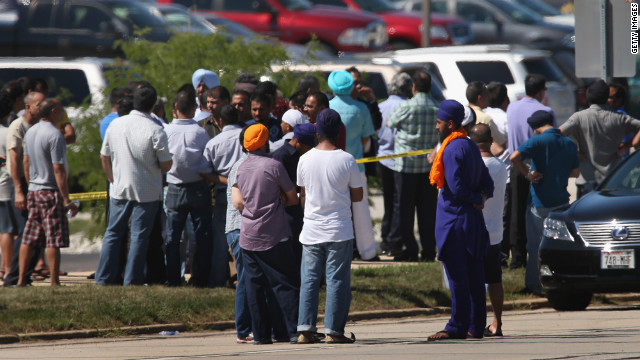
“Nobody's angry here. We're just confused. Was this a random act? Was this directed at us because of the way we look?”

The questions were raised by an onlooker at the site of the Sikh gurudwara at Oak Creek in Wisconsin where six people were killed by a white man on the morning of August 5; he was shot dead by the cops.

Why is nobody angry? Why assume it might be a random act? What does the loaded “way we look” convey and why let it overshadow the terrorist attack? The FBI will conduct the investigations as a “domestic terrorist-type incident”, but for a large section of the media Wade Michael Page, a former sergeant, is a “lone gunman” or a “shooter”.

The motives are as clear as sun in a cloudy sky. It now seems that he was a neo-Nazi. In fact, civil rights groups go a step further and refer to him as a “frustrated neo-Nazi”. Was he frustrated with the ideology or was his frustration a spur to become one? This is a convenient back-up vague term to absolve mainstream terrorism.

To caricature him is easy, for the blueprint is ready and almost cool – balding man with tattoos, strumming the guitar with devilish music in an offbeat band called End Apathy. His motto to “stand proud and raise the white man’s flag” is confusing white supremacy with neo-Nazism. Both have different histories. Tanking up on the latter is a hands-off stance for internalised racism. The Nazi satan image gets props for also psychologically working on public memory as victimisation.

There is tardiness to investigate the possibility of a larger group’s involvement, a routine that is followed when the shoe in on the other foot and forces are deployed to trace leaders, assistants, handlers, trainers, foot soldiers.

The United States is home to 700,000 Sikhs. They are handed out certificates for being “a peace-loving community”, implying their innocence only by default, while the criminal’s antecedents remain enigmatic and diffuse the pattern of devious behaviour.

State Rep. Mark Honadel, whose district includes the temple, said, “Unfortunately, when this type of stuff hits your area, you say to yourself, 'Why?' But in today's society, I don't think there's any place that's free from idiots.”

That we are still battling with terminology to use for terrorists in some parts of the world reveals just how much semantics play a role in brainwashing people.

It includes the victims, who are hostage to the munificence of an all-embracing country. There is diffidence among non-westerners to talk about racism or what is now increasingly obvious as white terrorism.

This has two very dangerous consequences: It results in suspicion and infighting among different ethnic groups, and the claiming of tragedy points makes it possible for the ‘war on terror’ to continue as a sanctimonious bubble for the Western establishments.

The discussion on gun control is just one of the sidelights to obfuscate the issue. A person with a gun does not necessarily go on a killing spree. There are unlicensed weapons available. There are bombs and the use of more basic forms of ‘fundamentalist’ tactics. The latter can spread right from televangelism to a president sneaking into another country to bolster the morale of his forces that have no business to be there in the first place.


How do we deal with a “lone gunman”, a “psycho” and other such assorted creatures that are products of psychiatric superpower wards as opposed to an organisation that can conveniently, and legitimately, be called a terror outfit? Did a group pilot an airplane into the Twin Towers? Were we not told there was just one soldier who walked in the dead of night and shot down villagers in Afghanistan? Anders Breivik was alone when he killed 77 people in Norway. Kiaran Stapleton “kept smiling” as the court pronounced him guilty for the murder of Indian student Anuj Bidve in Manchester.

How individualist are they? Why do we not just say that there is another terrorism that does not need caves or a rugged terrain? Countries carry the baggage of history, of calamities, of attacks. The ruling elite do not have to muddy their hands to clear the rubble, so they muddy the minds of the citizens. The melting pot swirls the ladle and scoops out the good from the bad. It is an act so subtle that no one notices it.

It is left to the conditioned-to-feel displaced and mentally unstable white guy to carry the moral fable forward. He is like any recruit at a terrorist training camp. His ideology is not born in a vacuum. He is doing it for country. The political leadership will quote from the Constitution, but they have whetted the appetite for vengeance with rhetoric. Incidentally, the indictment of soldiers by some senior officers is an even more potent testimony of such lobotomy. Not surprisingly, Page’s six year stint in the US army during the 90s, partly in psychological operations” is mentioned prominently, even if he was demoted and quit the military with a “Less Than Honourable Discharge”.

Despite this, he comes across as a backroom loyalist. His 9/11 tattoo in many ways subliminally exonerates him. America has not allowed the world to live in peace ever since that day. One Sikh leader stated that it “implies to me that there's some level of hate crime there”. Another one wants “to educate Americans about diverse groups and act ‘to lessen this kind of rage’”.

A crime that should be seen in isolation has become communalised. It is, strangely enough, pluralism that has caused it – a pluralism where you may look and dress like Kim Kardashian or Justin Bieber but not like ‘natives’ like you. Instead of pushing for quick action and security, there is trepidation over “mistaken identity”, that some white guy might think you are someone from the al Qaeda. The chairman of the Sikh Council on Religion and Education believes: “There’s always an apprehension and a sense of fear that this kind of incident will take place anywhere, anytime.”


Can this not happen to others, too? Sikhs were killed for being Sikhs in their home country, India, where the ruling party conducted an operation inside the Golden Temple. Sikhs have had to fight for their right to wear turbans and to carry their kirpans, symbolic swords. Was there any al Qaeda then?

If 9/11 is being propagated as a definitive revenge-worthy date to flush out enemies, then will insurgency and terrorist attacks on some Indian states be seen as fallout of the Partition of 1947, and subsequent wars with Pakistan and China too?

Mitt Romney is concerned that the Wisconsin attack took place at a house of worship. This gives the crime another colour. Places of worship draw attention to the faith, more than to the community. But in the world outside America, there are sects, castes, sub-castes. However, in an alien land, a temple of any religion has more than emotive value. It represents an uprooted cultural identity.

There is already guilt by association. Pakistan’s liberals who berate those who sympathise with the plight of Muslims in Assam or Rohingyas of Myanmar instead of the Balochis in their own backyard are themselves reaching out to American Sikhs. The Peshawar ones are a forgotten story. 1984’s massacre of Sikhs is a fade-out for India.

The sense of urgency different communities feel to identify with such sorrow at the individual and group level is most certainly part of a larger political expression. Every such tragedy is about lost human lives. The need to emphasise it beyond the obvious is driven by a subconscious need for self-preservation and, as a consequence, actualisation.

- - -
(c) Farzana Versey

31.10.11

Aiyyo, India Tussi Bharat Ratna Ho!

Of course, India is one country. Diverse, yes, but unified. You’ve got to be joking. Just one day’s news will tell you that not only do we have such strong borders within our country but we also react in a manner that would make an outsider seem less alien.


Let me start with the film of the moment ‘Ra.One’. I have not watched it yet. Now, besides all the criticism about flimsy storyline, SFX not up to nuff, nothing like Hollywood, listless performances, what I found a bit curious was one long article in the TOI about the portrayal of Shahrukh Khan’s non-superman character as a Shekhar Subramaniam. The writer of the piece, a Tamilian, “cringed” because,

“It was somehow difficult to imagine the man whose name has always been Khan or Malhotra pulling off this new surname or doing his signature wide-arm gesture in a veshti and baniyan or even preparing crisp paper dosas for that matter. No, I don’t hate SRK; he’s indisputably the master of spontaneous wit and Yashraj romances.”

Here is someone complaining about stereotypes and indulging in it. What is a Malhotra or a Khan? Why does she imagine all Tamilians wear veshti-baniyan all the time? As a Malhotra, has anyone seen him eat pakoras?

The criticism would have been fine if the nitpicking were not as puerile as this:

“The curly hair, usually a Malayalee trait, I can take. Even Subramaniam’s inability to make iidlis or his soft spot for Lord Balaji (whose largest fan base lies in Andhra Pradesh by the way) is excused. But, under no circumstances, and ‘you can take it in writing’ (now this is a line any Appa would be more prone to using), would a Tamil father quote V Shantaram. Thiruvalluvar, yes. Valampuri John even. But a veteran Maharashtrian film director?”

Do all Mallus have curly hair? Lord Balaji is pretty universal in those parts, and yes, I mean the whole South, which is not Madrasi. As for quoting V. Shantaram, aiyyo, Rajini saar is originally from Maharashtra and he rules the Tamil industry. In fact, what is the cribbing about caricature? Every Rajinikant character is a caricature, often of himself. Pointing out the subtle variations within the South is not educative but only emphasises the disparities and the archetypes. It is important if the issue being discussed were of import; here we are talking about the non-hero avatar of a superhero.

One scene has got quite a few people into a Maggi mass. The good Tamilian writer explains that an appa “is not someone with a natural taste for noodles and wouldn’t ever substitute rice in curd rice with noodles. Is that so hard to get?”

Yes. Because, some appas can be eccentric. Here we go on and on about fusion cuisine and someone does it in the privacy of his home and it becomes a matter of grave social concern. What if he had poured rasam over the noodles? Or, was there a problem because he eats with his hands (not just fingers)? Have you not been to any traditional home or even small restaurants? Balling the rice after adding the sambaar/rasam/curd is pretty common. There have been occasion when such images are poked fun at, but if you can take a joke then it should not be a problem. The Chinese and Japanese even in fancy restaurants have their soup straight from the bowl. Americans will stuff triple-decker burgers in their mouths, mayo, ketchup and all. North Indians will eat their gol-gappas with the jal jeera dribbling down their chins. Same goes for most chaat in other parts of the country.

As for the accents, Bollywood is not here to make realistic cinema. Watch the old films, see how comedian Mehmood portrayed the Tam-Brahm in ‘Padosan’, watch those lungi dances…and we have film stars from the South who spoke in Hindi as Malhotras but never did get rid of their accent. No one spoke about nuance and how they managed to stay at the top.

It is interesting that there is no word about Shahrukh’s character being lean. Why? Does the Tamilian appa not like himself to be a little robust round the tummy, by and large?

And here is this whirly-gig that “even the most accented Tamilian father does not have a problem pronouncing ‘keys’, no matter where he’s looking for them (in this case, a woman’s bosom)”. Well, maybe he had just travelled from Medrass and hopped across the Tamil border into Kerlah? If he can acquire curly hair, according to the writer, then he can indeed look for kiss in the oman’s boosum (keys in the woman’s bosom)?

The writer goes all moralistic about upbringing of Tamilians. Hello, how many of them have wives in several corners of the house? Ex-CM Karunanidhi might be able to help.

PS: I do not like SRK and my next recipe will most certainly include noodles with curd, since I have already been eating tomato bhaat (pronounced bath by Tamilians) with curd and papaddam.

- - -

From the South, we move north. Metallica decided at the last minute it would not perform at the Gurgaon venue – something to do with security. Dilliwallas were angry. Rightly so. But Dilliwallas are always angry, so angry that if they cannot break a signal, which is their birthright, then they just get on to the footpath. Of course, this was not a Delhi-only event, but there are some places that bring out the worst in you. And Delhi most certainly is.

It does have people from other parts of the country, but it is a strange mix of ‘ji huzoori’ and ‘civil disobedience’. Unlike Mumbai that does not make you into a uniform kind of Mumbaikar, Delhi does it unless you really strive to retain your individuality. The worst possible thing is that the Dilliwallas are probably not too happy that Noida pulled off the first Indian Formula One, pretty much without glitches. No one has as yet come out with CWG like scandals, and this in the land of Mayawati.

It is truly silly when people ask what will happen to that land now that the races are over. What happens to Jantar Mantar and Humayun’s tomb and Ferozeshah Kotla Maidan? The first two have symbolic-historical value, but after that picture of a stray dog at the spot before the races, perhaps it can be used to get our police sniffer dogs some exercise; it can be used as a jogging track; there can be music performances. Anything. Maybe even Team Anna can play a cricket match against the various factions that crop up within it every other day.

The cribbing continues, including how it is just a glamorous event. Sure, it is. But those with memories will remember that the respected news magazine, India Today, back in the old days had done a photo shoot of the makeover of athlete P.T.Usha. Think before you cast stones.

I have two cribs about the event, though.


  • Why did Sachin Tendulkar flag the winner Sebastian Vettel? One of the participating teams was Ferrari and we might recall that he sold his Ferrari, a gift.

  • I love Lady Gaga but an Indian band or a group of our best could have been chosen. After all, it was the Indian Grand Prix.


- - -

We move to Mumbai. Shiv Sena chief Bal Thackeray wants Amitabh Bachchan to get the Bharat Ratna.

"Amitabh Bachchan is the last 'Shahenshah' (emperor) of Bollywood. In many countries of the world, the people don't know who is the president or prime minister of the country, but they know Bachchan. He is a real jewel of India who has brought laurels to the country...Bachchan truly deserves the Bharat Ratna.”

We do not know if Balasaheb plans to take away titles and we cannot have another shahenshah years from today. Mr. Bachchan does deserve this honour. But, why this sudden interest? Because, recently a North Indian MP had asserted himself and there was a war of words. So, the SS decided they could use the man who represents the North best. Moreover, he is now the brand ambassador of our beloved Modi’s Gujarat.

Let me jog your memory, again. In 2008, Mrs. Bachchan, Jayaji, a fine politician from the Samajwadi Party, had said at a function when the ‘speak and eat in Marathi’ call was at its peak:

“Hum toh Hindi mein bolna pasand karenge. Hum toh UPwalle hain. Mumbaiwalle humein maaf karein.” (I would like to speak in Hindi since I am an UPite. Mumbaikars please forgive me.)

Smart woman that she was, she forgot that she is a Bengali married to a UPite; she was marketing UP then. At the time, Sena spokesperson Sanjay Raut had said,

“Why should anybody undermine the Marathi language in Maharashtra? Moreover, there is no need for her to promote Hindi in Mumbai. It would serve the purpose better if she campaigns for the language in southern states.”

So, Balasaheb is not only suffering from convenient amnesia, he is pushing the Bachchan agenda by bringing in the friction with the Congress as the reason that Mr.B has been denied the honour. Why has he kept silent for so long? Had he got it during his friendship period, then the accusations would be of favouritism.

Talking of Mr. Bachchan and his show 'Kaun Banega Crorepati', I think it is quite communal, in that it finds a Muslim and the queries are about naqab and some Urdu stuff; the Hindus get their queries from mythology, which is in surfeit, incidentally. Always has been.

- - -

It is, therefore, wonderful that the Mumbai High Court did not pussy-foot when it came to a mandal that claimed it was a temple and asked for it to be removed without touching the deity. Justice P.B.Majumdar stated:

“People are interested in building places of worship. But God is never interested in huge worship places. He is satisfied with a small place also. If you really have the love for God, pray to God. He can give you more.”

True. There should be a moratoriam across the country on new places of worship. We have more than enough of every religion and sect, not to speak of those in honour of film stars.

Mosques, temples and churches are anyway not about god, but about the devotees’ need to find god. A haystack should do. A pin here and there might confirm the best suspicions.

31.3.11

The Swami’s True Lies


Aseemanand is right. He probably has been forced to confess to his role in the bomb blasts in the Ajmer dargah, Mecca mosque, Malegaon and Samjhauta Express. But he is wrong that it is the investigating agencies that are doing so. It is likely that the Sangh Parivar put pressure on him when the saffron terror dragon began its first leap in public domain. In The Saffron Smokescreen, I had written:

So, what is the role of Swami Aseemanand? It is to create a soft-focus photoshopped image of the RSS. Has he mentioned any high-level functionary in his confession or any remote link to prominent leaders? Do any of the persons mentioned claim to take their instructions from a higher authority? No. The demon of Hindutva terror is doing its dance and there is no way in which to wish it away. The best course is to accept the extremists in the fringe fold of Hindutva, the over-enthusiastic, misguided people.

He now says that the National Investigation Agency (NIA) and Anti-Terrorist Squad (ATS) had put pressure on him. The smart thing is that because all the cases are in different states he can blame one at a time. He says that the Rajasthan ATS has not allowed him to hire a lawyer. So which lawyer had said that he was tortured into making the confession, although he had recorded his statement before a magistrate under section 164 of the CrPC which is admissible in a court of law?

If he is innocent, then why did the RSS chief, Mohan Bhagwat, say that there may be some radical members but they were told to leave the organisation since there was no place for extremism within it? He had said that the accused are not in any way connected to the RSS. Why, then, were they asked to leave?

As for Aseemanand, what happens to his heart-tugging story about the Muslim boy who reformed him? Kaleem who was wrongfully imprisoned and his “good conduct” affected him so deeply that he wanted to do “prayaschit” (penance) and therefore confessed. Was Kaleem from the investigating agencies?

16.1.11

Sabarimala: A Test of faith?

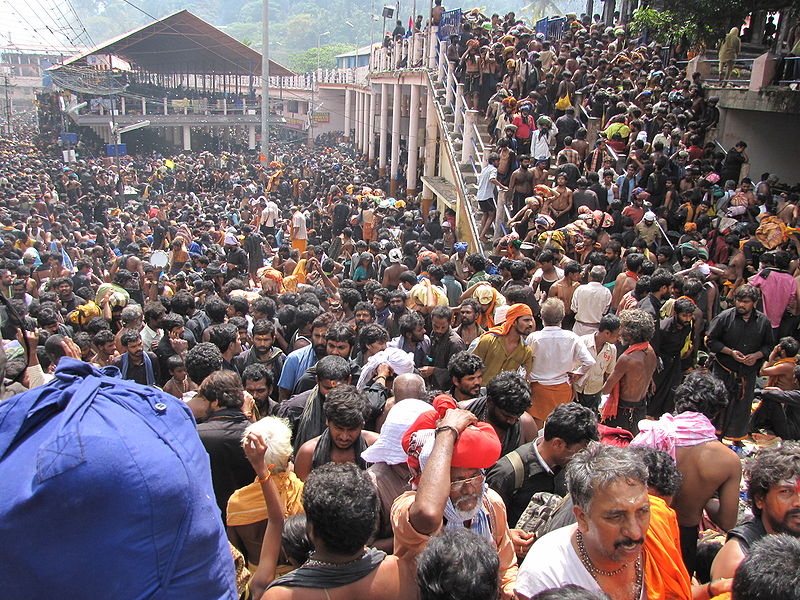
Pilgrims on the way
Every year, in some part of the world, in some pilgrim sites, people die. Tents burned, landslides, stampedes. Yet, year after year people continue to visit these places. As a non-practising anything, I can only tell myself that we don’t stop flying because of air crashes or driving because of road rage or indulging in risk-filled activities and eating the wrong foods knowing they are wrong for us.

However, where anything religious is concerned, both believers and non-believers alike start analysing faith: If there is a god, then why put the devotees through such things? We must understand that these are totally besotted people and they want to see miracles happen because they trust in them, blindly. They are not challenging the superpower; they are submitting to it.

I think such queries are too rational to understand religious faith or the god-mechanism. In fact, there is rarely rational explanation even for air crashes, because it is not always engine failure. It could be a bird hit. I mean a bird in the sky, that pretty feathered creature, can bring down a whole airplane. Turbulent weather can do so. These cannot be factored in by science. So, how can disasters at pilgrim sites?

The miracle light
On Friday, the 14th, 106 people were killed and several injured near the Sabarimala temple in Kerala. There were 200,000 people gathered there at one time. The shrine where the Makara Jyoti (celestial light) appears on its own thrice a year is a sight that every worshipper wishes to behold. There is talk of mismanagement, about how vehicles that are prohibited at the last stretch managed to get in, how there were few cops to man the area, how people had no choice but to push because parts of the rubble were falling on them.

A liquor baron had donated Rs. 18 crore to get the roof of the sanctum gold-plated. This sort of thing is done regularly by the rich in India, but no one bothers about basic infrastructure and, more importantly, management.

The state government has paid Rs. 5 lakh compensation and the Centre has chipped in with Rs. 1 lakh each for the families of the dead and there is money for the injured. This is done when there is large-scale calamity of this kind, but never when an individual is killed in a road accident due to the terrible condition of the roads. And who will take action against the cops who were not there? What about the vehicles when the drivers too are dead? What accountability can there be when there are no accounts?

I am beginning to appreciate these virtual rituals now. I think devotees should follow the rites they wish to and just watch the light or the idol on the internet or on television. And during Haj they can stone the devil in this manner, too, with some sort of interactive software. I know this sounds blasphemous, but I am sure the gods can take care of themselves; it is people who need to be protected.

And let us try and ‘unbrainswash’ them from believing that all this is because god is testing them. Given the way some of our lives go, even the atheists among us must then count as the greatest believers.

- - -

I do have some memories of Sabarimala on my frequent visits to South India during a certain period of my life.

As we’d drive from the Kerala side to Tamil Nadu there would be people walking, often barefoot, in saffron robes mostly to meet Lord Ayyappa, the reigning deity. Women of a fertile age are not permitted in the sanctum because the sage was celibate.

One day I had to return urgently to Mumbai and since there was no night flight, I drove past midnight to reach Thiruvananthapuram airport before dawn to catch the hopping flight at 6.30 AM. There were two drivers, both Tamilians, to ensure that should one feel sleepy the other would be ready to take over. The guy at the counter said the flight was delayed and I could not purchase the ticket since it was not certain what time it would arrive or even if it would make the scheduled stop.

My two escorts, accustomed to an early breakfast, asked if I was hungry. No, I said. Realising that they were, I told them to go ahead. “Madam, you come also,” they said. We went to a small eatery and all eyes turned. I had just worn a loose T-shirt over tights and my lids were heavy from lack of sleep. There were only men in here. Once we settled in, no one cast a glance at all. A banana leaf was placed before us, that was to act as a plate, and all kinds of chutneys were dumped on it, arranged rather neatly though in corners and then arrived my paper dosa, crisp and golden. The two men had ordered half a dozen things. The coffee came in a steel tumbler with an extra one that it had to be poured into from a height with the arm at a right angle. I stopped trying this jugglery but watched with fascination. This cools the beverage and adds froth. The contents of my cup remained in repose.

I could hear the others murmur, if it is possible at all to murmur in Malayalam which is a language that requires one to make groaning and gargling sounds …but there was softness in their demeanour, and I am not romanticising. They had just returned from Sabarimala. Their long fast was over and they were headed back home. They had made it safely, feet calloused, but worth the walk.

I did not take the flight and returned. This time I slept on the drive back. It was fate. Or faith?

6.12.10

India’s FCUK

The French head of state may not have had the streets washed and buildings painted in his honour, but he and his wife might just get an Indian baby.

Item 1:

They went to the Salim Chishti dargah at Fatehpur Sikri and reportedly the caretaker, Peerzada Rais Mian Chishti, asked the lady, “What is your wish, your prayer?” She is supposed to have said, “Pray for my son, and pray I have another.” The news says he "gave her a red thread that she tied round her wrist, recited the ayat-ul-kursi, and blew". I don’t if it was on the thread or her forehead, as is often done.


Hai! Main maa ban-ne waali hoon

Anyhow, the papers have mentioned that the lady was veiled and there are some ‘yippee’ comments about it because you know of the French position on the veil. Well, the lady was not veiled. She had wrapped a shawl round her head, that’s it.

What’s the big deal, anyway? And why did she ask for a son? They gave her the story about how Emperor Akbar walked to the shrine to get an heir. He had an empire to run and it was years ago when patriarchy was deeply entrenched. Here we have Sarko who is funded by a cosmetics company, L’Oreal, so what’s this sonny need? He has three form earlier marriages; she has one from her previous husband. Rais Mian, like most of the custodians of shrines, are always in the limelight during such visits, and he had formed an opinion about her: “Very kind, warm-hearted and extremely family-oriented mohtarma (lady).” I gather the desire for a boy makes her family-oriented.

Fik’r mat karo, maine kaam kar diya

What he should have done is given that red thread to Sarkozy saab and not Begum sahiba and blown over his head because the Y chromosome is with him, Salim Chishti or no Salim Chishti. At least Akbar Badshah knew that. Of course, Sarko stuck to his jogging regimen to stay fit; he knows he cannot rely on a thread and the breath of a man who looks after a tomb.

Item 2:

Now that the French couple has done the rounds of the tourist sites and seen turbans everywhere, if they thought they’d get some rest and bare heads, then they are mistaken:

Government sources indicated that the contentious issue of ban on Sikh turbans in France will again be taken up with the French side. The government is expected to politely convey to Sarkozy how strongly India feels about the issue when he holds delegation-level talks with PM Manmohan Singh on Monday.

Yeh lo, ungli diya tau haath pakad liya

Out PM has done this before at other meets and mentioned how the turban is “a very essential part of the Sikh way of life”. True. However, don’t you think this should be conveyed through emissaries and not during delegation-level talks? This is especially important because the PM himself wears a turban and it would seem like he is taking advantage. As a host, he needs to be more careful.

I might also add that had APJ Abul Kalam Azad discussed the veil ban issue, it would not have been considered proper. It would have been deemed regressive. Then, any aspect of religion in which we are trapped is harking back to something that was expected for certain reasons way back in time. Sikhs do not carry swords because it is not feasible and I am not sure how many wear the kachcha (loose underwear) beneath their tight jeans or don’t trim their hair.

Item 3:

Not quite certain about choice of French cuisine or Indian, the chefs decided to do a fusion. It seemed to have appealed to the palate of the guests, though one wonders how…maybe the lady being Italian has some acceptance of farm food so this would seem like really rich. The hotel plans to name something or the other in her honour. May I suggest Carla Coq au dahi and Bruni Blanquette de gosht? Let’s not leave the man out, so the two other items can be enjoyed with stuffed Nicolas naan.

- - -

Rough translation/meanings of the captions:
1. Wow, I am gonna be a mommy
2. Don’t worry, the work has been done
3. Give him an inch and he will take a yard