"You know nothing about the business of writing," he told me.
Then came the details. How to get off. Get it off. Take off. Take it off. Book launches. Public relations. Publishers and their demands. Reviewers and their demands. Readers and their demands. The format. The cover. The pages. The typeface. The people to meet.
"What's happening with your book?" I asked him.
"I don't know."
I returned to my soggy half-finished sentence and patted it dry.
© Farzana Versey
Showing posts with label readers. Show all posts
Showing posts with label readers. Show all posts
20.11.13
20.9.13
Have stings replaced news?

The anchor held up a piece of paper and shouted down a politician with the precious words: "I have this secret information." A rival channel did its own bit of smirking: "Our sting operation will give you the whole story."
It will not. This too is fed information. The reason there is a surfeit of 'stings' — how can a formal letter by a cop to his bosses be called a sting operation when he has written it and sent it? — is because newspapers and TV channels have saturated the regular routes and want to entertain. Many of the readers and viewers too wish to be entertained, and news stories, however controversial, become more interesting when they stink.
Sting operations get a whole lot of points by a gullible public that assumes those blurred video clips are done as an act of public good. No one bothers to check out the motives behind these moves. It is high time we made the mainstream media answerable, but the alternatives are not always as above-board as they appear simply because they too depend on the largesse of sponsors, advertising and benefactors.
A few noises are being made now about some of these exposés. I wish it had been done earlier, too. Then we would have been spared this rush and rash of scoops where dirt covers only more dirt.
I've said it in earlier pieces, and instead of repeating myself I shall reproduce two extracts, one from 2010, the other from 2007. [Unfortunately, opinions do not qualify as scoops and exposés!]:
Stings that stink, 2007, Asian Age Op-Ed:
Have sting operations changed anything? Have people stopped having their palms greased? Is there more awareness about wrongdoing? Are the culprits shunned by society?
You know the answers. They have, on the contrary, become even more important.
A reporter of a Delhi television channel tried to expose a teacher for forcing her students into prostitution. It turned out to be fake. It was done on the prodding of a businessman as a planned strategy to hit out at the teacher for owing him Rs 100,000. He called up a reporter who we are told harangued her to make a few quick bucks by getting into the flesh trade and supply women. It is said she fell for this bait. A colleague of the reporter was sent as a potential girl ready for the job.
The whole story sounds bizarre. Would a woman in a respectable profession be so gullible as to get into criminal activity? If there is any truth, then why has it been labelled fake? This is not a big channel. Had it been one of those fancy ones, do you imagine anyone would have made such a noise about its lack of authenticity? The reporter has been arrested. I would like to know what is being done to the channel owners. This isn’t just a sensational story. It is about an issue that concerns women and any sensible person. Sting operators cannot get away with it.
Is this about vigilantism at all? (In 2005), there was an exposé where 11 Members of Parliament were bribed to pose questions in the House. The website carried tape recorders and cameras to catch them red-handed and a TV channel aired what they thought was a complete travesty. These clippings were later shown in Parliament. Newspaper reports were dramatic: "Parliament was stunned into shamed silence."
Does Parliament feel no shame when elected members throw slippers and chairs at each other? Has no ministry ever been shamed for taking kickbacks by giving a contract to an undeserving company?
And who were the MPs who were paid Rs 15,000 to just over a lakh for asking questions? Were they important enough names? These nobodies suddenly got notorious fame as "the dirty eleven." I can lay a bet that even if they were not bribed and were told they would be given some media coverage, they would still have done what they did. The sting operation only helped make scapegoats of a few unknowns to let the real sharks march around like saints. A whitewash job has never been simpler.
The real scoop was this, and it had been reported in this newspaper: The television channel gave the sting operators about Rs 58 lakhs. Less than Rs 10 lakhs was spent on the entire operation. The bribe amount was less than Rs 3 lakhs. Other expenses were about Rs 5 lakhs. The equipment was available on loan. Was the balance money returned to the TV channel? Does anyone know?
There should be transparency regarding sting operations too. Jaya Jaitly, who ought to know, had made an interesting comment, that it would be honest if a person went to these sting operators and told them that someone was taking money for asking questions or getting things done; the snoops could then accompany the person and catch the culprit in the act.
---
Would they do a sting operation on cultural organisations or famous "respectable" artistes who get special privileges? What about nominated MPs from the "world of arts" who use their position to further their personal causes? What about NGOs that misuse foreign funds? What about media houses that take money from socialites to promote them?
The media as middleman, 2010, CounterPunch
Journalists have often got prime posts in social organisations or are sent on junkets; many of the hugely respected senior names conduct all their ‘investigations’ over the telephone, which means they are fed information by interested groups. What about owners of channels who get elected and become MPs?
To push the envelope (no pun intended) further, what about freedom of speech? Does the industrial house not have the freedom to lobby? Does the lobbyist not have the freedom to push her case? Does the journalist not have the freedom to act as a go-between?
---
Political stooges have always existed, only the level of subtlety has altered their persona. You just have to spend some time in any of the intellectual hubs in Delhi and you will see a journalist supping with a politician or a bureaucrat. There are TV channels that have given preference to young recruits merely due to their proximity to and sometimes family connections with such powerful people.
The (Radia tapes) revelations have become such a talking point, ironically, because they have been exposed with much flourish outside the mainstream media in India. Internationally, the Washington Post mentioned ‘paid news’ and reported that The Foundation for Media Professionals plans to host a conference on journalists as power brokers. The organisations’s spokesperson said, “We are actually happy that these practices have come out in the open. It forces us to address the problem. We as journalists sit in judgment of others all the time. We should hold ourselves to a higher standard.”
Journalists are fallible and their standards should be decreed by ethics and not morality and most certainly must not become a ruse for nobility. The self-examination should also raise questions about the media conducting kangaroo courts and making a spectacle of helpless common people.
"False history gets made all day, any day, the truth of the new is never on the news." (Adrienne Rich)
© Farzana Versey


9.5.12
Footnotes from the ledge
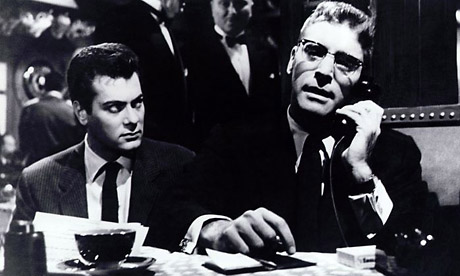 |
| From the film 'The Sweet Smell of Success' |
Years ago, a web portal I wrote for in the nascent stages of news and views on the Net in India, decided that it needed a footnote for its columnists. I was accustomed to ones that simply said I was “a freelance journalist” (I crack up when I read “independent columnist” – independent from what, of what, by what? Is that not to be taken for granted?) to the smart “refuses to sit on the fence” (it worked against me after 11 years of continuous writing of that column when I was told I was too independent and don’t take briefs!) to a phrase taken from my blog: “has a healthy disregard for objectivity”.
So, back to that e-portal. As some of you know, I could not imagine ‘writing’ for anything that did not scrunch in my hands. I did not even have a computer. One day, out of curiosity, I was at a friend’s office and casually mentioned this column. We reached the destination and as I scrolled down on my discovery trip, I reached that precious footnote. It was in red, italicised. It said that I, FV, was an “iconoclast”.
I froze. Images of me as Che Guevara flashed on several T-shirts. This was serious, and after a few seconds I was pretty much on the floor laughing, and ROFL was not yet known to us. From that vantage position where I had to look my iconoclastic best, I asked my friend whether he agreed with me that it was a stupid idea; he did. And made it sound more ominous: “It might appear as though you are saying it.”
This is the problem. It is more likely that publications decide. However, the newer lot ask you to send “two-three lines describing yourself”. I once wrote a horribly cheeky one and was told it did not go well with the content.
 |
| Sealing my fate! |
But I did not know who those writers were. Celebrities and those from other fields had not taken over the business of holding forth on what they were doing. This does not work as ‘inside’ information or adds any authenticity, for they too are writing for an audience and have their own biases.
Do readers care about the qualifications of the columnist? It is a bubble theory. It looks good until you prick it. And the pricking is just giving it a good look-over.
However, mostly the footnote works as a promo for people in different professions. I had once taken a swipe at someone mentioning how his CV exceeded the word limit. It was, therefore, good to read on the ‘Self importance of names and titles’ in Pakistan’s Express Tribune as to how the whole description business has gone overboard. When I was writing for them, I had half a mind adding, “The writer has a degree in Vampirism from the University of Dracula”. (Incidentally, third-person descriptions are supposed to look objective; they make me feel schizophrenic.)
Quite a few publications have these long rambling bottomlines, and most of their columnists are so darned third-degreed, all from the best universities. A good university ideally teaches you to explore, not flaunt knowledge.
We never read any mention of a degree from Gujranwala or Chhatisgarh. Reveals our colonial mindset and, dare I say, adds weight to the publication's reputation. They could probably have a roll-call of Oxford/Cambridge/Harvard types, all with halos. If they can take global roundabouts and quote Greek mythology in Latin phrases with a slight nod to desi lingo, then chances are that more people will notice because snob and blob value go together. They are like the always-open KFC outlets.
The other peeve regarding "X is a former something or the other" reveals our absolute obeisance to the past. Instead of wondering why s/he even at the prime has been rendered redundant, it imbues the individual with the gravitas required of a know-it-all. Much like a divorce might make a discussion on marriage legitimate. If the 'formerhood' has been achieved after much toil, then it works like a tiger's head poking out of the wall.
Now, chances are that if the writer were not a "political economist" or some such and just another bloke with something to say, a piece questioning such self-importance would not have gone through the thinker's pose of editorial discretion.
PS: I posted the last three paras at the website with a footnote that said “~A former ET columnist with several degrees of separation”. It’s still awaiting moderation after hours! (Finally published after 12 hours.)
© Farzana Versey
2.11.11
Authors and Mummies

I assume the writers have decided to participate out of a genuine need for academic excellence in the field of such scientific endeavour. One of them has probably done it out of gratitude. Val McDermid often tapped Prof. Sue Black of the Centre for her own research. As she recalls:
"I remember asking her what a body would look like once it had been in a peat bog for 200 years. There was a moment's silence on the phone and then she said: 'A leather bag with a face on'. And that was perfect because that gave me an image I could put in my book."
We can take this further and have restaurants, stadia, bats and balls, strip clubs, even a specific love-making position named after authors. I can’t wait.
It raises the question about what could motivate readers to vote. Would it be like any popular poll where you choose your favourite crime writer? Or, since the purpose is not a secret, will the person contributing the money be interested in the Centre’s plans and therefore keep this in mind and choose an author whose work is the most macabre and deadly?
What if after winning the author has second thoughts about the naming? Would that not amount to letting down the readers who voted? Do writers crave fame and not mind such an honour? But, are not death and murder the territories they stalk in their literary endeavour?
However, it might be a good idea if the morgue is named after a character from a thriller. Better still, it could just be called ‘Crime Writers’ Mummies’.
Subscribe to:
Posts (Atom)