Showing posts with label doctors. Show all posts

1.5.21

Corona in Cow Land – India Critical

Pic: Indian Express


“India is gasping for oxygen. Thanks to GOI’s (Government of India) incompetency and complacency.” At any other time, Rahul Gandhi’s comment might have been construed as point scoring by a leader of an opposition party. Not now. 

In the latest report of April 27, there have been 323,144 fresh cases. In a span of 24 hours, 2,771 people have died. Many could have been saved. 

People are dying outside hospitals because there are no beds available. A big private hospital known for its celebrity patients has transformed its lobby into a Covid ward. In other hospitals patients are sharing beds; some are getting oxygen while lying down on the floor or even in an autorickshaw parked outside. These are the lucky few. Many are still begging for help. 

Hustlers see this as an opportunity. A sting operation in a city of Gujarat revealed a hospital bed racket. One desperate relative was told by a hospital worker, “I won’t take anything less than Rs 9,000. You will get the bed in 30 minutes.” $120 is a lot of money for the middle class. Imagine, then, the plight of the poor. 

In March last year, when Prime Minister Narendra Modi announced a lockdown, giving Indians a mere four hours to stock up, the poor had no money to buy more than a meal. Overnight they were rendered jobless, and most of the migrants from other cities subsist on daily wages. 744 million earn Rs. 44 (58 pennies) a day. They live in sub-human conditions where a quarantine would be impossible. 

There are an estimated 1.8 million homeless people in India. Vaccination programmes do not include them. They need to produce proof of citizenship and residence; they have none. This is the reality that policy papers and party manifestoes do not address adequately.

If last year in March, Modi was flaunting Donald Trump at public gatherings, this year he and other ministers held massive election rallies. 

Last year the home minister denied that the virus was a threat; this year he denied that there was a shortage of vaccine. The PM announced a ‘tika utsav’, a vaccination festival, in an irony that escaped him because India has had to grant emergency import to the Sputnik vaccine.

Last year the PM asked us to clap and bang thalis – steel plates – to honour the medical staff. People came out in large numbers to dance and celebrate what they assumed to be the end of Covid when the truth was a shortage of N95 masks and PPE kits for the doctors and nurses they were applauding.

In the pandemic scenario, the government’s failure is not merely short-sightedness, but pig-headedness. 

Politicking in India includes pandering to religious sentiments. If these sentiments are about the majority, then leaders just look the other way. 

Even as India was struck by a surge in cases with a new virus strain, 3.1 million devotees bathed in the holy river Ganga on April 12 during the ongoing Kumbh Mela. The fair takes place once every twelve years. This time it was brought forward by a year because the stars in the galaxy apparently deemed it appropriate. The official website claims that “in such a cosmic occurrence, bathing in the Ganga sets human beings free from the cycle of birth and death”.

Sanjay Gunjyal, inspector general of police in the state of Uttarakhand, sounded helpless: “We are continuously appealing to people to follow Covid-appropriate behaviour. But due to the huge crowd, it is practically not possible to issue challans (fines).” Even more frightening is his understanding that were the cops to enforce such norms there might be a “stampede-like situation”.

For such whimsies, the state has had to deploy 20,000 police and paramilitary personnel to keep an eye on the 600 acres across which the festival is held. Some of the sadhus (many walking naked) have tested positive. The chief minister of the state showered flowers on them and sought their blessings. Before the start, he had assured devotees that “unnecessary” restrictions would be removed and “faith of devotees will overcome the fear of Covid-19”.  

Most Indians are poor, illiterate and fatalistic. Last year it was cow urine drinking parties where the virus was given a karmic twist. “Coronavirus has come because of the people who kill and eat animals. When you kill an animal, it creates a sort of energy that causes destruction in that place.” Now the chief minister of Gujarat, when asked about the logic behind night curfew, replied, “Corona has originated from bats who can see only in night. Therefore the virus comes out only in night (sic).”

Godmen and political charlatans take full advantage of this. Baba Ramdev, a yoga guru who has built an Ayurveda empire due to his proximity with senior leaders, launched Coronil as a cure for Corona. Ministers were present to stand by him, including the health minister. He claimed he had research papers on it but showed none. Later he was forced to market it as an immunity booster and not a cure. But the damage had been done. There was a daily demand for a million packages. It wasn’t as much trust in the efficacy of the product as it was blind faith in a ‘holy’ man. 

But politicians who have tested positive aren’t using these indigenous palliatives. They are consulting qualified professionals, relying on real science. 

Religion forms the subcutaneous layer of all politics in India. When the PM addressed the nation recently, he said, “Tomorrow is Ram Navami. Maryada purushottam Ram's message is for us to be disciplined.  It is also the 7th day of Ramzan. The festival teaches us patience and discipline. Patience and discipline are both needed to fight Covid.”

His government has showed no such qualities. For a while it appeared that even the supporters of the ruling party desperate over the loss of loved ones had tired of the mishandling. That the virus would prove to be a great leveller. That they were waking up and could be the resistance. But the rightwing was back to its old ways. 

When Naveen Razak and Janaki Omkumar, two medical students, danced to Boney M’s Rasputin and the video went viral, the rightwing started the hashtag #DanceJihad. It was seen as a jihad because the girl was a Hindu, the boy a Muslim. A lawyer said, “I smell something wrong here. Janaki’s parents should be careful. And if they are careful, they won’t have to be sorry later.”

Social media rose to the occasion. It pronounced that the two young students were a shining example of communal harmony when all they had wanted to do was spread some cheer around. 

When Pyare Khan arranged for oxygen worth Rs 8.5 million, his past as a slumdweller was raked up and his faith was highlighted. In fact, his act was referred to as “oxygen zakat” – Muslims offer zakat, a portion of their profits, during the month of Ramadan. Some liberals on social media platforms pointed this out as a reason why Muslims should not be mistrusted. They do not realise how problematic it is to expect a community to be held up to a standard the majority never has to. 

Heart-warming stories may act as a necessary salve, but they sometimes deflect from the harsh reality. A hospital’s ICU unit caught fire. An eyewitness said there were two nurses, but no doctors around. All he could see was dead bodies. 14 patients died in the fire. 

Priests are refusing to perform the last rites. In a moving account, a journalist recounts how they had to bathe her dead grandmother before the cremation: “My father cranked up the AC of the car to keep her body protected from heat…My mother, two of her sisters and I tied a bedsheet from the car to a pillar in the basement to create a private space for that. We did all we could to give her as dignified a farewell as possible.”

In many places there is a shortage of burial space and wood for cremation. Death, as much as life, is defenceless. 

Published in CounterPunch


3.4.20

Prayers, Piffle and Privation in the Time of Pandemic

“Go corona! Corona go!” Ramdas Athawale, a minister in the state government of India, chanted this phrase again and again at a prayer meeting at the Gateway of India. Among those invited to participate were Buddhist monks and the Chinese Consul General in Mumbai. The rap-like cadence soon inspired memes and a pop version.


While places of worship have been shut down to facilitate social distancing, nobody had the courage to stop a ‘gaumutra’ (cow piss) party on March 14. Guests drank the urine from mud bowls. They recited prayers before a holy fire beseeching the virus to leave. Swami Chakrapani, the president of the Akhil Bharat Hindu Mahasabha that organised the event, said, “Coronavirus has come because of the people who kill and eat animals. When you kill an animal, it creates a sort of energy that causes destruction in that place. They (global leaders) should get cow urine imported from India because the almighty resides only in the Indian cow and not in any foreign breed. I request all the presidents and prime ministers of the world to take cow urine on a daily basis. You have all these scientists who don’t know the cure, we have the cure given to us by the gods.” He also claimed that this was the “only cure” for COVID-19.

All this took place in the country’s capital even as government officials and ministers were issuing statements about scientific measures used to deal with the virus. This was a well-publicised event, yet there were no calls for a ban on it.

There is a call for a ban on the Tablighi Jamaat centre in New Delhi. The immediate reason is that between March 11-13 it hosted around 2000 people, some from overseas, before the lockdown. 24 of the participants have tested positive, and some are untraceable. This has come as an opportunity for the rightwing; the ruling party’s minority affairs minister called it a “Talibani crime”. However, some questions have been raised regarding the permission granted for the event as well as police laxity; the Jamaat premises share a wall with the police station. For a few days now some media channels are seeking a ban on the organisation under the garb of restraining ‘spreaders’.

Such communalisation apart, this event was unnecessary and could be one of the major instances of community spread. Gatherings, be it sects, churches or such jamaats, where devotees have ignored reason to be one with god in the company of others, have resulted in several such spreads.

***

Since temples, mosques and churches are shut, devotees look for other outlets, other gods. In the South Indian state of Kerala, the prayer being shared on social media is, “Saint Corona, protect us from coronavirus.” St. Corona has never been popular in the state nor was she the patron saint of epidemics. Her name has promoted her as the annihilator of the virus.


Applauding medical workers too has been imbued with a fantastical explanation: That March 22, the day Indians rang bells and clapped, was Amavasya, the darkest day of the month when evil forces like viruses have maximum power. Clapping and clanging vibrations reduce virus potency, it was said, and the increased blood circulation boosts immunity.

What is it about superstition that holds people in thrall, sometimes even more than religion does? Unlike belief systems, they do not have a halo. Superstitions give people the power to deal with an immediate threat to themselves. Some may even perceive their belief as a rational exercise that they are ‘scientifically’ experimenting upon.

Mass superstitions such as the cow urine drinking one are dangerous simply because, like placebos, they cannot be proven wrong. There have been instances of people refusing medical intervention based on the belief that faith, or faith-approved palliatives, alone can cure.

Adding to the mythology of magic cures, the government announced that the serials Ramayana and Mahabharata, based on the revered Hindu epics, would be telecast again on the national channel after over three decades. It is assumed that this will help people forced by the lockdown to retain their moral fibre through its kitschy portrayal.

India is, quite literally, in ‘Ram bharose’ mode, where riding on faith is considered as a confirmation of its efficacy. That the virus hasn’t yet affected the country as much as it has the rest of the world – 1932 confirmed cases, 55 deaths – is seen as some sort of karmic victory.

The facts are quite different, though. According to the director of the US Center for Disease Dynamics, Economics, and Policy, Ramanan Laxminarayan, by July end 300 to 500 million Indians would be infected of which a tenth would be severe cases. “Our model predicted that at the outbreak’s peak, even with conservative assumptions, there would be 10 million patients with severe Covid-19 disease in India, many of whom would need to be hospitalized. India has fewer than 100,000 intensive-care unit beds and 20,000 ventilators, most of which are only in the large cities.”

***

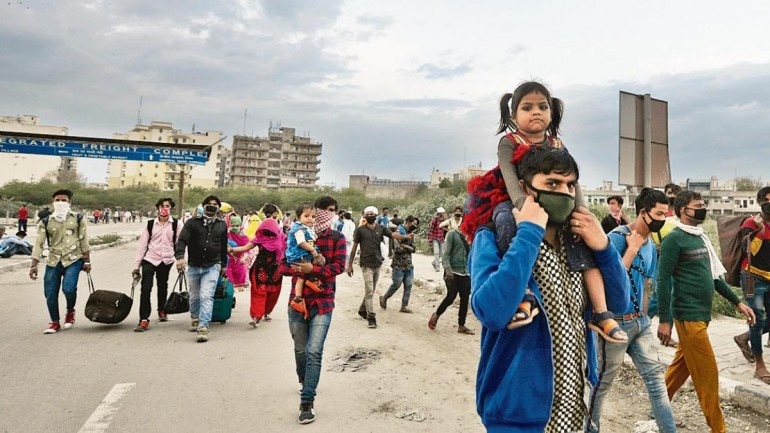
Large cities depend on migrant labour. Most are daily wagers, of which about 744 million earn Rs. 44 (58 pennies) a day. They have little or no money left. Some are walking several miles to reach their villages. They believe hunger will kill them before the virus even gets to them. As one of them said, “I know everything about coronavirus. It's very dangerous, the whole world is struggling. Most people who can afford and have a place to stay are indoors. But for people like us, the choice is between safety and hunger. What should we pick?”


There have been instances of people dying on the way.  The finance minister announced a package worth $22.5 billion as well as rations for three months to reach the poor. Many have not heard about these schemes nor received anything. Returning to their villages isn’t a panacea. As a man on his long trek of 542 kms to home said, “We came to Delhi in the first place because our farms were destroyed due to stray cattle who use to eat our crops. So, if we go back to our village, there also we have to work as labourers, but there is no work anywhere.”

When Prime Minister Narendra Modi urged people to applaud the doctors, nurses, paramedics who served selflessly despite risk to themselves, those from the informal sector that constitutes 90 percent of the labour force in India were not on anybody’s mind.  There is nothing grand about sweeping floors, dusting furniture, doing the dishes, or hawking and collecting garbage; they do not save lives, or minister to the ill.

However, the elite shared their ‘awws’ over a picture of a rag-picker noiselessly clapping, his expression confused. For them, it was evidence that the PM’s message had reached this poor man who cared for the carers. Ironically, social distancing that is embedded in the Indian casteist culture considers people like him to be a virus. Nobody cares that he belongs to the amorphous population of 1.8 million homeless people who do not even figure in the poverty or infected statistics because they do not even exist on any document.

--

Published in CounterPunch

2.7.14

Rumours and Reality - Revisiting Sunanda Pushkar


While the death of Sunanda Pushkar, wife of former Union minister Shashi Tharoor, appeared to leave several unanswered questions, I am not sure about the latest “twist”.

Dr. Sudhir Gupta, head of forensic sciences at AIIMS, has filed an affidavit in the Central Administrative Tribunal (CAT) claiming that he was 'pressured' by former Union minister and president of AIIMS, Ghulam Nabi Azad, to act in an 'unprofessional' manner to cover up the matter. 
"(The) applicant could not muster courage of openly placing the facts in black and white as the former president of AIIMS Ghulam Nabi Azad was an immensely powerful politician and the then health minister, and the husband of late Sunanda Pushkar was also a minister and a powerful politician," the affidavit stated.

Why was the job more important to the doctor than ethics? This query is valid now because there are charges of plagiarism and misconduct against him. Is he trying to cover his own tracks by alluding to a cover-up? What exactly does being pressured to act unprofessional really mean? This case was very public; the police were on the trail. Importantly, the forensic findings pointed out injuries, an overdose and drug poisoning. If there was pressure – and it not unlikely – nobody seemed to have keeled under it, at least as far as a medical report goes (although there were contradictory ones).

Before further investigations, the doctor should be interrogated not only about the nature of the pressure, but what he did not reveal in the report that he was forced to cover up. If it is different from what he gave the police, then he should be tried in court and his license taken away until he is cleared. It appears that he wants to be in the political good books and is more concerned about saving his own position.

Now that the case has resurfaced, there are a few points that need to be addressed.

The Congress made a huge mistake by fielding Shashi Tharoor, although he did win the Thiruvananthapuram seat. The point is about probity. He is not an accused, but the death of his wife under public and social media glare, where he himself was involved, sent out a message of arrogance and powerplay.

BJP members suggesting that there has been silence have got it all wrong. The media, in fact, went into overdrive then. The rumour mills were churning out conspiracies and propping up some of the players, however tangential their involvement with the personae. (My earlier post)

There were three main reasons they felt that Sunanda could have been murdered:


  1. She had said she would expose the IPL backroom deals.
  2. The ISI would want her out of the way because she suggested that Tharoor’s friend was a mole.
  3. The relationship between the couple.


Regarding IPL, she essentially indicated that she was made into the scapegoat. Either way, as it was sweat equity it would be difficult to pin down as financial skullduggery.

The ISI angle is ridiculous, and one of the reasons the case did not gather momentum. Tharoor is not a big-ticket minister, so sending a honey trap would not make any sense. Also, a gushing fan as honey trap would be counter-productive. The only notable point here is that the lady was planning to write a book on the Kerala elections. Seriously, there were attempts to get a publisher for a Pakistani to cover elections in an Indian state that has little emotional or real connect with the neighbouring country. The ISI can be accused of many things, but not stupidity.

The third reason is the personal equation between the minister and his wife. Sunanda was quite open about accusing him and just as suddenly expressing positive vibes. But to call him a murderer when they were both image-conscious people is a bit much. If things did go wrong, then they had other ways to resolve the issues. They had been through such phases in life separately before they got married to each other. Her father, brother and son all stood by Tharoor even in their moment of grief. Were they pressured too?

She was certainly in bad shape as her online activity reveals. But she was an independently wealthy woman and not dependent on her husband. She was also a glamorous person with a public profile that did bring its share of snarky comments. She had survived them.

In January, she became a corpse in a five-star hotel room. With injuries. They have not been explained. No amount of poisoning can cause these. Tharoor has said he wants the cops to probe. He should pursue the case, not to absolve himself but because like others he too must be concerned about it.

Until then, the rumours will over-ride justice.

© Farzana Versey

20.11.12

Foetus and Feminism: What about the other Savitas?

 
Words like “pro-choice” did not even occur to her as they forced an iron rod into her vagina and, together with the blood, remnants of an unborn human being seeped out. She wept a little for the lost child and much more for the scalded part that was essential to her job. Shanno was a sex worker. The brothel owner could not afford her ‘wares’ to be mothers. Shanno had opted for survival on sleaze street. Brothels are secular, so she followed all faiths. No one would justify or hold back her abortion on the basis of religion.

Savita Halappanavar’s death due to negligence at the University Hospital Galway in Ireland has become a global issue largely due to that. A 17-week-old foetus is considered risky for termination of pregnancy. Unfortunately, she was miscarrying and in the state of unbearable pain asked the doctors to abort the baby. The reply they gave her has become a whip-mantra: “This is a Catholic country.”

Is it news that the Catholic Church is against abortion? Savita’s family is justifiably incensed; the denial of her right to terminate the pregnancy is a crime for which they ought to get justice. However, would there be such international outrage had the doctors cited medical reasons for their refusal to abort? Indian politicians who pay scant respect for women’s health and welfare have urged the external affairs minister to intervene and order an enquiry into this case. A report states that 12 women die every day in India due to unsafe termination of pregnancy.


Jodie Jacobson wrote in RH Reality Check: 

“Someone's daughter, wife, friend, perhaps sister is now dead. Why? Because a non-viable fetus was more important than her life. Because she was left to suffer for days on end in service of an ideological stance and religion she did not share. Because a wanted pregnancy went horribly wrong, and, because as must now be clear, there are people who don't care about the lives of women.”

If it is an ideological stance, would the lawmakers in Ireland even consider this example based on a religion Savita “did not share”? Some foreign newspapers have carried stories with large pictures of Savita and her family at her wedding, including a dance video of a private function. The motive seems to be to pit one culture against another, or at least to highlight that an ‘outsider’ had to suffer because of these laws. Last month, the first private abortion clinic opened in Belfast amidst protests. Why did it take this long for such a medical service to be available when it is public knowledge that women travel to England for abortion? Do activists believe one case will lead to a re-examination of the country’s archaic laws?

Every religion talks about the value of life. That they do not value the quality of life, are misogynistic, and follow a wholly patriarchal notion should make us wary about using their programmed responses to falsify the reasoning. In fact, most social norms too consider abortion as the last resort. How many women, even among the educated, take an individual decision to abort?

***

Let us digress and expand on the idea of choice.  By applying the argument that a ‘woman’s body is her own’ – an obvious fact – the onus shifts entirely on women. Where abortion or childbirth is concerned, this amounts to being the sole caregiver or guilt-ridden slave of chauvinistic tripe. Just as the Pill did not really empower women but made her accountable for her ‘freedom’, the womb has been desexualised as a pre-birth nanny.

Contemporary feminist literature, especially about sexuality, while apparently busting myths ends up as a Hallmark card celebration of feminine body parts. Take this: “I experienced some of the 'thoughts' of the uterus myself”, from Naomi Wolf’s ‘Vagina: A New Biography’.  Imbuing the sexual organs with emotions demotes physicality as a natural state. The woman becomes an addendum to the part: “Your vagina makes you a goddess. Or rather, ‘The Goddess’.”

A review in The Guardian had taken on Wolf by recounting her description of “a ‘bodyworker’ who attempts, through massage, to re-engage sexually traumatised women and who, Wolf relates in the book with a straight face, once saw an image of the Virgin Mary in a vagina”.

This is a concept that the male module employs effectively to worship women as divine pleasure-givers whose own contentment is essentially to procreate. It appears that female sexuality can only be sanctified as motherhood. It is not easy to discard the psychological baggage, the subliminal conditioning of creating that which is in God’s image. When an Indian intimate cleansing product was advertised as satiating the male, some women activists had raised objections using the convenient hitch of its ‘fairness’ claims. While owning up to the right to pleasure, I had written then that they seemed to look upon it as an individual activity. This too amounts to a quasi-virginal Madonna state.


The supposedly more open western society is also not immune to this. When Demi Moore posed in the buff in an advanced stage of pregnancy for Vanity Fair, she was legitimising pop culture through maternity. Angelina Jolie goes a step further by a public forsaking of the crutch of cohabitation to become the ‘adopted’ mother.

Where choice is concerned, there can be extremes. If widows could use the frozen sperm of the spouse because the couple were seen as “together”, according to Britain’s Human Fertilisation and Embryology Act, 1990, then at the other end a foetus born to a brain-dead woman was kept alive because it had the right to live. Savita might well have been saved had medical assistance opted to do so.  

It is not only Ireland that has to think. We forget that in many parts of the world foetuses are discarded because they are female and infants are thrown in garbage bins because they are viewed as burdens. By some weird logic, this is justified as a choice by a society that has no respect for human dignity and for women.  It is the low self-esteem choice to be chauvinistic.

---

Published in CounterPunch

28.5.12

Half Truths: Satyamev Jayate (Doctors in trouble)

Doctors and medical frauds should concern us all. I have had some horrid experiences that made me revaluate the dependency we have on medicines. Capsules, doctors, hospitals have been a prominent part of my life. So, I was truly glad to watch yesterday’s episode of ‘Satyamev Jayate’ because there are many of us who have no option but to blindly trust our bodies with those who are qualified but treat us as organs, rather than people.

This time, the host cut down on the vicariousness and concentrated on more information. However – yes, there is a clause – for much of the show the emphasis was on how people are forced to take medicines when they do not need any. One particular example was of a man who flashed a packet of ORS and said that he could have been cured of his diarrhoea and vomiting with this at Rs. 15 instead of the few thousand he spent at two different hospitals.

There are such cases. But ORS is available over the counter or can be prepared at home. What if people start thinking that since most doctors are going to fleece you/mislead you, it would be better to self-medicate? What if it indeed turns out to be a serious illness?

The solutions were simplistic. Go to a chemist for generic medicine and you save money. This is for drugs that are expensive and for major illnesses. What about those we take for common ailments?

It would have been topical had the show also brought up the recent case of a poor man whose wife was denied admission to a hospital after an accident and his sorry tale of running from one to another to another till she died.

The tale of a village in Andhra Pradesh where all women had their uteruses removed should have been seen from the population control perspective rather than medical malpractice. Someone is responsible at a higher level; this cannot be doctors just wanting to make women sterile to earn money.

It is perturbing to know that India spends only 1.4 % of its budget on healthcare. And it was good to see the efforts made by some to use the pay-in-advance scheme, where the poor and the rest can benefit based on their capacity.

The racket and the treatment are two different aspects. Aamir Khan, it is being said with much appreciation, grilled the Medical Council of India (MCA) chief. All he managed was a schoolmaster version of extracting a promise to behave. Taking away licenses from doctors for malpractice is all very well, but how many doctors do we have with regard to ratio of population? Many people still visit quacks. Then, there is the ancillary industry of homeopaths and ayurveda, and these days they are all meshing.

I only hope that we don’t see a spurt of ‘actions taken’ and then the lull. This is an ongoing problem, a tragedy of our country.

- - -

Let me share something I had written earlier about exposing a doctor:

A few years ago I had followed up a case of neglect that could have led to death. A wrong blood group diagnosis prior to surgery. In a chawl at the far suburb of Ghatkopar in Mumbai resided this lower middle-class family; they put all their papers and trust before me. It was late night when I left them.

Next morning I decided to meet the doctor. I entered the clinic and after a very long wait his wife, also a doctor, told me he was not in town. It was a lie for the fruit vendor outside had in fact given me the exact address and also confirmed his presence.

When I went out, I told him he wasn’t in. “Aisa kaise ho sakta hai? Hum ne khud dehka aatey hue aur unki gaadi bhi yahaan hai.” (How is it possible? I saw him enter and his car is still there.)

It was raining outside. I crossed the street and lay in wait, hoping for something. Nothing. The showers were getting incessant and I was drenched. It must have been the time of a blink of an eye when I saw THE car get out of the gate. I couldn’t move. Where would I? How? It was a helpless situation. I left. An hour later a colleague from a magazine told me that he had got a call from the doctor, he was a nice man, very influential. The message was that I should keep shut.

I did not.

What happened? Did the family get anything out of it? No. Except that they had raised their voice. No action was taken despite their case being put before the medical council.

Slowly, it was almost forgotten…a year or so later I was shocked to read that this doctor had been given some award by his own fraternity.

The media today has a greater reach, more influence. It should use it as a weapon against offenders and act as a shield for those who need protection.

As for me, that scene still haunts me of a car that escaped and the rain that wouldn’t stop. It haunts me that I could do nothing. Absolutely nothing.

16.7.10

Fighting feet

If my leg was the Roman Empire then it had a fall. I ought to have used a more commonplace metaphor, especially considering I do tend to fall off beds. This time I did not. I was walking with what might be an autumn in my stride, the feet felt like they were crushing crisp brown leaves; they ambled from the balcony towards the bedroom and near the bottom corner of the bed a protrusion, a hook that had come off and hung loose with vicious intent, stalled movement. As it grazed my left ankle, the floor, smooth as a lover’s skin, dragged me down. I was on my left knee, in half a prayer pose, my hands akimbo – a bit like an opera singer and a bit like a bat in flight. The right leg had by then turned and my foot had twisted.

I screamed, as though the scream would untwist the foot, get me up from my knee. I was only slipping further, the foot twisting even more. I had nothing to hold on to except the bed. I tugged at the blanket like an urchin tugging at someone’s sleeve. I finally managed to sit on the floor, legs stretched out. With a great deal of effort I got to the edge of the bed and slowly slid up and wept into the pillow.

It felt strange. Just minutes ago I had opened my shopping bag and was admiring my new pair of shoes. When I had tried them they fit like a dream and I walked on air. Is this irony? Co-incidence? Or just another fall?

I know people fall. And this is hardly the stuff of Greek tragedies, pardon the mixing up of nations and metaphors. I had been on a high the past few days. I was treadmilling, bicycling, walking, sweating the hell out of myself, and I deserved those new shoes. An Iranian lady had helped me select them with facial expressions and delicate movement of hands. Our unspoken language made me feel good as she pointed me out to her whole family and they all smiled as though I looked like a bottle of Shiraz.

Minutes later, I was fragile glass. I had to manage the night with Deep Heat, which comes in spray form. Its sensual warmth penetrated my feet that ached uncharacteristically for the cold comfort of numbness.

Next morning brought a new pain, the pain of realisation of pain. Feeling pain is one thing. Realising that pain exists outside of feeling is quite another. Pain becomes an entity. It has its own dynamics, its own reason, and it chooses its victims carefully.

X-rays showed two broken bones. “Femur?” I asked the doctor, trying to sound knowledgeable about my body. “No, this is another bone.” He did not name it. There were two – they could be twins or they might be different. He did not think my bones needed names. The nameless bones were cracked. I imagined some fine piece of crystal on a mantelpiece with two cracks. Fractured feet. I needed a cast.

Before we could get to it, I asked the ortho if it would hurt. “Just a little,” he said. I either like a lot or nothing. I said, “Why must it hurt?” He smiled quizzically. I told him to give me local anaethesia for putting on a plaster. He was not amused. The new-fangled things are neat. He just kept winding what looked like an ordinary bandage, the soles touching his chest; for a while my soles could hear his heartbeats – I think on my feet! He was touching the wound gauze with water, pat-pat-pat, and the wetness set the plaster. I was amazed at how a simple bandage got so fixed to my feet. Now I can knock on it and it won't open any door. It is shut so tightly that no air can enter. It’s upto my calf because the pain travels. It must have chalked up quite a few qualifier miles.

I was out in a wheelchair and it felt like a stretch limo. If only I had a gown with a fur stole and a hat with ostrich feathers, I might have been in quite another age. The momentary charade of the imagination has now been replaced with a walker as I limp my way within the four walls. I see images on the walls, picture windows, the river, a beautiful table set for fine dining and the scent of jasmines as white as the cast on my leg. I think of sheesha, cinnamon flavoured, the smoke rings creating a haze, and I think how walls have doors and windows and yet we can see pictures on them without looking out. And I thank such moments for thoughts, for people, for strangers who make all this possible.

I don’t need glass slippers; my feet are glass.

18.5.10

A Kashmiri Victory?

Had Dr. Shah Faisal's father not been killed by “unidentified militants”, he would have been just another exam topper. It is a tragedy that such a Kashmiri is being showcased as the ‘other’ face of the region. This is pigeonholing and Shah Faesal is consolidating the viewpoint. He says he wants to show the world that Kashmir does not have a monopoly over the enterprise of terrorism. Even if we ignore the curious choice of words, there is still the issue of his being hailed as a hero for the wrong reasons.

Dr. Faisal is the first from the province to top the Union Public Service Commission 2009 examinations. This ought to be cause for concern and not celebration. And how has he transformed “a hurdle into a moment of opportunity”? Like him, several people survive with the scent of death after losing members of their families. This ongoing devastation has been prevalent since the past two decades. While he was giving interviews, there was a gunfire battle and two civilians and two security personnel were killed in Kupwara, where his father was murdered in 2002. There are many little kids who have seen their parents being shot dead. Some are poor and get sold for a pittance in the jihad market; some have the blood congeal in their memories.

When Faisal says, “I had only two choices — to be bogged down or to stand up and face the challenge”, he forgets that living behind closed doors in curfew streets that prevent essential supplies from reaching does not pose a challenge. When a boy is caught in a skirmish over flag-hoisting, he does not get bogged down. He just does not understand what is going on. These are wounded people living with shrapnel and solitude.

It is sad that instead of pursuing medicine, he opted for the Indian Administrative Service. “I felt that I could not have made a change by being at a hospital and wanted to work with the government.” Doctors are needed, not bureaucrats. What can a young person who has just cleared his exams hope to achieve in the government? Party equations change every few years, files pile up. One might deem his stance to be idealistic, but it is the opposite. He could have gone with his medical kit and expertise to the rural regions or to inaccessible places.

In the past so many decades no one has managed to bring about any change. If he is sending out a message, then that message will only reach the bosses in government. He will be made their slave and their symbol: the good guy whose father got killed by the bad guys. Faesal’s father was a teacher and there is no information about his ideological stand. This is the position that suits the powers and makes it convenient for them to assume that the victim was pro-establishment.

They like to give pacifiers, so Faesal has a good chance of getting a prime posting. Late last year a woman shot down a Lashkar-e-Taiba militant, who wanted to marry her, by grabbing his rifle after a four-hour hide-and-seek challenge. Rukhsana Kausar told the media, “I thought I should try the bold act of encountering militants before dying.”

She was made a special officer with the Jammu and Kashmir Police Force. She had never used any arms before and said she just mimicked what she saw on television. Without any training, she got a sop. No one seems bothered that such rewards can demoralise those who are deservedly awaiting a promotion.

The zeal to consecrate anyone who can be remotely seen as an enemy of militancy legitimises the false belief that terrorism is the norm and these chosen ones are the exceptions. Shah Faisal’s misfortune, as well as his achievement, is personal and not political. However, by being co-opted as the ‘other’ face, heroes like him end up unwittingly offering the other cheek.

- - -

Published in Express Tribune

30.4.10

What's up, robot?

Would you like your doctor to be a machine? I am wary about the first ever heart rhythm operation performed by a remote-controlled robot.

Dr Andre Ng, cardiologist at Leicester’s Glenfield Hospital, sat outside the operation theatre as his 70-year-old patient’s vital organ was manipulated to get his irregular rhythm back to normal. The doctor felt in “complete control” and could see and speak to the staff who were with the patient.

As a report says:

The main advantage is that the doctor doesn’t have to wear heavy radiation shields such as lead aprons, which are normally required in the operating room because X-rays are used to see inside the patient.

“Because I was sitting down in a relaxed, not having to wear a heavy lead coat, it was actually a pleasurable experience.”

I have read reports earlier about how patients prefer robot medics to unfamiliar doctors. That is different. It is more like scouring the web for information.

Science has progressed, but is technical progress enough? Doctors anyway use high-tech equipment; laser surgery has made it possible for a small incision to extract huge tumours. I do not understand the need to remove the person from the process.

It might well be asked that the patient is under sedation so s/he would not be aware of the doctor’s presence or absence. True. Yet, we need to ask a few questions:

Is the patient told prior to the surgery that it would be a robotic operation?

If something goes wrong, and our dear doctor is sitting relaxed outside, then who will rectify the situation, who will shoulder the blame? How long will it take the doc to wear his fancy superman suit and get into the OT? And if this is touted as a remote operation, then what is the big deal about other staff being inside? It only proves that human assistance will be crucial at all times.

I am seriously concerned about the possibility of this being done in cities far removed. The manner in which medical science is seen and acted upon by different cultures differs. How will a doctor in the UK liaise with the team in, say, India? What about the ego problems between the two? Again, who will accept blame for any goof-ups?

It is bad enough the way ‘specialisation’ has been promoted, but this truly is taking it too far. If robots must be used, it could be to teach doctors, to be used as guinea pigs for experiments, not to become the masters.

Has anyone given a thought to the psychological ramifications? How will the patient be affected before and after?

I understand that robots have been trained in bedside manners too in other cases. This really amounts to making the patient feel like a machine. I like my doctors with a warm touch and a smile, not some automaton advise me in a disjointed voice that I need a pill. He wouldn’t know if I just need to chill, would he?

18.4.10

Bared? Marilyn, Oprah, Sunanda…

I do not know which of these ‘outings’ is the worst.

THIS:

Fans of Marilyn Monroe will be able to bid for an intimate snap of the star at an upcoming auction. An xray of the stars chest is set to go under the hammer. The medical photograph was taken at a Florida hospital in 1954 when the actress was being treated for endometriosis. The x-ray shows Monroe’s ribs as well as the outline of her famed cleavage.


I would understand a dress from some film, a personal belonging. This has become quite the norm for the public that seeks such vicarious thrills. But the woman was ill, for god’s sake, and it is an x ray. Isn’t there any shame left? And, why is there a mention of her cleavage. This is beyond disgusting.

OR THIS:

Oprah Winfrey has repeatedly lied about her upbringing and made up stories about sexual abuse to boost her reputation, claims biographer Kitty Kelley in her new book. Where Oprah got that nonsense about growing up in filth I have no idea, the New York Post quoted Winfrey’s cousin Katherine Carr Ester as saying in the book. I’ve confronted her and asked, why do you tell such lies ... Oprah told me that’s what people want to hear, the truth is boring.


Kitty Kelly has her kitty full of tell-all tales. I have my reservations about Oprah’s modus operandi that caters to the most basic instinct – voyeurism. It has often been camouflaged as catharsis, but you can see right through the tears, which often reveal that some of it has been staged. She is also her best subject, using everything from her weight to her money. Just as well. However, I can understand exaggeration as a possibility, but to make up stories of sexual abuse, especially as a child, somehow seems unlikely. If it is true, then it is cruel. Cruel to the telly-viewing world that trusts her implicitly, cruel to herself for needing such a ruse. Also, I’d like to know a bit more about this high moral ground adopted by her cousin. How much was she paid for telling this 'truth'? If she knew about it and felt so strongly, why was she silent all this time? There are hundreds of tabloids and channels waiting for such exposes.

OR THIS:

Sunanda Pushkar's face recently launched a thousand IPL controversies. However, if you've had enough of it, you could try an older variation. The one you've been spotting these days is only a new and improved version. City sources say that the woman, who is in the eye of the Modi-Tharoor storm, had a nose job done by a leading Mumbai-based cosmetic surgeon ten years ago. Sources said that Pushkar also had two other fat reduction surgeries before the nose job.


(Latest reports say she has withdrawn her stake in the IPL.)

Take her to task for the franchise deal, but this is low. The Medical Council should take note of the plastic surgeon Dr Ashok Gupta for revealing these details. It goes against the ethics of his profession. Incidentally, Mumbai Mirror that carried the story showed the before and after pictures and amazingly in all of them the lady is wearing the same lipstick. Is it her fealty towards a certain shade or is someone tampering?

Besides this, it might help if those who socialise with bottle blondes stopped mentioning this aspect of her. It is amusing to see the ladies who lunch get all concerned about power women, which of course Sunanda is not because she has not yet had a chance to appear on Page 3. She is an insult, apparently. She is telling us what to think about Tharoor. How dare she? Phew. People who opine about piffle should not be wondering about how her opinion does not count.
- - -

The sainted and the tainted - Lalit Modi with the Dalai Lama:

No Comments

23.6.09

The way we are - 6

Wife beats man for not buying a bigger home

The demands for more are not unusual. Many women in our society are told to expect better lives, better opportunities to do things after they are married, things they are denied in their parental homes. She is transferred from one ‘boss’ (the father) to another (the husband).

Therefore, when I read about this guy called Aman complaining it seemed plausible. Him being beaten up also wasn’t really way-out impossible. But him shooting the whole scene while he was being thrashed with a broom does seem a bit stagey.

Video grabs of the clip the victim shot while he was allegedly being beaten up by his wife for failing to purchase a flat. The last grab shows an injury he suffered due to the beatings


Since both have filed non-cognisable offences are various times at the police station, to say that this was to produce as evidence is unusual. Did he know when she would start beating him? Did she not grab the camera when she saw it? If it was carefully hidden, then how did he manage to get fairly clear grabs of her in the act?

There are several cases with the police station, and he is a bus driver, so I am surprised it became a media story. Obviously, everyone wants a bit of the limelight and life has become a reality show. The newspaper also had a picture of the couple on their wedding day.

This man is very savvy. After saying that his wife has left several times, he approached a NGO, the ‘Madat Seva Sanstha’.

“Despite our fights, I prefer to live with my wife, as we have a five-year-old daughter. When women face such problems, they usually approach NGOs. Hence, I thought of approaching them to save my marriage.”

Very few women do, and they don’t take pictures when they are being beaten up.

- - -

HIV-positive woman branded

An HIV-positive woman was branded stuck with a label that read ‘HIV Serum positive’ on her forehead and paraded through the wards in a Rajkot, Gujarat, hospital to “warn other patients about her status’’. Only corpses are labelled after post-mortem.


That this was done by medical professionals is itself cause for concern. She was pregnant and had gone for a check-up; they suggested an abortion. After she underwent the surgery, this was done. A voluntary organisation that visited her house found out that her husband too was HIV-positive. She has been so troubled that she wants to end her life because of the humiliation.

The nurses and doctors responsible for this ought to be arrested. We live in a society where such a stigma will follow her forever. All efforts to educate people don’t serve any purpose if we are to continue in this manner of public display of degradation. If people who are supposed to know better don’t understand, how can the layperson? If they were concerned about her spreading the disease, they could have told her to stay away from other patients; it is not as though people were thronging to meet her because she underwent an abortion.

Plain disgusting.

- - -

Worth his weight?

Being Under-Secretary-General in the United Nations is one thing – it helps you get a ticket to many goodies, including the Indian Parliament and a ministerial berth. I thought Shashi Tharoor would at least bring in some newness and steer clear of religion as a publicity stunt. No such luck.

Here he is performing before god and the worshippers (and the electorate?):


Union minister Shashi Tharoor performs ‘thulabharam’, a ritual in which devotees offer goods equal to their weight to the deity, at the Guruvayoor temple on Sunday


- - -
Results of blog poll:

Which case must be acted upon first

1984 anti-Sikh riots - 8 (44%); 1993 Bombay riots - 4 (22%); 2002 Gujarat riots - 6 (33%); Afzal Guru -7 (38%); Ajmal Kasab - 4 (22%)

I am happy that the few who do visit this blog at least have their priorities right.