Showing posts with label acting. Show all posts

9.11.17

Revisiting Akbar-Salim-Anarkali


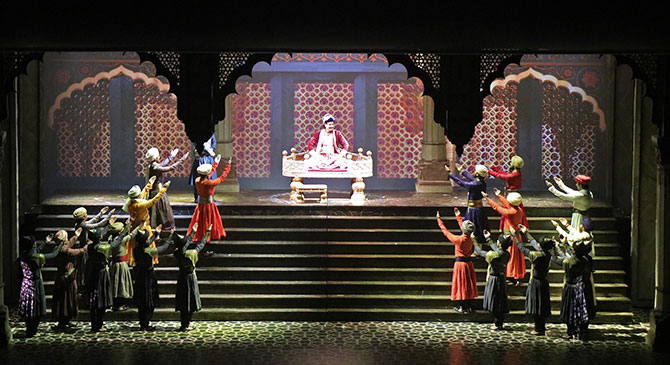
Last weekend I watched the stage version of Mughal-e-Azam. I like new perspectives, even if they do not hold the old charm.

Feroz Abbas Khan’s take on the Anarkali-Prince Salim love story under the not benevolent eye of Emperor Akbar is an ambitious project. How could K.Asif’s landmark movie translate in the confined space of a stage, especially since there weren’t any claims at ‘reinventing’ the classic and the intent was to almost repeat the scenes and the dialogues verbatim?

As a tribute it succeeds; it has the  head-bowed quality about it, aware all the time of looking up to an icon. And it has improvised marvellously. That battle scene is breath-taking because it relies on lights, sound and choreography. The same applies to the kathak interludes – these are professional dancers and, to be honest, it was they who elevated the Pyar kiya to darna kya song sequence by adding heft to Anarkali’s challenge, and pathos; in the film the song was about Madhubala. There was also an innovative use of ‘mirrors’ and light to create the sheesh mahal, although the light hitting the audience made me squint and miss out on some ‘chakkars’ by the dancers.

There was also live singing. Neha Sargam as Anarkali did a marvellous job, but was it necessary, considering it was the same music? It was also rather disappointing when at curtains down, the announcer mentioned how people weren’t convinced that it was live singing and asked her to sing a few lines right there. To my mind, this was insulting to the artiste. The makers do not have to justify anything and ask their own actors to give proof.
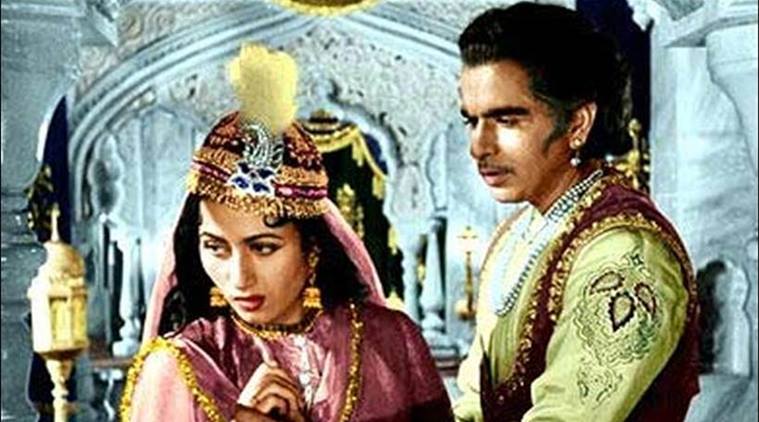

If the original was about performances, this was not. For a supposedly more intimate medium, the acting was alienating. Probably it is the stage where expressions rely on voice and body language. Nissar Khan as Akbar was powerful at moments and desultory at others. Sunil Palwal as Salim has presence, but where was the angst? And where was the passion with Anarkali, the understated caresses, that choke in the voice? As for Jodha, there is no real pining for a son nor the conflict between suhaag and motherhood. Bahar’s - the daasi hoping to become a princess - character too does not have enough oomph and guile that the original possessed.

For me that was sad because on the film I felt Nigar Sultana had overtaken Madhubala in the qawaali not due to the lines but gumption (aidedhugely by Shamshad Begum’s voice).

Naushad’s music was the stuff of legend and it was good to revisit it ‘pictorially’, even if not entirely satisfactorily. Theatre, unlike cinema, is not really a director’s medium. But here the director rules, followed by stage design, lighting, choreography. It was treated like an occasion. People were taking selfies before the posters in the lobby…after all they had paid good money for the tickets.


-->
I’d say it was worth the few thousand bucks. For the million bucks’ worth, buy a DVD for a couple of hundred rupees.

29.4.14

Tittle-tattle as Tribute

It’s a good thing that in a wired world we connect with information we might not have had access to so easily. But, together with that, there is also an excess of ‘uber facts’ that pass for knowledge. And then there is the surfeit of tributes – to coupling, to uncoupling, to botched-up cosmetic surgeries, to products, to people as brands, to dĆ©butantes, to the retired, to the living, to the rumoured dead. To the dead.

It does not matter whether you know anything about the deceased, or of the others, but it has become mandatory to add to the info pool.


Today as I signed in to access my mail, I saw a caricature of a man playing the table. But my eyes were riveted by the second ‘g’ and ‘l’ of google. They reminded me of Mahatma Gandhi’s glasses and walking stick. The link, of course, takes you to Ustad Alla Rakha. It is to celebrate his 95th birth anniversary. Who decides which year is worth commemorating? How many people who do not know him or about him would be enthused enough to read up or listen to his music?

Here is a short documentary on him:


What we end up with is over-the-top ‘connoisseurs’ who seem to know all, or the jejune attempts at keeping up with the Joneses that sometimes takes the form of distasteful parody.

On Monday, Zohra Sehgal turned 102. It is a remarkable moment for a remarkable lady. But the photograph that made it to most newspapers and websites was of her holding the knife high and, as one media outlet said, “attacking the cake”. She is an effervescent woman, but somehow her stance and the onlookers seemed to be at odds. Who were they? Family? Neighbours? Close friends? Where were the celebrities who keep throwing sound bytes about her achievements, about how lovable she is? I found the cake-cutting and the observers incongruous.


The picture I have chosen is gentler. There are personal moments when people end up as performers for an audience that only seeks certain characteristics, and thereby reduces them.

On her hundredth birthday, I had written:

There are times she acts as a link between generations, between spaces, between ideas, like a sutradhar, the perennial story-teller who weaves the chains together.

We don’t seem to care for stories anymore. The whispering gallery is where we stand and assume to understand life.

---

Here is the piece on her 100th: A hundred seas: Zohra Sehgal

30.10.12

Mind It

Still from 'Life of Pi'

"He wants to see the actor's mind in a shot." Actress Tabu said this about Ang Lee who has directed her in 'Life of Pi'.

It was so beautifully put, but what does it really mean? Is the actor's mind reflecting the character or her/himself? Or, is one superimposed on the other? 

Can one see a thought? If so, then the actor contemplating the motives and behaviour of the character would be methodical rather than spontaneous. Is thought not instinct?

You might suggest that premeditated thought cannot be instinctual. But, is there no lapse between thought and action?

Say, we play several roles in life; some we 'perform' because we are directed to - by precedent, norms, or for specific reasons. Is our failure to do so adequately a failure of thought or of action?

Think about some disabilities where the mind is hampered by lack of motor movement. These are unfortunate natural or accident-induced circumstances. However, even those of us who are not so restricted find that we cannot always act out our thoughts. Our thoughts are dependent as much on the manner in which they are received as on how they are conveyed. So, do they remain our thoughts anymore?

If the other person could see our 'mind in the shot', going by Ang Lee's expectation, then would we necessarily be understood? How often do we tear our hair in frustration that what we seek to convey has either been misinterpreted or whooshed past without even a moment of being acknowledged?

Can you read my thoughts? Routine question. But are you reading your own thoughts while trying to decipher another's?

Recently, someone sent a message in response to a call I made. It said, "I wanted to thank the thought." Was my act removed from my thought? Or, does the thought hold greater validity? Had I not acted upon the thought, would a person know? Can there be more than one thought for our actions and many ways to act based on one thought? 

If you can see a mind, then you are probably seeing not just what is but what might have been and can be. Mind or minds?
(c)Farzana Versey