Showing posts with label guru. Show all posts

19.2.13

Hunt for a baby

Helen Hunt with her baby

When I read about Helen Hunt getting a baby due to an ‘uplifting experience’, I adduced it must have been close to Immaculate Conception. 

What transpired, instead, was a combination of superstition and auto-suggestion.  The uplifting experience was a ‘lift’.  On the David Letterman show, Hunt shared her experience with Indian guru Sri Chinmoy, who has been described as a “United Nations-recognised master”.  The UN has a questionable record on political issues; therefore, one wonders on what basis it might have certified a spiritual guru as a master.  In form of address ‘master’ is quite the norm, but it is by believers. Did the UN test spiritual powers and, if so, how did it measure these?

Bollywood films used to have a standard cure for infertility – a visit to a godman or guru. Often, the person would be a villain with beady eyes, smacking his lips and while showering blessings on the woman giving her a once-over. Depending on how the characters were to develop in the script, the woman would either be forced to succumb or escape. Art-house cinema too explored the misuse of tantric practices. This, unfortunately, is not relegated to cinema.

A scene from the recent Bollywood film 'Oh My God - OMG'

Even today, one reads about charlatans from different cults and faiths using their ‘powers’ to offer women more than spiritual guidance. The better-known gurus have an ostensibly clean image and a celebrity flock. They cater to bruised egos, including their own, and in India while their role in politics was earlier mainly on the sidelines, these days they pontificate on major national issues. This camouflages the exploitative nature of the smaller players.

Hollywood has been a good place for those who managed to charm an international clientele. Everyone seems to have been in some form of rehab, and needs succour. Scientology has already asserted itself. Tibetan Buddhism too has done so, for those with political sympathies for the Dalai Lama.  Beverly Hills easily alternates between the good life and the god life, one feeding the other.  People do feel the need to rejuvenate and/or seek a higher purpose.

However, when someone certifies that an important bodily activity has been performed due to such intervention, one needs to look more closely.

Here is the extract from a report:

The guru, who passed away in 2007, was famous for showing off mind-over-matter feats of strength, and he celebrates the achievements of people he admires by lifting them above his head.

Hunt explains, “He lifted people that he felt had achieved something, that had contributed something to the world… (Archbishop) Desmond Tutu, Muhammad Ali and me.

“I went with my goddaughter… and we pull into this place and women open the car door and they’re dressed in, like, floral gowns, and they walk me into this garden. Then I get on this contraption, walk up four steps and he lifted me up.”

It is obvious that Sri Chinmoy understood achievement. It does call for a celebration, although this is a most unusual way to express it. Why did this single experience convince her that she could become a mother? It coincided with her conceiving. “I wanted to have a baby and he was encouraging me to pray and not give up and I did have a beautiful daughter, so he was right.”

There is place for coincidence and serendipity in our lives, and some of us have had what are known as ‘out-of-body’ experiences. These, if we try and understand rationally, are part intuitive and part strong desire. The mind is an extremely powerful tool. Ask those who suffer from psychosomatic disorders. One needn’t go that far. It is possible to experience a state of suspension merely due to a fever.

But making babies does require some amount of hard work and it is far from being a meditative state. One cannot merely wish to conceive or be so uplifted as to create out of nothing. The concept of Immaculate Conception has fascinated me for long and it is a profound spiritual metaphor for creation. Taking it out of the realm of its religious context, it is symbolic of the purest birth of what could change the world – it could be a piece of art or an ideology.

Helen Hunt’s encounter with the guru lacks this sublimity. It appears to have been at best a spiritual transaction; it was also two famous people meeting as a trade-off. Why could she not pray on her own? How much did merely sharing her deep need for a child have to do with it? Is it not possible that the seed had to be sown in her mind for her body to accept it?

She is fortunate that she is who she is. But, the legitimacy she gives to such errant experiences conveys that although thoughts are potent, she could not even think them on her own.

© Farzana Versey

17.3.12

Pakistan on an Indian Spiritual Trip

The guru in Pakistan

I stood in the sun, eyes blinking. On that dry Delhi summer afternoon of parched throats and heat without sweat, I was waiting in the queue outside the visa collection window of the Pakistan High Commission. People started exchanging notes. The moment they discovered I had been there before, the questions were rapid: Do you have family there? What are the good places to visit, shop, eat? Are they like us? I became a Pakistani expert, until I saw someone watching me with a bemused smile.

He was a tall lanky man with longish hair that he kept pushing behind his ear in a rather effeminate manner. In that line of nervous people waiting to know whether they had been granted entry, he seemed supremely confident. “So, you’ve been to Pakistan before?” he asked.

“Yes, of course,” I said, now that I was the ‘source’ the group around us had made me into.

“Is this your first time?” I asked.

By way of explanation, he opened a file. The sun was beating down and there was just too much light to read. I shrugged. “Many times,” he said. “For how long do you plan to stay?”

“I’ve applied for a month again, let’s see. And you?”

“Six months.”

“What? Do they give a visa for six months?”

He had a boyish grin that did not quite go with what he was about to tell me:
“I teach.”

“Oh, ok…” I was not sure if asking anything more would be deemed proper. He held up that file again.

“Actually, I teach the art of living.”

When spoken, it sounded like he was teaching Pakistanis the fine art of going about with their lives. But, obviously, he was a tutor with the Art of Living Foundation.

"Do you know about it?"

"Of course. They let you stay there for this?"

I must admit I was envious because of my own experience with visas. I was fairly certain then that there was a spiritualist inside me waiting to come out.

I got my passport and, unfortunately, just then he was called to furnish some papers, so no contact details were shared. If only I had looked at the file he had opened for me. Perhaps, he did not wish to make a public display.

I was curious then as I am now about how in a supposedly Islamic country there was enough space for such quick fix spiritual solutions. I met a few local soothsayers, too. One particular palmist was very popular in Karachi; people would go in their cars and stick their hands out. It sounded like a takeaway joint, only bizarre and fascinating. My friends took me there, but he wasn’t around on that day. The fact is that despite the Islamisation, these kinds of activities have been prevalent.

I recall this now because Sri Sri Ravi Shankar, the founder of the Art of Living Foundation, visited the country recently. I am amazed at the manner in which his trip has been portrayed in the media. ‘He is going to teach the Taliban to de-stress...this is a peace mission’, they say.

Quite naturally, he is not going to let go of this opportunity to appear as more than a soul spa. So he said:

“All those who fight have fear and concerns; they want to feel valuable. Our techniques give them a sense of well-being and calmness, and once the inner calmness happens, the feeling of wanting to fight and the urge for revenge disappears.”

Why has he not tried that in India? We have terror groups, criminal gangs, separatist organisations. He has met some, but will he dare to approach them to stop taking revenge? Can anyone imagine the Taliban members doing a breathe in-breathe out?

This is nonsense only to project the guru as someone with a higher purpose, and a vague Taliban rather than real criminals come in handy. Besides that, he is treading on dangerous ground by getting involved in politics:

“We want to talk with the Taliban in Pakistan. We’ll go in with an open mind, to find out who they are, their problems and their intentions—that has always been my approach.”

He is talking about the ‘we’ of his organisation, not as an Indian. I am surprised that there has been no objection to this. Even ministers who appear in studios with people who are considered enemies of India are lambasted. Those writing anything positive about Pakistan are questioned. And here we have this man talking about an “open mind” regarding the Taliban.

And how are the Pakistanis taking this? Do they not complain about their nation being run over by the Taliban?

At the time of the Lal Masjid incident when Islamabad was supposedly under siege, there were Pakistanis in deep meditation at the Art of Living Foundation, not to solve the country’s problems or shut them out, but to detoxify their indulgences. There are 5000 such people. It is part of one more salon trip.

Sri Sri Ravi Shankar’s mission is possible because he is not interested in really doing anything. If that were the case, then the government as well as the Taliban would have found ways to keep him away. His is a commercial venture, catering primarily to the elite or to those among them who want to ‘help’ others through pop philanthropy.

There is nothing more to it than this. However, it just does not sound important enough. After all, this is Pakistan. Both Pakistanis and the guru need to make it seem like ‘peace’, one of the most abused words in the Indo-Pak context. It takes on the pugnacity of a war-like situation.

This is the guru’s hope trick and ticket.

(c)Farzana Versey

24.4.11

Satya Sai Baba: Spiritual Rockstar


Baba died this morning of April 24, 2011. According to his own spiritual calculations, he was scheduled to depart earth in 2022. While I understand the grief of the followers, I do not understand the disposition towards worship. I usually do not fathom any kind of mass belief, so this is not to single out an individual. Not individual, say the faithful, it is Bhagwan. We need gods. Sachin Tendulkar is god, and Sachin was not going to celebrate his birthday because he wanted to pray for Satya Sai Baba’s recovery.

At 85, he did lead a full life. He was known for his miracles, more magical than any magician’s. Unfortunately, his own bodily organs failed and no doctors could revive them. Strangely enough, even the prayers of the devotees could not nor his own divine powers. 

This is a profound disclosure of the spirituality business. Many people need guidance; many people suffer from some sort of misery. Wealth, education and even therapy do not work. They prefer being part of a gathering where a guru offers solace by the mere fact of her/his existence. It is a rockstar phenomenon, a classic case of collective catharsis. 

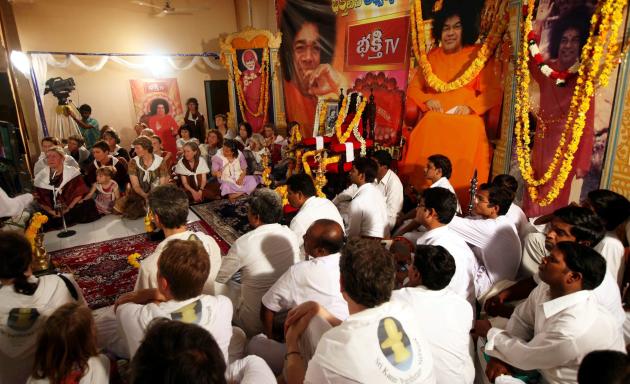
I was witness to it at Baba’s Whitefield ashram almost 15 years ago. I admit it was as a voyeuristic tourist that I went. A blue plastic shade covered a huge tent-like area. People were ambling about and most were foreigners. As I recollect, it was only Whites, a phenomenon that is noticeable in most such ashrams. You rarely see Blacks or other races, although there is considerable Japanese presence at the Osho ashram, because he had this thing about Zen. These foreigners wore carelessly draped cream-coloured sarees and bindis on the forehead; the men were in kurta-pyjama. At a water-tap a woman, her hair coiled at the nape of her neck, bent to drink water by cupping the palm of her hand. It was a memorable image, reminiscent of villages as seen in Bollywood films.

There was a canteen across the road run by the ashram. It was packed with people. Long wooden benches and tables. I am not sure if one had a choice, but the stuff on my plate was terribly spicy and as tears ran down my eyes, I watched the rest whose palates were even less trained for such food. They were eating with their fingers, seemingly enjoying every morsel. I thought to myself that perhaps this is what the spiritual journey is all about – getting used to whatever is on your plate. 

Back to the main ashram, they said Baba was going to give a darshan. The ground was dusty, but a platform was ready; soon there would be a throne for him to sit in and deliver his sermon and bless the congregation. Some had already begun reserving their places on the floor.

What were they looking for? They could read hundreds of tomes on spiritualism from several masters; they could be believers without moving from their homelands. They chose to travel all those miles just to become a part of the enterprise and get a glance of the man. Is this faith or is it about auto-suggestion where you begin to believe in your own delusions? How much of a role does any guru play in this, except for being a conduit to their greater search for going beyond the material? Can people not give up luxuries in their own environment and contribute to their societies? Where does the guru fit in when they cook, clean and eat humble meals?

Is it not a contradiction to see the person they have faith in sitting on a gilded throne and being hailed by the most powerful people, people who are willing to publicly be obsequious, unmindful of their reputations? Does that make them spiritual when after the ‘special’ moment they are back to their corporate offices and ministerial bungalows dictating policies that are hardly austere?

Baba had declared himself the incarnation of the Sai Baba of Shirdi; the latter’s devotees are not necessarily his worshippers and that itself should say something. 

It is also pertinent to note that when it comes to proving faith-healing and miraculous powers, it is the poor who are brought forward. It can be deduced that for them just a touch of any god-like creature is enough of a status leap. You won’t see them rubbing shoulders at community canteens with the rich devotees. Therefore, the Satya Sai Baba empire had little to do with his ability to produce Rolex watches out of thin air and vibhuti (holy ash) from his palms. Both have been challenged and proven by the Rationalist Society, but it has not affected the attitude of the faithful, even the ones with reasoning powers.

This is more likely about channelising wealth into a nirvana factory. Baba’s educational and health institutions are often quoted as examples of the good work beyond the ashram. These are commendable activities, but they also encourage people to owe their knowledge and their lives to Baba. Besides, there is a lot of money involved in maintaining ‘international standards’. Attempts to probe into the functioning of not only this but any religious organisation always meet with a dead-end because among the believers are those who run the investigating agencies. Any other improprieties are also shut up. Will any people’s movement have the courage to look into the financial dealings at the several ashrams and even madrassas and missionary-run outfits?

Complicit in this is the media. Rarely has any media group raised questions and when they do there is an arching over backwards to give a balanced picture. I was once told to “go slow” on religious figures for one of my columns, although I had written about Imam Bukhari of Delhi's Jama Masjid and the Pope earlier. In a casual conversation with someone much later, I discovered that the editor was a devout worshipper. It makes one wonder, then, what balance we are speaking about when there are already treacly tributes pouring in.

Ever since Baba took ill, news reports gave a daily update. It is fine since he does have enormous appeal and people were concerned. However, it was distressing to read about security arrangements at Puttarpathi, where his main operations are run from and in the ashram where he will be kept in state now. The forces are there because there will be a rush of VIPs. I can already imagine people killing themselves in grief. Who will do so? The poor. Not the rich and influential.

What does it tell us about the prospect of individuals as institutions? As Satya Sai Baba had once said, “Devotion has to be unintermittent, uninterrupted, like the flow of oil from one vessel to another.” Pity, he did not keep another vessel ready. Who will be in charge of the various organisations run by the private trust? It will be interesting to see how things unfold and whether Baba’s legacy can continue under the tutelage of his trusted aide, an IAS officer, or his nephew. It is unlikely. There will be a fight for the spoils. Spiritualism goes on the ventilator.

(C) Farzana Versey

Also published in Counterpunch, April 25