Showing posts with label foreigners. Show all posts

8.1.14

There's a Frenchman in the Pakistani Soup


Fine dining, by definition, is exclusive. Can a foreigner bar Pakistanis from his restaurant in Pakistan, their country?

The obvious reaction would be, no. It is racist any way you look at it. However, let us see the other side.

La Maison, run by Frenchman Philippe Lafforgue, in a part of his house at an upscale area of the capital Islamabad, has been forced to shut down after there was an outcry against this discriminatory policy. There was no board outside saying so; it was a discreet decision by the management.

As the owner stated:

“It’s not a discrimination thing. It’s a culturally sensitive thing. How can I serve pork and booze to Pakistanis without getting into trouble? So I have a rule: no locals getting in...I can’t open it up to the Pakistani people because I serve alcohol. If I start serving locals, which is obviously profitable, I will have to bribe the police…which I want to avoid.”


This last bit is important and has been ignored by the commentators. There are many in Pakistan who can afford it, and do patronise fancy restaurants. However, there is much hypocrisy regarding alcohol. Many of the elite like to show off their bars and collection of wines, but do not raise their voice against government policies over their eating and drinking habits. Their laws might discriminate against minorities, but they are quite willing to tap this segment for their quota of booze. Non-Muslims and those in the diplomatic services are their sources for tipple, although they can manage to arrange it through powerful local contacts.

Therefore, the owner is not entirely wrong when he talks about having to bribe the cops.

Is there a cultural issue that he is truly concerned about? Let us just say that the Pakistanis who might enjoy their drink at home or at private parties might put on a publicly moralistic mask. This is not a blanket judgment, but it certainly does apply to a few. Sometimes, it is pragmatism. A friend who has never hidden his lifestyle has had to hear the police knock on his door quite often.

Then, there is the sensitive issue of whether an outsider can prevent citizens of the host country from entering. Most reports have gone back in time to refer to the "Dogs and Indians not allowed" policy of British establishments during colonial rule.

There are clubs in India where certain people are not permitted even today. Depending on the portfolio of the club, politicians and film stars too have been debarred by the intellectuals and corporate sections. There is also a dress code policy; the famous artist M.F.Husain was prevented from entering the British era Willingdon Sports Club because of his footwear.

I am afraid, but I do believe that private establishments do have the luxury and right to choose their entry policies. Try dressing up scruffily and getting into the Karachi Club, or even a posh eatery in Zamzama. The hierarchy is well in place.

For that matter, at an exclusive do in Karachi, my host said he would not introduce me as an Indian because it was a cadets party. Although uncomfortable about it, I did understand his position, and was in fact grateful that he let me have a glimpse of something I would never have had.

Why would the French restaurant assume that all Pakistanis are uptight? I have been to an Italian restaurant not too far from this place and we were the only 'locals' there, if we don't consider my Indian identity.

What is particularly glaring about how this discrimination thing has worked out is that the main issue has been obfuscated. The assistant superintendent of the Islamabad Police decided to do a personal recce after getting complaints (a social media campaign, naturally). These are his words:

“So I personally called in to make a reservation, and was rejected when I said I was a Pakistani. The next step was obviously to check the place out. We found over 300 bottles of non-licensed alcohol and even a casino table.”


Lafforgue was charged with "unlicensed alcohol," a crime. Where does all talk of racism disappear? As an homily, the cop added:

“How can you live on our soil and treat us like this. No rules allow such behavior. This is not the nineteenth century.”


Part of the problem is the need to look up to foreigners. It is ingrained in the DNA of the subcontinent. The protests do not emanate from the ground, but from niche ideas of access. This too is privilege.

There is a flip side as well. Local Pakistanis, mainly young women, seek out invitations to parties at the diplomatic clubs, even though they are primarily meant for embassy staff and their families. It is another matter that they are often welcomed because they add exotica and are not inhibited.

The police have shut down the restaurant for now. It would have made sense if the registered crime was not illegal bottles of alcohol but discrimination. Unfortunately, that would be a difficult proposition. For, there is a huge mirror and it shows what Pakistanis do not wish to see.

Touché?

© Farzana Versey

---

Image: Philippe Lafforgue at his restaurant, NBC

24.4.11

Satya Sai Baba: Spiritual Rockstar


Baba died this morning of April 24, 2011. According to his own spiritual calculations, he was scheduled to depart earth in 2022. While I understand the grief of the followers, I do not understand the disposition towards worship. I usually do not fathom any kind of mass belief, so this is not to single out an individual. Not individual, say the faithful, it is Bhagwan. We need gods. Sachin Tendulkar is god, and Sachin was not going to celebrate his birthday because he wanted to pray for Satya Sai Baba’s recovery.

At 85, he did lead a full life. He was known for his miracles, more magical than any magician’s. Unfortunately, his own bodily organs failed and no doctors could revive them. Strangely enough, even the prayers of the devotees could not nor his own divine powers. 

This is a profound disclosure of the spirituality business. Many people need guidance; many people suffer from some sort of misery. Wealth, education and even therapy do not work. They prefer being part of a gathering where a guru offers solace by the mere fact of her/his existence. It is a rockstar phenomenon, a classic case of collective catharsis. 

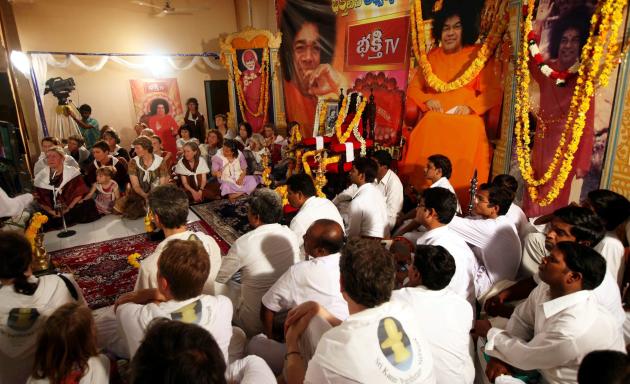
I was witness to it at Baba’s Whitefield ashram almost 15 years ago. I admit it was as a voyeuristic tourist that I went. A blue plastic shade covered a huge tent-like area. People were ambling about and most were foreigners. As I recollect, it was only Whites, a phenomenon that is noticeable in most such ashrams. You rarely see Blacks or other races, although there is considerable Japanese presence at the Osho ashram, because he had this thing about Zen. These foreigners wore carelessly draped cream-coloured sarees and bindis on the forehead; the men were in kurta-pyjama. At a water-tap a woman, her hair coiled at the nape of her neck, bent to drink water by cupping the palm of her hand. It was a memorable image, reminiscent of villages as seen in Bollywood films.

There was a canteen across the road run by the ashram. It was packed with people. Long wooden benches and tables. I am not sure if one had a choice, but the stuff on my plate was terribly spicy and as tears ran down my eyes, I watched the rest whose palates were even less trained for such food. They were eating with their fingers, seemingly enjoying every morsel. I thought to myself that perhaps this is what the spiritual journey is all about – getting used to whatever is on your plate. 

Back to the main ashram, they said Baba was going to give a darshan. The ground was dusty, but a platform was ready; soon there would be a throne for him to sit in and deliver his sermon and bless the congregation. Some had already begun reserving their places on the floor.

What were they looking for? They could read hundreds of tomes on spiritualism from several masters; they could be believers without moving from their homelands. They chose to travel all those miles just to become a part of the enterprise and get a glance of the man. Is this faith or is it about auto-suggestion where you begin to believe in your own delusions? How much of a role does any guru play in this, except for being a conduit to their greater search for going beyond the material? Can people not give up luxuries in their own environment and contribute to their societies? Where does the guru fit in when they cook, clean and eat humble meals?

Is it not a contradiction to see the person they have faith in sitting on a gilded throne and being hailed by the most powerful people, people who are willing to publicly be obsequious, unmindful of their reputations? Does that make them spiritual when after the ‘special’ moment they are back to their corporate offices and ministerial bungalows dictating policies that are hardly austere?

Baba had declared himself the incarnation of the Sai Baba of Shirdi; the latter’s devotees are not necessarily his worshippers and that itself should say something. 

It is also pertinent to note that when it comes to proving faith-healing and miraculous powers, it is the poor who are brought forward. It can be deduced that for them just a touch of any god-like creature is enough of a status leap. You won’t see them rubbing shoulders at community canteens with the rich devotees. Therefore, the Satya Sai Baba empire had little to do with his ability to produce Rolex watches out of thin air and vibhuti (holy ash) from his palms. Both have been challenged and proven by the Rationalist Society, but it has not affected the attitude of the faithful, even the ones with reasoning powers.

This is more likely about channelising wealth into a nirvana factory. Baba’s educational and health institutions are often quoted as examples of the good work beyond the ashram. These are commendable activities, but they also encourage people to owe their knowledge and their lives to Baba. Besides, there is a lot of money involved in maintaining ‘international standards’. Attempts to probe into the functioning of not only this but any religious organisation always meet with a dead-end because among the believers are those who run the investigating agencies. Any other improprieties are also shut up. Will any people’s movement have the courage to look into the financial dealings at the several ashrams and even madrassas and missionary-run outfits?

Complicit in this is the media. Rarely has any media group raised questions and when they do there is an arching over backwards to give a balanced picture. I was once told to “go slow” on religious figures for one of my columns, although I had written about Imam Bukhari of Delhi's Jama Masjid and the Pope earlier. In a casual conversation with someone much later, I discovered that the editor was a devout worshipper. It makes one wonder, then, what balance we are speaking about when there are already treacly tributes pouring in.

Ever since Baba took ill, news reports gave a daily update. It is fine since he does have enormous appeal and people were concerned. However, it was distressing to read about security arrangements at Puttarpathi, where his main operations are run from and in the ashram where he will be kept in state now. The forces are there because there will be a rush of VIPs. I can already imagine people killing themselves in grief. Who will do so? The poor. Not the rich and influential.

What does it tell us about the prospect of individuals as institutions? As Satya Sai Baba had once said, “Devotion has to be unintermittent, uninterrupted, like the flow of oil from one vessel to another.” Pity, he did not keep another vessel ready. Who will be in charge of the various organisations run by the private trust? It will be interesting to see how things unfold and whether Baba’s legacy can continue under the tutelage of his trusted aide, an IAS officer, or his nephew. It is unlikely. There will be a fight for the spoils. Spiritualism goes on the ventilator.

(C) Farzana Versey

Also published in Counterpunch, April 25