20.8.12

Just a touch of faith...

Never seen the Taj Mahal like this. Pic Hindustan Times

Of the first time I am supposed to have heard the azaan, there is no recollection. It was whispered in my ear as a newborn. My memory isn’t that great. The complete azaan is a full-throated call, every syllable enunciated with as much power as preventing an echo from falling off a cliff. You do not need to understand the language, and you must suspend the ‘yours and mine’ to be able to just listen to the sound. Think of it as thunder, of waves lashing, of a cry, of laughter. Of thoughts unspoken.

I know so little about religion that once when I was at the health club while travelling, and I needed to get to one of the machine, a man on his knees was in the way. I went up to the reception and asked, “When will this guy finish his yoga?”

“He is praying, ma’am.”

I had failed to notice the prayer mat or his hands on his ear. When he turned to the left and then the right, I thought it was an asana. Was I entirely wrong? If prayer is meditation, then it does not matter what you call it. I hasten to add that I know what a namaaz is. It was just the thought of seeing someone there, in my space, so to speak, that confused me.

This year during the month of Ramzan, I heard no azaan. It wasn’t something I was aching to hear. Just the thought of having heard it in days past made me wonder – crowded areas, traffic might well have drowned the sounds. Back in the early days, when one of my relatives fasted, along with the azaan call to prayer, I used to rush to look for the light bulb in a building across. It was an indication that it was time to break the fast. I felt no guilt that I had not been on an empty stomach, but did feel elated as I watched those who had stayed hungry bite into a date and eat slowly, waiting for tongues to form liquid to swallow.

Ignorant as I am, nostalgia is my shelter. Each morsel of life I take is celebration, each morsel I have denied or been denied is a lesson about vacuums, emptiness.

Here is a poem by Gulzar that conveys my thoughts:

Sparsh

“Quran haathon mein leke naabeena ek namaazi
laboun pe rakhataa tha
donon aankhon se choomtaa tha
jhukaake peshaani yoon aqeedat se chhoo rahaa tha
jo aayaten padh nahin sakaa
un ke lams mehsoos kar raha ho

main hairaan-hairaan guzar gayaa tha
main hairaan-hairaan thahar gayaa hoon

tumhaare haathon ko choom kar
chhoo ke apni aankhon se aaj main ne
jo aayaten padh nahin sakaa
un ke lams mehsoos kar liye hain”

My rough translation:

Touch

The blind namaazi brushed the Quran with lips
Kissed it with both eyes
Touched his forehead to the ground
With such faith
As though the verses he could not read
He could feel with a mere touch

Confused I left
Confused I pause

By kissing your hands
Touching you with my eyes
The verses I cannot read
I can still feel them

Eid Mubarak…

For those who came in late, for more of my memories More than a moon

17.8.12

Rethinking Asylum for Pakistani Hindus

Crossing over. Pic; India Today

What has made 250 Pakistani Hindus want to seek asylum in India? The obvious answer is that the community is persecuted. Hindu girls are kidnapped, raped, forced to convert to Islam and marry Muslims. This is true, as true as Muslim girls being kidnapped, raped, and forced to marry men they do not wish to be with. The only difference is that there is no conversion. Criminal law for all citizens of Pakistan is the same, and it falls short in execution where women’s issues are concerned.

The law does not protect minorities. The Blasphemy Law is ridiculous, for it assumes that non-Muslims will run down the Prophet or the Quran, although it must be understood that Muslims too have been arrested for the same.

However, I’d like to know why it is only Hindus who are looking to move to India, and why now? Christians are treated no better; Ahmadis suffer; Shias are killed. Only a small fraction of extremists is involved in such persecution and holding the country to ransom. We do hear Pakistani leaders talk about minority rights, and either they do nothing about it or have to suffer the consequences.

The Hindus who arrived here got visas for pilgrimage. Did they plan not to return, or was it an idea that germinated in their minds later? Do all of them belong to a group? Mass asylum – although this really isn’t all that large a number – is sought with some pre-meditation. Did the Indian government know about the plans?

The opinions are contradictory. Some say they are seeking refuge here because they are afraid. Others are emphatic they will return. Yet, voluntary organisations have rushed to help them the moment they crossed the border. Were they intimated about it?

India Today states:

NGOs, lawyers, professors and artists have stepped in to bring relief to the 113 Pakistanis, living in a refugee camp in the national capital. They have arranged for food, sanitation and even education for them.

Human Rights Defence secretary general Rajesh Gohna said, "We have moved the application for extension of visa for them and now we are going to meet the chief visa officer on the first (December 1). Our group could go there along with their representatives. We will request the government of India that their visas should be extended and long-term visa should be granted to them and subsequently citizenship should also be granted to them."

Are those who are here the persecuted cases? If they are being helped on the basis of actual experience, then the human rights organisations must file specific cases.

I am afraid that do-gooders these days also have political agendas. In their enthusiasm, they might take away from these Pakistani Hindus their homes and livelihood only to make a point.

At the camp. Pic The Hindu

Art of Living guru Sri Sri Shankar too met these Pakistanis at the camp. He runs a franchise operating in Pakistan. Has commercial gain superseded his concern for all these years? He visited the country a while ago. Did he listen to the woes of the Hindus? Did he approach the Indian government for assistance?

A PTI report of August 11 gives another picture:

"It would be wrong to say that Hindus or Hindu families who have crossed over to India were no more willing to go back to Pakistan," group leader Rajesh Singh said. The Hindus from Pakistan have come to India to pay obeisance in the Hindu historic temples located in Amritsar, Indore, Haridwar, Rishikesh and Delhi but not for asylum," he said, while dismissing as "rumours" reports of exodus of Hindus. "In fact, none of the Pakistan-based Hindu families could afford to live in India while leaving their ancestral houses and set up behind in Pakistan," he said.

250 of 4.3 million Hindus do not constitute an exodus. So, are there only practical considerations? Certainly that is the major reason. Since most are based in Sindh, it is rather obvious that it was a factor in their not moving to India during the Partition or later. It has been 65 years. How many tried to return to India? Were they denied licences to run their businesses in Pakistan? Don’t they hold jobs? I am speaking purely at the practical level. Indeed, there are fewer temples than there were in 1947. It is not the Islamists who have targeted those. They were mainly demolished as illegal constructions. There is rarely any mention of the celebration of Hindu festivals, including Ganapati visarjan.

A minority in a religion-based majority state is at a disadvantage by default. In principle and practice there are some things they have to accept and have done so. Therefore, Justice Bhagwan Das had taken the oath of office in the name of Allah. It seems absurd that the momins would want those they consider ‘kafirs’ to utter the name of Allah at all.

Returning to those who have arrived in Indian, an anonymous voice has been quoted:

"If Indian government throws open the doors for Pakistan based Hindus, they would flock to India," he said, adding that they felt life would be much easier here especially when they have to marry their children.

Again, it is a practical consideration.

India as refugee haven is a bit of a delusion. If these Hindus who have crossed over are provided for, despite being illegal immigrants (should that happen), and they are granted quick citizenship, it will raise questions about several Bangladeshis who have been living here for decades and should have become naturalised citizens and are not.

Would political parties be as enthusiastic had Muslim refugees decided to land up here and seek asylum? There are many more Muslim families who are separated. If persecution is the yardstick, then Pakistani Muslims are right up there.

The reason I bring this up is simple: It is not merely a humanitarian story. It is politically charged.

The global censure for its failure to protect minorities appears to be pinching the Pakistani regime. The 250 Hindus who recently arrived in India were briefly detained at the border by Pakistani authorities. They were allowed to enter India after signing a commitment to return, and told not to criticize Pakistan while in India.

Why did the Pakistan ask them to sign documents stating that they would return? Would the government not wish them to go away? Or do they fear a diplomatic impasse? That is unlikely. The Pakistani establishment has never expressed concern about such niceties. Is it really afraid of international repercussions when the concern is diplomacy and little else? Is Pakistan looking for lamb to feed the fundamentalists? Going by figures, and the different kinds of communities and sects targeted, this is unlikely.

Pakistan is a helpless spectator. If you have visited Hindu homes and met Hindus, or for that matter other minority groups there, they are not Islamised. I was at a friend’s home and her help wore a Gujarati style saree and a bindi. Shopkeepers run their businesses, their identities rather obvious. Sikhs, of course, stand out because of their turbans. If anything, it is the poor Christians who due to the menial tasks they are relegated to perform are disparaged. People don’t like comparisons, but think about how we treat “bhangis”.

Is the Indian government going to capitalise on this or play safe? Minister of State for Home, Mullappally Ramachandran, had said:

"All such Pakistani nationals who have come to India on group pilgrimage visa will have to return to Pakistan... within the visa validity period or the short extended period allowed in specific cases."

Since then, there are attempts to approach the authorities, mainly by making it into a TV show. The Hindutva parties will benefit the most. This should be pause for thought. Just as Indian Muslims, or even most Muslims in Pakistan, are urged not to fall into the rightwing trap, the same applies to Hindus, in Pakistan or in India. The ruling party should not bite the saffron bait and act in a hurry. It is dangerous, for Pakistan might want to swoop down on just such an opportunity and offer asylum to Indian Muslim victims of riots only to score points.

I understand that people are concerned, but let us look beyond the concern. How many of the Hindus were asked to “Go back to India” by the general Pakistani population? If it is fundamentalists we are talking about, then this is not what they want. This is what they do to draw attention to their shaky ideology.

I would not want to leave home. Think about those people too, the ones who are not part of this group of 250. In fact, think of mass exodus of Christians, Sikhs, Shias, Ahmadis. This will not be a reversal of Partition, but one more.

If we paid heed to the larger picture we’d not be feeding off a group of pilgrims.

(c) Farzana Versey

15.8.12

Azaad Hind...sight?

"To know how to free oneself is nothing; the arduous thing is to know what to do with one's freedom."

- Andre Gide

India completes 65 years of being independent today. There are many who quote Rabindranath Tagore's poem, "Where the mind is without fear and the head is held high" mindlessly. What do the feudals have to fear and will they permit their 'slaves' to hold their head high and speak out any truth, forget a truth uncomfortable to them? These are people who thrive on "narrow domestic walls". In fact, they flaunt fearlessness in opposition to those outside their own walls.

It's easy to memorise homilies and lecture others. In their slumber, they mumble "let my country awake".

And then there is this - a silence of poignant wakefulness:


- - -

I cannot do better than that. Or add to what I have already written in Despicable dogs and Independence and Lay off the National Anthem.

A Happy Independence Day to all Indians think beyond 24 hours...and look back, and ahead, with anger if needed.

12.8.12

Sunday ka Funda

I can't touch the spirit or grasp the air. I can feel suffused. I do. With, and in, this too:


7.8.12

Beyond Wisconsin: Page of Terror and Establishment Apathy


Page of Terror and Establishment Apathy
Beyond Wisconsin
by Farzana Versey
Counterpunch, Aug 7


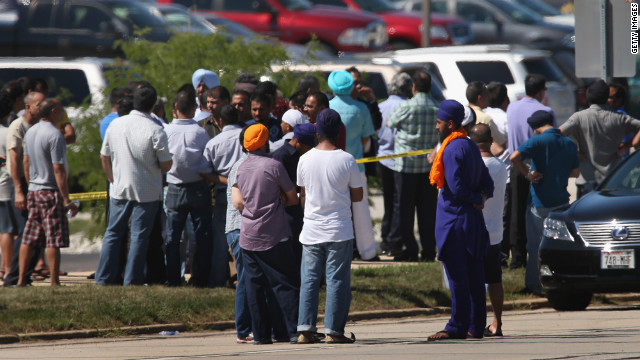
“Nobody's angry here. We're just confused. Was this a random act? Was this directed at us because of the way we look?”

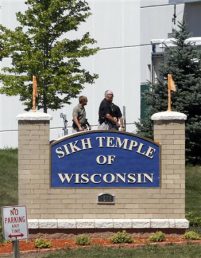
The questions were raised by an onlooker at the site of the Sikh gurudwara at Oak Creek in Wisconsin where six people were killed by a white man on the morning of August 5; he was shot dead by the cops.

Why is nobody angry? Why assume it might be a random act? What does the loaded “way we look” convey and why let it overshadow the terrorist attack? The FBI will conduct the investigations as a “domestic terrorist-type incident”, but for a large section of the media Wade Michael Page, a former sergeant, is a “lone gunman” or a “shooter”.

The motives are as clear as sun in a cloudy sky. It now seems that he was a neo-Nazi. In fact, civil rights groups go a step further and refer to him as a “frustrated neo-Nazi”. Was he frustrated with the ideology or was his frustration a spur to become one? This is a convenient back-up vague term to absolve mainstream terrorism.

To caricature him is easy, for the blueprint is ready and almost cool – balding man with tattoos, strumming the guitar with devilish music in an offbeat band called End Apathy. His motto to “stand proud and raise the white man’s flag” is confusing white supremacy with neo-Nazism. Both have different histories. Tanking up on the latter is a hands-off stance for internalised racism. The Nazi satan image gets props for also psychologically working on public memory as victimisation.

There is tardiness to investigate the possibility of a larger group’s involvement, a routine that is followed when the shoe in on the other foot and forces are deployed to trace leaders, assistants, handlers, trainers, foot soldiers.

The United States is home to 700,000 Sikhs. They are handed out certificates for being “a peace-loving community”, implying their innocence only by default, while the criminal’s antecedents remain enigmatic and diffuse the pattern of devious behaviour.

State Rep. Mark Honadel, whose district includes the temple, said, “Unfortunately, when this type of stuff hits your area, you say to yourself, 'Why?' But in today's society, I don't think there's any place that's free from idiots.”

That we are still battling with terminology to use for terrorists in some parts of the world reveals just how much semantics play a role in brainwashing people.

It includes the victims, who are hostage to the munificence of an all-embracing country. There is diffidence among non-westerners to talk about racism or what is now increasingly obvious as white terrorism.

This has two very dangerous consequences: It results in suspicion and infighting among different ethnic groups, and the claiming of tragedy points makes it possible for the ‘war on terror’ to continue as a sanctimonious bubble for the Western establishments.

The discussion on gun control is just one of the sidelights to obfuscate the issue. A person with a gun does not necessarily go on a killing spree. There are unlicensed weapons available. There are bombs and the use of more basic forms of ‘fundamentalist’ tactics. The latter can spread right from televangelism to a president sneaking into another country to bolster the morale of his forces that have no business to be there in the first place.


How do we deal with a “lone gunman”, a “psycho” and other such assorted creatures that are products of psychiatric superpower wards as opposed to an organisation that can conveniently, and legitimately, be called a terror outfit? Did a group pilot an airplane into the Twin Towers? Were we not told there was just one soldier who walked in the dead of night and shot down villagers in Afghanistan? Anders Breivik was alone when he killed 77 people in Norway. Kiaran Stapleton “kept smiling” as the court pronounced him guilty for the murder of Indian student Anuj Bidve in Manchester.

How individualist are they? Why do we not just say that there is another terrorism that does not need caves or a rugged terrain? Countries carry the baggage of history, of calamities, of attacks. The ruling elite do not have to muddy their hands to clear the rubble, so they muddy the minds of the citizens. The melting pot swirls the ladle and scoops out the good from the bad. It is an act so subtle that no one notices it.

It is left to the conditioned-to-feel displaced and mentally unstable white guy to carry the moral fable forward. He is like any recruit at a terrorist training camp. His ideology is not born in a vacuum. He is doing it for country. The political leadership will quote from the Constitution, but they have whetted the appetite for vengeance with rhetoric. Incidentally, the indictment of soldiers by some senior officers is an even more potent testimony of such lobotomy. Not surprisingly, Page’s six year stint in the US army during the 90s, partly in psychological operations” is mentioned prominently, even if he was demoted and quit the military with a “Less Than Honourable Discharge”.

Despite this, he comes across as a backroom loyalist. His 9/11 tattoo in many ways subliminally exonerates him. America has not allowed the world to live in peace ever since that day. One Sikh leader stated that it “implies to me that there's some level of hate crime there”. Another one wants “to educate Americans about diverse groups and act ‘to lessen this kind of rage’”.

A crime that should be seen in isolation has become communalised. It is, strangely enough, pluralism that has caused it – a pluralism where you may look and dress like Kim Kardashian or Justin Bieber but not like ‘natives’ like you. Instead of pushing for quick action and security, there is trepidation over “mistaken identity”, that some white guy might think you are someone from the al Qaeda. The chairman of the Sikh Council on Religion and Education believes: “There’s always an apprehension and a sense of fear that this kind of incident will take place anywhere, anytime.”


Can this not happen to others, too? Sikhs were killed for being Sikhs in their home country, India, where the ruling party conducted an operation inside the Golden Temple. Sikhs have had to fight for their right to wear turbans and to carry their kirpans, symbolic swords. Was there any al Qaeda then?

If 9/11 is being propagated as a definitive revenge-worthy date to flush out enemies, then will insurgency and terrorist attacks on some Indian states be seen as fallout of the Partition of 1947, and subsequent wars with Pakistan and China too?

Mitt Romney is concerned that the Wisconsin attack took place at a house of worship. This gives the crime another colour. Places of worship draw attention to the faith, more than to the community. But in the world outside America, there are sects, castes, sub-castes. However, in an alien land, a temple of any religion has more than emotive value. It represents an uprooted cultural identity.

There is already guilt by association. Pakistan’s liberals who berate those who sympathise with the plight of Muslims in Assam or Rohingyas of Myanmar instead of the Balochis in their own backyard are themselves reaching out to American Sikhs. The Peshawar ones are a forgotten story. 1984’s massacre of Sikhs is a fade-out for India.

The sense of urgency different communities feel to identify with such sorrow at the individual and group level is most certainly part of a larger political expression. Every such tragedy is about lost human lives. The need to emphasise it beyond the obvious is driven by a subconscious need for self-preservation and, as a consequence, actualisation.

- - -
(c) Farzana Versey

It's a caaarrrrr: Why did Pakistan over-react to wheels on water?

What made Pakistan react so vociferously to a water car? I find it interesting that despite it there was almost no talk of how they had been embarrassed before the world, quite unlike our media did when we had a major power grid failure.

It is a nation that thrives on a healthy dose of superstition, although how an engineering experiment, whatever be its merits, can qualify as superstition beats me. Most discoveries have taken place with only hypothesis. Now that we do have some knowledge, does it mean the denial of other probabilities? If science can land on the moon, in a deliciously ironical reversal it is the religious who think this is bunkum. No different from ‘rational’ superstition. And now we are getting to Mars.

Agha Waqar Ahmad believes he can make a car run on water. 

Barely had the chatter started and TV channels were discussing it than there was an outcry against it. Let us assume that this car just cannot work and it only made for some interesting TV, probably brought tears to the eyes of a few, how did it shake up the scientific community? Did people line up to try it out? Were the petrol stations and diesel pumps rendered redundant by any group of people? This was not even a bathtub moment. Yet, a respected physicist like Dr. Pervez Hoodbhoy held forth in an Op-ed piece titled, ‘The Water Car Fraud’. A scientist responding to a fraud is like a cordon bleu chef dissing street food.

Here is what he wrote:

“At first, it sounded like a joke: a self-styled engineer, trained in Khairpur’s polytechnic institute, claims to have invented a ‘water kit’ enabling any car to run on water alone. It didn’t matter that the rest of world couldn’t extract energy from water; he had done it. He promised a new Pakistan with limitless energy, no need for petrol or gas, and no more loadshedding. For an energy starved nation, it is a vision of paradise.”

Why can Pakistan not do what the rest of the world cannot? Mr Agha Waqar had made no promises. There was some jubilation, and typically Hoodbhoy pointed out names of some religious figures and a few ministers.

Someone rightly pointed out that there was a case in India about a man who had made similar claims about herbs. I know that a couple of respected business houses had run some elementary tests and there was even talk of a patent. It fell through because of lack of sustainability and, obviously, commercial viability.

I do not know anything about thermodynamics, and have no interest in water cars, but Prof. Hoodbhoy overstates:

“Scientific frauds exist in other countries, but what explains their spectacular success in Pakistan? Answer: our leaders are lost in the dark, fumbling desperately for a miracle; our media is chasing spectacle, not truth; and our great scientists care more about being important than about evidence. It is easy for them all to get away with this.”

How many scientific frauds have succeeded in Pakistan? It is true that politicians will make merry, but not because they believe in the experiment but it helps divert a nation’s attention. This is done the world over – some do it by conquering other nations, or by creating paranoia. The media has given more than enough space to respected people like him as well as satirists who would fail to deliver a line without such inspiration. As for the great scientists, one assumes their greatness has been verified in a laboratory. How have all of them got away with it? What will they get from it?

And just for argument's sake, is it not possible that some big lobby does not want small players? 

And how many Pakistanis have access to regular water, forget own cars? If a case is being made for such ‘issues’, then opposing something fake makes no sense at all.

The mind boggles at how a little water can cause a storm.

- - -

I posted a comment on the piece, half in jest; it landed up on the letters page:

This is an insult to your nation. I do not mean this lovely little dream machine, but an Op-ed to say that you cannot dream. It isn't as though people were tanking up with baltis and piping it in their cars. One man with a sense of drama does not mean that the Hondas would die a slow death.

The media, at least this time, sold a harmless story and did not sponge on some blood.

Water is an important symbol. In India, we have many such 'miracles' - water spouting from deities/shrines. People worship at water sources that are polluted. If only we had someone with a wet dream too, we'd save on petrol to visit these miracle sites!

Someone read it and sent a reply to me here. I reproduce it in full because it reveals just what people choose to pick on:

madam,

I just read your comment on express tribune about water car fraud.

You have your opinion about that issue, but dragging others religion aka Hinduism in to the issue and making fun of it in a Pakistani website shows how perverted your mind is..

The water fraud issue is a matter of science and the religion is a matter of faith. Its their faith that tells them to take a dip in a holy river even though it is polluted. You may not agree with their faith but do not insult them.

As a matter of faith, Islam also has many un-natural and unbelievable beliefs that mention about 72 virgins,caliphate... blah blah.... . Should i also need to act as a flag marcher on blogs and websites and insult it? Answer is Absolutely no...

Our country is based on secular principles that tells us to respect other faiths even though u do not believe others faith. That's how our country survived for the last 65 years and still continue even though it consists of people from different ethnicity, religions, castes.. etc.

So please refrain from insulting other faiths of the country. If you do not agree with me you have various countries ( i hope u know those countries) to live and propagate ur views where those views are encouraged officially.

Sorry if am being harsh to you but truth hurts...

To call this truth should hurt more.

3.8.12

Land and religion: Bangladesh's fight


What started as protest against the grabbing of ten acres of land has become a sinister plot that includes accusations of blasphemy. I got to know writer-activist Salam Azad about six years ago (a reference to it is here). Today, his life is in danger as fundamentalist forces issue death threats. His crime? He wants the property of the Hindus returned to them.

“People of the locality started a movement to recover the land back and build a hospital and girls school in the Hindu owned vested land. Very few people are concerned about the plight of the Hindus. Slowly and naturally the people of locality placed me in the leadership of the movement. I told the local people, at first, we save the three Hindu temples and then recover the land they agreed with me. The movement still continues. This effort to save the Hindu Minority interest is not of interest to the average, aloof middle-class and fundamentalists. Meanwhile Mr Nuh-ul Alam Lenin, is former pro-Moscow communist and presently Publicity Secretary of Bangladesh Awami Legue Lenin, supposed to be a moderate, is hand in glove with Fundamentalists. On 22nd of June 2012 in Sreenagar stadium, about 50,000 fundamentalists gathered demanding vociferously to hang me. Some even went to my village home (village Damla, Police Station: Sreenagar, District: Munshigonj) and attacked my paternal home. It is very painful and horrific for me and my family.”

What is surprising is that in March 2010 he was shortlisted to be Dhaka’s deputy high commissioner in Kolkata. But Muslim leaders in West Bengal wrote to Bangladesh Prime Minister Khaleda Zia not to send him because of his controversial writings, indirectly alluding to Taslima Nasreen. So, clearly he was not considered unwanted by the political elite and was not averse to a political role.


His book of fiction, Bhanga Math (Broken Temple), was banned by the Bangladesh Government on July18, 2004. However, as he states, “There was no other charge, like Blasphemy against me.”

Now, the ghost of this banned book is revisiting him. Two cases were filed in June, including an arrest warrant issued based on his “slanderous” references in 2004. No mention was made at the time. For commercial gain some vile forces are using religion. Land grab is riding on charges of Blasphemy. His situation reveals how monetary gain surpasses everything else.

“The citizens in a Secular Democracy do not have the faint idea how dangerous it is to live in a fundamentalist place with the charge of Blasphemy, hanging over the neck. The Government also tries not to displease the radical elements, unless that is absolutely necessary for their own interest.”

The death threats continue. The police have the numbers of the culprits, but have done nothing, provided him with no security till date. “I am in a dangerous situation and need protection.”

He has not sought attention for his banned book or his contribution to the minorities. He was accustomed to opposition, but after living a few years in exile he returned home. A home that apparently cannot shelter him.


Another encounter


“Where are our guns?” asked the 20-something. I don’t meet Bangladeshis too often, but whenever I have there has never been such a vociferous reaction. His father worked in the corporate sector, but scepticism about the lifestyle and youthful rebellion made him run away from home. He writes occasionally for the Bangla papers.

Although I have earlier written about India’s stand on Bangladesh (The Bangladesh India Forgot), the man born much after the 1971 War has inherited anger that we refuse to believe. I tried playing devil’s advocate: “But did not India help the Mukti Bahini?”

“We are thankful for the help. But when Indians say that Pakistanis ran away, then who took away our guns, our gold? We were left with nothing…”

“Are you saying India looted Bangladesh?”

“It is still looting. Bangladesh has rich natural resources. Burma and India have easy access, and India knows what is where.”

“And no one can control it?”

“We have fighting inside. I am concerned about our wealth. So many families lost their means of livelihood. I ask the elders and they are silent. How can guns disappear? Where are the records?”

“Aren’t you more concerned about the way things are now?”

“It is because of what has happened. Now extremists are taking over or people are looting us, destroying our land.”

He hates the Saudis and he hates Indians. He feels nothing for Pakistan. He is not a Muslim.

The conversation left me with mixed feelings – a minority in a land that needed a language, but who thought that both RabindranathTagore and Kazi Nazrul Islam, contemporaries and poets that bound India and Bangladesh, were a waste of time and taught nothing about “how to live”. He did not speak about being a Hindu. He spoke as a Bangladeshi who will one day return home. A home without gold and lost guns.

(c) Farzana Versey