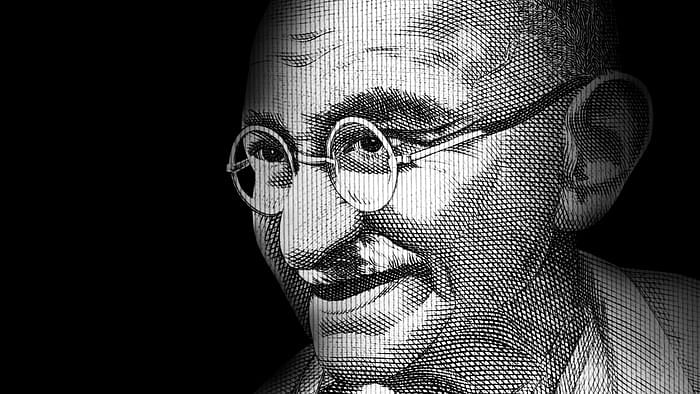
Years ago I had walked into the manual scavengers’ colony at Dadar in Mumbai, and for the first time discovered that there is a Mahatma Gandhi that is not a road name, not a face on currency notes, not a statue or a line drawing, and most certainly not a universal metaphor for all that is virtuous.
For the first time I discovered that there is a Gandhi that others see, and not as a human beyond the Mahatma angle, but as a seriously flawed person. The obeisance industry refuses to even consider the viewpoints of Dalits, feminists and anti-communalists. From politicians to the leftist ‘azaadi from poverty’ ring leader Kanhaiya Kumar, they quote the Mahatma when they wish to speak out against Hindutva.
Fact is, Gandhi was the Lord Ram and the Chanakya of his time. The rejecter of a throne manoeuvring the game of thrones.
The main roadblock to the Indian National Congress is not dynasty, or the recent dissidence within its ranks, but secularism.
73 years after Independence, we realise that individuals can be secular, but a country cannot, unless it is homogenous.
After the Partition of 1947, unlike Muhammad Ali Jinnah’s offering of secularism as dessert to Pakistan, India had to make a meal of disparate ingredients. Multiculturalism was projected as secularism, even as three other ‘isms’ continued to mock it – communalism, parochialism, regionalism.
---
Ironically, Muslims seeking a leader from within the community are viewed with suspicion, when India has voted for a party that not only flaunts its Hindu identity and seeks a ‘Hindu Rashtra’, but also tries to silence those who contest such an idea.
“Go corona! Corona go!” Ramdas Athawale, a minister in the state government of India, chanted this phrase again and again at a prayer meeting at the Gateway of India. Among those invited to participate were Buddhist monks and the Chinese Consul General in Mumbai. The rap-like cadence soon inspired memes and a pop version.
While places of worship have been shut down to facilitate social distancing, nobody had the courage to stop a ‘gaumutra’ (cow piss) party on March 14. Guests drank the urine from mud bowls. They recited prayers before a holy fire beseeching the virus to leave. Swami Chakrapani, the president of the Akhil Bharat Hindu Mahasabha that organised the event, said, “Coronavirus has come because of the people who kill and eat animals. When you kill an animal, it creates a sort of energy that causes destruction in that place. They (global leaders) should get cow urine imported from India because the almighty resides only in the Indian cow and not in any foreign breed. I request all the presidents and prime ministers of the world to take cow urine on a daily basis. You have all these scientists who don’t know the cure, we have the cure given to us by the gods.” He also claimed that this was the “only cure” for COVID-19.
All this took place in the country’s capital even as government officials and ministers were issuing statements about scientific measures used to deal with the virus. This was a well-publicised event, yet there were no calls for a ban on it.
There is a call for a ban on the Tablighi Jamaat centre in New Delhi. The immediate reason is that between March 11-13 it hosted around 2000 people, some from overseas, before the lockdown. 24 of the participants have tested positive, and some are untraceable. This has come as an opportunity for the rightwing; the ruling party’s minority affairs minister called it a “Talibani crime”. However, some questions have been raised regarding the permission granted for the event as well as police laxity; the Jamaat premises share a wall with the police station. For a few days now some media channels are seeking a ban on the organisation under the garb of restraining ‘spreaders’.
Such communalisation apart, this event was unnecessary and could be one of the major instances of community spread. Gatherings, be it sects, churches or such jamaats, where devotees have ignored reason to be one with god in the company of others, have resulted in several such spreads.
***
Since temples, mosques and churches are shut, devotees look for other outlets, other gods. In the South Indian state of Kerala, the prayer being shared on social media is, “Saint Corona, protect us from coronavirus.” St. Corona has never been popular in the state nor was she the patron saint of epidemics. Her name has promoted her as the annihilator of the virus.
Applauding medical workers too has been imbued with a fantastical explanation: That March 22, the day Indians rang bells and clapped, was Amavasya, the darkest day of the month when evil forces like viruses have maximum power. Clapping and clanging vibrations reduce virus potency, it was said, and the increased blood circulation boosts immunity.
What is it about superstition that holds people in thrall, sometimes even more than religion does? Unlike belief systems, they do not have a halo. Superstitions give people the power to deal with an immediate threat to themselves. Some may even perceive their belief as a rational exercise that they are ‘scientifically’ experimenting upon.
Mass superstitions such as the cow urine drinking one are dangerous simply because, like placebos, they cannot be proven wrong. There have been instances of people refusing medical intervention based on the belief that faith, or faith-approved palliatives, alone can cure.
Adding to the mythology of magic cures, the government announced that the serials Ramayana and Mahabharata, based on the revered Hindu epics, would be telecast again on the national channel after over three decades. It is assumed that this will help people forced by the lockdown to retain their moral fibre through its kitschy portrayal.
India is, quite literally, in ‘Ram bharose’ mode, where riding on faith is considered as a confirmation of its efficacy. That the virus hasn’t yet affected the country as much as it has the rest of the world – 1932 confirmed cases, 55 deaths – is seen as some sort of karmic victory.
The facts are quite different, though. According tothe director of the US Center for Disease Dynamics, Economics, and Policy, Ramanan Laxminarayan, by July end 300 to 500 million Indians would be infected of which a tenth would be severe cases. “Our model predicted that at the outbreak’s peak, even with conservative assumptions, there would be 10 million patients with severe Covid-19 disease in India, many of whom would need to be hospitalized. India has fewer than 100,000 intensive-care unit beds and 20,000 ventilators, most of which are only in the large cities.”
***
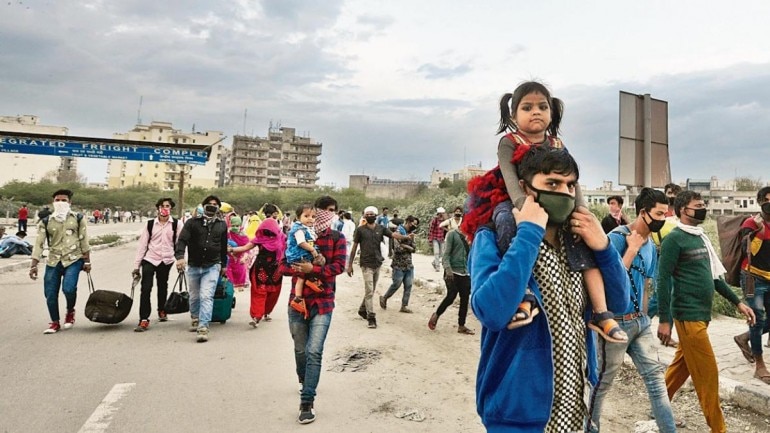
Large cities depend on migrant labour. Most are daily wagers, of which about 744 million earn Rs. 44 (58 pennies) a day. They have little or no money left. Some are walking several miles to reach their villages. They believe hunger will kill them before the virus even gets to them. As one of them said, “I know everything about coronavirus. It's very dangerous, the whole world is struggling. Most people who can afford and have a place to stay are indoors. But for people like us, the choice is between safety and hunger. What should we pick?”
There have been instances of people dying on the way. The finance minister announced a package worth $22.5 billion as well as rations for three months to reach the poor. Many have not heard about these schemes nor received anything. Returning to their villages isn’t a panacea. As a man on his long trek of 542 kms to home said, “We came to Delhi in the first place because our farms were destroyed due to stray cattle who use to eat our crops. So, if we go back to our village, there also we have to work as labourers, but there is no work anywhere.”
When Prime Minister Narendra Modi urged people to applaud the doctors, nurses, paramedics who served selflessly despite risk to themselves, those from the informal sector that constitutes 90 percent of the labour force in India were not on anybody’s mind. There is nothing grand about sweeping floors, dusting furniture, doing the dishes, or hawking and collecting garbage; they do not save lives, or minister to the ill.
However, the elite shared their ‘awws’ over a picture of a rag-picker noiselessly clapping, his expression confused. For them, it was evidence that the PM’s message had reached this poor man who cared for the carers. Ironically, social distancing that is embedded in the Indian casteist culture considers people like him to be a virus. Nobody cares that he belongs to the amorphous population of 1.8 million homeless people who do not even figure in the poverty or infected statistics because they do not even exist on any document. -- Published in CounterPunch
Charlatan godman Gurmeet Ram Rahim Singh Insan, head of the Dera Sacha Sauda, has been sentenced to 20 years of rigorous imprisonment for the rape of two of his devotees. To prepare for this court pronouncement, the army had to conduct a flag march, the police was on high alert, some areas were placed under curfew. One might have imagined that a terrorist was on the loose.
In India when a godman is arrested on rape or murder charges, his followers can and will take to the streets to avenge a court order. This happened on Friday, August 26 as a Central Bureau of Investigation court convicted Singh. The country was shocked that 200,000 of his band of followers had congregated well before the verdict precisely as a strategy to create mayhem — they stoned building windows, torched buses and cars, including television broadcast vans; 30 people were killed and over 250 injured. What the country does not get shocked over is the existence of such fake gurus and the respect they command among those who matter and their constant presence in the media.
Gurmeet Singh has been sentenced for a crime he committed 15 years ago; the sexual assault on the two young women continued over three years. It was Ram Chander Chhatrapati, a journalist from a small local Hindi newspaper called Poora Sach (the full truth), who had exposed the sins of the saint. A few months after he carried the letter of a victim, he was shot dead outside his house. The murder case is still pending.
The letter was addressed to the then prime minister, BJP’s Atal Bihari Vajpayee. The young woman had given a detailed account of her trauma. She was not the only one. Her turn to be used came once every month. When she was sent for the first time, Singh was sprawled in his bed watching porn, a remote in his hand, a revolver by his side. Her parents who were followers had insisted that she join the sect. She was stunned by what she saw. She is educated and asked questions. He silenced her protests with threat, flashing her parents’ devotion as well as his clout. And then he used his spiritual hold over her: “He told me that at the time of becoming his disciple, I had dedicated my wealth, body and soul to him and he had accepted my offering. By this logic, your body is mine now.” In fact, many female disciples were asked to go into his private chambers for ‘maafi’, forgiveness. He sold sexual assault as penitence although there was nothing they had to repent for. “We appear like devis (pious women), but our situation is that of prostitutes.” If women were sexually exploited, men were rendered sexually incapable. There are reports of castration of at least 400 men. They were drugged and their testes were surgically removed. Singh seems to have wanted to play the role of an ancient king with a harem and a retinue of eunuchs. Clearly, it appears his masculinity felt threatened.
***
Singh’s Dera Sacha Sauda empire is spread across 700 acres in Sirsa, Haryana. It is a fort-like establishment that ran along the lines of a philanthropic corporation even as the guru produced kitschy films on social consciousness where he essentially promoted his ego. Not only was he cocking a snook at the famed Indian austerity and belief in abjuring, he was also challenging the white and saffron robed hypocrisy of the prevalent uniform of godmen.
His seeming lack of hypocrisy should have been a red rag. Instead, he was feted as a guru reaching out to the new masses with chutzpah. Where other gurus had bhajans (religious hymns) playing in the background, he brandished a guitar and belted out off-key pop music. News channels that began trending him as “RapistRamRahim” and inviting responses to increase their viewership were promoting him a few months ago as a movie messiah, a multi-talented maverick. The mainstream media that is today taking a moral high ground did not bother about following up on the cases against him or even boycotting him until the verdict had been pronounced. He added to the entertainment quotient as “bling baba”. Were they not alerted by his lifestyle to question his credentials?
When they now flash the photograph of Chhatrapati with the “lest we forget” hashtag it is ironical, for they had forgotten. They were woken up with a jolt only because their vans and their reporters became the targets. And much of their ire was against the followers.
Singh has around 60 million followers, and most would not be aware of what happened inside the gufaa, his cavelike residence. The Dera Sacha Sauda, like other deras, isn't a cult started on the whims of a guru. It is a group of sects that believes in the scriptures but does not owe sole allegiance to it. Their tagline is “confluence of religions”. The guru’s name itself reflects that confluence. Everybody uses ‘Insan’ (human being) as their last name.
***
Following Gurmeet Ram Rahim Singh Insan’s sentencing, there has been discussion on what drew so many people to him. One of the reasons put forth was that he catered to the lower castes that were left out of the upper caste hold on the faith and the economy. It is a plausible argument. However, this assumes that the poor kept his image alive, which is not true. Indeed, those who are denied comfort and luxury do look up to pomp and pageantry, as can be witnessed in loud and garish celebration of festivals in the streets. But that cannot be sustained over such a long period. Besides, how would they identify with his “love charger” blatancy, that too in English?
Like most gurus, he offered welfare. The Dera ran a hospital, had medical camps. It is unlikely that this is what the devotees came for and stayed back with, although it might have helped them at some point. The operative term is slavish obeisance. Whether through drugs, hypnosis, guilt, threat or fear, followers can be held hostage.
Political leaders genuflect before these godmen in full public view, often consulting them on matters of state and law, making a mockery of the Constitution. Singh had helped the BJP win seats in the Punjab and Haryana regions. The Congress Party too had earlier enjoyed his goodies. Prime Minister Narendra Modi praised his efforts for his government’s cleanliness drive. Two days after the godman’s men went on a rampage, the PM in his radio address to the nation said, “No one has the right to take the law into one’s own hands in the name of one’s beliefs.” It is easy to pick on a mass of unknown faces and names with pop pleas. He made no reference to the charlatan or his crime or to the verdict. Because there are many such gurus who owe their existence and provide patronage to politicians.
And one reason Indians even on the right are celebrating this conviction is because Gurmeet Singh is a Sikh who took potshots at Sikhism and Hinduism. He was grudgingly accepted for facilitating new money and votes, unlike the glowing accolades reserved for the levitating elevated gurus of mainstream godliness.
***
Rather shockingly, a day after the protests in support of Gurmeet Singh The Indian Express carried a piece by Sadhguru Jaggi Vasudev (who is often invited by media think tanks for their seminars) in which he wrote: “All the embodiments of the divine you worship — Rama, Krishna, Shiva — cannot call be called morally correct figures. They are not. Because it never occurred to them to be that way. But they are the peak of human consciousness.”
This echoes Singh’s stance. When he boasted that he was god to the sadhvi he planned to rape, she had asked him whether god did such things. He replied: “Sri Krishna too was God and he had 360 gopis (milkmaids) with whom he staged Prem Lila (love drama). Even then people regarded him as God. This is not a new thing.” Asaram Bapu, another godman and rape convict, had said: "Lord Buddha, too, had faced such kind of allegations and I am also facing the same. But the truth will come out…I am willing to go to jail with a smiling face. And I think I want to spend some time in Tihar jail. I consider jail as my Vaikunth (heaven)."
But Indians live in denial. Each time a person who owes allegiance to a god comes under the scanner, the knee-jerk reaction in the 140-character and 4-minute read op-ed world is, “Stop calling him a godman.” The fact is that they become the powerhouses they are because they project themselves as men of god and are accepted as such not only by the masses, but by the elite too. India is a country of gods and in this crowded environment there are bound to be middlemen who make devotion accessible and human, even if not humane.
In 2005, the Communist Party of India had exposed Baba Ramdev for using human and animal bones and flesh in his ayurvedic concoctions; he runs a thriving empire today. Yogi Adityanath is the chief minister of the largest state in India. MPs attend Parliament wearing saffron robes. A monk even addressed the Haryana assembly naked.
Indians love to idolise, whether it is godmen or judges. The judge who sentenced Gurmeet Singh is being lauded for his bravery. It does not strike anybody that this is what the law says and the judge was doing his job.
The CBI took 15 years. This, when the victim had stated categorically in her letter: “If a probe is conducted by the press or some government agency, 40 to 45 girls — living in utmost fear at the Dera — if they are convinced, are willing to tell the truth.
There are many more victims of many more such godmen who represent neither religion nor culture. Their ashrams are dens of vice preying upon gullible minds to further their spiritual corporate empires. -- Published in CounterPunch
A naked man addressing politicians in the assembly should raise eyebrows. But in India this is cause for reverence. It is the same India whose moral police has problems with the way people dress up.
So why is it okay for Tarun Sagarji to be nude before MLAs at the Haryana Assembly, discussing subjects ranging from female foeticide to Pakistan? Because he is a monk of the Digamber sect. This sect believes in being 'sky-clad', and one accepts the different forms of worship and the reasons for it.
However, one does not see other Digamber Jains go around without clothes. Besides, if it is the Muni's religious uniform, then he should be adhering to it in the religious confines. The Assembly is not one. Religious figures of various stripes should not even be permitted in these halls, let alone become political leaders, as indeed some are.
The whole point of abstaining from clothes is to divest oneself of comfort and arrogance, of specific markings and attachment.
Would these ministers listening to him in rapt attention offer the same respect to any other member not clothed according to their moral prism? They would be sniggered at, and if a woman we to dress 'inappropriately', whatever that means, then she would be objectified.
As happens often, much of the reaction is not to the monk, but to a response to him. Music director Vishal Dadlani is said to have "mocked" him when he posted on a site: "If you voted for these people, YOU are responsible for this absurd nonsense! No #AchcheDin, just @NoKachcheDin ."
He belongs to the Aam Aadmi Party, and his chief Arvind Kejriwal was quick to say: "Tarun Sagar ji Maharaj is a very reverred saint, not just for jains but everyone. Those showing disrespect is unfortunate and shud stop" and "I met Shri Tarun Sagar ji Maharaj last year. Our family regularly listens to his discourses on TV. We deeply respect him and his thoughts."
Ideally, Mr. Kejriwal should be questioning religious people being in a political space. But, he is himself at the mercy of them. Nobody should care what he or his family personally believe in, but by stating it as a response he conveys clearly that he is a part of the rotten system. Vishal apologised and says he will quit politics.
We cannot blame only the Hindutva parties, for even the secular ones kowtow to religious leaders from every faith and use them to influence the electorate even though they have precious little real influence.
I am not against religion or anybody practising it. We all need spiritual sustenance (and not everybody can handle their drinks well!), but, seriously, god is in her/his heaven and therefore perhaps nothing is right with the world.
---
Speaking of which, this photograph of Olympics winning athlete P.V. Sindhi on her way to thank the deity. Again, this is personal.
But India's showing at the Olympics is not something to crow about. The few exceptions only underline the apathy. Besides, the athletes have complained about neglect and paltry conditions. It is their talent alone that stands with them despite everything.
If they think the talent is god-given, then it should be looked after by the gods too. Or at the very least the gods should do something about Indian officials.
Indians are big on 'mannat', asking for favours at various shrines and dargahs. In that sense, we are all greasing palms, if not of babus then babas.
---
Speaking of babus and government servants, here is Madhya Pradesh chief minister Shivraj Chouhan carried by policemen when he was on a tour of flood-hit areas in his state. Was the water too wet?
“Snapchat or drought?” demanded Arnab Goswami on Newshour. That one cryptic query bears witness to how reductive debates are and what freedom of expression has come down to.
A standup comic Tanmay Bhat put up a short video where he impersonated Lata Mangeshkar and Sachin Tendulkar in a mock battle. Impersonation and mimicry are a staple of comedians and if done well can caricature the subjects and throw in more than just laughs.
Tanmay Bhat does nothing of the sort. It’s the kind of thing your friends might slap their thighs over as you crack off-colour jokes at the pub, and that too only if you are paying for the drinks.
However, everyone has their rights. He to do what he did, and I to find it objectionable. But, there are people who will fight for his right to be stupid but not yours to be offended by such stupidity. And how do they justify it?
It so happens that the MNS party and the like issued threats calling for the removal of the video, and of beating up Tanmay. The police too got into the act.
All of this happened after the controversy broke out. It is ridiculous to assume that those who object to the video want it censored or the comedian arrested or harmed in any way. (I am putting it up, too.) If they want a bloody disclaimer with that line, “I may not agree with what you say but I’ll defend your right to say it”, then I’ll just ask them to shut up since they think there will be fewer clicks on their liberalism were they to defend another’s right to have a differing opinion.
I have one major objection to that video, and it is Tanmay as Sachin poking fun at Lata’s age – her face looks like it has been in water for eight days apparently – and urging her to die. To anybody who has elderly parents, this should hurt deeply. It isn’t about the pop taunt of “hurt sentiments” – it is closer to the bone. You are a hypocrite if you go online to outrage over an old person being ill-treated by her family or post pained captions on seeing pictures of old age homes but think that Mr. Tanmay Bhat’s act is just fine.
The funny thing is that the Tanmay camp finds it offensive when there are girth jokes about him. Fat-shaming, they say. It is and it is offensive. Wonder why they do not find age-shaming offensive too. Clearly, a level-playing field satisfies nobody.
They say people are just obsessed with this icons business and both are Bharat Ratnas. The irony is that even suppose they are ‘protected species’, just what are these urban legends like Tanmay Bhat? One does not see social media denizens support the right of a Johny Lever or a Kamaal R. Khan for similar ‘humour’; they are, in fact, dismissed as crass. This proves that it is not about freedom of speech but about elitist cliques.
For those who think Tanmay Bhat as well his AIB group are independent-minded rebels, do not forget that they had sent their queries in advance to be vetted for their roast on Bollywood celebrities and apologised to the Church. [I had written about AIB Knockout's fake fight for FoE]
Somebody even posted that those “hounding Tanmay” would return after a couple of days to their old task of “harassing Muslims”. This is just so pathetic to even put them on par. The hounding is done by some political parties/idiots; minority harassment is social behavior in its varied forms.
Also, all manner of caste and regionalism has come into play, and while these aspects of the ‘hounders’ (including weirdly enough the people spoofed) are highlighted, the comedian’s caste etc. are not dragged in. One says it is because Lata and Sachin are Brahmins people are protecting them, another says Marathi pride should be hurt by drought in Maharashtra and not a Snapchat video.
Nobody can deny that casteism is prevalent in India, but in this case is it being milked dry to support bad humour, reducing the genuine debate over it. Ask these same people to do a Snapchat funny video of our other Brahmins – TV anchors and newspaper editors (who should naturally stand for their FoE) and they have no answer.
I suspect some even think that the comedian was making an anti-casteist statement...except that the Brahmin Lata trills to Sachin, "Vinod (Kambli) is better than you". Kambli is from a backward class community. And if we really want to get into this, then it is again the Bhat way to get a high-caste to legitimise him.
The worst is dragging in the drought. Media people who were pained about the time wasted on such stupid debates as against the drought went on to host shows discussing Tanmay Bhat. Do they even have a spine, forget a conscience?
The drought vs. Snaphat idea is opportunistic and insensitive. Nobody is censoring the drought, so give it attention, and not only when it is ‘happening’ to do so.
Then there were those saints who said if you don’t like it don’t watch it. They seem to have reached a Zen state where they know without watching whether something is likeable or not. And if switching off is the answer to deal with what we find offensive, then I guess we can apply if to hate speech and government policies too. In fact, these zombies probably do, except for they Twitter/Facebook forays where they lend their shoulders to the martyrs they create.
Director Mahesh Bhatt posted this quote by George Carlin:
“I think it's the duty of a comedian to find out where the line is drawn and cross it deliberately.”
Yeah sure. Our PM has been doing this for a while now. And the joke is on us.