Showing posts with label congress. Show all posts

5.9.20

Indian Muslims Need Political Representation, Not Sham Secularism


The main roadblock to the Indian National Congress is not dynasty, or the recent dissidence within its ranks, but secularism. 

73 years after Independence, we realise that individuals can be secular, but a country cannot, unless it is homogenous. After the Partition of 1947, unlike Muhammad Ali Jinnah’s offering of secularism as dessert to Pakistan, India had to make a meal of disparate ingredients. Multiculturalism was projected as secularism, even as three other ‘isms’ continued to mock it – communalism, parochialism, regionalism.

--- 

Ironically, Muslims seeking a leader from within the community are viewed with suspicion, when India has voted for a party that not only flaunts its Hindu identity and seeks a ‘Hindu Rashtra’, but also tries to silence those who contest such an idea.

---

Read more here

31.10.14

The invitation Modi did not get...

Of Bukhari, politics and politicians


"Should we invite him? Say, do you want us to invite the prime minister? If not, what are we debating?" Tariq Bukhari, whatever be his other qualities or lack of them, nailed it on all the TV discussions I surfed through.

His brother Syed Ahmed Bukhari, Shahi Imam of Delhi's Jama Masjid, recently named his 19-year-old son Shaban Bukhari as his successor. There is to be an initiation ceremony to anoint him the 'Naib Imam'. Invitations have been sent out. Narendra Modi has not received one, although some other BJP members have. Political leaders from other parties as well as foreign leaders have been invited. Nawaz Sharif is one of them.

This whole package has led to a most juvenile debate — from the use of the coronation to the nationalism of Muslims. There is something cussed about how everybody plays politics to the detriment of how to deal with the immediate.

Recently, there were communal riots in Delhi's Trilokpuri. Should Muslims not address this as well? Instead of doing so, Ahmed Bukhari explained his reluctance to invite the PM thus:

“Muslims of India do not recognise Narendra Modi as their leader, hence the invite has not been sent. He may have been elected the PM, but the Muslims of India do not accept him. Narendra Modi should first tender apology for the Gujarat riots.”


Let me get this out of the way. Bukhari has no locus standi in the community. He is seen by Muslims as the head of a mosque whose primary job is as moon-sighter during Ramzan. Outside of the Chandni Chowk area he is persona non grata. Indeed, he does meet politicians and they do try to woo him to support their candidate. This works at the symbolic level of secularism.

Unlike the Shankaracharyas and certainly the RSS/VHP remote controlling organisations, there is little by way of Muslim leadership that can speak with any authority on the community. Bukhari does not even have the febrile impact of, say, the Deoband seminary in Uttar Pradesh. In that sense, he is non-controversial simply because he is irrelevant.

Having said that, I fail to understand why Kamal Farooqui of the All India Muslim Personal Law Board was screeching about how Modi is everybody's prime minister and he respects the office. In that case, he was also the chief minister of Gujarat and people could justify everything as respect for that office.

Even more unfortunate is how one invitation has again raised the question about where Muslim allegiance lies. I do not blame Bukhari for this because as I have taken pains to point out he is not in a position to decide or influence. But why are those in power even bringing up the loyalty card? Why is it not assumed, as in the case of the majority community?

The Congress Party's Renuka Chowdhary called Bukhari a social reformer. That is her problem, not that of Muslims in India. Besides, to be charitable, we have very many people in power who are hailed as reformers in full-page ads when all they have done is added varnish to derelict structures.

My first thought when I saw a clip was: what if Bukhari had not made a comment on the PM? Would it be considered just one of those occasions where a name is left out? BJP members are appearing on TV to express anger over this deliberate omission is akin to wrangling for an invite. Some have even said that if anybody attends it would be an insult to 1.2 billion Indians and display a lack of self respect.


Is the invite to Pakistani PM Nawaz Sharif a reason for the bluster? Pakistan has fired along the LoC so anybody being friendly with the leadership is anti-national goes the argument. Track II developments have not stopped. If India is serious, why is it permitting such initiatives? Why did we offer Diwali sweets to their border forces, which they declined? Why do we continue to watch their TV serials and why are their actors and singers such an intrinsic part of our pop culture?

These questions are not about alarmism, but a genuine need to understand why we resort to such passive-aggressive moves. Detente cannot be carried out in studios; it requires leaders. And pragmatism happens to be the core of politics. What we see is not that; it is pussy-footing.

Modi did invite Sharif for his oath-taking ceremony. When this was pointed out, a BJP spokesperson was livid: "What kind of arrogance is this to compare." That says it all. It is a display of arrogance that prompts such a statement. The PM's function had all the pomp and pageantry of a coronation, so for the party members to remember democracy now when some fellow will be anointed in a mosque is disingenuous.

It is also galling when they ask why people do not recall other riots. We do. Today is the anniversary of the 1984 massacre of Sikhs under a Congress regime. The PM has announced a Rs. 5 lakh compensation to the next of kin for the over 3000 killed. It is good, although late and rather obviously a point scoring move. However, if this is the precedent, will we see similar announcements for the 1993 Mumbai riots, 2002 Gujarat riots, 2013 Muzaffarnagar riots, and a host of others?

Should the monetary exchange buy justice? That would be most unfortunate.

It is also time for the establishment to grow up and stop using the public to achieve its ends whenever elections loom ahead. There is too much of a price innocent people have to pay to 'earn' sympathy gestures.

If Ahmed Bukhari, or anybody else, incites people to violence and bigotry pull him up, arrest him, try him. Just do not use every occasion to flash your prejudices and give even more legitimacy to a non-entity.

End note: Just wondering what would have been the reaction had this been a khatna (circumcision) ceremony of Bukhari's son/nephew/grandson and not an anointment.

2.7.14

Rumours and Reality - Revisiting Sunanda Pushkar


While the death of Sunanda Pushkar, wife of former Union minister Shashi Tharoor, appeared to leave several unanswered questions, I am not sure about the latest “twist”.

Dr. Sudhir Gupta, head of forensic sciences at AIIMS, has filed an affidavit in the Central Administrative Tribunal (CAT) claiming that he was 'pressured' by former Union minister and president of AIIMS, Ghulam Nabi Azad, to act in an 'unprofessional' manner to cover up the matter. 
"(The) applicant could not muster courage of openly placing the facts in black and white as the former president of AIIMS Ghulam Nabi Azad was an immensely powerful politician and the then health minister, and the husband of late Sunanda Pushkar was also a minister and a powerful politician," the affidavit stated.

Why was the job more important to the doctor than ethics? This query is valid now because there are charges of plagiarism and misconduct against him. Is he trying to cover his own tracks by alluding to a cover-up? What exactly does being pressured to act unprofessional really mean? This case was very public; the police were on the trail. Importantly, the forensic findings pointed out injuries, an overdose and drug poisoning. If there was pressure – and it not unlikely – nobody seemed to have keeled under it, at least as far as a medical report goes (although there were contradictory ones).

Before further investigations, the doctor should be interrogated not only about the nature of the pressure, but what he did not reveal in the report that he was forced to cover up. If it is different from what he gave the police, then he should be tried in court and his license taken away until he is cleared. It appears that he wants to be in the political good books and is more concerned about saving his own position.

Now that the case has resurfaced, there are a few points that need to be addressed.

The Congress made a huge mistake by fielding Shashi Tharoor, although he did win the Thiruvananthapuram seat. The point is about probity. He is not an accused, but the death of his wife under public and social media glare, where he himself was involved, sent out a message of arrogance and powerplay.

BJP members suggesting that there has been silence have got it all wrong. The media, in fact, went into overdrive then. The rumour mills were churning out conspiracies and propping up some of the players, however tangential their involvement with the personae. (My earlier post)

There were three main reasons they felt that Sunanda could have been murdered:


  1. She had said she would expose the IPL backroom deals.
  2. The ISI would want her out of the way because she suggested that Tharoor’s friend was a mole.
  3. The relationship between the couple.


Regarding IPL, she essentially indicated that she was made into the scapegoat. Either way, as it was sweat equity it would be difficult to pin down as financial skullduggery.

The ISI angle is ridiculous, and one of the reasons the case did not gather momentum. Tharoor is not a big-ticket minister, so sending a honey trap would not make any sense. Also, a gushing fan as honey trap would be counter-productive. The only notable point here is that the lady was planning to write a book on the Kerala elections. Seriously, there were attempts to get a publisher for a Pakistani to cover elections in an Indian state that has little emotional or real connect with the neighbouring country. The ISI can be accused of many things, but not stupidity.

The third reason is the personal equation between the minister and his wife. Sunanda was quite open about accusing him and just as suddenly expressing positive vibes. But to call him a murderer when they were both image-conscious people is a bit much. If things did go wrong, then they had other ways to resolve the issues. They had been through such phases in life separately before they got married to each other. Her father, brother and son all stood by Tharoor even in their moment of grief. Were they pressured too?

She was certainly in bad shape as her online activity reveals. But she was an independently wealthy woman and not dependent on her husband. She was also a glamorous person with a public profile that did bring its share of snarky comments. She had survived them.

In January, she became a corpse in a five-star hotel room. With injuries. They have not been explained. No amount of poisoning can cause these. Tharoor has said he wants the cops to probe. He should pursue the case, not to absolve himself but because like others he too must be concerned about it.

Until then, the rumours will over-ride justice.

© Farzana Versey

7.6.14

Narendra Modi's Fatwa

It is no less than an edict, one which has prompted me to say, "yes, Prime Minister, but..."


Narendra Modi's advise to the ministers sounds school-marmish. Do they have any merit? Some do, some don't. His media-related comments are more important than the rest. Here are two quotes from separate reports:

• Sources said the Prime Minister also asked the MPs not to talk to the media as spokespersons of the party but raise the issues of their own area and constituency with them instead.


• The Prime Minister also advised the parliamentarians to refrain from giving comments to media on national issues. He said they should be polite while dealing with the media.


I completely agree. In the past few years, ministers have struck out on their own during primetime and hurt the party they represent. The ill-timed sound bytes have only given anchors a 'debate', and the issue those remarks are for is soon forgotten. The cacophony coterie thrived in this environment, and became known for outspokenness or idiocy, depending on which side they were on.

The fallout was retraction the morning after. More debates on being misquoted. More TV and print time. It did not matter what the subject was. From coal to land sharks to rape, these made up the rogues gallery. Other panelists, mainly from the media, shared a camaraderie with them. This ensured both got what they wanted — a story.

Most of them lacked expertise in the subject, and were there only due to their availability on speed dial. Why did they come to the studios night after night to be shouted down by anchors? And what did they do? It invariably ended up with the spokespersons protecting their leaders. A Catch-22 situation, no doubt.

It served no purpose. Even offending ministers were back, smiling or sneering, after being anointed/insulted by a media person whose own expertise came from the research done by her/his team. People elect leaders, not journalists. The former owes them responsibility and self-respect. They represent us.

In sensitive cases, there is also the danger of a preemptive remark interfering in a judicial probe. Not everybody is in a position to discuss national or international issues with any degree of conviction, unless they are directly handling that portfolio and have hands-on experience or have worked in the department.

What we know now is which party members are the favoured ones on what channel, which ought to be anathema for freedom of the press. We recall their quotes. Let us not forget how Mani Shankar Aiyer's "chaiwalla" comment gave the BJP and its then PM candidate a new identity, an emotional handle. The quotable quoters are elitist, as is the media that projects them.

Is there a flipside to this? Yes. Since the media is not terribly interested in work done in constituencies, for want of ministers to pin down they might not cover issue-based controversial news as much. Or, if they do, it might become a free-for-all with decoys speaking on behalf of the party. This will provide an easy exit for the head office. A shrug will suffice. If the PM is serious, he should have a team of dedicated spokespersons who do as much homework as he expects from Parliamentarians.


Another reason I welcome this media 'layoff' is that the ball will be in the court of the PM. It is his diktat, his choice to stay away, his ministers are responsible for everything they say.

The media, in fact, has the upper hand here. For every Giriraj Singh utterance, they can go straight to the PMO.

Is the directive dictatorial? No. It would be if there is a complete disconnect between the media and ministers. The media is not being muzzled. As someone who has been right in there, as also an avid objective and, need I emphasise, cynical observer, newspaper and TV journalists will have to rely on independently-investigated stories. It is no secret that 'sources' are often dissenters or opponents. The information is fed to the media, and that becomes a 'scoop'.

Is there a flipside to this too? Yes. The ministers who won't talk about national issues might try and whitewash a few glaring stains in order to please their leader. They might then not feel the need to address the problem because it is not visible, and there are no checks on it.

This does not sound simple because it is not. Therefore, I've tried to give two arguments.

Regarding the other diktats, they are self-evident. Except that doing away with sycophancy is not restricted to dissuading feet-touching. It is good as symbolism, though. We did see Modi during his campaigns touching the feet of elderly voters, and on his first day in Parliament touching the steps of the "temple of democracy". Such gestures are unnecessary, precisely because of the nature of our democracy.

His comment on 'service providers' is interesting: "Before you know it you will find yourself beholden to these people. And it will be difficult to shake them off even if you want to."

Is this restricted only to the ministers in his cabinet? What about the industrialists? He does know there is no free lunch, right?

One cannot also ignore the fact that his short lecture to the ministers came after he superseded them to meet the bureaucrats alone. It is one thing to help streamline procedure and quite another to be the sole authority. I am afraid, but a mindset cannot alter overnight. Bureaucrats are accustomed to pretending to take orders. You give them a carte blanche to handle things and they might change, but only superficially. Instead of going through a layer of benefactors, they will now feel empowered to be answerable only to one.

Narendra Modi is a man in a hurry. That is the problem. He is too busy cutting off branches and painting flowers on the trunks of trees.

© Farzana Versey

---

Image: TOI

Report sources:
Indian Express and IBN

23.4.14

Shazia Ilmi's secularism


There is much, much more to call out Shazia Ilmi on. Not this:

“Don't be much secular. Muslims are too secular and they should become communal. They are not communal and do not vote for themselves. Arvind Kejriwal is ours. Muslims have remained secular for long...have voted for the Congress and helped them win. Don't be so secular and look at your house (community) this time. Other parties have their votebank intact and Muslim votes split. This is a controversial statement, but we should look at our own interest.”

Ilmi, the Aam Aadmi Party candidate from Ghaziabad was talking to some members of the community, including clerics. As is expected, there has been a reaction. Her own party members believe she should not have said it. She herself has clarified:

"I said it half sarcastically. Somebody was saying Muslims are very communal. I am saying Muslims are not communal, infact they are very secular. They need to be communal. This does not mean to incite hatred. They must think of themselves and must not be political slaves. What have the political parties done for Muslims in terms of political empowerment and representation in either government or private jobs, education... in terms of economic and political opportunities."

I figured the sarcasm bit out immediately and I am sure her audience did too. The only ones who did not are her party cadres, the opposition, and the media.

Their reason is obvious – to extend the show. For long the BJP has accused AAP of covertly working to benefit the Congress. But, then, why would they want the votes that would probably go to the party? Will AAP divide the votes against the BJP, and then see how it goes?

Besides that, there is Ilmi’s ‘be communal’ suggestion. Everybody is using the communal card or offering sops based on it, every group wants to protect its own. Why is this so surprising? I suppose wanting to build a Ram Mandir in the BJP manifesto is about the development module the party talks about.

If you look at Ilmi in this picture, she was not even trying to be non-communal. She was reaching out to a group of Muslims, and with her head covered was trying not to disrespect sentiments, although it is unlikely a non-Muslim would have tried to do so, and whether the people there might have been offended at all.

From some responses, it is rather amusing that those who have often been abusive towards the community and slandered its members for divisiveness now believe one newbie politician is spreading the message of communalism. Will they take back their insults, then, considering that Muslims are not communal? Interesting to see how they get trapped in their own arguments.

---


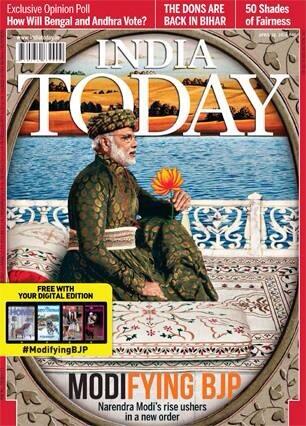
PS: Narendra Modi is trying hard to drop his communal stance. This magazine cover takes him right back to the days that his party wants erased. How will he build a temple with this image?!

© Farzana Versey

16.4.14

On caps, Vajpayee and the Modi Trial

There is competition over who meets Muslim clerics among the two top political parties, and then both accuse each other of appeasement.

When Sonia Gandhi met the Shahi Imam of Jama Masjid, Ahmed Bukhari, she apparently got an assurance from him regarding her plea that Muslims should not divide the secular vote. The BJP accused her of vote-bank politics. It was as though they had captured the Muslim votes already in that little meeting that has nothing to do with Muslims at all.


Days later, BJP president Rajnath Singh met a whole bunch of clerics – vice-president of the All India Muslim Personal Law Board Maulana Kalbe Sadiq, Maulana Kalbe Jawwad, Maulana Hameeudul Hassan, Maulana Yasoob Abbas and Maulana Khalid Rasheed Farangi Mahali. The Congress hit back.

Both described these as courtesy calls, but when pushed the BJP said


“Rajnath Singh is a candidate and it's his duty to go door to door to everyone's house. Not be selective. All prominent persons in Lucknow are close to each other. So we have to call on everyone and reach out to people of all sections.”

These politicians talk about wanting to improve the lot of common people, so why are they meeting “prominent persons”? One of the clerics later told a TV channel: “We are scared of Narendra Modi, but Rajnath Singh has the acceptability of Mr. Vajpayee.”


Acceptability of Mr. Vajpayee?

Congress spokesperson Sanjay Jha got into a bit of trouble over his statement


“The weakest PM ever was AB Vajpayee, who wanted to sack Mr Modi for the ghastly Gujarat massacre, but succumbed to BJP bullying.”

Does anybody recall Vajpayee’s support of Modi post Gujarat riots, his speech in Goa at the time? Does anyone recall that he was famously called a ‘mukhauta’ (mask) by his own party man? He was positioned as the nice face and knew about it. Jha further stated: 


“The weakest PM India ever had was AB Vajpayee who despite the treachery of Kargil, gave Musharraf a red carpet welcome at Agra. The weakest PM India ever had was AB Vajpayee who was hugging PM Nawaz Sharif, even as 50 soldiers...”

Hindutva parties are so against Pakistan and would oppose any red carpet welcome, but now they have nowhere to look. So they call out the change in the earlier Congress stand where the former PM was praised. This is so churlish. I do not agree with Jha about using Pakistan as a touchstone to decide strength and weakness of our national leaders, but it is no big deal. The Sangh has been critical of Jawaharlal Nehru for years as well as Mahatma Gandhi.

Most of them are in a twist. No politician can keep religion out of politics because they themselves are blind worshippers of anything that will get them power.

Vajpayee’s photograph with a skull cap and Rajnath Singh’s recent one are making some kind of statement to transpose with Narendra Modi’s refusal to do so. In the by-now hyped-up interview he gave India TV, the loop on the skull cap was played in the promos and given prominence. My stand on it has been clear. I do not think it is important, nor is it evidence of secularism. However, if he talks about it, there will be some counter argument. This question should have been irrelevant, considering this was a major interview.

In a mock courtroom, he sat in the witness box. This effectively made it appear as though he was taking justice head-on. Nothing of the kind happened, and it was a horribly creepy show, where the audience clapped after every sentence. It lacked dignity and probity. It was a sham. The interviewer Rajat Sharma helped Modi sail through, not only with planned queries but his whole demeanour of agreeableness. 

The cap question was designed to give Modi an opportunity to softly peddle his views about a community. He gave it a lot of importance, and spoke about how he would respect all cultures, but not do what was against his “parampara” (tradition). I have an issue with this.


He positioned himself against one community, showing that they were outside his parampara, which I assume is Hindu. It better be, for India is not a Hindu nation and Indian Muslims, with or without skull caps, have a stake in it. Indian parampara is as much ours. To transpose this cap against the others makes for an interesting discussion when one is given the argument that he wears other caps because those are regional. How is the Sikh turban regional? Are the khasis not Christian? I won’t even get into his Buddhist outings, for he has cravenly started even using Dr. Babasaheb Ambedkar, who would find him an untouchable (pardon the use of the term).

When people get competitive about who is wearing what, then we need to shut up about secularism. These are ritualistic and gimmicky. However, if political leaders go to the Ajmer dargah to beg for favours from a dead saint, then they have no right to make distinctions about parampara. Modi knows that there are a few influential and rich Muslims in Gujarat or of Gujarati origin who contribute to development, his presence being absolutely incidental. Why, then, does he meet Muslim religious leaders? Why does he not go to the relief camps, instead?

One person in the audience asked in a pained voice how he coped with the aftermath of 2002. Seriously, nothing could be worse than asking a man who uses the “puppy” analogy for Muslims about how he coped during the period. He said it was “Satya ka saath, desh ka pyaar” – The side of truth and love of the nation. Such delusions.

I obviously did not expect any counter-questioning, but he was clear about his position as a grand mufti of sorts.

Pictures were shared of the big moment. People sitting out in the open on plastic chairs before huge screens when even slums have TV sets. This cannot be spontaneous; they were herded there to create a buzz. After all, this cleric was going to give his devotees a sermon.

© Farzana Versey

Also: Modi reads from The Satanic Verses

5.4.14

Are voters spoilt for choice or a dead-end?


They all look and act the same, with cosmetic differences, after you have sat down and taken stock. Why don’t the Congress, the Bharatiya Janata Party (BJP), and the Aam Aadmi Party (AAP) just form a coalition and be done with it? We can then have all their marketing ploys under one roof - secularism, development and no corruption. The rag-a-tag Third Front can work as an opposition. The Communists, Samajwadi Party, Bahujan Samaj Party and all the regional political groups can keep these three on their toes. This is if we ignore the fact that they all have enemies within. 

The Congress topi has already become redundant. It used to be the Gandhi cap, which Gandhi never wore. The AAP cap tries hard to mimic the common man, especially Mumbai’s dabbawallas. It is quite a sight to see Bollywood stars and a banker who has declared a Mercedes among her assets don that cap saying ‘Aam Aadmi’. The BJP wears an invisible RSS cap. All leaders end up with some head-gear on their campaign trail to appear affable to the locals. One leader refused to wear a skull cap, though. But he even refused to wear spandex tights.

Unlike the United States of America we do not have clear Red and Blue states, but rainbow states, with rain and shine, slush and dryness. People are spoilt for choice and yet there does not seem to be one that a person who is not ‘naturally’ aligned would veer towards.

I have to keep repeating that these are general elections, not assembly polls, where a good candidate who fixes sewers, listens to citizens’ woes, attends kiddie parties, passes files for parks and sports grounds would work. Here you are directly casting a vote for a political party and the candidate is only a medium. S/he might visit your constituency occasionally, but the major decisions will be based on which party comes to power.

Then there is the debate about party manifestos. “Where is the manifesto?” I have been hearing the shrill cries in TV studios. How many people read the manifesto? Do not talk about only the few of us who manage to go through excerpts reproduced in the newspapers. We read the promises, are happy or disappointed with various offerings on paper. Do we ever put the parties on the mat to pledge that they will not change the basic values that they stand for and you voted for and ally with a party whose candidates they have publicly abused and put you through the same torture? How is this not crucial when it ought to form the backbone of who they are?

After much deliberation, I have come to the decision to support NOTA (none of the above). I have reservations even about this ‘nothing’, and had talked about it here. This is not a U-turn for me. It happens to be the only way in which I can assert that not making a choice is also a choice.

I had written the following:


Is NOTA an opinion? It sounds good on paper. But it won't have an impact. 
The EC has already clarified that the candidate securing the highest number of votes would be declared elected even if the number of electors going for the NOTA option surpassed the votes polled by the electoral contestants. 
There goes the non vote. NOTA is a wasted opinion, and chances are that those who have made this choice would publicly claim otherwise, if the party that comes to power looks cosmetically good. Will those who opted for NOTA come out and claim to be votaries of it? 
In some ways, the rejection of all candidates is a rejection of the electoral process. If no one is good enough, then just boycott. 'None of the above' reeks of self-righteousness, rather than an opinion.

I admit I am being self-righteous. Personally, I can and may boycott the elections, but I have no right to urge or even suggest that others do the same. NOTA has got constitutional validity and I can proselytise about it, although I will not.

It brings us to the other question I raised: Will I sneak out of this after the results are announced and it could help me to stand by the victor? No. That is the reason I have put up the NOTA logo in the sidebar on this blog. I shall remove it only after the finale.

© Farzana Versey

--

Note to those who read me:

As you know, I try and engage with the comments. For the past few weeks I have been tardy, and it might continue for some time. Besides, where political stories are concerned I do not write anything I do not believe in, so it just ends up as reaffirming what I have already stated. I shall keep the comments box open, but will not respond to everything. A simple ‘thank you’ and ‘lovely’ is not my style. So, hope you understand and accept my thanks in advance for just reading and spending time thinking about it, thinking your own thoughts. I am sure your views would be of interest to others too, including me.

2.4.14

The Election Commission's Ethics

Aamir Khan: Muffling an 'ethical' laugh?

For all the hot air about voting as a right and duty, it is being hawked by brand ambassadors. After dithering (over what?), actor Aamir Khan has come on board as the voice of conscience. The Election Commission now has stars in its eyes with its own “national icon”.


The video spot, interestingly, does not just stop at Aamir asking people to vote. The cinestar, known for his "perfectionist" approach, also exhorts people to vote ethically...Aamir asks people to resolve to vote without fear, pressure or inducement, financial or otherwise. As the musical score of 'Saare Jahan Se Achcha' plays in the background, Aamir is shown tying a tricolour thread on his wrist and taking a pledge not to "sell" his vote in the name of religion, caste or any other inducement. "I pledge that I will untie this tricolour thread only after I have cast my vote in these elections," he says and calls upon people to take the same pledge.

Will Aamir Khan take a pledge not to portray a corrupt politician on screen ever? Will he ensure that his peers in the film industry and those in advertising, of which he is a part, take all payments in cheque and do not endorse any unethical product? 

Politics is about social discourse too. You cannot be ethical selectively. What does tying a tricolour thread mean when TV ads sell pasta in the colour of the national flag? So, you can keep eating it to vote ethically?

---

The EC’s role raises important questions. Does a state channel have any business to play moral vigilante? Are voters under tutorship of the Election Commission? Is the definition of ethical by the authorities the same as or similar to that of voters with varied issues and from different strata?

A few days ago the EC in Maharashtra, after appealing to voters to avoid corrupt and criminal, and choose “pro-development”, candidates went further in its enthusiasm and wanted us to sign a pledge:


The letter, written in Marathi for Maharashtra's voters and in other regional languages for people from other states, urges voters to elect a candidate who will 'meet the aspirations of the people and the nation as a whole,' thus making it clear that they should look beyond narrow agendas...and to 'inspire and encourage friends and family members' to vote in this fashion.

The job of the EC is to ensure that candidates follow rules, and do not indulge in corrupt or criminal activities, and that includes going against campaign rules. It must ensure there is no cross voting and people are not denied their right due to goof-ups. It is not the job of the EC to advise on how and who to vote for. If a candidate is hiding assets, how is a voter to know about it? What exactly does pro-development mean? Is the EC also riding a wave? It is also obvious that this is to target the educated middle class. Is this pledge being signed in the slums and rural areas, where the poor often vote for freebies? This is the more obvious aspect, for the rest are bribed with other promises, if not passing of files and berths.

And truth be told, we would not vote if we were not offered something in return. It is barter, and for whatever it is worth the voter is at least empowered by such knowledge. The EC is infantilising the procedure. Like a bunch of obedient students, after we sign the pledge, “Voters can either give the letter back to the school or submit at the nearby polling centres or election offices before or at the time of voting”.

This contradicts anonymous voting, for the pledge will have our name, signature, polling station number and name, assembly segment number and name. This is not only unlawful, but unethical.

---

If you want ethics, and however much you may snigger, it is in this rather basic move by Rakhi Sawant, an item girl in Bollywood. I am deliberately highlighting it because it is a job for which she earns and has declared her assets. There is more:


And in an interesting first from the zone, the debutant has submitted Annexure 16 detailing her expenses on public meetings and rallies. Also, she was the only one to specify the number of vehicles to be used in her campaign, the proposed expenses on pandals, lights, furniture, posters, etc.

The other actor who is getting noticed is BJP’s Smriti Irani, automatically considered worth attention and respect because she has enacted ‘bahu’ roles in TV soaps. This has been marketed as the USP by her party. Ironical, for she is contesting in Amethi against Rahul Gandhi, whose mother Sonia has often been called out for being just a dynasty bahu. That apart, politics is unforgiving business. The Aam Aadmi Party’s Kumar Vishwas took a potshot at her:


“The message has reached villages. Now it doesn’t matter whether Irani comes, Pakistani comes, Italian or American ... Amethi has already taken a decision.”

Vishwas is a stand-up comic. He is also silly. However, the reaction, especially about the Pakistan reference, is astounding. The earlier NDA government was behind the huge PR exercise called the Agra Summit.

This particular statement does not qualify as misogyny, although there have been way too many instances, including the term ‘Hate Hags’ used for the BJP’s women candidates. It is a patriarchal system where the only manner in which women can be reduced is to personalise/sexualise their identities. Every party has indulged in such lookism fantasies. 

Worse, it is disgusting to watch that panellists in discussions are repeating the offensive terms. How does that work against hate speech?

End note:

Look at this picture of Buddhist monks in Bihar wearing Nitish Kumar masks.


Imagine what would happen if some mullahs did so? Or sadhus? Or Christian priests? Does this not amount to religious interference in the state?

© Farzana Versey

---

Images: Hindustan Times, Times of India

7.2.14

Horn 'ok' please: Varun Gandhi's dilemma


They were hopping mad, this group of 'independent' BJP supporters. Columnist Tavleen Singh asked angrily, "Is Varun Gandhi trying to return to his family party? What was this 'shahzada' doing on Modi's stage in Kolkata?"

The other darbari of the disciplined party, Madhu Kishwar, expressed her anguish too: "Varun Gandhi joins Modi Baiters. In private conversations he never made secret of pathological hatred for Modi. Now battle in open."

This is a hoot, especially the familiarity of private conversations.

What does it take to start a controversy? A report that sounds like a third-grade account of a picnic managed to make Varun Gandhi into both a traitor as well as a 'family' man.

Indian Expressstarted the sophomoric excursion with this headline: "Varun Gandhi bats against Narendra Modi,says Rajnath Singh ideal BJP PM pick."

Not a single phrase alluded to this shift in stance. In fact, IE was interested in the size of Modi's rally in Kolkata's Brigade Parade Grounds. As always, the BJP gave figures of a "huge" crowd running into lakhs. The party's general secretary Varun Gandhi seems to have said that the crowd wasn't the size that was reported and the rally was "okay".

The newspaper did not think this answer was good enough, so it persisted:

Asked why he did not think it was excellent, Varun said, “You have got the figures wrong. It is not true that 200,000 plus people turned up at the meeting. The crowd was at the most 45,000 to 50,000.”


What is this? Why is the media suffering from performance anxiety?

Not unexpectedly, Varun Gandhi has called it a "mischievous article...implying that I was trying to denigrate Modiji and the historic Kolkata rally. Why would I denigrate a function that I myself organised? When asked whether the rally was okay, I replied it was absolutely okay."

Who is going to set crow now?

By then, conspiracy theories were raging. NDTV website had this title: "Varun Gandhi's reported assessment of Narendra Modi rally is gift for Congress."

Why can't the media just wait, or ask people who have either covered election rallies or have some knowledge of bells and whistles thinking? If anything, his being a Gandhi will help the BJP for he has already been portrayed as an outcaste from the fold before. He is the one who decided to take a risk and strike out, joining forces antithetical to the family's politics.

In 2009, when he was arrested for hate speech, he had said, "In our country, Varun Gandhi is jailed under the NSA and was having 'lauki' (bottle gourd) in Etah jail but Kasab is treated with 'tandoori chicken' inside the jail."

And his views on the 'paternal' family weren't charitable at all: "I won't comment against Congress as it was breathing its last, my mother had told me that I should not say anything bad against people who are on their deathbed."

Things do change in politics, but to base such an assertion on whether Varun Gandhi was satisfied with a particular size or not reveals immaturity.

© Farzana Versey

4.2.14

Third Front or Facade?

How many Third Fronts will we have? Promiscuous political relationships are not likely to last simply because they are not meant to.

What do Nitish Kumar, Sharad Yadav, Naveen Patnaik, Deve Gowda, Om Prakash Chautala and Mulayam Singh Yadav have in common? Does the need to “form this anti-Congress, anti-Modi block” suffice? The BJP also wants a “Congress-mukt (free) Bharat” and the Congress does not want a “communal” party. Therefore, each can qualify as a Third Front if the idea is to oppose a bloc.

It is worrying that parties are coming together at this stage, for the stakes for horse-trading are high now. Rather than an anti-anything move, it appears to be one garnered to make themselves relevant. Many of them have been made irrelevant or have been snubbed. The CPI may not have high ambitions, but it is on the list of all these parties for an alliance. It has already tied up with the AIADMK.

Jayalaitha stated: “AIADMK and CPI have decided to enter into an alliance to face the upcoming Lok Sabha elections together.” Therefore, how would they dethrone Congress to form a “secular and democratic alternative” when the alliance itself if purely electoral?

Nitish Kumar had said, “It’s not exactly a merger of parties, but we can federate these parties.” Given that all of them have only a regional presence, how would they federate? What role would Odisha have in Bihar or UP in Haryana? How much of a presence do these parties have in states where the Congress or BJP are ruling? For that matter, do they even count in Delhi where AAP is holding fort?

Nobody quite knows what such a tie-up entails. Are these alliances designed for the Centre should the results be skewed? Who all would jump in and what happens to the different manifestoes and ideologies of the parties? How many ambitions will they have to deal with?

A small detail has been ignored. The Congress government is a UPA government formed with people like them. The BJP too had ruled as the NDA. Instead of working against the two big parties, the Third Front will in fact give them an opening to pick and choose based on their stated objectives. Did not AAP, which started as pretty much a Third Front prototype, without alliances, end up with ‘support’ from the Congress? Recall the Anna Movement hobnobbing with rightwing parties. What came of it?

There will be more middlemen who will help these alliances for their own ‘cuts’. The Third Front will be fractioned into many smaller groupings and some of these fighters will emerge as victors after joining forces with those they started out opposing.

© Farzana Versey

28.1.14

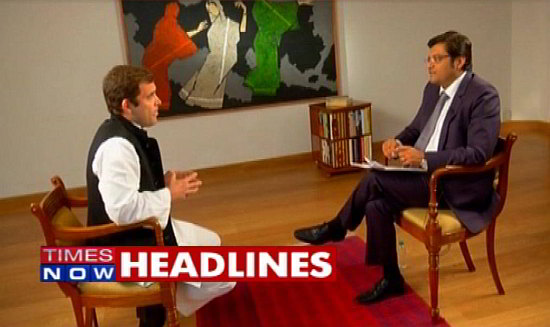
How He Turned The Tables: The Rahul Gandhi Interview


If you are looking for a parody or, more appropriately, a lame attempt at humour, then please skip this.

Rahul Gandhi may not be a great subject for a television interview, he may not even turn out to be a good political leader, but on the much-touted first-ever interview in 10 years (he clarified on camera that this was not the first, but the first formal one!) he did exactly what he set out to do. Say his piece. What seemed like repetition, if not ducking, was a strategy he adopted to bludgeon the inquisitor softly, if not tire him out.

Some in the media have dubbed this a Rahul vs. Arnab fight. I am amazed at the ignorance. No one, I repeat no one, in the higher echelons of power will give such a big interview without vetting the queries. Therefore, Rahul Gandhi must certainly have been aware of what Arnab Goswami (AG) would ask. If AG added specific queries later, then isn’t it funny that at the beginning of the interview he makes it clear and RG says “You can draw me back as much as you want” but would he be okay if he took a broader look? Think about it. Besides, it does not take rocket science (ahem, those Bharat Nirman ads) to figure out what the nation as filtered by the media would want to know. As he said:

"I have done a little media interaction, prior to this. I have done press conferences & spoken to the media. But mainly bulk of my focus has been on internal party work and that's where I have been concentrating, that is where most of my energy was going."

In the latter half I will reproduce some salient points, with quick notes.

First, the minutiae: This was not a live interview; it was conducted at Jawahar Bhavan; it lasted for a little under 90 minutes. According to The Telegraph:

But sources said the Congress leadership wanted to ensure that Rahul’s “outing” should be with a journalist who has a reputation for being unsparing. An off-the-record session between Priyanka Gandhi Vadra and Goswami, over pakoras and tea, also helped pave the ground for the interview, the sources said.

It just so happens that those who are building up this “unsparing” interviewer have rather short or selective memories. Some of us do recall his almost obsequious questioning of Bal Thackeray; even Raj Thackeray has managed to stand firm. So, let us not create heroes only because we need to look down on certain people.

Let us talk about some problem areas.

Why was RG not being specific?

Why should he? He will do so in his speeches when he addresses the nation, not for revenue-run TRP-driven media. Has Times Now donated to the Congress Party’s election campaign? Is there a quid pro quo? No.

Arnab did his business of mentioning names – as the tagline of his show states – and Rahul spoke about the issue. Yes, the issues are more important. It is the system that deals with individual offenders. If he took the names, or repeated them after AG, he would be a bloody stupid politician and VP of his party.

Why did he not take the Modi bait?

This was by far the best thing Rahul could have done. He treated Narendra Modi as just another guy. The persistent questioning about whether he would agree to a debate with the Gujarat CM elicited what I thought was a perfect clincher: “The debate is already going on.” This effectively took the battle to where it belongs – outside the TV studios.

Why did he not apologise for the anti-Sikh riots of 1984?

What would he achieve by doing so? Get brownie points from the viewers and a pat on the back from the media, with Times going berserk by claiming that it was their channel that brought about this major penance? The PM and Sonia Gandhi have both apologised, and if RG has to do so it needs to be done to the people who are waiting for justice.

Why did he not come clean about his degrees?

Here you have an anchor who has netted a huge catch, and he is quoting a shark lapping in the shallows. Arnab brought in Subramanian Swamy to put RG on the mat regarding his educational qualifications. With all his Ivy League credentials, Swamy comes across as an uncouth man. Besides, how is it important? This Oxford-Cambridge showing off might appeal to the urban upper middle class, not the majority of the population.

Has anybody bothered to check for how long exactly Modi ran a tea stall that he is using as his new USP? Is there any evidence of it?

Why did he not commit on the Aam Aadmi Party?

Simple. The AAP is not one that sticks to its own word, so how can anybody else? Here is one bit from the interview

Arnab: Are you using the AAP to split the Anti Congress vote bank, to keep Mr. Modi out of power
Rahul: You are implying that we have brought the AAP...

This was really giving it to those ones in the politest of tones.

Why did he keep repeating about RTI, empowerment of women, the system?

Because these are crucial subjects, though they don’t sound terribly sexy. Indeed, he used these terms to also answer unrelated queries, but as I said at the beginning, he was here to say his piece.

We have got so accustomed in the past few months to war cry rallies and dharnas that someone who comes across as vulnerable, yet refusing to fall prey, is not easy to accept. Calling Rahul Gandhi a fool might prove to be our biggest fallacy.


Here is how he answered some of the questions, from Modi to being attacked, and why moving off-track sometimes seemed to be just the right move:

Why display Tipu's Sword?


Should culture be a denial of history? And what history ought to be remembered?

When Karnataka decided to celebrate Tipu Sultan in their Republic Day tableau, the opposition did not really think about this. For them it was ‘murderer of Hindus, temple destroyer”, and the Congress government was chided for fake secularism. Some even called Tipu, “the Tiger of Mysore”, a Mughal king. This is par for the course for the Hindutva agenda. To be noted is that we never seem to have an issue with the British. Has there been any move to demolish the Gateway of India?

Having said this, the opponents of the opponents are using Tipu’s bravery against the Raj colonial rule, and his death in battle as an example. All very well, but the Indian National Congress cannot take credit for that.

I do indeed have an issue with Tipu Sultan in the January 26 float for the simple reason that India was already an independent nation when it chose to become a republic. We do not need to commemorate kings. And what is this obsession with his sword? Can we forget that it was brought back to India by business tycoon Vijay Mallya in 2003 by paying from his "personal funds" of Rs. 1.5 crore? (The second sword was auctioned in London in 2013.)

At the time it was seen as a political move, and like many political moves it was explained as "rightful legacy" by "a proud Kannadiga". If anything, this is parochialism. Which is also what the tableaux are about.

For us culture seems to be a mish-mash of song and dance from various regions. This is static. It does not convey the growth of a nation. It is as much of an anomaly as display of weapons. Who are these shown off to? What does it convey? That we are prepared to deal with any enemy attack.

It is not too different from Tipu's sword that Karnataka owes to a corporate house, which represents in some ways how we view the enemy of dislocated people today. What about other enemies within? Is it not the duty of the Republic to address these issues?

And if we want an exhibition of culture, then this is one area where we could do with fusion. Why not bring two or three regions to create something together?

History is killed by crude and ostentatious statues of dead heroes used opportunistically. Tipu Sultan is now included in the pantheon. There will be dissonant voices. Why play into them? Why not celebrate what can be instead of what was?

© Farzana Versey

---

Image: India Today

6.11.13

Opinion Polls, NOTA and Intellectual Waste


The word 'ban' is so potent that even those who do not know what is going on suddenly become agitated. Needless to say, these are what we charmingly refer to as the cream of society. This is not elite in the posh sense. You will find crumpled kurtas, jholawaalas, bidi-smokers, Old Monk drinkers in this crowd. Should you dare to even want a discussion, you will be deemed a conservative.

Now, here comes the rub. The rightwing political groups are part of the move against the ban on opinion polls.

Reportage and commentary have stuck to two neat divides of to ban and not to ban.

It is the AICC that has asked the Election Commission for "restriction on their [poll findings] publication and dissemination during elections". Congress party general secretary Digvijay Singh said:

“...These have become a farce. They should be banned altogether. The kind of complaints, information that I have got show that anybody can pay and get a survey as desired...In a country of 1.2 billion people, how can a few thousand people predict the trend. It has become a racket. So many groups have sprung up.”


One may have issues with the man, and also accept the possibility that the party is responding in such a manner because some trends are going against them. However, it is typically churlish to suggest that it is due to fear of Modi, especially as in the past the BJP too had problems with such polls.

Not so now. Narendra Modi is agitated by this undemocratic behaviour:

"Those who have followed Indian politics and the workings of the Congress party after Independence would agree that the stand of the Congress Party does not come as a surprise. The biggest casualty of the Congress Party’s arrogance while in power and its tendency to trample over Institutions has been our Fundamental Right to Free Speech."


How much of freedom of speech and expression could he possibly believe in when his government has banned the screening of films and art galleries have been destroyed in his state? Perhaps he should have asked for opinion polls to find put the public reaction. He has issues with the occasion when there was a clampdown on the social media. It is only natural for him to have expressed "solidarity" because most of the accounts were part of the disruption process. These same accounts are out to discredit anyone who exposes their government and ministers.

It does not in any manner imply that other political parties are not prone to such muzzling, but do we really consider such chaos as democratic?

To digress: The Congress came up with the ridiculous suggestion that the marshes in Madhya Pradesh should be covered because the lotuses in them would be publicity for the BJP election symbol and against the campaign rules. This is asinine, and the party was called out on it.

Modi further writes:

"My concern is not limited to this proposal to ban opinion polls. Tomorrow, the Congress may seek a ban on articles, editorials and blogs during election time on the very same grounds. If they lose an election they may then seek a ban on the Election Commission and if the Courts do not support them then they may say why not ban the courts! After all this a Party that resorted to imposing the Emergency in response to an inconvenient Court Verdict."


A politician will target only his immediate opponents, notwithstanding the fact that he will camouflage it as a principled stand.

There is a rather misguided perception that this amounts to banning opinion. It does not. Polls are based only on random selection. Everybody knows that, like rigging at booths, these too can be manufactured, especially since today the process has gained a certain sex appeal where titillation works. So, you have trends that do not commit and talk about a wave and sway. This is really devious, for they are wiling to to play into selective hands until they can retain the primetime slot. There is nothing to lose for the sponsors, because the end result can be attributed to several aspects, including low voter turnout due to everything from climatic to anti-climactic factors.

If they are so useless, then why want to do away with them at all? My reasoning is that it once again props up a limited number of people as the constituency and the deciding factors. The impact works as auto-suggestion, and we have the great Indian middle-class with its online shopping and yuppie dreams believing in any spectacle.

It is particularly important this time — whether during the upcoming Assembly polls or the general elections next year — for it has become a circus where the competition is between acrobats and clowns. Arvind Kejriwal has used his now-patented idea of having transparency. How can there be transparency in opinion polls? They are safe, for they do not stick their necks out.

To the hyperventilating suggestion that this could be a prelude to banning of other forms of expression, it has been done before and not because of opinion polls. (Not too long ago, a spoof site on Modi was blocked.) The media is often restricted due to commercial considerations that want to cozy up to certain political groups. This is an ongoing bias. However, a reading of any analysis is most certainly less random and quite clearly an opinion. The right to reject that viewpoint is embedded in it.

One cannot say the same about opinion polls where amidst charts and chants you are being bulldozed into believing something that may not even be an outright lie, forget the truth.


Rather interestingly, the Election Commission has confirmed the new symbol for the 'None of the Above' option, where voters reject all the candidates.

Is NOTA an opinion? It sounds good on paper. But it won't have an impact.

The EC has already clarified that the candidate securing the highest number of votes would be declared elected even if the number of electors going for the NOTA option surpassed the votes polled by the electoral contestants.


There goes the non vote. NOTA is a wasted opinion, and chances are that those who have made this choice would publicly claim otherwise, if the party that comes to power looks cosmetically good. Will those who opted for NOTA come out and claim to be votaries of it?

In some ways, the rejection of all candidates is a rejection of the electoral process. If no one is good enough, then just boycott. 'None of the above' reeks of self-righteousness, rather than an opinion.

© Farzana Versey

3.10.13

Secularism and shit

Have we exhausted all options that political parties are fighting over who spoke about sanitary facilities first? If this is a necessity, then go and build those toilets instead of throwing up nonsense.

In his now familiar style of useless rhetoric, Narendra Modi told a group of 7000 students in Delhi:

"My image is that of Hindutva but I'll tell you my real thinking. I have said in my state: pehle shauchalaya, phir devalaya (toilets first, temples later)."


It is not his image that is the problem, but his fake attempts to wipe that image when and where it suits him. Addressing a young audience in the capital is different from repeating these words before the RSS, the Vishwa Hindu Parishad and his own party, the BJP.


Will Modi say this in Ayodhya? Will he say this while talking to the sadhus who blessed him at the Maha Kumbh? Will he make this into an electoral issue and expunge any reference to temples? Will he be able to sell this idea at the woo-the-minority rallies and add other places of worship too?

It is not only Hindutvawadis who need to use the facilities.

He further stated:

"I define secularism as nation first, India first. Justice to all, appeasement to none. No votebank politics - a poor man is a poor man, where he prays is immaterial."


Why is this only about the poor? The majority that lives in the rural areas have figured out how to use waste as manure. He knows that the poor do not vote if they are promised toilets. They first need something to eat before they can digest it. They need water, they need jobs, they need healthcare, they need electricity, they need roads. They are not looking for a special place to take a dump. Not until their other needs are fulfilled.


And they really do not spend an inordinate amount of time thinking about where they can pray. They just raise their hands when they want rains, and they fall to the ground when they want the earth to sustain them. They do not need temples or mosques or churches.

Justice is not only about toilets. Modi should know that.

---

Not to be left behind, the Congress has joined in to claim credit for the toilet idea.

Rural Development Minister Jairam Ramesh is on surer ground here, though. He had said this last year, and now recalls:

"When I spoke, Rajiv Pratap Rudy said I should respect the fine line between faith and religion. Then he went on to say that the BJP maintains that one should not get into the debate of whether a temple or toilet is more important. Prakash Javadekar also attacked me. Activists of the RSS and VHP came to my house and left bottles of urine. I wonder where they are now when Mr Modi has suddenly discovered the value of toilets. I still believe we need more toilets than temples. I wish Modi had discovered this 20 years ago, then we would not have had the Babri Masjid episode."


The point is, has the Congress done anything about those toilets? Talk is cheap.

After the demolition of the Babri Masjid, there were many ideas floated by Indian citizens, not politicians. Among those that suggested building hospitals and schools, some even mentioned toilets.

I personally think this is reductionism. Nobody is really interested in these non-controversial issues unless they are used to promote 'development'. Imagine a basic facility being touted as development. Worse, it is not the ones who are supposed to benefit making the demand, but those with all the amenities. They start the fire and then use the smoke. A stinky smokescreen for secularism again.

© Farzana Versey

---


Images: GujaratIndia & New York Times

11.8.13

Where is Dawood Ibrahim?


It is the sort of truth-or-dare query that is good for a game. I have been watching promos and there are special 'Shoaib' moments to market the film. What is interesting about it is that the character is based, not so loosely, on Dawood Ibrahim. This is not the first such film, but it has one of the mainstream actors essaying the role. So, does 'Once Upon A Time In Mumbai — Dobaara' have anything to do with the recent spurt of reports on the underworld don?

Perhaps. You switch on the television and on surfing channels you realise how reality and fiction meet. It begs the question: Is it okay to glorify a character, ride on his notorious fame, and find that the news stories are just adding to the hype rather conveniently?

We are all lapping up the stories — news and fiction. The lines are blurred.

Looking for Dawood has an absurdist quality. This time, it started with Pakistan Prime Minister Nawaz Sharif's "special envoy for improving relations with India" (a bizarre portfolio, to begin with) Shahryar Khan. He said:

"Dawood (Ibrahim) was in Pakistan, but I believe he was chased out of Pakistan. If he is in Pakistan, he should be hounded and arrested. We cannot allow such gangsters to operate from the country."

Mr. Khan, for whatever it is worth besides obviously covering up, seems to be concerned about his country. He is not interested in anything beyond that, and most certainly not to help India.

On what did he base his statement? As I've said and what has been reported quite often, Dawood Ibrahim's Karachi residence was revealed in the Pakistani media. The Indian media has all too shamelessly carried interviews with him for years from his "unknown" locations. A scoop seems more important than any other consideration.

The same applies to some politicians and cops. The fact that D-Company, as well as a few other underworld groups, operate with such impunity should be a clear indicator that the intent to get hold of Dawood is just not strong enough, despite all talk. It does not speak too well of our Intel agencies, given that India has fairly good relations with the UAE, where he was a public figure appearing on Indian TV channels.

The argument is that he was not dangerous enough then. Now the situation is different.

How different it is is borne out by the reaction of the Ministry of External Affairs (MEA). Its spokesperson, Syed Akbaruddin, told the media:

“Like you, I too have seen these reports which have been attributed to a senior official of the Pakistan Government. As you are aware, the 1993 Mumbai Bomb Blasts dossier has never been closed by us. Therefore, now that we have received more information about it, we will not rest till those responsible for the 1993 attacks against our citizens in Mumbai are brought to justice, wherever they are. We will continue to pursue this quest.”

What is wrong about this statement?

• The Indian Ministry depends on the Pakistani envoy's offhand comment calls it "more information".

• Is the March 1993 attacks dossier not closed, although several people were arrested and sentenced, only to get Dawood? This does not quite sound plausible, for Dawood's family resides in Mumbai and he continues to operate his businesses that we get to know about from intelligence sources.

• This is not under the purview of the MEA, but I'd like to emphasise here that those who were targeted and killed in the riots of 1992-93 are also citizens of India. Is there even a dossier on that?

• The MEA is supposed to act in concert with our sources and not what Pakistan chooses to dish out.

It is not surprising that the Pakistani diplomat did not stand by his initial words. As a report said:

However, he later did a complete U-turn on his statement by telling an Indian television channel that he had never known where Dawood lived and his earlier statement was just reflecting what the Pakistani media has been reporting in the past.

The BJP did not want to be left out, so Shahnawaz Hussain declared:

“Thus, the Government of India should pressurize Pakistan. The whole world should put pressure on Pakistan that Hafiz Saeed and Dawood Ibrahim should be handed over to India. Only after that there is any point of any dialogue. Till they don’t get a strong message from India, Pakistan’s morale will not be down. The time has come now that Pakistan’s politician has admitted that Dawood Ibrahim is in Pakistan, why isn’t the Government of India putting pressure?”

Whenever a Pakistani official says anything, please wait. He has denied it, so our responses look foolish. For all we know, the statement could have been a red-herring that exposes how we respond. Across party lines, it appears that we are completely dependent on the Pakistani version.

Why would they hand over Dawood to India? Even Portugal has made it clear that India has to follow the terms of extradition with regard to Abu Salem, another gangster. Dawood would not leave any trace of his involvement. 'Masterminds' don't. So, except for his illegal activities, not much action can be taken.

The BJP should think before talking. It has been 20 years since those bomb blasts. They were in power. What did they do to pressurise Pakistan? Was it not Atal Behari Vajpayee as prime minister who initiated bus services and other measures to mend ways with Pakistan despite 1993?

These hot-air responses have no basis in pragmatism. It is only to add noise to the standard 'war-like situation', each time there is a border incursion or killing of soldiers. Instead of discussing the whole process of covert actions at the border, and how the huge deployment of forces does not seem to inhibit infiltration, we just end up with ridiculous dramatics. (The Chinese manage to cross the border, but it does not get us as agitated.)

The worst was probably a TV channel asking viewers to vote via SMS on whether they thought there should be a war against Pakistan. This keeps the media running and is an advertisement for itself rather than consideration for dead soldiers, the country, or the citizens. There is money involved. Just as there is money involved in keeping the search for Dawood Ibrahim in the news.

While it helps in marketing, it also sanitises the obvious commercial interests and political wishy-washiness.

© Farzana Versey

---

Also:

Waiting for Dawood
Mumbai blasts and selective justice

10.7.13

Bodh Gaya attacks and political 'terrorism'


The Dalai Lama laughed a short laugh. Then, he said such small small things happen...few individuals are involved.

He was asked to respond to the bomb blasts in Bodh Gaya, Bihar. On Sunday evening I tuned in to Headlines Today. It had been over 12 hours since the attack in the early hours. The reporters had reached there. The verdict, however, was out way before that. We'll get there.

First, let me tell you about this amazing reportage. A Nepali woman and a Bhutanese man were being interviewed, and the questions contained the answer. Essentially, that this was bound to happen, there was not enough security. There was such a barrage of implication in the queries, with the emphasis on "the seat of Buddhism...of peace and tolerance", that the woman was forced to say, "What harm has the Buddha done?"

And later it was the Dalai Lama who laughed. He is the head of the Buddhist community the world over. But, apparently, our news anchors and TV reporters are the holinesses.

Politicians are playing politics, resulting in terror tourism, and we are not talking about the recce by the culprits. Most senior leaders have visited or are planning a visit, mainly to score points.

In his enthusiasm to not jump the gun over the Indian Mujahideen, one of the main suspect organisations, the Congress Party's Digvijaya Singh got tangled in a web:

"Amit Shah (BJP general secretary) promises a grand temple at Ayodhya. Modi addresses Bihar BJP workers and asks them to teach Nitish (Bihar Chief Minister Nitish Kumar) a lesson. Next day bomb blasts at Mahabodhi Temple at Bodhgaya. Is there a connect? I don't know."

If he does not know, then he ought to keep quiet. Instead, he gave a lecture to the opposition:

"BJP also gave statements linking the persecution of Muslims in Myanmar to this incident. They are clearly targeting Muslims and I want to say to all that for god's sake, let the NIA complete the investigation."

He was repeating what has been implied and stated by the usual suspects. Even if the Myanmar angle turns out to be true, on what basis should this permit "targeting Muslims"?

There is absolutely no reason and basis for any such acts to be committed anywhere in the world. Terrorists, of extremist organisations as well as establishment machinery, have no business to target innocent people. However, 'civil society' has taken on the mantle of mimicking the attitude it abhors by using language as a tool. The hate speech and insinuations, quoting from ancient religious texts, seems to have become a lucrative pastime. Therefore, it is not surprising that the verdict was pronounced.

It gets more people to salivate than discussing the security lapses. If agencies send warnings, why are necessary precautions not taken? Are most such warnings red herrings or the result of paranoia?

To specifically talk about the Maha Bodhi temple, the statue of Buddha was not damaged. The terrorists used low intensity bombs during a time when few people would be there. Two monks were unfortunately injured, one seriously.

What message were the terrorists trying to convey, given that they are usually clear about their intent?

Sushma Swaraj said, "India is the land of the Buddha. We will not allow a Bamiyan here."

It is a good sentiment. One hopes that at least in contemporary times Buddhists, and not only Tibetans, are in safe hands. It wasn't so in the past, the same past that the Hindutva parties love. This quote might put things in perspective:

According to the historian S. R. Goyal, the decline of Buddhism in India is the result of the hostility of the Hindu priestly caste of Brahmins. The Hindu Saivite ruler Shashanka of Gauda (590–626) destroyed the Buddhist images and Bo Tree, under which Siddhartha Gautama is said to have achieved enlightenment. Pusyamitra Sunga (185 BC to 151 BC) was hostile to Buddhism, he burned SÅ«tras, Buddhists shrines and massacred monks. With the surge of Hindu philosophers like Adi Shankara, along with Madhvacharya and Ramanuja, three leaders in the revival of Hindu philosophy, Buddhism started to fade out rapidly from the landscape of India."

And it isn't all quite a nice scene that it is made out to be. This is beyond politics and recent. Buddhist monks have been demanding control over the Bodh Gaya shrine against the Hindu majority in the managing committee as per the Bodhgaya Temple Act, 1949. They had to take the matter up with the Supreme Court.

More from this report:

"The Gaya district magistrate is the ex officio chairman of the panel while other members are nominated. What has been deemed ultra vires of the Constitution by many legal experts is a provision that empowers the state government to nominate a Hindu as the chairman of the committee if the DM of Gaya is not a Hindu."

There is a Shiva temple within the precinct, which seemed to give it some legitimacy. How it got there is a different matter.

The report further states:

"Buddhist monks have gone on indefinite hunger strikes demanding that the community be handed over control of the shrine. NCM had passed a unanimous resolution in 2005 that the Act needs to be amended. However the demand for full control has never cut much ice."

So much for concern for Buddhists. Meanwhile, the latest news is that no one has been arrested. Indeed, this ought to be news too. In October, Delhi Police had handed over information. On July 3, a DIG reviewed security with local administration. It is impossible for any security to be foolproof, but if 10 of 13 bombs go off within a small radius, should not the government be more transparent?

Home Minister Sushil Kumar Shinde said:

"Arresting anyone in a hurry is not right. Investigations should go into detail and catch hold of the real culprits...There are so many complex problems. Infiltration from other countries is there, Naxalites are there, local communal disturbances are there. We have to see all angles."

He was asked about the Naxal angle. The infiltration problem is a concern always. As regards communal disturbances, I hope he and everyone realises there are more than two communities in India.

And in what has become a mandatory requirement, Muslim organisations in Mumbai have condemned the blasts. I dislike this defensiveness. One day, though, peace-loving Buddhists too will speak out against the killing of Muslims in Myanmar. They constitute five per cent of the population.

Until then, politicians can continue to run our lives and protect places of worship. They are the new gods feeding hate.

"Holding on to anger is like grasping a hot coal with the intent of throwing it at someone else; you are the one who gets burned." (The Buddha)

© Farzana Versey

---

An earlier post on the stony reaction to a Buddhist nun's rape