Showing posts with label development. Show all posts

9.11.15

Laloo is the mouse that's licked all the cream: Bihar elections


Like many others, I too have been riveted by the Bihar elections. Or, rather, its coverage. And the feeble response to and recognition of the man whose party has got the maximum number of seats. RJD chief Laloo Prasad Yadav is being treated as a side dish when he is the main course.

The media influence has resulted in drawing room opinion that he will pose to be an impediment to Nitish Kumar, leader of the JDU, an ally in the Grand Alliance, and Chief Minister of the state. "Laloo will try and halt development," they say, when the whole country is wondering how development has in fact been about benefiting only a few. If anything, Laloo should most asseetively work as an opposition within to keep Nitish Kumar on his toes to ensure development for everyone and not just the chosen ones.

Bihar, even its cities, does not really qualify as urban in the metro sense of the term. However sleek the new roads and development the new anthem, the ethos of the state is grounded in a more basic sense of roots. Denial of this beneath the blanket term progress, or even secularism, would mean denying the majority of its population an identity.

The slur of "backward" for Lalu is essentially an insult to those deemed "backward caste" for centuries. But, as he himself had stated with some arrogance long ago, "Jab tak samosey mein aalu, tab tak Bihar mein Lalu." It was, and is, as basic as that.


Here is my column from Rediff (April 21, 1997) when he was CM:

When the chief minister of Bihar, one of India's worst-ruled states, organises a mother or father of all rallies, there are sniggers. Laloo Prasad Yadav has become a joke but, let us be fair, he is not quite our Dan Quayle.

In fact, he is good for our culture. He is the living example of the virtues of being oneself. Whether elections are rigged or the coal mafia rules, Laloo remains Laloo.

The Yadav who has made it big suffers from the pride of the lowly for their humble background and the insecurity his new position has thrust upon him. That is the reason he is slightly brash. He is up against everything -- hypocrisy, stereotypes and our congenital pigeonholing of men in power and how they should behave.

Yadav behaves in no particular manner. He has no set agenda for his politics or his life and, in a world that is getting increasingly ideological (never mind that the ideology is to blow up someone's brains), this might seem like a classic case of spinelessness.

Instead, he comes out trumps. He has made this an anti-establishment stand, though riding on the back of the establishment is his unique selling point.

I don't care what his motives are. When he appointed Harijan priests in temples and Harijans as Shankaracharyas, the media response was typical: it was a political gimmick rather than a reform measure, they said. This is only partially true, unless you insist on wearing blinkers of doubt. Here, Yadav was "testing the Hindu religion."

It would have been far more dramatic and gimmicky had he put a brahmin on a donkey and paraded him through the streets.

To suddenly upturn what, for centuries, has been the status quo requires guts. This is not mere symbolism. He has put those who were considered the scum of the earth into the most sanctified position; he has legitimised their place in society. He may look like a country bumpkin but it is no more passé to be so. Because there is a certain confidence instilled in the people who have been at the receiving end of atrocities.

In a country where 180 million people belong to the scheduled castes and scheduled tribes, we still have a situation where action for crimes committed against them is slack, despite untouchability being forbidden by law by the Civil Rights Act of 1955 and the Scheduled Caste and Schedules Tribes (Prevention of Atrocities) Act, 1989. Yadav is not the panacea; he is merely the looking glass; he has shown that it is possible to hold your head high wherever it is you come from.

How, then, can anyone dismiss Laloo Prasad's efforts only because, as a lot of academics are fond of saying, they come naturally to him? We have the amazing ability to transfer our tunnel vision into overviews - they sound so much more authoritative. Hence, Yadav's looking after the interests of the lower castes is considered a one-dimensional approach.

This is what has kept Harijans in a bind for years. In Bombay, there is a small colony where sweepers live. On my visit there once, they were celebrating Dussera. For the first time, I realised how important these festivities are for them -- while the ghettoisation is complete, this is the one time when it does not become circumscribed.

I know that talking about Harijan values may seem like a very patronising thing to do, but there it is -- a nice little hierarchy wherein one scheduled caste person is superior to another.

These are the lessons history has taught them. That equality is a myth. That someone has to pip someone else to the post. That tomorrow is not another day, but a continuation of today as today was of yesterday. That you are stuck for life.

And in this marshland appears Laloo Prasad Yadav. Not to tell us about the lotus in the gutter or the phoenix rising from the ashes. But about how cheese balls sometimes fail to become rat-traps. He is the mouse that's licked all the cream.

5.4.14

Are voters spoilt for choice or a dead-end?


They all look and act the same, with cosmetic differences, after you have sat down and taken stock. Why don’t the Congress, the Bharatiya Janata Party (BJP), and the Aam Aadmi Party (AAP) just form a coalition and be done with it? We can then have all their marketing ploys under one roof - secularism, development and no corruption. The rag-a-tag Third Front can work as an opposition. The Communists, Samajwadi Party, Bahujan Samaj Party and all the regional political groups can keep these three on their toes. This is if we ignore the fact that they all have enemies within. 

The Congress topi has already become redundant. It used to be the Gandhi cap, which Gandhi never wore. The AAP cap tries hard to mimic the common man, especially Mumbai’s dabbawallas. It is quite a sight to see Bollywood stars and a banker who has declared a Mercedes among her assets don that cap saying ‘Aam Aadmi’. The BJP wears an invisible RSS cap. All leaders end up with some head-gear on their campaign trail to appear affable to the locals. One leader refused to wear a skull cap, though. But he even refused to wear spandex tights.

Unlike the United States of America we do not have clear Red and Blue states, but rainbow states, with rain and shine, slush and dryness. People are spoilt for choice and yet there does not seem to be one that a person who is not ‘naturally’ aligned would veer towards.

I have to keep repeating that these are general elections, not assembly polls, where a good candidate who fixes sewers, listens to citizens’ woes, attends kiddie parties, passes files for parks and sports grounds would work. Here you are directly casting a vote for a political party and the candidate is only a medium. S/he might visit your constituency occasionally, but the major decisions will be based on which party comes to power.

Then there is the debate about party manifestos. “Where is the manifesto?” I have been hearing the shrill cries in TV studios. How many people read the manifesto? Do not talk about only the few of us who manage to go through excerpts reproduced in the newspapers. We read the promises, are happy or disappointed with various offerings on paper. Do we ever put the parties on the mat to pledge that they will not change the basic values that they stand for and you voted for and ally with a party whose candidates they have publicly abused and put you through the same torture? How is this not crucial when it ought to form the backbone of who they are?

After much deliberation, I have come to the decision to support NOTA (none of the above). I have reservations even about this ‘nothing’, and had talked about it here. This is not a U-turn for me. It happens to be the only way in which I can assert that not making a choice is also a choice.

I had written the following:


Is NOTA an opinion? It sounds good on paper. But it won't have an impact. 
The EC has already clarified that the candidate securing the highest number of votes would be declared elected even if the number of electors going for the NOTA option surpassed the votes polled by the electoral contestants. 
There goes the non vote. NOTA is a wasted opinion, and chances are that those who have made this choice would publicly claim otherwise, if the party that comes to power looks cosmetically good. Will those who opted for NOTA come out and claim to be votaries of it? 
In some ways, the rejection of all candidates is a rejection of the electoral process. If no one is good enough, then just boycott. 'None of the above' reeks of self-righteousness, rather than an opinion.

I admit I am being self-righteous. Personally, I can and may boycott the elections, but I have no right to urge or even suggest that others do the same. NOTA has got constitutional validity and I can proselytise about it, although I will not.

It brings us to the other question I raised: Will I sneak out of this after the results are announced and it could help me to stand by the victor? No. That is the reason I have put up the NOTA logo in the sidebar on this blog. I shall remove it only after the finale.

© Farzana Versey

--

Note to those who read me:

As you know, I try and engage with the comments. For the past few weeks I have been tardy, and it might continue for some time. Besides, where political stories are concerned I do not write anything I do not believe in, so it just ends up as reaffirming what I have already stated. I shall keep the comments box open, but will not respond to everything. A simple ‘thank you’ and ‘lovely’ is not my style. So, hope you understand and accept my thanks in advance for just reading and spending time thinking about it, thinking your own thoughts. I am sure your views would be of interest to others too, including me.

3.10.13

Secularism and shit

Have we exhausted all options that political parties are fighting over who spoke about sanitary facilities first? If this is a necessity, then go and build those toilets instead of throwing up nonsense.

In his now familiar style of useless rhetoric, Narendra Modi told a group of 7000 students in Delhi:

"My image is that of Hindutva but I'll tell you my real thinking. I have said in my state: pehle shauchalaya, phir devalaya (toilets first, temples later)."


It is not his image that is the problem, but his fake attempts to wipe that image when and where it suits him. Addressing a young audience in the capital is different from repeating these words before the RSS, the Vishwa Hindu Parishad and his own party, the BJP.


Will Modi say this in Ayodhya? Will he say this while talking to the sadhus who blessed him at the Maha Kumbh? Will he make this into an electoral issue and expunge any reference to temples? Will he be able to sell this idea at the woo-the-minority rallies and add other places of worship too?

It is not only Hindutvawadis who need to use the facilities.

He further stated:

"I define secularism as nation first, India first. Justice to all, appeasement to none. No votebank politics - a poor man is a poor man, where he prays is immaterial."


Why is this only about the poor? The majority that lives in the rural areas have figured out how to use waste as manure. He knows that the poor do not vote if they are promised toilets. They first need something to eat before they can digest it. They need water, they need jobs, they need healthcare, they need electricity, they need roads. They are not looking for a special place to take a dump. Not until their other needs are fulfilled.


And they really do not spend an inordinate amount of time thinking about where they can pray. They just raise their hands when they want rains, and they fall to the ground when they want the earth to sustain them. They do not need temples or mosques or churches.

Justice is not only about toilets. Modi should know that.

---

Not to be left behind, the Congress has joined in to claim credit for the toilet idea.

Rural Development Minister Jairam Ramesh is on surer ground here, though. He had said this last year, and now recalls:

"When I spoke, Rajiv Pratap Rudy said I should respect the fine line between faith and religion. Then he went on to say that the BJP maintains that one should not get into the debate of whether a temple or toilet is more important. Prakash Javadekar also attacked me. Activists of the RSS and VHP came to my house and left bottles of urine. I wonder where they are now when Mr Modi has suddenly discovered the value of toilets. I still believe we need more toilets than temples. I wish Modi had discovered this 20 years ago, then we would not have had the Babri Masjid episode."


The point is, has the Congress done anything about those toilets? Talk is cheap.

After the demolition of the Babri Masjid, there were many ideas floated by Indian citizens, not politicians. Among those that suggested building hospitals and schools, some even mentioned toilets.

I personally think this is reductionism. Nobody is really interested in these non-controversial issues unless they are used to promote 'development'. Imagine a basic facility being touted as development. Worse, it is not the ones who are supposed to benefit making the demand, but those with all the amenities. They start the fire and then use the smoke. A stinky smokescreen for secularism again.

© Farzana Versey

---


Images: GujaratIndia & New York Times

5.3.13

Wharton Woes: Modi Gets a Feel of Poison Ivy League


Those applauding the Wharton School of the University of Pennsylvania for dropping Narendra Modi from its list of keynote speakers had better pause. 

If anything, Wharton can be seen as the ‘Vibrant’ wing of the university. By denying Modi the opportunity to address what is clearly a capitalist-driven agenda, it has managed to imbue itself with a liberalism it may not possess. It is essentially a conformist management institution and the sole concern is to further precisely what Narendra Modi is claiming to do.

The Wharton Economic Forum is run by students, so clearly there are many who did not consider inviting Modi wrong. Even the protests are conformist, and playing into a politically-correct pattern from the humanities stream, working the stereotype. The US administration had already denied the Gujarat chief minister a visa in 2005, and that stands.

Recall the last time this happened, senior BJP leaders like L.K. Advani, Manohar Joshi, Arun Jaitley addressed a rally when Gujarat organised a ‘Bharat Swabhimaan Divas’ (self-esteem day) to regain the lost prestige of a state chief minister who could not visit America to address some hoteliers in Florida.

Modi had responded with: 

“No court of India, or the world, has passed any judgment against either the Gujarat government, or its chief minister. The decision is heavily lopsided, against the tenets of democracy and human rights and a violation of natural justice. The American government, which prides itself on being a democracy, has indulged in the misdeed of insulting the Indian Constitution and the five crore people of Gujarat.”

Modi is not India. And he has gone against the tenets of the Constitution and degraded the self-esteem of his people.

Mr. Advani had said, 

“The US regards India as a ‘pushover state’. However, this time they have chosen the wrong person. The fight for swabhimaan initiated by Narendra Modi will become the fight of the entire nation. It must be noted that even those who are ideologically against us have stood by Mr. Modi.”

This was an insult to the country, for India has not fallen prey to US moves in its internal policies or even on how to deal with foreign powers. The entry of multinationals too is debated and argued.

If his self-esteem was so important, why did Modi agree to address the forum via satellite on March 23? This time the BJP spokesperson Prakash Javadekar said, “It doesn’t matter as Americans don’t vote in India.”

But, a huge PIO population does exercise this right. Then, there is the funding and a promise of investment. Besides, America is itself an imperialistic power. How much does its antipathy towards Modi have to do with the fact that he "did nothing to prevent a series of orchestrated riots that targeted Muslims in Gujarat” and how much because it wants to ensure that the economic promises made by Modi could considerably reduce its leverage in the market and lead to the prodigals returning home?

The main sponsor, Gautam Adani, Chairman of the Adani Group, has backed out as a protest. Other speakers too are dropping out.  The Shiv Sena that has problems with Indians from other states coming into Maharashtra, has said, ”Wharton’s move is an insult to India.”

There is some noise about how Modi will become a martyr because of it. The rightwing parties have little opportunity to get sympathy votes, so clutching at such straws often helps ride a storm.


Why has the rejection of Modi become such a huge issue?

The educated middle class aspires to get into Ivy League colleges. One has to only see the desperation over getting an entry into this rarefied world. The alumni associations help these wishes come true with annual sponsorships. The universities are happy to gain a bunch of bright students who will add to the US economy in future. However, its mainstay is the significant contribution by India's rich. All the scions of business families have performed the ritual of that mandatory MBA, and the parental wealth has helped a good deal to keep these universities in a happy frame of mind.

That is the reason Wharton had no ethical or technical issues when Anil Ambani got a lecture series dedicated to his father Dhirubhai, a man who used the simple old-fashioned method of keeping people in fine fettle to get where he wanted without any management technique. Wharton is, therefore, not terribly picky. It is important to note that Anil Ambani has not commented on Modi's invitation being cancelled. Just a month ago he had hailed him as the "king of kings".

The Wharton Forum has no lofty principles. Described as one of the big-ticket “India-focused business conferences that provides a platform for leaders to discuss the opportunities present in India and the challenges that need to be addressed", this meet is essentially about how to make the most of the Indian economy that has suffered fewer blows than the US or Europe.

So, whether it is Modi or anyone else, this would be like a preview trade delegation. It has been doing so for 16 years and has never got much attention.

The protest petition states:

“We find it astonishing that any academic and student body at the University of Pennsylvania can endorse ideas about economic development that are based on the systematic oppression of minority populations, whether in India or elsewhere. Our role as scholars and students—and indeed as would-be entrepreneurs and business managers—must be to develop conscientious and efficacious modes of economic organization, not to piggy-back onto the inhuman policies of politicians who not only lack a commitment to human rights and to ideals of social justice, but whose political success is based on the suppression of substantial sections of their own citizens. Modi still does not have a US visa to enter the US, but Wharton plans to present him on Skype to the audience. Recently there have been efforts to whitewash Modi’s grim record and to grant him respectability. Wharton’s invitation lends itself to doing just that.”

All good. But business models anywhere in the world ride on political initiatives. The very idea of a liberalised economy lends itself to some amount of wiggling. The Occupy Wall Street Movement was not organised by big business and bankers. A group of Wharton students, essentially expats, are indulging in diaspora nostalgia. How many minorities are accommodated in US universities? Pointing out a universally-recognised wrong in India does not absolve the flaws within their own system. 
 
To make up for the snub, news has come in that the expats under the aegis of ‘Overseas Friends of the BJP’ have decided to redeem him. He will address them at Edison, New Jersey, Chicago, Illinois, of USA through video conference.

One hears that Aap Aadmi Party chief Arvind Kejriwal has been invited. This is irony for he will be the only aam aadmi they will get to see, as the university has no place for commoners. How many cabbies and corner store owners have been to management schools in the US or even in India?

Recently British Prime Minister David Cameron on his visit to India went to express his regret over the Jallianwalla Bagh massacre. He was not revisiting history; he was ensuring that the Southall population kept the UK economy buzzing via Amritsar. He assured that the brightest students and big bucks got easy access to the old colonisers.  And he is not against the Gujarat chief minister. Most political leaders use a convenient modus operandi of semantics and split ‘acts of commission and omission’ with proactive development.

This is what the Wharton Economic Forum had done.  And this is also what the protests are doing. They are merely denying him space to speak. Will any of them sign petitions that say they would not invest in Gujarat and do business with anyone associated with Modi and the state?

If they get a good ‘package’, they’d pick it up in the future when the T-shirts and the slogans are frayed and the management cap seeks out talking heads.

(c) Farzana Versey

22.9.12

Tussi chha gaye, Sardarji! Will Manmohan Singh's Moment Last?

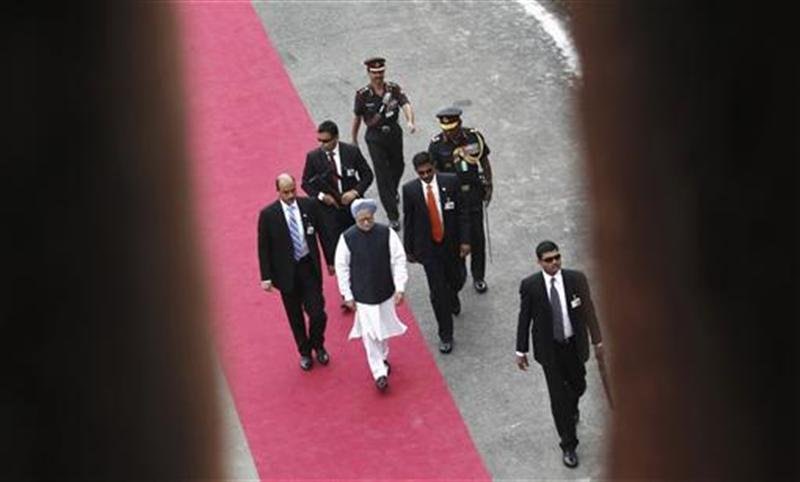
Time to roll out the red carpet?

I am not alluding to Dr. Manmohan Singh’s faith by addressing him as ‘Sardarji’ here. Sardar is a leader, and for the first ever time he spoke as one in his eight-year-long tenure. But all good packages don’t always have fresh and edible contents. In fact, the fine print on the package can be misleading.

Yet, I’d like to learn from the PM’s speech on the economic policy decisions for two reasons:

  1. I know precious little about the economy in terms of fiscal deficit and inflation. Therefore, I cannot see the issue holistically.
  2. He addressed the nation directly, instead of selecting a favourite media outlet to express his views, which is truly what a leader ought to do.

There were obvious political moments:

No government likes to impose burdens on the common man. Our Government has been voted to office twice to protect the interests of the aam admi.”

The aam aadmi does not read party manifestos. The aam aadmi, and even industry bigwigs, like freebies.

The government has taken away the freebies:

“Let me begin with the rise in diesel prices and the cap on LPG cylinders. 
We import almost 80% of our oil, and oil prices in the world market have increased sharply in the past four years. We did not pass on most of this price rise to you, so that we could protect you from hardship to the maximum extent possible…Much of the diesel is used by big cars and SUVs owned by the rich and by factories and businesses. Should the government run large fiscal deficits to subsidize them?”

This is utterly wicked. But, then, that is what politicians do. It is not as though the corporate guys will take out a morcha; Dr. Singh works in a FICCI manner, more or less. This is really a buffer comment to hide the small cars, small homes that will bear some of the burden. It may not be huge, but with this statement he has tried to build confidence, conveying that the rich will take the blows. Reminiscent of Indira Gandhi’s “Garibi Hatao” slogan that later transmogrified into the License Raj.

It is time to revisit history and the PM did just that. He brought in 1991 when he as finance minister in P.V.Naramimha’s Rao’s cabinet made the economy ‘free’. The problem was, and continues to be, that freedom will always be in the hands of a few; that it might percolate to the lower strata is a bonus, never the main concern. I don’t wish to be a killjoy, but weren’t the big scams with lobbying and kickbacks the result of just this free-for-all?

Fine, kerosene has been left untouched because it is used by the poor. This is simplistic thinking, especially when he asks:

“Where would the money for this have come from? Money does not grow on trees. If we had not acted, it would have meant a higher fiscal deficit, that is, an unsustainable increase in government expenditure vis-a-vis government income. If unchecked, this would lead to a further steep rise in prices and a loss of confidence in our economy.  The prices of essential commodities would rise faster.  Both domestic as well as foreign investors would be reluctant to invest in our economy. Interest rates would rise.  Our companies would not be able to borrow abroad.  Unemployment would increase.”

He has created a Robinhood scenario. Rich subsiding the poor. Only, the rich will get a backdoor entry through “building investor confidence”. Is this good for the economy in the long run? How many of the poor will be employed, how many health and education schemes will see fruition as a result? Of course, this is putting the cart before the horse. The reason is that the horse can gallop away and leave the cart behind.

The PM’s views on the world situation, however, cannot be discounted:


“You should know that even after the price increase, the prices of diesel and LPG in India are lower than those in Bangladesh, Nepal, Sri Lanka and Pakistan.”


“The world is not kind to those who do not tackle their own problems. Many European countries are in this position today.  They cannot pay their bills and are looking to others for help.  They are having to cut wages or pensions to satisfy potential lenders.”


There is absolutely no doubt about this. India has remained relatively unsullied by the fall of the big economies, but who had to bear the brunt? And who were the people responsible for part of the major bungling? Wall Street. Big men with big greed.

His emphasis on global investment is a huge concern.


“The world is not kind to those who do not tackle their own problems…I am determined to see that India will not be pushed into that situation.  But I can succeed only if I can persuade you to understand why we had to act.”


It is, indeed, better for a nation to let its citizens work on the money than depend on loans directly. The “begging bowl” syndrome has not afflicted India to a great extent.

And this, the country can be proud of. The country should also be proud when people question it, for only then can there be true progress. India is not a single state whose development module can whitewash its other ills. To be more blunt, Manmohan Singh is not Narendra Modi.

We all know that there is a need for growth, but it cannot happen with a magic wand. In the process of the economy being stabilised, there might be little tremors. Can’t help but paraphrase Rajiv Gandhi’s comment (“When big tree falls, earth will shake”): When big tree is planted directly in the soil, there will be some mud that will come loose.

At this moment, my ‘aam aadmi’ imagination can only conjure up diesel-guzzling SUVs being splashed with sludge.

© Farzana Versey

26.10.11

NGOs, Kiran Bedi, the Media: Who’s the ‘farest of them all?


Kiran Bedi is indeed wrong, but when media persons sit to judge her it is a bit of a laugh. Clearly, they do not look in the mirror.

Instead of seeing this as an opportunity to question all sorts of voluntary agencies and their modus operandi, we have a situation where a person is pinned down for wrongdoing without a backward glance at how the whole NGO business works, often with the media’s involvement.

Kiran Bedi has been fudging her bills, where she charged inflated amounts from her hosts. The main source was airline tickets. She would travel by economy class, that too at a discount because of her gallantry award, and charge business class fares. We now have these sanctimonious NGOs tell us that they took it at “face value”. Most NGOs send the tickets themselves. So, why did they let her use her travel agent? And what sort of auditing departments do they run? The reason for keeping quiet is not that they were afraid of Ms. Bedi’s wrath – they obviously did not mind shelling out Business Class fares – but because their finances will lead to many question marks.

This is my point. The media and certain activists have taken a convenient yo-yo stand on the Jan Lokpal Bill campaign. They propped him up and were completely besotted by Team Anna. After they were done with the photo-ops of the caps and the fasting and dancing, they realised that there were chinks in the armour. No one was interested in the deeper questions – it came down to superficial put-downs.

Let us get this fudging business clear. Kiran Bedi has admitted to it and says she will return the excess money that she wanted to use for her own NGO. Where do the NGOs get this kind of money that they can afford to invite people from different cities for seminars? I have often posed this query when we rubbish other institutions. Do you know that most of the activists themselves travel Business Class, stay at fancy hotels, and order the best food – for what? To gupshup about the state of the nation, the homeless, female foeticide, dowry, terrorism, communalism?

Check out the number of people who have left their high-paying corporate and bureaucratic jobs to “serve the nation” or, “become useful members of society” or, “fight communalism”. They could do all of these by continuing to work. The reason is that activism has become a paying proposition. Have you seen the huge ads put up in newspapers inviting you to attend some conclave or the other? Is it affordable or even appropriate to shell out this kind of money on overheads? Besides government grants, there is a good deal of foreign sponsorship and donations from industrial houses. While the international ‘intervention’ often comes with some amount of side-effects (pushing of substandard products and services clubbed with the do-good, feel-good stuff), some of the Indian business black money that is not stashed away in banks abroad is routed to charitable organisation, with income tax exemption.

Why does the media not raise a voice about this? Has the media ever questioned journalists who attend these same seminars? Oh yes, the same journalists who give inflated bills to their accounts departments for their travels and hotel stays and “related expenses”. Journalists who sit at the desk and make phone calls but charge taxi fare for the quotes. Journalists who try to get tickets and freebies because they think they are in a position to ‘arrange something’. Journalists who do not have to spend a paisa at restaurants and spas because they just might mention it, in passing, in their next column. Journalists who give us scoops that are fed to them by interested parties or who conduct sting operations that are again paid for by interested parties.

Of course, it is not only the media at fault, but also those who host such talks. Corporate India’s ladies who lunch get a big high when they invite a person who can indeed talk and add to their resume. They flash such people as trophies to display their own worth as ‘aware citizens’. That some media people are doing their evening show with this group should be an eye-opener rather than a can-opener.

If, as some commentators wish to know, why people from public office enter the fray late in the day to become part of NGOs, then one might wish to ask them why they have timed their queries now and not for all these years. Do they ponder about it when they go on government-sponsored junkets?

The problem is that this whole Anna Hazare campaign has been a sham, and revealed more shams both on the inside as well as on the outside. It showed us how the ruling party and the opposition got to pay politics; the arrests also reveal a lot about those who got away without a scratch to their reputations. It is rather disingenuous of Digvijay Singh to say that if Kiran Bedi can offer to return the money, then every bribery case can be closed by saying the bribe-taker will return the money, including, A. Raja.

This is some gumption. A minister in the government of India is caught in a scam of frightening proportions and another government person uses this as an analogy. He is also quite gung-ho about such a thing happening at the highest level. The 2G Spectrum scam is not just about bribes, but also about how the nation was taken for a ride with the government, big industrialists and lobbies involved. It is about how the government functions and not merely who took how much. This case has come under scrutiny; many others do not.

If political agencies get a chance, they try to co-opt the activist groups. Most are willing to go along because it is the easy option. In some cases where they need the government to act, it does become a crucial mutual involvement. Therefore, if a political party invites activists, and they fudge figures about travel expenses, then what will the political parties do? Why not question the complete lack of balance by media groups? One can understand individual commentators taking a particular position, but why do they blatantly follow the newspaper/TV channel line? Where is their independence? Those who talk about objectivity should really look in their own backyards. There is favouritism everywhere and the media indulges in it as much as politicians, and the ‘activist’ role of the media should also come under scrutiny.

Tavleen Singh, Indian Express columnist, while raising some important points, makes a rather shocking comment:

“My own observation is that many NGOs working in India appear to be funded by organisations bent on ensuring that India never becomes a developed country… In order for India to become a halfway developed country, we need new roads, airports, ports, modern railways and masses more electricity. In addition, according to experts, we need 500 more cities by 2050. The odd thing is that the NGOs who oppose steel plants, nuclear power stations, dams and aluminum refineries in India never object to the same things in China.”

Is this the definition of development, and the only model? As I have already said, many NGOs do have an agenda, but not only if they are funded by organisations that do not wish to see a developed India. By this logic, Gujarat should have no NGOs. And why must Indian NGOs object to what happens in China? Has the Indian government opposed the self-immolation of Tibetan monks and nuns in support of the Dalai Lama’s return? Has the BJP done so? Has the media done so?

Forget the NGOs for a while. Think about how these plants were to come up, who was to be uprooted and how it would affect the environment. If this development is only for those setting up factories and making India technologically advanced, then why are we still the hub of western-powered outsourcing? Are the NGOs involved here?

Why absolve the fat cats of business only to hit out at the NGOs unless they are specifically playing dirty? How many media people have taken free jet rides, attended fancy wedding functions abroad and written glowing accounts of them? Will they be sanctified as the facilitators of development? Or do they need to get closer to the seats of such power or perhaps such development? These are trick or treat queries. Ask them we must, for there is much beyond Kiran Bedi, whose banshee persona was in fact given a boost by the media when they needed her sound bytes. They were birds of a feather, until she was grounded.

The still-feathered ones have taken wing and are giving us a bird’s eye-view.

(c) Farzana Versey

Also published in Countercurrents

- - -

My earlier related piece on such superficiality: Kiran's Dance, Illiteracy and Symbolism

5.5.11

Quote uncoat

One can never step into Narayana Murthy’s shoes. I am just stepping into a position called chair of the board

- K. V. Kamath, new CEO, Infosys

For all the humility and ‘aal izz well’ formula of Infosys, the fact remains that Narayana Murthy made the decisions. He was the throne of Egalitaria. He may now be ruminating about “siesta and sitcoms”, but there won’t be any let-up. The hierarchy here might not have been vertical, but it is most definitely horizontal with all the speed-breakers and zebra crossings in place.

Okay, I don’t know anything about Mohandas Pai and whether he quit because he wanted to be CEO, but was the company not started by seven broke blokes? Where are they in this successful enterprise? Does the world gasp for any of them and the way Infosys played the global game according to global standards? Truth is it became a one-man enterprise with one man being nice about the rest. It is a private company and people can do what they want with it, but it most certainly was not about real inclusiveness.

What Mr. Kamath says is not only about stepping into shoes; the chair itself is Narayana Murthy.

18.3.11

Reservations, Minorityism and the UID Threat

Do not expect the UID (Unique Identity) scheme to track absconders and the corrupt. It will see to it that the backward remain where they are with a mid-day meal and an occasional trip to the local Disneyland ensured.

Reservations, Minorityism and the UID Threat
by Farzana Versey
Countercurrents, March 17


Who is really exploiting the reservation policy? If this is the constant fear, then there is more going on than we know. If politicians back certain groups for electoral ends, then those groups are not to be blamed. It was indeed shocking to read the Times of India editorial pick on the Gujjar and Jat communities that have demanded reservations and pass a blanket verdict:

“Today, reservation has ended up creating ‘creamy layers’ in targeted sections. The Supreme Court’s 50% ceiling on quota has been breached as well, as in Tamil Nadu. Quotas were meant to facilitate upward mobility in terms of jobs, livelihoods or status.”


What about sectors where the real 50 per cent are not considered? This has not happened because of more reservations, but due to the nature of nepotism and promoting one’s own, and it starts at the lowest level of bureaucracy to the highest power centres. On what grounds can it be stated that quotas are about upward mobility when public visibility ensures that they are recognised as the downtrodden? How many top positions have been filled with this reservation policy? How many candidates standing for elections are given this opportunity, unless it is to woo the constituency, and this is done by all sections – the Brahmins, the Rajputs, the Muslims, the Christians in their respective majority areas?

The editorial goes on to say that “six decades ago, it was thought that ostracised and marginalised groups needed reservation only as a time-bound instrument of socio-economic levelling. India has come a long way since then”. If that were the case then there would be no need for other groups to downplay their status, not in a country where recognised as heirs and designated with labels is so very important. There was much media attention paid to an over-the-top wedding of the children of two Gujjar politicians in Haryana. It does not reveal prosperity of the community as a whole, although it does make the upper castes uncomfortable to see their ostentation mimicked. It therefore acts as a convenient stick to beat the issue with:

“Clearly, if we’re to have reservation, it must be based on the economic criterion. More important, quota-based positive discrimination must make way for affirmative action in the form of efficient services delivery to the poor across the social board.”

While economically-backward people from all communities must benefit in terms of opportunity, how will such action be carried out? In the unorganised sector where daily wage is the mode of earning, there is no talk of reservation. Those are among the poorest people irrespective of their caste. Where has this great economic leap reached them? The definition of welfare does not have to be relegated only to paper.


It is pathetic to see the media playing the role of government spokespersons. The UPA gets a pat on the back for its food, health and “need” based schemes:

“Whereas quotas create social friction by building coddled niches, welfare-for-all has unifying potential, and hence can help bridge caste divides. The midday meal scheme in schools – encouraging community eating at a young age – is a case in point.”


Why is there always a problem regarding coddled niches where the SC/ST groups are concerned and not when the fat cats are? How does school children sitting and eating together result in a feeling of community? How many schools do not discriminate in matters of admission and, more importantly, attitude? What mid-day meal schemes are there in the rural areas?

These are camouflages that only serve those in power and probably let the middle-men make some money on the food-packets. Also, eating in a Dalit house does not unify anyone when we know who is eating where.

The worst part of the debate is regarding “fasttracked” development. This will work at the level of lining the roads with potted plants when a foreign dignitary visits. There is a rather vile motive and that is to promote the government’s UID scheme.

“The underprivileged have a sense of powerlessness and low self-esteem precisely because they’ve been treated as a faceless collective to be swayed by political populism, rather than as individual citizens with distinct identities and entitlements. Here’s where UID and financial inclusion come in. By giving the poor identity, financial agency and provable claim to social benefits, such projects can do more good than quotas ever could.”


Okay, so now that they have a face and a card, instead of a broom trailing behind them to clear the path for the others, will they get equal benefits? Or will their identity, stamped and marked, exclude them from certain areas while keeping up the pretence of welfare in others? Won’t their recognised identities help even small politicians trace them and use them for populist reasons, all at the click of a button? Is it not possible that were the younger lot to progress on their own and seek positions they will be tracked and prevented because those wonderful opportunities have been reserved for years for the privileged? Will not such a government-sanctioned identity, where everything from their source of food to their birth control methods are on record, not in fact work as a process of elimination quietly in the background?

Do not expect the UID (Unique Identity) scheme to track absconders and the corrupt. It will see to it that the backward remain where they are with a mid-day meal and an occasional trip to the local Disneyland ensured. India’s economic policy is a showcase, not an internal buffering system. It is about Forbes not welfare.


In this fairytale version of progress, one of the sops that has been thrown in is to give a well-settled institution like the Jamia Millia Islamia minority status. One might well ask where all the talk of welfare is now. In an article Najeeb Jung, the vice-chancellor, mentions that when it became a central university in 1988 with all the relevant faculties working, it had about 50 per cent Muslim students. In 2011, it has the same number. Unfortunately, he sees the positive aspects in what is clearly negative demarcation.

“First, over the last 90 years Muslims have had a sense of ownership and a fierce attachment with Jamia. They believe it is an institution of higher learning set up by their forefathers, to further in essence the cause of Muslim education, and declaring it a minority institution makes them secure in this feeling. Two, with the introduction of reservations for OBCs, the level of reservations in the university would go beyond 50% and therefore over time Muslim numbers will decline.”

Jamia is seen as a secular institution and promoting it as a minority one defeats the purpose. Citing the example of Christian-run colleges does not quite work because most of them have a missionary background and yet a ‘convent’ education is considered prized. The Christian community did not feel any ownership and having studied in such institutes one can say that except for the occasional superficial religious dimension, it was the elite students who felt more of a sense of belonging irrespective of their caste or religion. What the government has done is to make Jamia work as a double OBC unit, in a way.

On the subject of women’s education, Jung writes:

“Today, one of the glorious achievements of the university is that within its campus one frequently sees groups where girls in hijab mix easily with all others.” 

He is playing into a stereotype. Delhi has Muslim students in other universities who go without the hijab. Why does he assume that Muslims do not mix otherwise? The criticism that this could well be a ghetto, as much as is the UID scheme, is valid. And it is proved when he declares:

“While this is a huge affirmative action on the part of the government that the Muslim community must accept with grace and gratitude, I believe the government has put an onus on the Muslims to prove that they can look beyond common perceptions of ghettoisation, fundamentalism and so on and understand that imbedded in this initiative is the challenge to be tested at the altar of competence, professionalism and, above all, commitment to fierce nationalism and secularism that has been the bedrock of Jamia for the past 90 years.”

Technically, the Jamia is anyway entitled to 50 per cent quota for Muslims, so giving it the minority tag is a trap and it is easy to fall into it. Why should there be an onus on one community to prove not only its capability to be professionally qualified but committed to fierce nationalism, which incidentally is at the core of contemporary disparities and communalism?

The devious double dhamaka of minority certified as minority is to push a group into the corner. It is not surprising that an established institution has been chosen for this ‘honour’. It will be used as an example to throw more crumbs at lesser people, be they minorities or the Scheduled Castes and Tribes, all in the name of welfare and unification. The fact is their every footprint is being marked to make certain that they can only walk thus far and no further.

(c) Farzana Versey

2.12.10

Bihar's Mythic Development: No Looking "Backwards"

Bihar's Mythic Development

No Looking "Backwards"
by Farzana Versey
Counterpunch, December 1, 2010


India, once considered a natural democracy, now needs shaky excuses to be so sanctified. Bihar, one of the most backward states in the country, has elected Nitish Kumar’s party, the Janata Dal (United), to power in a ‘stunning victory’. The bellicosity of commentators to be flagholders for such a myth has to be read to be believed.

It is amazing that this glorification is for his second term. Everyone knows that ruling parties have an edge to bulldoze their agendas. Such agendas may include pushing all the real issues under the carpet.

Bihar’s backwardness had little to do with the existence of scheduled castes and more to do with the manner in which they were treated. In Nitish Kumar’s utopian state, caste has got sidelined. This is not cause for celebration but concern. We are talking about a large segment of society being covertly discriminated against by two deceptive options – co-opting and debarring. The larger political spectrum that is being hailed has, in fact, narrowed it to the pyramidal apogee by selective probity.

One report came up with a rather dodgy analysis: “The Bihar results will have rippling effects in other areas where negative agendas of caste and communal forces do not allow people-driven agenda of development.”

Caste and communal forces are about people and do not spring from the bottom but the top; they have been traditional vote-banks thus far. They remain so, but in a non-conservative fashion by being covered beneath the veil of poverty. It is a real issue. However, the trick here is not to deal with poverty but make it a palpable saleable idea. Water, food, education, healthcare, electricity, roads are necessities that are sold as comforts. There is a reason for it; it is to set the ground for the development agencies to send in their quotations. The people of Bihar are not going to say “let there be light” and have shining bulbs nor will dry taps start running by the mere expedient of thirst; roads won’t be tarred for bare feet. All these require raw material, infrastructure and money. The poor obviously do not have money. Therefore, the rich come into the picture.

The rich in Bihar belong to the feudal class or criminal gangs. Both have tremendous political clout if they are not already in politics. It is pertinent to point out that both these categories are extremely caste conscious. The landlords use labour belonging to the lower castes and consolidate their position based on such bondage. Crime, too, relies on caste equations to settle scores. Therefore, the current development will need to not only factor in such disparities but also rely on them. Since over 80 per cent of the population is Hindu, communal politics can be reined in by sheer force. It ought to surprise no one that Nitish Kumar has been an ally of the right-wing parties.

During this election, he skirted Gujarat’s Narendra Modi’s involvement in electoral matters. This was seen as keeping away from a controversial figure. On the contrary, Bihar has cunningly emulated the Modi formula; the snub to Modi could have been a tactic or an ego trip. Either way, he is the role model here. The difference being that Bihar has been considered a backward region, Gujarat is not. But the economic saviours have worked along similar lines by co-opting those they have scant regard for. In Modi’s Gujarat the Muslims have stood by him despite the horrific establishment-engineered riots and killings of 2002; Nitish’s Bihar has used the abused members of society to the same effect by showing them glittering streets and whitewashed ideas.

The female voter turnout has been much-lauded without seeing the larger picture. This is not about empowerment or a woman’s natural understanding of development. Bihar, for all its progress, still has a large number of migrants to other cities. The question to ask is this: if the growth rate is 2.5 per cent more than the national rate of growth, then why have these sons of the soil not returned?

Iconoclasm has the ability to camouflage all con jobs. It is a rather sad statement that the original patented hero of Bihar, Lalu Prasad Yadav, is seen as a beleaguered has-been today. Despite his not-so-clean record and his scams that were out in the open for all to see, he had made Bihar into a brand of sorts. It was not mere rural hubris. If his was a one-man show, then no one really knows of any prominent people in Nitish Kumar’s cabinet. Lalu made no attempt to hide the caste of his candidates; at the national level this is an important element if the reservations policy is to be made use of by adhering to authenticity rather than fakery.

It is also an irony that while Bihar under Lalu Prasad was the only state to prevent the rath yatra of L. K. Advani from passing through in what was to turn out to be the worst communal divide after Partition is now dependent on the BJP. Long before talk about development, Lalu had the courage to appoint backward caste priests and shankaracharyas. These were quite possibly gimmicks, but for a country that still has such an aversion towards Dalits this was a strong statement.

Development must include political vigilance and progressive inclusive thinking. The end of the road is not roads.