Showing posts with label writing. Show all posts

17.10.14

Flanagan's Wake


I like Richard Flanagan already. He has won this year’s Booker Prize for ‘The Narrow Road to the Deep North’ that I have not read. I have read nothing by him, but following the award the search has yielded some wonderful insights.

Of course, I like him for saying that he is “ashamed to be Australian” because of the environmental policies of the government. But, what is more interesting is how he gets into the mind of another real person. A good writer does not only create characers out of thin air. S/he can make the most simple reality appear profound or mystical or mythical.

Flanagan has done it with David Walsh that I now know so much about Walsh and so little about Flanagan. This he manages to do without any self-effacing sophistry. In fact, he pushes the boundaries of language to create something out of somebody. In the essay for The New Yorker, he wrote:

Attempting to describe Boltanski’s devil is like trying to pick up mercury with a pair of pliers. At fifty-one, Walsh has the manner of a boy pharaoh and the accent of a working-class Tasmanian who grew up in Glenorchy, one of the poorest suburbs of the poorest state in the Australian federation. His silver hair is sometimes rocker-length long, sometimes short. Walsh talks in torrents or not at all. He jerks, he scratches, and his pigeon-toed gait is so pronounced that he bobs as he walks. He is alternately charming, bullying, or silent. As he looks away, he laughs.

This comes somewhere in the beginning, so it has to be tantalising. Flanagan certainly knows about a good way to grab attention. From his subject as arriviste, to his perversities, his enterpreneurship of the arts and his inner demons, it is a sheer treat.

Walsh’s favorite novel is “Crime and Punishment,” and conversations with him can sometimes feel like talking to the deranged narrator of Dostoyevsky’s “Notes from Underground”: possessed, but rarely less than compelling. His obsessive desire to explain makes his thoughts sometimes seem to proceed algorithmically. Though the condition has never been diagnosed, Walsh and those around him believe that he has Asperger’s. It would explain his extraordinary gift with numbers, but it is hard to know where the condition ends and bad manners start. Walsh’s rudeness is legendary. “Let’s face it,” a close friend told me. “David can be a complete cunt. But he is also the kindest and most generous man you will meet.” Walsh funds a major tennis tournament, the Moorilla Hobart International, as well as Hobart’s MOFO music festival. There are also many and ongoing private kindnesses: kids he sponsors at Hobart’s Quaker school, support of several families, and friends he constantly helps. Pointing out that Walsh has always spent more than he has earned, Ranogajec said, “David was never motivated by money.”

I doubt if the idea behind the Booker Prize is to make you fall in love with a person the writer writes about, but here you have it. I am in love with David Walsh and I couldn’t be bothered about finding out anything more than I know about him through Richard Flanagan.

20.11.13

I no knot what to do...

"You know nothing about the business of writing," he told me.

Then came the details. How to get off. Get it off. Take off. Take it off. Book launches. Public relations. Publishers and their demands. Reviewers and their demands. Readers and their demands. The format. The cover. The pages. The typeface. The people to meet.

"What's happening with your book?" I asked him.

"I don't know."

I returned to my soggy half-finished sentence and patted it dry.

© Farzana Versey

31.7.12

A CounterPuncher Forever...

 
“Alexander Cockburn no more” would sound like a terrible headline. The reality of it is as biting as his prose. To think that I just got to know about his death early today shook me up a little more. I crumble easily and almost did. The ‘almost’ worked because every word of his obit on Christopher Hitchens still haunts. To many it was either blasphemous or an excoriating take on a man on a self-indulgent pulpit. I saw it as Alex’s honesty towards his ideas. The subject’s demise would not alter that.

I have gone through a few memorial pieces in respected mainstream publications. "Radical", "iconoclast" are the running themes. It is true he took no prisoners. It is true, and I say this from my experience, that he welcomed whatever skirted the beaten path. One day, about five years ago, when I came in from miles away and got accepted, he and Jeffrey St. Clair made me realise that CounterPunchers was a community.

There are several reasons to respect him for his hard-hitting work, but he was also aware of limits in certain areas. He did not carry one article I sent. He owed me no explanation, but he did. It was about sensitivities. I was surprised, even shocked. The good thing is it was not to coddle up to some commercial enterprise.

There was another piece he carried – an account by his nephew about his battle with schizophrenia. It appeared in the weekend edition and in his diary Alex introduced it. This, to me, is as honest as taking on the system and speaking of truths that are sought to be hidden away.

While he was open to different thoughts, he was human enough to have his own biases. How could we not expect it of one with such strong opinions?

He called his readers a “communicative lot”, forwarded emails that complained to him about publishing me, but expressed genuine happiness when some pieces “got around”. The people who have corresponded with me have been from varied fields based on the different subjects I wrote on – from scientists to academics, from fanatics to the faithful to atheists, from purists to adventurers, from the prurient to sexual libertarians (and, yes, some who wooed). They do not need an open forum.

That is the reason CP is not a journal. It is a movement. I differ with those who talk about it being non-mainstream. This is what the mainstream should be like. I’ve written for a whole range of publications and websites, and know the difference.

“Please ask your web team to fix it,” I had said in one of my emails about a broken link.

“Le ‘Web Team’, c'est Jeffrey. There's just the two of us. Best A,” was the reply.

So shall it always be…the two of them. And a bunch of writers and readers bound by questioning minds.

- - -

I do not know what world I occupy to be so unaware. Here is Jeffrey's piece:  Farewell, Alex, my friend

9.5.12

Footnotes from the ledge

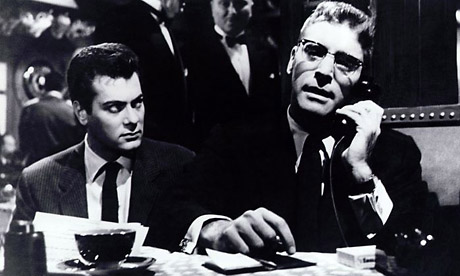
From the film 'The Sweet Smell of Success'

Years ago, a web portal I wrote for in the nascent stages of news and views on the Net in India, decided that it needed a footnote for its columnists. I was accustomed to ones that simply said I was “a freelance journalist” (I crack up when I read “independent columnist” – independent from what, of what, by what? Is that not to be taken for granted?) to the smart “refuses to sit on the fence” (it worked against me after 11 years of continuous writing of that column when I was told I was too independent and don’t take briefs!) to a phrase taken from my blog: “has a healthy disregard for objectivity”.

So, back to that e-portal. As some of you know, I could not imagine ‘writing’ for anything that did not scrunch in my hands. I did not even have a computer. One day, out of curiosity, I was at a friend’s office and casually mentioned this column. We reached the destination and as I scrolled down on my discovery trip, I reached that precious footnote. It was in red, italicised. It said that I, FV, was an “iconoclast”.

I froze. Images of me as Che Guevara flashed on several T-shirts. This was serious, and after a few seconds I was pretty much on the floor laughing, and ROFL was not yet known to us. From that vantage position where I had to look my iconoclastic best, I asked my friend whether he agreed with me that it was a stupid idea; he did. And made it sound more ominous: “It might appear as though you are saying it.”

This is the problem. It is more likely that publications decide. However, the newer lot ask you to send “two-three lines describing yourself”. I once wrote a horribly cheeky one and was told it did not go well with the content.


Sealing my fate!
When I became a serious op-ed addict during college, I recall reading pieces that were written with care for both language and thought. Some were ponderous, no doubt, but many were challenging. For me, this is the purpose of a good edit piece. There was space enough to explore ideas, and not the need to compress because there has to be place for ‘likes’, ‘share’, ‘send’. I understand this is the way to connect, but when some publications ask you to send SMSes to say whether you liked or did not like the column, it is a bit much. The writing becomes another product. Unfortunately, these days it often is.

But I did not know who those writers were. Celebrities and those from other fields had not taken over the business of holding forth on what they were doing. This does not work as ‘inside’ information or adds any authenticity, for they too are writing for an audience and have their own biases.

Do readers care about the qualifications of the columnist? It is a bubble theory. It looks good until you prick it. And the pricking is just giving it a good look-over.

However, mostly the footnote works as a promo for people in different professions. I had once taken a swipe at someone mentioning how his CV exceeded the word limit. It was, therefore, good to read on the ‘Self importance of names and titles’ in Pakistan’s Express Tribune as to how the whole description business has gone overboard. When I was writing for them, I had half a mind adding, “The writer has a degree in Vampirism from the University of Dracula”. (Incidentally, third-person descriptions are supposed to look objective; they make me feel schizophrenic.)

Quite a few publications have these long rambling bottomlines, and most of their columnists are so darned third-degreed, all from the best universities. A good university ideally teaches you to explore, not flaunt knowledge.

We never read any mention of a degree from Gujranwala or Chhatisgarh. Reveals our colonial mindset and, dare I say, adds weight to the publication's reputation. They could probably have a roll-call of Oxford/Cambridge/Harvard types, all with halos. If they can take global roundabouts and quote Greek mythology in Latin phrases with a slight nod to desi lingo, then chances are that more people will notice because snob and blob value go together. They are like the always-open KFC outlets.

The other peeve regarding "X is a former something or the other" reveals our absolute obeisance to the past. Instead of wondering why s/he even at the prime has been rendered redundant, it imbues the individual with the gravitas required of a know-it-all. Much like a divorce might make a discussion on marriage legitimate. If the 'formerhood' has been achieved after much toil, then it works like a tiger's head poking out of the wall.

Now, chances are that if the writer were not a "political economist" or some such and just another bloke with something to say, a piece questioning such self-importance would not have gone through the thinker's pose of editorial discretion.

PS: I posted the last three paras at the website with a footnote that said “~A former ET columnist with several degrees of separation”. It’s still awaiting moderation after hours! (Finally published after 12 hours.)

© Farzana Versey

22.12.11

Character Assassination

Due to the untimely demise of one of my characters, I was in mourning and could therefore not submit the story on time.

This is a real note I sent years ago. A colleague had entered my name for a short story competition by the British Council. I was not terribly enthusiastic about such events, but since it required imagining, it was par for the course. I thought nothing about it and since I was not accustomed to writing for a reason, I wove the words at a leisurely pace.

A tap on my shoulder and a thick envelope served as reminders that I paid no attention to. The date of submission was gone. I folded the sheets of paper and put them in the envelope – the address and stamps were ready. My friends were still enthusiastic. I quickly grabbed a page from my diary and wrote down the note:

“Due to the untimely demise of one of my characters I was in mourning and could therefore not submit the story on time.”

What else could I say? I am not good with formal letters. Besides, it was succinct and happened to be the truth. The cat in the story had died. Obviously, I had killed it. Yet, its death was a departure, a turning point.

Recently, an Indian media house gave an award to a novel and the jury used a curious phrase for its choice: one of the reasons was “for its non-judgmental attitude to the characters”. How does a writer not judge a character when s/he has created it? This is not immaculate conception. You sweat over it, love it and get suffused in it, for however brief a time. The judgement lies in the nature of the relationship. The writer is the initiator and woos the character. It is possible that the character might mirror the writer. Introspection is also judgement. You are pronouncing a verdict on your thoughts and feelings.

Any objectivity would be forced. The character is because you are.

Back to my old story, I had written it for myself. In those days, there was no audience I was seeking or speaking to.

A few days later, rather uncharacteristically, I got a note from the British Council. It said, and I will rely on memory and promise not to exaggerate, that indeed I had missed the date of submission and rules would not permit my work for consideration. However, my accompanying note was rather interesting and caused much amusement and they could not but let me know that although the story would not be included in the competition, it was noticed.

I wondered whether dead cats could lick the cream.

1.12.11

Who moved my 'journalistic space'? The Age of Twitter Set-ups

Why the hell is ‘journalistic space’* being taken over by micro-blogging? Why is it that when one person breaks wind there, a whole bunch of people queue up outside the loo?

Hmm…I had just finished my morning adulations, and ignoring the Toffee-nose of India (TOI), I went to the stapled sister. I like Mumbai Mirror. I like mirrors. Now, in the midst of all the light frothy gossipy stuff it mentioned a “corruscating review” about a recently-published “social Bible”. It did not specify whether it was the Nobu or the Antillia version.

What follows here is a reaction to the responses to the riposte to the review and the rejoinders to the remnants that remain of the righteous rumblings.

Since those who do not read my blog are not acquainted with those who do not read everything else, I will have to introduce the characters that are not there and what they did not do.

An author Soul Setter, henceforth referred to as Setter because I want to sound like a Goan, wrote a book, a social Bible, if you must, called 'Getting To the Top of ITC’s Everest in a Chartered Plane: Ten Rules for Being Moses'. The Setter has friends and clients. That is his business – to make clients feel like friends and friends become clients.

It is simple enough. Learn to get all the Gifts of the Magi without being Christ. Or, if the atheists prefer, how to lay eggs without being a hen.

A lot of people might have bought Setter’s book because they were friends and clients and wanted to read about how they were making people.

Then, what is the problem? Setter is popular among the television channels and is always on panel discussions. He is a marketing guy and many of the big companies would like to see him talk about the state of the nation while he is selling their soap suds and hotels.

According to my sources – okay page 2 of the paper – the Setter read that “corruscating review” and went into “an indignant, inelegant splutter”. Fine, the couple of examples I read weren’t exactly nice, but then wasn’t the review “corruscating”? Setter was blinded. Hurt. Setter could not control. Setter blurted out: “So @me-churma (name changed) reviewed my book for a magazine no one reads. Am not surprised! He is supposedly an unemployed economist for an unread mag!”

What followed is truly weird. A news magazine that we read for taped conversations, excerpts from the editor’s book (oh, no, will leave that for now), and four-page essays by Oliver Twist asking for more Mao jumped into the buzz. It went full-throttle into an excavation expedition and besides Shivaji’s personally autographed copy of Adil Shah's memoirs, they found tweets from the time of the Cripps Mission. Standing apart were those about the Setter controversy. It turns out that a month before the “corruscating review” appeared, Setter had praised the magazine – let us call it Craven – addressing its senior editor with the shining words: “and by the way I love the way your magazine CRAVEN is doing in the journalistic space*…super stuff…” (italics mine)

This should tell us that Setter is a bit displaced. He needs to shout, as he has done by typing the name of the mag in all-caps. However, I do not see any disparity in the two comments. He loves (or loved) the magazine in a confined space to which he supposedly has access (remember the chartered plane and all?). He is telling us that not everyone has that access. “No one reads” clearly means he is not No One; he is Someone. He is also hoping it goes unread. This is Setter Subconscious. The personal attack on the reviewer is because he assumed a slight directed towards him.

I have not read the book (extracts, yes), but did go through the review. It seemed like the reviewer went into the deep dark woods to figure out a bonsai plant.

The problem for people like us is that everyday we find little bon mots, and not all by bon vivants, which Setter claims to be, and we often do not know the context. Recently I came upon some exchange between the Diva and other divas about maids. Suddenly, out of nowhere, another best-sailing author’s name cropped up. Let us call him Chattan Bang. It transpires that he was being sarcastically awarded something for watching films with his maids.

Now, Chattan really likes films and his latest watch is The Dirty Picture: “The movie breaks so many new grounds, and opens the door for Indian biopics.”

If it is breaking so many new grounds, where will there be place for doors?

He is so taken up that he even gets patriotic: “Few Indians make me proud of being Indian. Vidya Balan is one. She isn't just an actor, she is an artist. Superb performance.”

I am told the boobs and midriff prosthetics are not made in India.

Then, this: “If a dog keeps on barking your name, he makes you famous. The dog, however, remains a dog.”

And the bark remains a bark, no?

Unless you have a dog named Google, like Setter does, who can find the doggie doo even in coruscating darkness.

2.11.11

Authors and Mummies


Forget a chair named after you at a tony university. Several dead bodies can soon claim to have been at your place if you have the honour to win the online poll for the best crime writer. Ten authors have signed up for the ‘Million for a Morgue’ campaign. Those who get the most votes will have a morgue named after them. Dundee's Centre for Anatomy and Human Identification (CAHID) in Scotland needs £2m; it has contributed half the amount. The rest will come from the vote, where each voter chips in £1. This is to facilitate a special embalming facility for research.

I assume the writers have decided to participate out of a genuine need for academic excellence in the field of such scientific endeavour. One of them has probably done it out of gratitude. Val McDermid often tapped Prof. Sue Black of the Centre for her own research. As she recalls:

"I remember asking her what a body would look like once it had been in a peat bog for 200 years. There was a moment's silence on the phone and then she said: 'A leather bag with a face on'. And that was perfect because that gave me an image I could put in my book."

We can take this further and have restaurants, stadia, bats and balls, strip clubs, even a specific love-making position named after authors. I can’t wait.

It raises the question about what could motivate readers to vote. Would it be like any popular poll where you choose your favourite crime writer? Or, since the purpose is not a secret, will the person contributing the money be interested in the Centre’s plans and therefore keep this in mind and choose an author whose work is the most macabre and deadly?

What if after winning the author has second thoughts about the naming? Would that not amount to letting down the readers who voted? Do writers crave fame and not mind such an honour? But, are not death and murder the territories they stalk in their literary endeavour?

However, it might be a good idea if the morgue is named after a character from a thriller. Better still, it could just be called ‘Crime Writers’ Mummies’.

28.10.11

Words/Sperm Count

Writers who think blogging is a waste of words are like men who don't masturbate for fear of wasting their sperm or making them weak.

~F

5.9.11

What the Dickens

 Should an unfinished novel by a writer whose works have a special stamp be completed and adapted for the stage? How can anyone complete Charles Dickens’ novel? It is an adaptation for the stage, but will it then go without an ending?

Between now and 140 years ago when he died, people have apparently been curious as to how “half the psychological thriller” he wrote might have ended. In this time, I doubt if it was curiosity that killed those that passed on. Besides, on what basis is it assumed that The Mystery Of Edwin Drood was half finished? At 23 chapters, it might have been almost towards the end, or maybe it was intended for the long haul and had only just warmed up, slowly.

BBC Two has entrusted the drama to Gwyneth Hughes. She said: “The tragedy of the erotically obsessed cathedral choirmaster, John Jasper, throbs with sexual menace, murder and opium addiction. But alongside his story runs a brilliant small-town social comedy which is often laugh-out-loud funny. After all, this is Dickens, the great emotional extremist, and master of the rollercoaster ride. It’s just the most enormous fun.”

Jasper falls in love with his nephew Drood’s 17-year-old betrothed, Rosa Bud. A small portion from the last written chapter may give some peek into the story:

That he must know of Rosa's abrupt departure, and that he must divine its cause, was not to be doubted. Did he suppose that he had terrified her into silence? or did he suppose that she had imparted to any one - to Mr. Crisparkle himself, for instance - the 
particulars of his last interview with her? Mr. Crisparkle could not determine this in his mind. He could not but admit, however, as a just man, that it was not, of itself, a crime to fall in love with Rosa, any more than it was a crime to offer to set love above revenge.

As subjects go, this is as relevant today. Emotions are not dinosaurs, although there can be half-finished emotions that remain on the cusp and wait to be realised. While Hughes is not working on the novel, the act of giving it a finale when there was none is a bit disconcerting. It is like adding icing to a half-baked cake. Theatrically, even a chapter can be staged, but one would be aware of the work in its entirety.

Would this qualify as an adaptation of Dickens? Then, on what basis is the end assumed? We are talking not only about one form as opposed to another but also about one writing against another. We are not talking about assembly-line Mills & Boon or, for that matter, the James Bond franchise. When I see a film based on a Jane Austen novel or watch a play by Tennessee Williams, it is the authorial voice that comes through. Despite several innovative interpretations of Shakespeare, the core of the bard seeps through the props, the characters and the sheer power of language, however much it might be ‘simplified’, or indeed made pretentiously complex.

Dickens had said all those years ago: “The whole difference between construction and creation is exactly this: that a thing constructed can only be loved after it is constructed; but a thing created is loved before it exists.”

This is a cogent thought and might well apply to the current situation. However, I’d like to examine the two terms outside the context. The BBC is in the business of construction (rather peculiarly it has described the work as “a strange, disturbing and modern tale about drugs, stalking and darkness visible”). The raw material is there, but the blueprint is not unfinished. It builds the skeleton of a structure, start piling on the bricks and mortar, adds the plumbing, the wires, but the last few floors – let us assume the penthouse or boutique apartments – have no design. Being in the construction business it will follow the module of the lower floors. Or will it experiment and give them a special touch? Can one architect replicate another’s unspelt-out ideas?

When Dickens talks about love for the creation before, it is as conceiver. The creative process is ongoing and the creation itself grows over a period of time. Does the love for it and of it alter too? Does the pre-emptive love negate the very creativity, in that it falters? Is it weighed down by the fact of how the constructed work will ensure love?

With some writers, the love is in the lines. And that includes the fine lines on the face of a work. It is completion.

31.7.11

Bad writing worse

She has “slaughtered sparrows and the English language”, they say, and have awarded her for the “crappiest of sentences”. They are generous, “How can there be good literature if there was no bad literature?” Aw. It is like saying how can you have good mangoes unless there are bad mangoes. The Bulwer-Lytton Fiction Contest for 2011 has chosen Wisconsin professor Sue Fondrie for her “her 26-word sentence”.

Here it is:

“Cheryl’s mind turned like the vanes of a wind-powered turbine, chopping her sparrow-like thoughts into bloody pieces that fell onto a growing pile of forgotten memories.”

Okay, it isn’t the best of sentences, not even good. But is the verbosity a problem? And how many sparrows have been slaughtered? I have read sentences that run into paragraphs. We also apply the word literature carelessly. Does it mean all of published work or is there a standard, like high art or classical music? Don’t we expect a hush to fall when we hear lit-er-a-ture enunciated in high-ceilinged libraries with tomes of men and women who chiseled words to sculpt a story? Guess what? I just composed a 26-word sentence. Had this line been in a book, would it be doomed?

I am tired of saying that language evolves, people in different parts of the world talk in varied tongues, think and dream in lingos that are not universal even within the standard English category.

We have the Bad Sex Writing Award and I find it amusing because when there can be bad sex why should the writing elevate it always?

I would like to give Fondrie a more holistic treatment. Outside of this sentence, do we know anything about Cheryl’s mind? Maybe it did turn – would it sound better if instead of turning it churned or lashed? Her thoughts being sparrow-like could mean they were chirping in small voices or were just small, niggling, pecking at grains. However, there had to be bloody pieces. Why? Because when there is an addition to forgotten memories the new entrants need to show that they have met with death. Blood is a potent symbol of it. Lashing winds and churning cannot draw out blood, so the turbine comes into the picture.

Anyhow, here are two possible versions.

A minimalist, often a fine creature, but when following a trend just settles for a quickie, might say it like this:

Cheryl’s thoughts became history.

The writer of erotica would write:

Cheryl’s thoughts palpitated even as her breasts felt raw after the night that left her drained from the vanes of the wind-powered turbine that had roughed her up. Her desires fluttered sparrow-like despite the hangover the morning after. She ran her hands over the sore skin and felt a trace of blood, its trail went all the way to the door. He had left long ago, adding to the growing pile of forgotten memories. She went back to the wind-powered turbine.

Now, I await my award with bated - and baited - breath. 

11.7.11

Lady Gaga's Mirror


She echoes my writer self. I am sitting here looking into what seems like a well, but I am dragged into it and soon the reflection is not water. It is solid matter as I hit my head on the ground.

Lady Gaga's quotes from a piece she wrote for 'V' are being showcased for reasons of her narcissism and obsessiveness, but she is delving deep. That well I was looking into could be her.

For two days I did not write. Deliberately. It was deliberated upon. Until now, I was utterly charmed by my ability to slake my thirst with words. The happenings around pummelled me and I was left gasping or angry or wounded. It has often affected me. That is not as worrisome as my complete subservience to what I write. What I imagined was a natural part of me I realise now to be an addiction. Some might say it is pleasant, but it has had a deleterious effect. Not because someone decides to seal my fate, or cannot fathom the complexity of certain thoughts, or finds them simplistic for their world-view is not my world-view and most prefer Disney characters to the dark nooks, unless one can caricature them, and the media so loves to do that.

The effect it has is internal. I begin to feel ill when I do not write. I get irritable, I do not behave normal. There are a couple of people who have seen me in this state and it is not nice. I transform. Writing can be a huge part of my life, but must it replace it? I was cogitating upon these when Lady Gaga’s words touched a chord immediately. Let us travel together through some of what she said and what it means to me:

I have said before that I am a master of escapism, which many attribute to my wigs, performances, and my natural inclination to be grand, but perhaps that is also a lie. Maybe I am not escaping. Maybe I am just being. Being myself.

Think about the many situations writers write about. When do the lines between creation and creator just tumble over each other? I write a lot on topical issues and one might not imagine it possible to escape from what is reality while analysing it. It is. I am reacting; this is cathartic and therefore escape. All purging is escape, a denial of retention. I hate to say this, but I believe that by responding to everything around one becomes a puppet, even if the subconscious self does the string pulling.

Is this me, these wigs of ideas, the grand stand that may in fact appear to be lies if seen from the perspective of one ideology that negates another? I know I am being myself. Yet…and here is Lady G again:

The lines for myself have become so blurred now, I know not the difference between a moment of performance and a moment of honesty. If you were to ask me to remove my Philip Treacy hat at a party, in truth it is the emotional and physical equivalent of requesting I remove my liver. Talk about giving “clutching her pearls” a new meaning! I know not the difference between the hair that grows from my head and the teal wigs that grow from my imagination. They are the same. They are both honest, and always have been. So maybe I know nothing of “the art of escapism.” I was just Born This Way. I revere the dream to be real. I am always, and shall forever be, private in public.

Private in public. Think about it. Writers sit in their worlds, making new worlds – places, people, verse, prose, plots. We go back to cook, eat, bathe, shop, have relationships, and even ‘connect’ with real anonymous people. What is the truth here? The latter is a fact; the truth is larger, in that it is the submerged imagination ticking away. I know that if you take away my words, I cannot tell you who I am. I have forgotten.

I watch television and even the soaps seem to be ‘material’ to explore, to deconstruct, to analysed.

I read the newspapers and every bit looks like it has to be torn apart. I, too, am not ‘escaping’, for I know that each time I make a travel itinerary, it is with the intention of writing. My plans work around that – the laptop, pen drives, notepads,several pens and pencils to doodle. I go shopping in these new places and, of course, something happens that invariably leads to an experience. It could well be interesting, but after I have picked up the bags and sat down for a coffee, I bring out my little notepad or my phone and am jotting down observations. Do I not taste the coffee? I do, perhaps give it more importance than it merits.

So, what happened in the two days I did not write? I took a dust cloth, wiped the laptop, and then sat down, immobile for long, because I ceased to exist. The food, the shower, and the clothes I wore were things stuffed into what seemed like an automaton. I began to feel nauseous, drowsy and my hands went numb. Yes, numb from not writing.

These are withdrawal symptoms and I took a good look at myself in the mind’s mirror and saw imaginary lines scrawled on my face – incomplete sentences. I am doomed. My escape has become my life.

2.7.11

Puncturing Punctuation

 ? , ; : (...) !

Punctuation marks are to writing what meaningful pauses are to conversation. The comma drama was a yawn that became a sneezing epidemic. In the last couple of days you have been assaulted by the Oxford comma from everywhere. Op-eds in respected journals have quoted from social networking sites where, forget commas, even words are half-chewed to ‘brng on da mt horses’, so to speak.

Therefore, the dirge seems ironic. They have dusted grammar books and are telling us in Moses-like tones that the Oxford comma is a serial comma. My imagination has been running wild ever since as I see a woman (comma does not sound manly enough) wearing an eye-mask, ice pick in hand, going on a murderous spree over lines, slicing them mid-sentence, and killing all ambitions of linguistic rebellion.

The controversy started when some Oxford group announced that there was no need for that comma; it was not meant for the whole world but its muddled academic huddle. People who had no knowledge of that pit-stop between words got agitated. How can you take it away, they asked. In the interest of facts, let me also cite what happens if you desist from the usage of this mark. Should you choose to write, “I ate burgers, fries, and brownies” then you are the Oxford kind. If you write, “I ate burgers, fries and brownies” you are wrong. No, not for eating them, but because you were supposed to add a comely comma before ‘and’. Don’t ask me why. Okay, let me guess: is it to demarcate that the fries are not part of the brownies and the brownies are not mixed in the fries and you have paid for three items and not two?

I love the English language; I love language gliding over tongue and sliding on paper and blinking on monitors. But, I am more than likely to say, “I ate burgers, fries, brownies…” The ‘and’ is an add-on anyway, so a comma with an add-on is just extra cheese.

I do respect technique but not at the expense of a natural flow of words. If there are times I might not be able to communicate adequately, it would be due to the ideas and how they are argued. As I said at the very beginning, punctuation marks are pauses, and pregnant ones at that. Most times, I am in a hurry, my thoughts are rushing past and it would be completely unfair to stop them and give them a dressing down: “Hey, how could you forget to put in that comma there?”

Much of my writing is done without any punctuation marks or as they appear naturally while typing. If after a longish stint with the writing world this does not happen as a matter of course, it might be cause for serious concern. Does it mean there are no bad sentences? Of course there are. I start some with ‘But’, which is not considered quite the right thing to do; others with ‘Because’. I know that there are others words that could easily replace them, but the ‘buts’ and the ‘becauses’ sound right to me; they are sometimes there with a purpose. A style evolves and if writing is as hormonal as it is for me, then I’d be damned to play killjoy and correct fragments. They are meant to be fragments.

My handmaidens are the semi-colon and ellipses. They work best with my writing. And (yes, I also begin sentences with ‘and’) I do hyphenate some terms even though I am told they are considered old-fashioned now.

More importantly, I rarely use the exclamation mark in prose pieces; it is like canned laughter. If some people do not smile back at my smiling words, then they have missed the joke. I haven’t.

17.5.11

Anti-anti-anti


Yes. So? I don’t plead guilty to it. I am not guilty about it. The accusations have been piling up for many months now: I do not feel victimised and I am not looking for a shoulder to hold on to. This post is about me, so if you are not into me, you may skip it. But this is also about you. Betrayal was about you, the ones whose silences seek to coagulate in my bloodstream.

Before we get anywhere with this, let me tell you why I can take a stand.

There were emails, calls. It was an invitation to speak on a subject I have written about often. This wasn’t the first time. I don’t feel the need to flash it, especially since I mostly stay away, anyway. But today I will tell you because I am honestly fed up. I will tell you because those who want debates fall silent when it matters. I will tell you because when I talk about co-opting it means from anyone anywhere and the term itself can be broadly classified.

So when those emails came quite recently to be one of the speakers, and from people who are deeply involved and extremely respected, I paused. It did not surprise me, but unlike many people who would be glad to make the journey to another city in an all-paid-for trip, my instant reaction was: Why?

I called up a friend who is in, let us just say a security agency, but does not toe any line. “What would you do?” I asked him.

“Of course, I’d go and you should.”

“Where do they get the money from?”

“All NGOs are given some funds from government sources and then they have their well-wishers.”

“Who are the well-wishers?”

“They could be people who believe in this.”

“They already have speakers, so why call me the distance, and how will it add to anything?”

“I think your voice needs to be heard…”

“I write.”

“That is not enough. You need to understand that such visibility is important. It will be reported in the papers, and such things matter.”

Do they? How do my ‘ivory tower’ scribbles transform into an agent of change by just bellowing into a microphone? Although I believe strongly in the subject, I found it difficult to identify with the linearity of the proposed discussion, although this was the only way to highlight the issue.

I did not go.

I have too many questions. Where are the answers?

I share with you portions of email exchanges with two people; they encapsulate what has been said a good many times. The first is specific to a recent subject; the other is more general. I am omitting the praise that was in both of them.

From X

Note 1 (On the latest Binayak Sen piece):

Should we always be anti-establishment ? It makes one's job simpler, isn't it? You don't take any responsibility, you only criticise. I do not mean anybody in particular. I know you have taken sides, rationally, in just the previous article about Rahul Gandhi and Mayavati. But sometimes, when you are in the actor's seat.... What happens then ? (I am rather fond of that Hamlet character!)

What is wrong with Binayak accepting an advisory position with Planning Commission? I know that he is not guilty of the charges framed against him and I know how apathetic the system can be.

I know the various routes of co-option and allure of an easy life. Certainly I see the dangers ahead of this appointment. And I wholeheartedly endorse your view that there are innumerable tribals etc. who will not have access to such fame and international support. What should we do about them?

My reply:

I do not know Binayak Sen or anyone close to him to be able to comment. (The person is acquainted with people.)

I wonder if you have read my pieces in support of Binayak Sen, arguing the loopholes in the case. I still believe in that. However, one day his wife Ilina talks about seeking asylum in a "more liberal country". Next, she says nothing of the kind, they will stay here. She did not mention that she was misquoted. It was a change of stance, just like that. This bothers me.

I wish my current critique were read holistically. It is surprising that you say it is easy to be anti-establishment. Had the situation been different, we'd not have thought so. I keep talking about the anti-establishmentarian cliques that form their own System, with heroes in place.

Even though I dislike Modi, when there were murmurs about how the activist lobby tutored witnesses, I did want them to come clean. These standards apply to everyone. So, what does this mean…I am anti-anti-anti?

Meanwhile, the governments use such opportunities and we have people conveniently change their stands.

This is what is frightening. I do not think many people would have signed petitions had they known that a political party would jump in. And how many people are going to talk about this, anyway?

An actor is also a character. I like Hamlet, too, but where would he be without the ghosts?

Thank you for an engaging dialogue even if we disagree.

Note 2 (I am withholding personal references about people):

I know, Farzana. My response to your post was knee-jerk, and more on emotion than logic. Of course you are right (as usual!).

I was also bothered by Ilina's statements, contradicting her earlier stance.

Hamlet will be forever haunted by his ghosts, it seems.

Regards and best wishes,

P.S. I am sorry about that responsibility bit. Of course, for some of us action is synonymous with writing, exposing or highlighting issues we consider important. (Remember "Plebians rehearse the uprising" by Gunter Grass ?)

My reply:

Perhaps I am not right and just centred, even self-centred in the metaphysical sense?

It is curious but after I had written about the Anna Hazare campaign, a friend said, “This is the first time I have seen you so establishment!” What does one say to that? He understood what I was conveying, and here’s an important detail – he is part of the establishment, quite literally.

I am beginning to think that Hamlet is beyond ghosts and more about altered graveyards.

Incidentally, I do not resent intellectual engagement with the Sen case; it is the one-dimensional nature of it that makes me wonder about how crusty any counter position can get.

Talking of Gunter Grass, he also said, “Art is accusation, expression, passion. Art is a fight to the finish between black charcoal and white paper.”

What we get, alas, is black on black and white on white.

* * *

From Y:

Note:

I dont think I really understand half of what you write (and then I despair) but I love the way you write it. What you write FEELS right. My one, small, humble "criticism" (observation is a better word) is that...you're always protesting something...you come off as being very unsatisfied with everything around you. If that is your motivation to write thats fine...I just wish the dissatisfaction wasn't so...relentless? I would love to read your analysis on something that pleases you. I hope I havent offended you or made myself sound like a fool.

My reply:

Shukriya...even if some of it is a bit dense, it is mainly about feeling, whether right or wrong.

Yes, the latter is an important aspect of right, in my opinion. I am not offended by your remarks because I hear them often. I'd say I am not complacent. It does not mean those who do not come across this way are, but I take it to the next level. And, if I may say so, I have seen most of what I write at close quarters for long. My opinions are formed with this background and not as a 'seminarist'.

It always feels good to get feedback, so isn't this positivity?

* * *


Beyond notes:

So what is this negativity? Are not the things I write about/against negative, to begin with – anti-civility, anti-poor, anti-caste, anti-good sense? My motivation to write is not limited to expressing dissatisfaction; if that were the only reason I wrote, then why the poems, the musings, the sex, the other BS? I don’t even have a motive to write. I express and articulate and never claim to speak on behalf of anyone. It pleases me when I have written something that I feel about, that resonates within me.

There are dark corners, and I go there. It includes the dark corners of my own mind. If I go into a coal mine, it need not be to find a diamond or even coal but to look for the dried sweat of coalminers or to feel the soot in my hands, my mouth, my eyes. I am not Aesop’s Fables. Okay, even my poems are quite macabre, my doodles are just stuff I do when I am…angry? I don’t know. I am usually at peace with myself even when I am protesting. Maybe because I am not comatose. Maybe because when I shout from the mountains I am listening to the sound of the wind and not my own echo, forget other people’s echoes. Now you watch as they lie in wait for others to say something and then come out with their ‘original’ vision – a twist here, a twist there. Maybe after I have written one piece, I don’t lie back and watch the circus unfold, but follow up. Is this relentless? It is. Because every story that has more than one character is about many other stories.

I may be with one story, but what are those characters about – don’t they mean anything? Shall I just shut my senses? I have often said the real idealist is the cynic. If I am holding a thorn, it means I am darned well acquainted with flowers. Not the bottled essences and paper memories, but the ones that were still seeds and could well be nipped as buds.

“I shall speak of how melancholy and utopia preclude one another. How they fertilize one another... of the revulsion that follows one insight and precedes the next... of superabundance and surfeit. Of stasis in progress. And of myself, for whom melancholy and utopia are heads and tails of the same coin.”

- Gunter Grass

14.3.11

The Interview

I was on the other side, being interviewed. It wasn’t the first time but I constantly found myself asking the questions inside my head. It’s part of the experiences I have had. So, before I get to me, I shall get to them.

How does it feel to get into the mind of someone, I am often asked. The answer is always: Challenging. Almost all of my one-on-one interviews have been rather intense. It is two people in a room, not unlike the relationship between a psychiatrist and a ‘patient’, except that the roles can and do get swapped. It is amazing how much you discover about yourself in the very nature of the queries you pose. Even after all these years, I like to have some questions ready; there on I take off from the response I get.

Then, a Pandora’s Box opens, and the treasures could be precious memories, newly-formed opinions, or skeletons, and there have been occasions when the person has broken down or felt elated or got angry because what had remained submerged suddenly spurted out. The catharsis was not expected. I still recall this woman quite literally jumping on the sofa I was sitting on, her rage barely contained. It was a large house filled with antiques. Should I leave or leave her alone? The answer came in the form of tears - mine. I sat there, plunging my nails into the upholstery. She had calmed down and reapplied her makeup. There was a smile on her lips and her long fingers touched my hand.

One thing I know. If you are not honest, you won’t get honesty. It may sound strange but I have met honest politicians, or at least whatever was discussed was done so honestly. Recently, I had to make a sort of list of the interviews I have done and the range includes industrialists, gangsters, people from films, academics, science, sports, activism, feminism, theatre, writing, media, astrology, psychology, sexology, religion. These are what may be called ‘names’ in their respective fields, but there have been very many others who were interviewed on themes. It could be a story on beggars or eunuchs or nuns. (Me: “Sister, what do you fantasise about?”)

How much of oneself enters into the subject’s voice? It depends on how the interview has progressed. I do not buy into the theory that one must not express an opinion in an interview. I spend a minimum of an hour and besides the words recorded there are the background sounds and images and my own voice.

“I was looking for your voice,” said a writer-colleague about my book. “It was there throughout but I found it most evident in the section with interviews.”

“But, they were speaking.”

“Your questions were what created this chain and sometimes you’d just move on, almost impatient!”

It was a perceptive observation and quite true.

So five months ago, in October, when I got a call from Khaleej Times (UAE) asking for an interview, I did not at the time know anything about the media there. “Why,” I asked.

“Because of your book.”

“That’s been around for a while,” I said.

“Yes, but it will be interesting for our readers and we will also talk about the other issues you write about.”

She told me she had been “warned” that I was very particular about whether she had really read any of the stuff and promised me that she had and will read more before we met.

I walked into the hotel lobby where we were to meet. My foot was recovering from a fracture so it was in a stopgap air cast. I would have been easily identifiable although the white slacks did cover the pumpkin green cast. No, she did not spot me. I just went up to the lone young woman sitting there in a hijaab. We moved to the coffee shop and the first thing she said was, “I was told you are a veteran.”

“Hmm, well, yes, I guess so…”

“You don’t look…” and the thought trailed off.

I told a media friend from that part of the world about it and asked how one was supposed to look like a veteran and why did I not, and he was quite exasperated, “A normal person would take this as a compliment.”

The interviewer was honest. I could sense it. There were questions about inspiration, the book, my political views, the process of writing, and some fun queries. It went on for over an hour. I did not want a photographer around. Now, I don’t have a portfolio and I took a few self-timer pictures. It shows.

I got a small shock when I saw the paper (it was in the main section and not the supplement and was duly announced in an earlier page). The low-resolution image had been blown up. I immediately knew what had happened. It helps being a ‘veteran’. Most of the quotes had not been carried and it must have been a last-minute decision. People who know informed me that my views are not always ‘proper’, so they had to temper it. Why could they not use a long blurb, instead? It was also referred to as a new book, but again my friend said, “Some people think Anna Karenina is a new book.”

The problem is that if you have been an interviewer for long, you do tend to be understanding: People at the desk only know that chop means chop from anywhere, including have an abrupt end without any context. I was particularly distressed about discovering that I do not read. I do not read maniacally other people's views on the subject I am working on. It does interfere.

This is one more aspect to note. I research a person only to an extent that I know the background or the specific topic of expertise. In my case, I have already spoken quite a bit, written a lot, there are reviews, so rather unfortunately a good deal of that seeped in and the interviewer’s fresh queries and my replies went wasted, except about how the book happened which I have not spoken about yet. Heck, she should have asked me about favourite fragrances or something and there would be more words rather than the grainy picture.

But you know what? Most people don’t care for what you say or how you think. For them a big picture is the big picture. So, text messages were exchanged about how I was in the news. I found it embarrassing, which is why I held back until now. Because now I can see the humour when an acquaintance who does not have any interest in writers or writings had held the paper against the lamp in a Chinese restaurant and said, “Man, I did not know you had been mainlining. You look like you’ve been out of rehab.”

“Hrmph, so has Lindsay Lohan. And I am a veteran.”

- - -

The interview is uploaded on 'A Journey Interrupted blog' here.

Yes, there is a scanned image and I have never mainlined or mainstreamed for that matter!

12.3.11

Business is now comic-al

“Why?” was my first instinct. Why and how can business books adapt into comics? Then it struck me that with the graphic novel gaining currency – fiction has always been considered the hallmark of imagination – showing a ‘How To’ series should be a more natural progression.

The little I have seen of graphic novels, too, does not intrude into the manner in which words are used. It is just a different way of seeing. Being personally more inclined to imagery and metaphor, the idea of a pictorial depiction may take away from the reader’s way of looking at the work. But then, if the work is different from one’s ‘area’ in a manner, then the graphics add rather than take away from what is being conveyed. It is like watching clouds and then you see flashes of the sky that has already been ‘painted’. It gives a different dimension to how we watch the cumulus disperse or words tumble.

Non-fiction of a certain kind lends itself wonderfully to such pictorial depiction. As a report states:

SmarterComics is to produce a line of comic books based on bestselling business, motivational and personal self-help titles. Among the titles coming out next month in graphic novel form are personal motivator Larry Winget's business bestseller 'Stop Whining & Get a Life', sales and marketing guru Tom Hopkins' 'How to Master the Art of Selling', performance psychologist John Eliot's 'Overachievement' and technology magazine Wired's editor-in-chief Chris Anderson's 'The Long Tail: Why the Future of Business Is Selling Less of More'.

I do not read self-help books (ah, whining gives me a chance to dine and wine and, occasionally, shine), but it is a huge market and there could well be titles that I would find cumbersome to read because it just isn’t my territory but would like to know about. Of course, there is pretty much everything available on the Net, yet I would be curious about how a book like I’m Ok, You're Ok would translate in images. It is such a psychological journey and it just so happened that at around the same time I was reading Surely You’re Joking, Mr. Feynman, which I think would be an absolute delight as a comic book. I do tend to visualise and even imagine while reading non-fiction, the drier it is the more vividly I think about the characters or ‘players’ or ‘scenes’.

Unfortunately, the publisher’s targets are the “Twitter and Facebook generations” for whom the books will be “lively, visually appealing comics, for a generation of readers who want valuable information in easy to understand bits”.

I think there is no specific generation anymore on social networking sites and the need for valuable information and easy to understand bits need not be seen as dumbing down. Serious issues can be dumbed down, poetry can be dumbed down in the manner in which they are interpreted. It would be quite educative if instead of drab graphs one can watch the more complex works made accessible, rather than easy. And the difference lies in placing before us a well-laid out meal and spoon-feeding.

Even at the most basic level, if the works reach a wider readership, there would be some who might want to explore it in greater detail.

To give another example, I discovered many old folktales in their pure forms after reading comics.


Long before Indian television gave us garish images of mythological caricatures, there was the Amar Chitra Katha series of comics. As a comic book aficionado, I admit that except for the Panchtantra series, there was not much that kept me regaled. It was a simple and simplistic rendition, but so are most text books. However, what these books did was to make children conscious of our epics. Anant Pai, the founder, writer, illustrator kept at it till his death recently, because he noticed that youngsters knew more about the Greeks than Lord Rama. Of course, he did not realise that this would become a household name for entirely different reasons.

From mythology he ventured into stories of real people, the heroes. Again, I can well imagine how much more wonderful it must be to read these with quote bubbles and loud drawings for a mind that is transfixed by butterflies and in a hurry to chase them.

One should hope children grow up and grown ups can retain a wide-eyed wonder.

5.3.11

Blank Sex

After five minutes of deep contemplation, I am ready with my book 'What Every Woman Thinks About Apart From Sex'. It will have blank pages to convey that no one knows what a woman is thinking of, even regarding sex. Of course, to make sure that I am taken seriously I will refer to the ‘painstaking research’ that went into the effort.

Will it be a bestseller?


If my luck is as good as Sheridan Simove’s, then yes. The Oxford graduate’s work 'What Every Man Thinks About Apart From Sex' has raced ahead of Harry Potter and Dan Brown. It is listed at number 744 on Amazon. The 200 blank pager that is supposed to suggest the answer to his thesis is “nothing” is sheer gimmick and one is surprised at the stupidity of the ‘readers’ as well as, I am afraid, the ‘writer’. You might say that a man who has such entrepreneurial skills cannot be stupid. It depends on how we define entrepreneurs and stupidity.

He explains:

“This book is the result of 39 years of painstaking research and practical study into the subject. I left nothing to chance and really threw myself into my work. After many years of hard work I finally realised that men think of absolutely nothing apart from sex. It was a shocking conclusion and I realised that the world needed to be informed of my findings.”

Huh? He is 39, so has he been studying and practising this even while he was burping out baby vomit?

For years different studies have been telling us that men think about sex every two seconds or whatever. What sort of hard work did such discovery involve? Did he speak to men from different cultures and spheres of life? What did he notice when men were performing other tasks – did they get moony-eyed or cast lustful glances or went all the way and got spasmodic? What exactly constitutes ‘thinking’? Did professionals doing their jobs imagine sexual imagery in their work areas – like cardiologists saw a hole in the heart and the mechanical engineer looked for the right lubricating agent?

Students in Britain are happily shelling out £4.69 for the book. It has become a “craze”, but they are taking lecture notes on those blank pages. Any person who feels it is “gratifying to see my book outselling many other academic works whose authors claim to have worked even harder than I to break new ground and further the extent of human knowledge” would pause and question his posture. Not so, Sheridan:

“I never anticipated that my book would be used for students to take their lecture notes in. In a sense they are proving me wrong by filling my book with content. But I wonder how many of them go back to thinking about sex once the lecture is over. I’d be willing to bet that answer is 100%. In fact I would go even further and estimate that 99% are thinking about sex even during the lecture. They probably think using my book as a notepad will help them get laid. And they are of course totally correct in that hypothesis.”

This is the sit-down version of stand-up comic stuff. He is so obsessed with the idea of thinking about sex and his now-popular ratings that he imagines the use of his work as a notebook will help the students to get laid. He has threatened to write a similar book about women, but as of now he knows precious little. Women do not get excited seeing men/boys reading books on sex, especially if they are empty. Women don’t like vacuums or the vacuous.

And guys may think of sex often, but they grow up and find it sexier to hit the ball or the competitor harder. Now if only Sheridan had tied his labour of lust with a nice leather whip then both men and women might have had something to do besides taking notes on calculus.

1.1.11

Tech that...

It’s maroon-coloured, slick and light. I’d lie down with it propped on my stomach like a baby as words would dribble out of its warm, white mouth. When it fell asleep, bubbles would appear on its chin and rise up to the cheeks. My little notebook with thousands of sentences spanning six months just gave up on me. I made the error of treating it like a big child, one who could take the knocks and could hit a mean punch. It obviously couldn’t; it was not born for that. It was meant to be coddled, taken in a perambulator, stuffed with a nipple in its mouth to keep it quiet and put gently to sleep to save on battery life.

I thought I was doing everything right, except that I did not treat it gently enough. It handled my jabs, my tears, my maniacal laughter, but that day it just curled up. I thought it was a petulant sulk and I poked it, tickled it…there was a gurgle, but no delight in the sound. A balloon came up: “Critical HDD error.” I did not know what HDD was. It sounded like an illness. I persevered. It rebooted many times and it was back again to nothing, although those bubbles did appear. I had not backed up the pictures, the documents, the notes…I did not know this would be over so soon, like a fling, a brief encounter. It did not appear to be this way. After all, it had been with me to protect me when I was laid up, it was there to make me not feel lost, to stand by me and renew me. But this was just another man pretending to be a child.

I should be crying. This is my work, my memories. And they are gone. For now, at least. I may never retrieve it all. But I am not crying, I am not even angry. For me this means taking more pictures, making more notes, finding newer words.

- - -

The dependence on technology frightens me. I have begun to make notes on my cellphone about every little thing. My calendar is full every day – to remind me to get what I have got, to make calls that I will not make, to sleep on time, to wake up, to read, to write…I have not yet posted one that reminds me to breathe.

It disgusts me, for I do have a keen memory. I can remember even what did not happen.

- - -

The other day I misplaced my credit card. The company said it was lost. Lost puts the onus on others; misplaced is about one’s own fault. What is the difference? There is a lost-and-found department, but not a misplaced-and-found department although in the latter case you are more likely to find it. So, I reported lost and all transactions were blocked.

Now began the problems. In order to make my life simple I had signed up for the automatic clearance of certain bills. Poof. Calls, text messages inundated me…the bills were boomeranging. My phone would be cut off. I did not bother, until it got serious. I find these cellphone companies quite funny. You have to go through the whole computerised crap till you reach your desired destination – ‘our executives are busy playing with the dog, your call is as important to us as canine biscuit, so please stay on the line’…then there will be this horribly happy tune playing and finally someone will come and announce who they are. I am unfailingly polite.

I say, “Hi, this is Cleopatra and I want to know where Egypt is”…well, you get the drift. I give them my name, my number, and whatever else they ask.

When I mention my problem, the person at the other end sounds as though a condolence is necessary. “Oh, ma’am, I am so sorry to hear about it.” Huh? Get to work, damn it.

“Can I put you on hold while I check?” Yes, please.

“Sorry to keep you on hold for so long,” says the bloke who has appeared within five seconds.

“So, what do I do now?”

“No problem, F,” (yes, they do get familiar sometimes), “Just log in to our website.”

“Just a minute. I am calling you, so you tell me what I can do.”

“You first pay at our billing centre or through online transaction or the phone, and then we will adjust the amount in the next cycle when your credit card accepts.”

“But my credit card company is ready for you.”

“Please discuss this personal matter with Mr. X who is in change of your account.”

“Is there a Mr X in charge?”

“Yes, yes, he will be happy to help.”

I dial Mr X who listens patiently. He is on the road so will solve the issue as soon as he gets to his office. “It’s all cool,” he says.

“Cool?” He really said it and told me not to worry since I am an old customer and have never reneged on any payment. I feel like a prison inmate who has been let out on bail.

Problem is almost getting solved. I send an email. One little glitch. I typed out my number wrong!

Poke, poke, poke. Little note. Reminder. Call hotline. Send email saying I am me, but my number does not have that particular digit, so do make the rectification. I am not paying for someone else.

- - -

The touch screen froze.

2.12.10

I have an opinion, so what's your problem?

“Have you been there?” “How well do you know about the place, the person, the idea…?”

These queries have beset me and, I am certain, several others in the writing and more specifically the journalistic field. It is a valid query if one is reporting from the ground. It goes without saying that when you are at the scene, then you would gather some basics by the mere fact of being there. Is this sufficient?

Often the questions are not arising out of curiosity, but to pin you down, to challenge not your knowledge but your opinion. When I had written about the Indian army, among the several responses there was one that assumed that I had never met an armyman in my life. I had, rather cockily, said that I had not met god and yet wrote about religion. In further areas I have been put on the mat for different reasons.

I would like to put myself through self-scrutiny. I do not write on subjects, even opinion pieces, of which I have no knowledge or very little. The financial area is one; technology is another; science is fascinating, so I try and understand some nuances. But, it is not possible to have first-hand knowledge about everything one opines about.

So, how does one form opinions? There are strong opinions and reasonable ones. There are opinions that are reactions or come from a strong belief. The responses to them are also opinions. We consider a viewpoint reasonable when it confirms our beliefs or when it ostensibly looks balanced.

I am mortified of balanced opinions; you can give two sides of a story but it is as you see it, not as it necessarily is. Therefore, the balance lies in sitting on the fence and watching both sides and it includes the experience of sitting on the fence and the sore-ass it causes.

A logical opinion is one where the person tries to string together the threads of disparate thought processes; it is essentially seeking to make sense of the noises in the head, but you’d never be able to tell! While we use the term loosely, ‘personal opinion’ is tautology. All opinions are personal, unless you are sponging on someone else’s views or relying on research even to form an opinion, which is the last refuge of the scrounger.

Now, there are some opinions that are considered kneejerk. As the recipient of this honorific often, I must say that such rashness is possible when you know you are entering where angels fear to tread. It is akin to a satanic rite of passage, perhaps the predecessor of the more honourable devil’s advocate that I love playing. There are certain subjects that one has internalised or understood or discussed before and what comes forth is impulsive and spontaneous, but it is also a reaction. To assume that a reaction put in words has no merit makes little sense; it springs from a strong feeling. Are feelings opinions? Indeed, they are. Belief or disbelief without emotion is mercenary. The expression of it need not be emotive, though.

So, how does one form opinions? I think conditioning plays a very minor part if you are highly individualistic. The environment is crucial not because it influences you, but it makes you respond to it for what it is and how it ought to be. In this ‘ought to be’ aspect lies one’s ability to chart a mental course. It could be a tried-and-tested formula or out-of-the-box thinking. Some people change their opinions according to what is convenient. These are chattels to the available material. However, if the alteration in perspective arises due to deep thought or disillusionment with an ideology, then it is not turn-coat behaviour.

This long but necessary preamble brings us to the queries posed to opinion-makers. There is much scientific endeavour expended on finding things from little tubes. Here, hypothesis is an opinion that is sought to be proved. An artist’s painting on canvas is an opinion of an event or an abstraction; s/he may have not been there in the first instance and it is not possible to do so in the other. A writer of fiction is expressing an opinion through the characters.

If you were to ask anyone what they think about a political event, party, figure or a film, film star or celebrities or even the person in the street, they will have something to say. 

Why then is the person writing in the newspapers made answerable? I have not been to Bihar, just as Manmohan Singh has never contested an election. One has to have some basic knowledge, some facts, some ideas formulated in the past to reach certain conclusions. We know about poverty, about the caste system, about crimes, about feudalism, about lack of basic facilities, about the economic elitist idea, about politicians…there is a process of transposition and an understanding that conjecture is based on some edifice or precedent. We can be on different sides but the basic facts remain. How we see those facts – whether we take them at face value or bore holes into them or hang them from a pole are opinions.

One may question opinions but not the existence of them. It is like wondering about dreams, but no one can deny the existence of sleep. Of course, it is possible to argue that daydreams are more potent. But that is just my personal opinion.

And, yes, if some people think I am opinionated as hell then they must thank me for giving a sneak preview of what they too have no clue about!

22.8.10

A seatful for a million dollars

There is literary merit in the fact that J D Salinger’s toilet seat is up for auction. Think about the ideas many creative people say they get when they are digesting more than thoughts. Is there any truth in this phenomenon?

As a somewhat creative person, I do come up with the most imaginative description of post culinary indulgences while responding to pathology tests. One doctor even guessed I was a writer based on the poetic justice I did to what appeared to be a drab report that exposed me not only to amoebae and bacteria but also to a future reader.

Given this little episode in the nascent stages when my literary yearnings got a boost, I can conjecture with a degree of certitude that it has to do with the seating arrangement.

It is said that Rodin’s The Thinker is in such an inspired pose. With feet on the ground, while the left side of the brain is occupied in logical activity, the pressure reaches the right side and sparks off the dance of the cerebrum. There is also the psychological fact that something is leaving you; although the departure is welcome in this case, it harks back to a past. This becomes the manure to fill the fertile soil of the future. The mind suddenly has ideas and on occasion they could be psychedelic. It is quite akin to a state of deliriousness as closure is being reached.

The difference between a scientist and an artiste is that the former can soak in a bath tub, think up something and run out stark naked screaming ‘Eureka’ because he has a hypothesis; the latter, due to the peculiar task at hand cannot leave until it is over and therefore there is time to ruminate and think it through. You can later always say that you were preoccupied with your Muse.

- - -

“I'm the most terrific liar you ever saw in your life. It's awful. If I'm on my way to the store to buy a magazine, even, and somebody asks me where I'm going, I'm liable to say I'm going to the opera. It's terrible.”

(Holden Caulfield in Salinger’s The Catcher in the Rye)

13.4.10

3 Readers in Search of a Writer

X, Y, Z belong to three nationalities and do not live in their homelands. We first ‘met’ on the page and the monitor screen. I was a byline. There was communication beyond that, but I remained a Person Who Wrote (PWW).

One day I met them in person. It was not the first time I was meeting readers, but the first time I was meeting such disparate people within a span of days in one city.

X and I had the longest correspondence and talks and he knew quite a bit about me; he also knew what was not there. In effect, I came away feeling like a curiosity that had been satiated. I was still the writer, the metaphor for a person. I was familiar but that sense of familiarity was black on white. I never became grey or blue or red or pink…and if I did it was as a ‘colourful’ character. The writer became a character. If my blood had been drunk it would have only congealed into ink.

Y is a new recruit! We exchanged only two notes; the first time he was ticking me off because I had written something about his area of expertise and he felt I was wrong. I said I was right about my right to be wrong, and he agreed. So, we were okay. Then, we met. It was nearing sunset and I was dying to look at the sky in all its flaming brilliance. I sipped iced tea; he stuck to Earl Grey. It was an amazing chat, completely metaphysical, and he did what I often do – drew various patterns with his hands on the table: pyramids, squares, other shapes to highlight a point. I don’t know when exactly, but he mentioned a personal incident from my life in passing. I immediately reacted, “How do you know?” He laughed, “You wrote about it!” I did not expect that as someone new he would have read this. More importantly, those pyramids and squares, so meaningful in our debate, now became me. I was also an atom, a molecule, something you brought to the table. I was a PWW.

Z knew me from my book, primarily. He had written a few times, and had got fairly acquainted with my work. He invited me home and I would have met his wife and child, but it was too short a notice. So it was dinner at a club without them. Fun insights about his life, about the diaspora. He asked little. Towards the end of the meeting, he said, “The moment I saw you, I said this is F. Frankly, if you were not what I had imagined, I would have been devastated.” Again, I was the writer, except that he had imbued me with the flesh and blood of his imagination. Yet, the imagination was about what I wrote. During the conversation he had said, “I see you as completely liberated…” I paused. I knew what he meant. As an Indian woman writing on certain subjects I am seen as a bit of a rarity, especially the language I use. In fact, I am told it has little to do with my nationality. I am bold and far too upfront even by normal western standards. Z was, like many others, projecting that onto me as a person.
The parting shot, just before I left, was most amusing and interesting. “But, you can also be quite frightening. There is a divinity about you that seems to go contrary to that other image.”

I chortled. I began to think of a halo around me, but again it was either as a writer or as an imagined person going a bit against that which he said he had also thought about.

It has made me contemplate about whether I want to be seen as just that. Recently, I did not write for a while. One of the reasons was, as I mentioned in Who moved my bubble?, to unwrite myself.

From being a curiosity, a pattern made on the table, an imagined entity, a bagful of words seeping out on the sand, leaving small little imprints and occasionally metamorphosing into crabs clinging to what will be washed away.

Even more importantly, in this supposed bonfire of the vanities I was in fact trying to reclaim my person. I realised only later that although I knew all along that these three people are hugely accomplished in their fields, have interesting experiences – professional and personal – by seeing them see me as only a writer, was I not seeing them only as readers? The difference is that I know them from what they say or do; they know me from what I write.

What sort of synergy is possible in such sharing? It also makes me wonder whether there can be any equitable understanding. Different perceptions aside, does the reader not have the upper hand? S/he can see you as you are, as you could be, as you may not be, as they think you are, as they want you to be, as they hear you are. There is no room for factual analysis at all. Strangely, the subjective makes you into an object.

I used to crave the company of people who had not read me. One friend would boast that she had met me without having read a word and wanted to stay away from my writing as much as possible to see the real me.

As the friendship evolved, she often remarked, “You are so transparent. I can read you like a book.”