Often, the most meaningful things are said in the simplest manner. One must, therefore, appreciate this effort to get Indians and Pakistanis to talk. The premise is basic – we have phones, they have phones, so telephone. I warmed to it immediately.
But, will this bring people on both sides (we are not even speaking about the two nations) closer together? This was a ‘controlled’ atmosphere, and even if comments were not censored it was understood that the conversation was to be light. What we see is one reality – the coffee shop or corner store one. The young even on campuses are politically aware and most certainly come with a bagful of stereotypes about the other. It does not negate the awareness about Bollywood, cricket, or food. Yet, all of these can be politicised on the day there is a clash of films, a match or a culinary competition.
Take that delightful moment when the Indian girl asks her ‘friend’ in Pakistan, “Do you like Salman Khan?” and the latter replies, “No. Why?”, the Indian says, “Then we can talk!” It is humorous, but in the subtlety is embedded conditionality. Or, the fact that the Pakistani is portrayed as thinking he holds on to a deep, dark secret for being a fan of Sharukh Khan.
The makers have also matched the profiles of the people they partnered, dude with dude, accent with accent; in a way it helps to bring out the commonalities but it also conveys that communication is limited to ‘people like us’.
It was cute when the Indian girl speaking to a Pakistani who wants to visit Jaipur tells her, “Main bol deti hoon inse (I’ll tell them to do something)”. Or, when the Pakistani young man asks the Indian when he will visit Pakistan and he says, “Sir, aap mereko visa bhejo tau main nikal jaoon abhi kal ka kal (if you send me a visa I am ready to leave rightaway).”
This is all tongue-in-cheek swagger, which makes it an astonishing little outing. In fact, after having written these couple of paras, I am feeling guilty for nitpicking. This is what charm offensives do!
Milne do. Let us meet. This is how the peace narrative of India-Pakistan relations go. Some of us have expressed reservations, emphasising how diplomacy is imperative and cricket, films, culture should not intrude or override political considerations.
Peaceniks are nice people. I am not sure about movements at any time, for they too become political if not commercial enterprises for certain media groups to use people-to-people contact for just making music, quite literally. One does not need to assert peace if the intention is purely cultural.
However, I do know that families are separated, and it is not only due to the Partition, although that is the most heart wrenching memory because it divided the country and, to an extent, the people. I do know how getting visas for people who can spot the sliver of a river or peek at trees across the border are torn because of such divisions and acrimony. These are not the ones who will go via Wagah.
While I wait for that, I cannot deny that this short by Google is indeed a warm recognition of the soul of what were once 'one people':
This is far more important than the hype over our Home Minister P. Chidambaram being in the same room as a Taliban leader Mullah Abdul Salam Zaeef at a non-government function.
Are India and
Pakistan at war? If we take a pragmatic view, then there has never been peace
between the two nations. Does this translate into war? Should crossing the
border, killing soldiers, infiltrating be treated as war during peacetime?
On January 8,
the Pakistani army killed two Indian jawans, Lance-Naik Sudhakar Singh and
Lance-Naik Hemraj. It was made out to be as though they ambled across, fired at
the two, beheaded one and took away the head as trophy or proof. But this
wasn’t a random act. The mainstream media has largely been talking in terms of “giving
them a bloody nose” whether it is stated explicitly or implied.
Combat across
the Line of Control (LoC) where both countries are involved does not amount to “diversionary
manoeuvre to push infiltrators into J&K”, especially if the Intelligence
Bureau was aware of it.
Winters in Jammu and Kashmir were generally considered as downtime for infiltration, the snow
making it difficult for such incursion. If the IB had tipped off the Army, why
were there no adequate pre-emptive steps taken? This is where it gets
interesting.
False
peace
Pakistan has,
expectedly, denied any such killings. But what has the Indian government done?
It termed it “provocative action”. The Indian Army also called it “grave
provocation”. If the ceasefire is not respected, it is beyond provocation. This
is not some game.
Foreign minister
Salman Khurshid said:
“I think it is important in the long term that what has
happened should not be escalated…We have to be careful that forces ...
attempting to derail all the good work that's been done towards normalisation
(of relations) should not be successful.”
Who are these abstract
forces that want to derail the peace process? Unlike in most countries that
have a dispute, here peace is the Damocles Sword that hangs over the heads of
India and Pakistan. It is ridiculously forced and caters primarily to the
commercial and elite classes that gain points at seminars and encourage
exchange of artistes to uphold a common heritage. If the heritage is common,
why do we need clones?
Has any treaty
been signed without ho-humming about the Kashmir issue? No. So, let us accept
that the two governments are not interested in peace or a solution to Kashmir.
We treat such casualties as collateral damage for a non-existent détente.
The two sides
have taken position – away from the border – and ironically both are using the
same excuse: non-state actors. This is particularly perplexing, for after the
26/11 attacks in Mumbai India had categorically blamed the Pakistani government
and finally its ‘non-state actor’ Ajmal Kasab was hanged to death. This time,
Home Minister Sushil Kumar Shinde has suggested that the mastermind behind
those attacks, Hafiz Saeed, was seen having a chat with people across the LoC
and therefore the Lashkar-e-Toiba could well be responsible.
How, then, can
we blame the Pakistani government for being in denial? If this is an act of
terror, then no government will accept the blame, even if there is complicity
and jihad training camps.
Besides, between
different versions of truth and lies, facts become the casualties. According to
a Reuters report:
“The body of one of the
soldiers was found mutilated in a forested area on the side controlled by
India, Rajesh K. Kalia, spokesman for the Indian army's Northern Command, said.
However, he denied Indian media reports that one body had been decapitated and
another had its throat slit.”
The theory of
provocation assumes that needling is part of our respective foreign policies.
Why should a former Pakistani cricketer not get a visa to visit India? The obvious reason is that his son is married to underworld don Dawood Ibrahim's daughter.
I am not a proponent of Aman ki Asha, and his trip is not a part of it. To suggest that the Indian government is doing so as some kind of détente is ridiculous. We have celebrities visit us, and work here too, including cricketers.
Isn't his connection with Dawood Ibrahim sufficient?
Doesn't anyone realise how strange this sounds? If, as is the practice meted out to most criminals, he is on top of the 'wanted' list, should the GoI not have asked the Pakistani government to question Miandad years ago when the marriage and wedding plans were flaunted openly and our media and senior officers went to Dubai and returned with nothing, except wedding pictures?
We won't even get into the subject of the Sharjah matches where celebrities were spotted on the stands with him. Some later claimed they were under pressure to do so. This is just too convenient. The underworld financed Bollywood for a long time, and they were happy to be his guests.
There is a lot of hair-splitting over nomenclature. From don to terrorist. The March 1993 bomb blasts ring out clearly in people's minds.
Has the Indian government managed to arrest him? Why can we not take responsibility? Dawood Ibrahim is an Indian. His family lives in India. In Mumbai. His brother was to contest an election. Everybody seems to know where he is, but there's no hurry to arrest him.
It is fairly common knowledge that everyone,from the cops to politicians, maintain a rapport with the underworld. It's been this way from the days of Haji Mastan, Varadarajan Mudaliar, Chhota Rajan (his Ganesh pandal in Chembur was a great draw and his brother produced films, including 'Vaastav' loosely based on his life), Dawood and the later entrants.
All of the big ones escaped the legal rap. The great encounter specialists depend on informants from rival gangs. It is a relationship beyond convenience, though.
Since there is so much discussion about 'shame', why are we as Indians not ashamed that such blasts took place? Where are our Intelligence agencies? We should be ashamed that even Portugal wants its extradition of Abu Salem reverted because they don't think he is getting justice! We should be ashamed that our cops don't have proper ammunition and facilities. On a tangential note, on New Year's Eve, due to special bandobast, policemen got two packets of biscuit each for a 12-hour shift.
I will not under any circumstances let the popular idea of terrorism overtake other crimes. By trying to make Dawood into a Pakistani stooge - something we already know was exposed by their magazine and not our security agencies - we completely ignore the killings of others, during the riots that preceded the bomb blasts (no luxury of 'action-reaction' terminology permitted here), during police shootouts, and by the gangs that operate under a different guise these days.
If we have problems with Javed Miandad visiting India because of familial links with Dawood, then we'd like to consider stopping all diplomatic ties and peace efforts. These tantalising attempts in cricket, music and trade reek of political hypocrisy.
Also, it is time we cleared our own dirt. The 1993 blasts culprits were arrested, compensation given in quick time. The victims of the riots preceding are still waiting for justice.
Does the Indian government want Dawood Ibrahim for that, too? In fact, it just might be an idea, considering his influence.
The reason the Opposition has dragged in this visa issue up is simply because we need a 'war-like' situation with Pakistan at all times. They seem to be doing rather well on the field in the current ODI series, so we can't display painted faces patriotism. The next best alternative is throw a loose cannon. It won't hit the target as it is not meant to, but will bring out the nationalist in every 'sporting' Indian.
PS: Imagine if Pakistan's Interior Minister Rehman Malik turns around and says, "Send us a dossier. We don't even know whether Javed Miandad lives here"!
Not many in Pakistan would have heard about their cricket team for the blind. Fewer would have known about Zeeshan Abbasi, the captain. They are playing in the T20 World Cup for the Blind.
However, one accident and it becomes an issue of intrigue. The Hindu reports that today morning after drinking from a water bottle at breakfast, Zeeshan felt sore in the throat and took ill. Some say it was cleaning acid, others say it was liquid soap, still others say it was phenyl. An endoscopy was performed; he has been discharged.
But the backroom chatter has just started. It is, as happens always, about the tense relations between India and Pakistan. A case of gross negligence by the hotel staff has turned into a whoddunit. (Does anyone remember Bol Woolmer's death in Jamaica?)
I don't wish to sound insensitive, but India is more interested in its international series against England, where it is being trashed.
To even imagine that the phenyl was part of some vendetta is weird. It raises a few questions about whether there can really be normal relations between the two not only despite, but because of, peace initiatives. 'Aman ki Asha' is essentially a Mom & Pop store version of amity. It has not reached the general public.
What if an Indian player drank that 'water'? Would it not be seen as the responsibility of the hotel, and not the organisation hosting the event? Even so, here's the official statement:
Mr G K Mahantesh General Secretary of the Cricket Association for the Blind in India (CABI) and founder of the Samarthanam Turst for the Disabled, who are organizing the 10-day tournament, termed the incident as ‘shocking and embarrassing’. He said “All players are important to us. The Movenpick Hotel have promised an internal inquiry and we await the results.” Mr Mahantesh added the ‘strictest of actions’ will be taken against those responsible for the incident.
In today's paper, I saw a picture of the Jaipur Foot meant for Pakistan. Our neighbours come here for medical treatment. They come for literature festivals. They come to perform. They come for conferences. These do not need the crutch of peace. These are services and ideas we avail of and share with everyone. The same applies to Indians.
A sports event, especially involving the differently-abled, requires care. However, accidents occur even with those with regular faculties. Haven't we heard complaints of Delhi belly, food poisoning, sun stroke?
A probe has been ordered. It will reach the authorities who don't care about such people otherwise. A team fighting against the odds of not being mainstream will now be politicised by opportunists. Zeeshan Abbasi will have to uphold nationalism for the seeing blind.
“I predict future happiness for Americans if they can prevent the government from wasting the labors of the people under the pretense of taking care of them.”
- Thomas Jefferson
(The insider view)
“You can always count on Americans to do the right thing - after they've tried everything else.”
- Winston Churchill
(The outsider view)
The coming US elections seem awfully tough. It's just another form of warfare. And so, it is only fitting to quote:
Is hatred a handicap? Can't you move with it? In fact, people keep alive ideologies and patriotic zeal, the killer instinct in many competitive fields because of just this feeling of hatred and opposition.
Is 'Aman ki Asha' merely using emotive appeal?
It is good that the disabled will play together. But there will be one team that will win. If we say it's the game that matters, then in this case it is probably a concession.
Let us see it as an exchange programme. Not everything must be marketed as an Indo Pak peace initiative.
I wonder if soldiers from both sides who've become handicapped in the course of battles would not make more sense. Who'd understand the importance of peace more than them?
The Ajmer Sharif Dargah in north India has become for politics what the Wagah border is for peace activists. It is just so much melting wax and withering flowers.
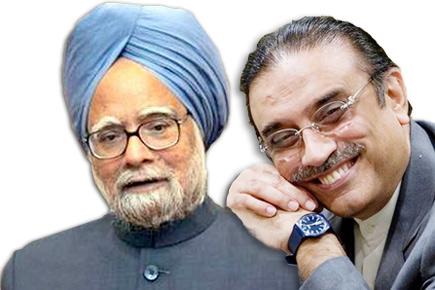
Pakistani President Asif Ali Zardari is to pay a visit to the shrine on what has been touted as a “personal” trip. Given his position, it is quite natural that Indian Prime Minister Manmohan Singh would ask him to join him for lunch. Now, when these two countries meet for any meal, there is a slow fire burning and a pot boiling in the background. You can see what is cooking, but the people at the table do not seem to have a clue.
We are still at the stage where the sophomoric question is: who should make the first move? Many moves have been made, in wars, by insurgents, through signed pieces of paper, with hugs, blasts, dialogues. These seem to have fallen on the head without anyone making the first move. Instead, the friendly country far from the neighbourhood has decided to do something about it.
The United States of America has put Hafiz Saeed, the leader of Jama'at-ud-Da'wah that was declared a terrorist organisation by the United Nations in December 2008, up there as the big dish. A little problem here. You don’t get him. He is just an item on the menu. You have to hand him over to the great master chef, Barack Obama, and in return take away the $10 million bounty offered by the U.S. for any information on him. No one quite knows what Mr. Zardari plans to pray for at the dargah, but it certainly isn’t a huge amount of money this time. As for Dr. Singh, he is a clean man with clean thoughts and, anyway, he does not have Hafiz Saeed. He can demand that he be handed over, is the chorus. Pages and pages have been exchanged over the Mumbai attacks of November 2008.
We need to look at this a bit carefully. India and Pakistan do not perceive Saeed in the same manner, and the simple reason is that they cannot. They are two countries with different compulsions. Saeed has been the mastermind behind those blasts. Ajmal Kasab, the hit man and the last guy standing, became the fall guy. In terms of a criminal act with the evidence he would be culpable. How does one gauge the extent of input by a mastermind? Osama bin Laden did not go out and attack anyone, yet he was the hunted. If we go by this logic, then the U.S. President must take responsibility for the killings of all the civilians in unprovoked wars.
The reason for bringing this up is the crucial element of American convenience. It would be facile to believe for a moment that the US is concerned about India, even though Obama said it has not forgotten the Mumbai attacks. It remembers at an opportune time. The present Zardari-Singh meeting is not terribly important, except to discuss the same old things. I also do not believe that the US bounty will suddenly make terrorism an issue. It has always been an issue.
The American establishment is only making sure it gets a sneak preview. While peace between the two countries is whimsical, the state of unrest has helped outsiders a great deal. This bane has been a boon for them, for a huge world population can be managed, if not colonised, by the simple expedient of posing as a saviour figure. It simply does not understand that terrorism in these parts is feeding off angst. It is playing on sentiment.
To put it simplistically, for the West the Mumbai attacks showed India as a rich country and Pakistan as a few men in dinghy. Good old David Headley, Hafiz Saeed’s video maker and map drawer, managed to get a visa to India and do his recce trips as a US citizen. They have him there. Do the two countries have the courage to ask America what exactly it is doing with him?
Hafiz Saeed is roaming free. His December 2011 rally against NATO killings turned out to be bigger than that of most politicians. This was not in some small town, but in Lahore, where he turned the ‘war on terror’ on it head by urging the Pakistani authorities to revoke its cooperation. Whether anybody likes it or not, there are many Pakistanis who support his organisation, Difa-e-Pakistan. Political pragmatism would make it imperative to be on his side, because at least with regard to NATO he is expressing the prevalent sentiment: “In 10 years of war that US has fought in Afghanistan, Pakistan actually lost more than the invaded country.”
Afghanistan has been a sore point with mainstream Pakistani politicians from the time of the influx of refugees during the Afghan war to the Taliban entering the plains and attacking just about every group of people. The splitting of hairs over ‘good Taliban’ and ‘bad Taliban’ has in fact blurred the lines. In the popular imagination, the U.S. is to blame for it. The audacious move to assign ‘guardian angels’, troops to watch over their sleeping comrades “against possible attacks by rogue Afghans” after an American soldier Sergeant Robert Bales killed sleeping Afghans, amounts to playing victim.
Pakistan is caught between these two victim-aggressors. It is willing to risk drone attacks, but the authorities probably believe that the rightwing within might come in handy. The view that Pakistan wishes to create communal tensions in India works symbolically to the benefit of Pakistan and India should disabuse such notions actively. If Pakistan wishes to destabilise India by hitting out at its totems of economic progress, then why would it want to do trade with India and why should the Indian government encourage it?
If India believes that the Inter Services Intelligence (ISI) is behind it all, then does it make any sense to ask Pakistan to hand over Hafiz Saeed or to even try him? More importantly, if India believes that all acts of terror emanate from Pakistan, then is there any purpose in pursuing peace? Peace does not merely mean no war. It conveys a sense of confidence and trust. Neither country trusts the other.
This leaves a large opening for America, and it never fails to appear. The farce of a $10 million bounty will be played out in salons rather than in Islamabad or New Delhi. This is a huge bait for Pakistani liberals and expats to fill the U.S. coffers during the run-up to the elections. The money will be in trust, without it being spoken of in such clear terms, and the well-wisher Pakistani lobbyists will buy peace. America knows this only too well.
The obvious question would be: Aren’t there more prominent Indians in that country? Rich Indian immigrants are keener on being American; they do not have to prove their innocence, unlike Pakistanis. This is a major difference.
What has this got to do with President Zardari meeting Dr. Singh? If one is to understand some of the ‘peace’ proponents, then India is doing a subtle America without the bluster. The lead opinion piece in The Times of India had this gem:
“Clearly, Zardari has stolen an imaginative moment from the bitter-sullen history of India-Pakistan, by asking to come to pay his respects to a cherished and much-beloved saint across the Indian subcontinent. It shows what we, despite the horrendous Mumbai attacks of 2008, are still capable of. Perhaps the Pakistani president will seek forgiveness for those attacks and pray that both countries can move on by jointly erasing the scourge of terrorism. God knows, there are more people killed in Allah’s name in Pakistan today than elsewhere in the region.”
This is so full of Pat Robertson type evangelism, with its penance and forgiveness tone, that one wishes that all SAARC meetings are held at the shrine. In fact, such ‘private’ visits only reinforce the belief that we in South Asia will always mix religion with politics.
Taking such peace talks further is a piece in The Hindu jointly written by former Foreign Secretary of Pakistan Humayun Khan and former Foreign Secretary of India Salman Haidar:
“Peace within the region is an essential requirement for India to continue on its upward path. It must make renewed efforts to convince its neighbours that it poses no threat to them. It still has to fully convince them that it is ready to honour their independence and separate personality.”
How can such a thing be proved? India is fighting movements within almost as much as Pakistan is, with probably fewer casualties. The emphasis on economic progress, in fact, diverts attention away from political instability. There is no doubt that India being the larger nation has to respect other nations, but their sovereignty depends on how they manage contradictions within. Bilateral peace has little to do with this.
“To further allay apprehensions, discussions could be initiated on relocation of forces along the border and on regular meetings between chiefs of the armed forces and of intelligence agencies. The need for better understanding between the two militaries cannot be over-emphasised, because the security syndrome in Pakistan is the major obstacle in the way of progress.”
Do the armed forces act independently? They don’t. Besides, there is a difference between armed conflict and terrorism. Terrorism does not take the regular route. While Pakistan has to deal with the army as possible government, India has to handle the politicisation within the army. How they talk to each other matters little when compared with how they operate inside their own countries.
Dr. Manmohan Singh does not have to worry about the Indian armed forces posing a threat to his position. Asif Ali Zardari has to every minute of the day. A little prayer at the dargah will not change that. What he might get by way of benediction is a new eureka motivation: blame the existence of Hafiz Saeed on newbie willing to sup with Islamists Imran Khan for the moment. Wasn’t seize the day an all-American novel?
I understand that when a politician is on a private visit to a country, he does not speak on behalf of the country. Mani Shankar Aiyar, by virtue of being a former diplomat based in Pakistan, is knowledgeable about the country. It seems that he has lost touch with it, and even his home country.
Sitting on a panel discussion in a studio in Islamabad, he was confronted by Jamaat-ud-Dawah chief Hafiz Muhammad Saeed through a phone link:
"Giving India MFN-status is not correct in any manner because there are already big problems that haven't been resolved, including the Kashmir issue. At this moment, the dams being made by India will create a crisis in Pakistan."
This is the man considered the mastermind behind the Mumbai 2008 attacks. His position would not be much different.
It is Aiyar's comment that is typically on a limb:
"There are some persons like Hafiz Saeed in our country who do not want things to move forward but thankfully the ordinary people want our ties to improve. We can improve our relations irrespective of what his (Saeed's) opinion is. We want him to be caught and taken to a terrorism court."
By getting into this same-same maze, he is in effect implying that the Hafiz prototypes in India are against any ties with Pakistan.
We do have a consolidated saffron terror in place, but it is essentially and rather tragically targetting people within the country.
It is pertinent that a couple of days prior to this studio peace, a piece of news which has much to do with Hafiz Saeed went largely unnoticed. The amicus curiae, advocate Raju Ramachandran, told the Supreme Court that Ajmal Kasab was not part of a larger conspiracy for waging war against the nation.
As reported:
'Maintaining that the prosecution has failed to prove the case against him beyond doubts, he told he bench that his right against self-incrimination as well as his right to get himself adequately represented by a counsel to defend himself in the case have been violated during the trial.'
Kasab said he was brainwashed like a "robot".
What would Mr. Aiyer's position be? Does he believe that brainwashing takes place only in the area of terror? This is where we need to look at the scenario holistically.
Saeed's opinion is not an isolated one and neither is it restricted in both countries to fringe elements.
There are two crucial segments.
1. The overtly nationalist middle class that believes that an enemy gives credence to identity.
2. Those who take what appears to be a cynical view that
a) the terror industry is over-rated
b) peace through confidence building measures does not do away with insecurity. These placebos cannot and are not meant to address diplomatic issues.
Almost all politicians have spoken about such initiatives and gestures. Does anything tangible come out of it?
In the Islamabad studio, it was Hafiz Saeed who spoke honestly. Mani Shankar Aiyar is being hailed for his brave move in confronting him, when he was just aiming aimless darts.
Perhaps he might like to see the large queues outside the High Commissions in India and Pakistan to understand how difficult such 'private' visits are for those he is claiming to speak on behalf of.
Pakistan gave India the honour of being the Most F…. Nation. The F stands for Favoured. When Pakistan does that to us, we are truly f……. Or so we’d like to believe. We have this strange ESP with our neighbour; it probably realised we had something up our sleeve and so there were second thoughts. Pakistan always has second thoughts about India. There is always a second coming, a second infiltration, a second war, a second summit, a second peace initiative. Of course, India holds half the key.
Anyhow, forget about the second thoughts. What does being MFN mean? It is strictly a trading term, so we can sell each other exploding mangoes. Maybe, if they think we are really f…., our business heads could even get a slice of the Murree Breweries pie. Vijay Mallya can support his flailing airline business and lend some Kingfisher aircrafts to hover over the drones.
Our lobbyists can offer to intervene in the political hide-and-seek games and have late night chats with people who matter on how to get people who matter posts that will help other people who matter. This will result in Pakistan’s first 2G scam (I told you they like seconds, so 2G stands for second ghapla, which is a polite way of saying they’ve lost count of the ones before).
Some of our politicians will take kickbacks for tilting the Minar-e-Pakistan because Asif Ali Zardari who wanted to emulate Sonia Gandhi thinks it should have an Italian touch, like the Tower of Pisa. The Opposition will get their business partners to work on a British theme with Frontier motifs to please Imran Khan, who wants to build a living people’s memorial there.
No Pakistani politician will, however, go to prison because he will be given a second chance. No, they don't feign illness to get into hospitals and even though both their kidneys are functioning, they flaunt about managing a third one.
- - -
The case of three Pakistani cricketers getting prison terms for spot fixing made front page news because India had to live up to its MFN status. This is the deal. With three players of promise out of the Pakistani team, it is obvious that whether they say so or not we are MFN.
To commemorate the event, unfortunate as it is, here are a few songs dedicated to them:
For Salman Butt:
Patta-patta, butt-a, butt-a, haal hamara jaaney hai Money hi money phir bhi hai money chaal hamara jaaney hai
For Mohammad Asif sung by Veena Malik:
Boli ke peechhe kya hai, boli ke peechhe Boli mein bill tha tera, bill mein de di media ko, big boss, haye
For Mohammad Aamer (since his mother says he is only a child):
Nanha-munna khiladi hoon, videsh ka sipahi hoon Bolo mere sang, jai Pind, jai Pind
Post-script: Last heard, President Zardari was enquiring, like an Indian ad for cars, "Kitna deti hai?" (How much mileage does it give?)
This is Asif Ali Zardari’s shrewdest move. Sending Hina Rabbani Khar on what amounts to be the equivalent of cricket diplomacy. This is not meant to be a sexist comment. She pretty much sailed through the India test by fire even as Pakistani intellectuals and the media have been rubbishing her ever since she was appointed to the post.
What are the dynamics here? It seems impossible to disregard the references to what she wore, how she looked and spoke, and it is a tad stupid for well-traveled Indians to comment on her designer labels as though they are not exposed to these. If anything, they look a bit awestruck even as they seemingly reduce her to superficials. The Times of India decided to tread carefully and mentioned our foreign Minister S.M.Krishna’s necktie, as though it were mandatory to give him equal sartorial time.
Zardari’s victory is that he knew the attention would be diverted from important issues although he had said that giving a 34-year-old with little experience the plum assignment was “a demonstration of the government's commitment to bring women into the mainstream of national life". There is no contradiction in his mind that the mainstream is the elite. He is sending out a few messages here: our societies are obsessed with the façade of economic progress, so let us dress the part even if we are dependent on foreign aid. A report had said that Richard Holbrooke was keen that she was given more responsibility. As foreign affairs minister she does not need to know what happens in the bastis. Does Rehman Malik, the Interior Minister, know? She has to convey Pakistan’s intentions, which is an easy job to do because India already knows it. As she said in a television interview, when questioned about her meeting with the Hurriyat leaders before her official itinerary, that this was the “stated position of Pakistan”.
Rather smartly, she also took the age issue head-on and said it was a matter of how one sees it. She has been an elected MP and served two terms as junior minister that helped her “learn on the job”. This sounds like a simple statement. Think about it, though. The head of our government is not elected; the woman running this country has no experience; the youth leader has been learning on the job for years now with the added advantage of dynasty. If we decide to look into our own backyard, Ms. Khar’s debut would appear like quite a masterstroke.
So, what is it about her that has riled Pakistanis? A former envoy, Zafar Hilaly, had been dismissive: "Asif Ali Zardari clearly does not want a heavyweight in the job. Hina will play the role and say her piece; but I don't think anyone is expecting anything significant from her."
He should know that no minister can do anything significant with India. We have been playing a carrot-and-stick game for years and will continue to do so. All paperwork, statements and dossiers will be cosmetic offers.
There are derisive put-downs that she is just a rich spoilt woman from a feudal family. This comes from the media; most of the owners and editors are rather well-off and have other businesses and most certainly give the time of day to social butterflies. In fact, some noted writers have made a career of carousing for the Chanel chicks. They seem to have forgotten that none of their prominent leaders has been a grassroots person. Zardari is himself a greenhorn with a shady history. What about Benazir Bhutto? What was her experience except to belong to a political family? Jemima Khan had dismissed her as "The Kleptocrat in an Hermes scarf" (my rejoinder was here), completely forgetting her own posh Goldsmith girl days. What is Imran Khan’s experience that some people think he’d, be a great prime minister? One will not question the political experience of military leaders because they rule either by coup or from the coop.
Professor Pervez Hoodbhoy added some perspective but a bit harshly: “In a male dominated culture, she will be derided as no more than a pretty face. This would be true even if she was hard-as-nails and an exemplary negotiator. She will also be the object of jealousy within the PPP, where sycophants know that the boss decides and suck up to him. How forcefully Khar is able to present Pakistan's position as foreign minister remains to be seen. Although she was selected for her docility rather than bold originality, there could always be surprises."
How many Pakistanis, forget politicians, have expressed a position that is boldly original on matters of foreign policy? Any national psyche makes it incumbent for people to believe in certain aspects; much of it is inherited baggage. If she is to push Pakistan’s position, that too with regard to India, how can she be original?
Before her visit, a report had quoted an unnamed observer who said, “It is well-known that Pakistan's foreign policy is in the hands of agencies, not the foreign minister or even the President. Hina will have a tough time proving that she is not just a puppet. I don't think anyone is going to forget that her roots go back to the Musharraf administration."
This goes in her favour. Pervez Musharraf conducted the biggest PR exercise in India during the Agra Summit although it ended rather badly. He became a martyred hero, so the connection is her silent trump card. Again Zardari, who it is suspected could get close to Musharraf again in one of those opportunistic alliances that his father-in-law was so adept at, has played his cards well.
And for those who are talking about maintaining the status quo, that is what Indo-Pak relations are about. That or months of sulking. The outcome is, as expected, simplistic. India and Pakistan have agreed “on the need to strengthen cooperation on counter-terrorism including among relevant departments as well as agencies to bring those responsible for terror crimes to justice”. This is worth a yawn although it gives sufficient grist for several yarns.
The confidence building measures (CBMs) will be another Samjhauta – compromise. You take some missiles out of the way, but that does not prevent the threat perception and the real threat. It is not about whether either country decides to attack, but how much it feels the need to defend itself. This is never overtly at the government level. We have coined the phrase “non-state actors” just to make sure that foreign ministers can “agree” without having a clue as to what is happening behind their backs. The intelligence agencies have to deal with the headache, unless they are the headache.
The Line of Control will now be accessible for travel and trade. Is this a big leap forward when the economies of both sides of Kashmir are not really bullish? As regards travel, residents of Kashmir are anyway given visas more easily.
In general terms, trade opening acts as one more people-to-people initiative.
By far her entertaining the Hurriyat leaders at the Pakistani High Commission before meeting our foreign minister - while deemed undiplomatic and a kick to protocol - was her real moment. Tutored she was, but she made it seem like the most natural thing to do. India and Pakistan are just two nations. Emphasise Kashmir and you sit on the TNT bomb. To keep it simmering has proved to be the most lucrative aspect of Indo-Pak politics. CBMs are just loose change.
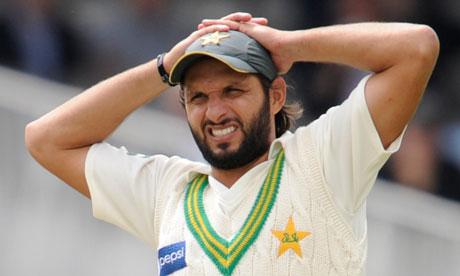
Pakistani captain Shahid Afridi has hit out at India and the Indian media. It is amusing, so let me present here an imagined conversation between him and Veena Malik in Big Goss. Parts of the report with his comments are interspersed:
"In my opinion, if I have to tell the truth, they (Indians) will never have hearts like Muslims and Pakistanis. I don't think they have the large and clean hearts that Allah has given us," Afridi said during a talk show on Samaa news channel when he was asked about relations between the two countries.
Veena Malik: “Shahidji, how kaan you say this ji? After so much afat we are making out here. Allah is not your jaagir and Allah has made my haat large and clean so I can put lots inside and also make it look like bright Taj Mahal.”
Shahid Afridi: “Mohtarma, aap kuchch na kahe tau hi behetar hoga. (Ma’am, it would be better if you did not say anything) You are insult to Pakistan, to Muslims, to hearts and all parts.”
Veena: “Haan, haan, apni zaat pe aa gaye na? Mard hote hi aise hai. (Yes, yes, you are showing your true colours. Men are like this only)”
Afridi: “Tau Ashmit kya cheez hai? (So what is Ashmit Patel?)”
Veena: “Dawnt get personal. Ash-mit has only shown bigness of haat and also its cleanness. He knows me and my Allah wary vell.”
"It is a very difficult thing for us to live with them (Indians) or to have long-term relationship with them. Nothing will come out of talks. See how many times in the past 60 years we have had friendship and then how many times things have gone bad," he said as the audience in the TV channel's studio applauded him repeatedly.”
Veena: “Fast of all, it is more than 63 and half years. I know all figures, ask Mohammed Asifji. Frandship is two sided, if you temper one side of ball and rub on ground, then frandship will be balled out.”
Afridi: “You made big bang only for publicity. Apni match-fixing par thoda tawajjo dijiye. (Concentrate on your own match-fixing)”
Veena: “I am bold and open…”
Afridi: “Now stop. Don’t go further. Bilkul Indian film star jaise talk-shauk kar rahi hai aap. (You talk like an Indian film star)”
Veena: “Ji, becaaz I have mammary. All our banda used to come here only…Mran Khan, Wseem Kram, Shwaib…sab Bollywood ke khwaab dekhte they ya Bollywood ki hairoyenon ke. (Imran Khan, Wsaeem Akram Shoiab would all dream about Bollywood or its heroines)”
Afridi: “Their women are after us, did you see any of us with pouches?”
Veena: “Woh tau aapka problem hai na? (Isn’t that your problem?)”
Afridi: “Yuvraj lekar ghoom raha tha aur pregnant aurat jaise vomit kar raha tha. (Yuvraj was walking around with it and vomiting like a pregnant woman – the reference is to an initially unfit Yuvraj and his paunch)”
Veena: “But than he plad so vall. Sab ki chonch chup kar di. (But then he played so well, he shut up everyone’s beak.)”
"We don't want to fight with each other but a third country – everyone knows which one it is - is trying to spoil our relations. (This country) is taking advantage of Pakistan and wants to take advantage of India. I don't want to go into details but these people will not let us come together," he added.
Veena: “Now dawnt blame Siri Lanka.”
Afridi: “Suniye, you don’t know cricket or politics, aap acting hi karein. (stick to acting)”
Veena: “Agar acting kar sakti tau role mil gaye hote. (If I knew acting then I would have got roles)”
Afridi: “So even you agree that Indians don’t have large hearts?”
Veena: “Nawt at all. It is large haats that even though I kanaut act they give me prime tam. Why no other country is coming in way of my relationship with India?”
Afridi: “Because outside India and Pakistan nobody knows you.”
Veena: “Saare jahaan ke log jaante hai (everyone in the world knows me), not only crickatting world. If you were bold like me you would name the mullahs who are spoiling relations.”
Afridi: “I said other country.”
Veena: “So I am also saying other country. Mullahvi.”
Afridi: “Aap ko tau Allah bhi…(With you even Allah…)”
Veena: “Dawnt be jealous of jarnail knowlej I own, theek hai ji? (Don’t be jealous of my general knowledge, okay)”
Asked about the Indian media's coverage of the Pakistani team during the semifinal with India at Mohali on March 30, Afridi replied: "The Indian media has a very negative approach and very negative thoughts. The people may not be like that but I think the media had a very dirty role in spoiling relations between us and India. Our media, which is criticised by people, is hundred times better than theirs," he said.
Veena: “I am making vawes in Indian media, no nagatiwe proach, no nagatiwe thot. Media is making me have good relations with all Indians. Pakistani media puts me in front of camera with some bearded man.”
Afridi: “And if India will put you in front of their bearded man you will jump with joy…”
Veena: “They don’t have those types.”
Afridi: “Amitabh Bachchan hai na.”
Veena: “His beard is designer and awerybody knows from paaon to sar (head to toe) I only like designer.”
Afridi also criticised Interior Minister Rehman Malik for warning the Pakistani team not to get involved in match-fixing and Indian cricketer Gautam Gambhir, who vowed to dedicate victory in the World Cup final to victims of the 2008 Mumbai attacks. "I think they were both very stupid comments by Rehman Malik and Gautam Gambhir...I wasn't expecting this from Gautam...This is all politics, what do you know about who carried out the Bombay attacks?" he said.
Veena: “Rehman ji and I are both Malik and Malik and only we know inside of match-fixing.”
Afridi: “Whole world is involved. It was bad for our morals.”
Veena: “Ab ismey moral kahaan hai? (Now where do morals come into this) Be bold and crejiss like me.”
Afridi: “That I can see. Boldness is not about upper stuff…”
Veena: “Dekhein, aap hadd paar na karein. (Look, don’t go beyond a limit)”
Afridi: “I am only saying outside you can be bold in dress and Rehman Malik was bad for moral with e.”
Veena: “Vot English is this, hain? Moral tau hmm…mmm…haan ‘M’ se shuroo hota hai…(Moral starts with, well, ‘M’)”
Afridi: “Ji. Hum ending ki baat kar rahe they. (Yes, I was talking about ending)”
Veena: “Pakistaniyon ka yehi prowblim hain. End ka sochte hain. Pichur abhi baaqi hai dost.(This is the problem with Pakistanis, they only think of the end. The picture is still to go on)”
Afridi: “So why did Gambhir want to dedicate to victims of Mumbai attacks?”
Veena: “He said for finals ji, and we were not playing, tau don’t do fikar. Indians have large haat that’s why we did not reach final.”
Afridi: “They did it for themselves. It is all politics.”
Veena: “Aap cricket kheliye, yeh kaafi hoga. Theek hain, ji? (You play cricket, that will be enough, okay?)”
Afridi: “Aur aap India mein hi rahe. (And you stay back in India)”
Veena: “Tau phir Pakistan ke crikaters ka kya hoga ji? (What will become of Pakistani cricketers then?)”
Afridi: “Badey dil se kaam chala lenge, ji. (We will manage with our large hearts)”
- - -
End note:
I'd like to add that I received a few congratulatory emails and text messages from Pakistanis after the semis as well as the finals. I was confused. I don't want piece, I want the whole ji.
(c) Farzana Versey
- - -
Updated: April 5, 6.30 PM:
Shahid Afridi is now walking with his tail between his legs. He did not say all that…er…he did not mean all that…ho-hum.
I have uploaded a video. It really does not make much of a difference. But his clarification comes to an Indian channel – NDTV – whereas he gets the applause in Pakistan.
“I have enjoyed my cricket in India and I love Indian people. Don’t take my comments negatively. I have always got a lot of love and affection from Indian fans. And I request the media to play a more positive role and not waste time on such trivial issues. The media makes a big deal of small issues. It is shameful. I have always done my bit to improve Indo-Pak ties but sometimes you say something and it is interpreted the other way. I have been quoted out of context.”
His answers were direct. What context was not there? This should just teach us about not going haywire about cricket diplomacy and players doing their bit. Perhaps he’d like to ask one of his own predecessors, Aamir Sohail, who had objected to his comments.
I find the phrase “diplomatic offensive” rather amusing. So, one such offensive took place yesterday when Pakistani singer Rahat Fateh Ali Khan was not arrested despite being caught with $142,000. He was not being harassed; this is customary procedure. I know there are people who will shoot back about transactions worth crores that get past. They do but they must not. It is as simple as that.
It is appalling that a report in the TOI can flaunt how he could get away with this:
The decision not to arrest the singer was influenced by the fresh peace process between India and Pakistan that started only a week ago.
At risk would be the PM’s latest effort to mend fences with Pakistan, because Rahat is not only a popular Bollywood singer, in many ways, he is also the voice of all attempts to foster India-Pakistan peace.
Great. It follows that we should not probe into other issues – whether it is Hafeez Saeed or Dawood Ibrahim – because we are talking peace. There was diplomatic pressure from Pakistan and there would be because he was a celebrity. The same prompt action is not taken when fishermen are caught only because of the tides that push them into each other’s territories.
And how does he become the voice of peace? We have had people like Mehdi Hassan and Reshma years ago, but there was no attempt to project this ‘aman ki asha’ commercial enterprise. Let us not say there was no need. Our relations with Pakistan have always been strained. If he is a Pakistani icon then I wish he’d get more singing assignments there. He is a marvellous singer, but it isn’t that we don’t have any of our own. I have repeatedly said that the import of performers is limited to the safe bets and those who will increase the TRPs. There is not sufficient reciprocity, though.
Regarding the practical issue, why was he carrying this much foreign currency? It is common practice for performers, Indians included, to be paid in cash, though they do show a percentage of their earnings on paper. Therefore, this is ridiculous:
Documents revealed that Khan sang in Hindi films for free as “a goodwill gesture”. However, DRI officials don’t buy it and suspect that the singer was paid Rs 15 lakh per song through a different manner, which they are investigating.
We have had cases of high-profile Indians who have been detained. There was the wife of an industrialist who was carrying undeclared jewellery; she had to put up with the investigations although she was known to wear a lot of these baubles.
More recently, the Income Tax raided the houses of Priyanka Chopra and Katrina Kaif. They are famous and ‘icons’, for whatever it is worth. I am quite certain they could and probably did use their contacts to hurry up the matter, but did the government put pressure?
The media is making it out to be a case of Indo-Pak relations and mentioning the cases of Adnan Sami and comedian Shakeel who was sent threatening messages by Raj Thackeray’s MNS. We know that this party threatens and roughs up Indians from other states as well. As for Adnan Sami, his property was attached because his wife has filed a suit against him.
Why does not anyone talk about peace initiative in this case?
- - -
Salman Taseer’s killer Mumtaz Qadri has been indicted, but on Valentine’s day students and other fans sent him roses.
Now, wasn’t he supposed to be a hardcore Islamist and doing his bit for the religion? Then why are the clerics not flogging his supporters? Some Maulvi Ibrahim had threatened to flog anyone who was spotted selling or buying red roses. He said:
“Islam condemns Valentine’s Day and boys presenting flowers to young girls is vulgar and goes against the norms of Islam.”
If Islam follows the sharia, is there any hadith that actually mentions Valentine’s Day? Who is this man kidding? Is there mention of flowers, roses or lilies or even cacti, mentioned in any religious scripture of Islam and their role in corrupting morals? What is so vulgar about it?
Anyway, this is some mullah who has nothing better to do. He should be sent off to Syria, a nice Muslim country, where women wear the most enticing lingerie that have feathers and flowers. Some of these are gifts from their husbands.
Which makes me wonder: Is it okay in Islam if a man gives his spouse roses on V day? Or will he have to consult a maulvi about this impious act? And does placing flowers on graves of persons of the opposite sex also go against culture? Just asking…
- - -
In India the Darul Uloom Deoband has come up with its latest fatwa:
“If a holy Muslim doctor advises that a woman is unable to bear birth pangs, then a less than three months old pregnancy can be terminated but if it is more than three months old, the abortion is absolutely unlawful.”
Medical practitioners already know that it is inadvisable to terminate a pregnancy later than three months. But how will this holy Muslim doctor know whether a woman can bear birth pangs six months in advance? Is he that holy? I assume this doctor is a male, so is it okay by the Deoband that a woman would be examined by him? Or will he only check her pulse and get a brainwave?
I think these guys should just take their business on the roads and get parrots to pick out cards to give ‘advice’.
- - -
A man has been granted divorce due to mental cruelty. No, his wife was not tormenting him to perform well or nagging him or asking him for roses everyday. She just wore revealing clothes.
The courts thought he had a point:
Cruelty includes not only physical but mental cruelty as well. Ostensibly, she (wife) has indulged in bloating falsehood beyond proportions, additional district judge Manmohan Sharma ruled, accepting the husbands plea that he suffered mental agony as his wife regularly wore vulgar dresses. The court allowed the divorce plea saying mere living under one roof without the necessary ingredients of love and faith, which are the hallmark of a fruitful matrimonial relationship, is nothing but animal existence. The man contended that his wife wore vulgar clothes during their honeymoon. She dressed herself in a very vulgar manner and asked to change she retorted that she wanted to be noticed by at least 50 people.
Fine, it is possible for a man to feel disturbed and insecure. But there are instances when men like the idea of their wives being noticed. It is a huge ego boost. In this case, did she love him less? Did he lose interest in her? Was she unfaithful?
Let us flip this: If he wore lungis or tight-fitting jeans, would the court accept a divorce plea from her on grounds of mental cruelty?
These are indeed personal choices and the partners need to have some understanding, but it is unfair to undermine individuality. Men get attracted to women who are all sexed up but once they get married those very clothes, that foxy look and aggro attitude become a problem.
Stick to inflatable dolls. I think there is nothing in any religion's scriptures against this.
Omar Abdullah has never been a particularly responsible man. He takes after his father. The guy who at one time supped and slurped with the NDA now has problems with the BJP wanting to hoist the national flag at Lal Chowk in Srinagar on Republic Day.
"What is the need for an individual to hoist the flag? If their aim is to set Kashmir afire, please tell them to stop. If there are repercussions, I will hold them personally responsible. They should not hold me responsible if there is a fallout of that in Kashmir. They will have to come and sort it out. They shall not hold me responsible.”
This is the chief minister of Jammu and Kashmir talking. We may remind him that any individual is permitted to hoist the flag; they do so even in prisons. If he has a problem with an ‘individual’, then on what grounds is he talking about ‘personally’ holding anyone responsible? Is he saying he will hold a person responsible or that he will do so in his personal capacity? If it is the latter, then he has no business sitting in the chair he now occupies. What exactly does he mean that if there is a fallout they should come and sort it out? Why does he not just take off on vacation or something?
He wonders if their aim is to set the state on fire and this he believes is counterproductive to the peace that has apparently returned to the Valley. Just to jog his memory, the incidents of the past few months of “civil unrest” had nothing to do with flag-hoisting or any political party. It was under his administration that the protests took place.
Having said this, it must be mentioned that traditionally it is the ruling party that conducts the flag-hoisting ceremony at Lal Chowk. The possibility of a clash of egos, rather than any public skirmishes, is likely.
What is the BJP’s agenda? Leader of Opposition in Rajya Sabha, Arun Jaitley, said:
“BJP maintains that Jammu and Kashmir is an integral part of India... We are going to carry the national flag not in one state but through several states...This is part of a campaign for national sovereignty and solidarity.”
Since the Rashtriya Ekta Yatra is to start on January 12, pass through several states and end in Srinagar on Republic Day, I have a few questions:
How does carrying a flag ensure national sovereignty and will the BJP also flash its own saffron flag along the way?
Why could it not start in Kashmir and end in Kolkata, for the message would be the same, isn’t it?
Given the views in the Valley and the fact that the BJP feels so strongly about it being an integral part of India, what is it doing to make Kashmiri Pandits a part of this solidarity?
Is it possible for Arun Jaitley and any other BJP/saffron party members to carry a message of peace, instead of this ‘yeh hamara hai’ ownership agenda?
At the end of it with Omar’s fumbling and the BJP’s chest-thumping, and the pre-emptive noises, the people may be forced to come out in the streets to give both of them a piece of their mind.
And Omar Abdullah, do not take peace as lightly as you take the paranoia about fire.
This is the front page of today's TOI. It is a report. How can the 'aman ki asha' logo (highlighted by me) appear right at the centre? Was this 'movement' responsible for the SAARC Summit? Is it behind the efforts of these leaders to meet?
If not, then it is completely unethical and misleading. Or, are we to assume that our elected leaders and government spokespersons are now puppets of the media?
An Indian Spy in Pakistan by Farzana Versey May 4, 2010
Is it just a fantasy to portray Madhuri Gupta as a hysterically vengeful mole? One has to be particularly naive to believe that spies can compromise a nation’s security, especially in a world of hackers and satellites that can count the number of hair in a politician’s ears. Opinion pieces and reports on the Indian diplomat case have been chauvinistic, besides being fairly lame.
Had Gupta not been “lonely and frustrated”, would she be less dangerous? Why did the government need to call her on a pretext rather than just summoning her? Did she really want to get back at her seniors for ill-treatment? Did her colleagues desire a piece of the action too? If she is being framed, then it makes no political or tactical sense.
Foreign offices do not possess strategic information about defence matters within the home country. The real issue appears to be the creation of an undercover subculture and obfuscate the role of well-entrenched intelligence agencies in India and Pakistan. It became amply clear when there was a minor whimper that the spy drama might affect talks between the two countries at the Saarc Summit. The dialogue was to be a placebo, but this ruse came in handy.
While newspapers have been giving us examples of ‘honey traps’ from history, they haven’t bothered to emphasise recent examples. Remember Kashmir Singh who returned home after 35 years in Pakistani prisons and revealed that he had been a spy for Indian military intelligence? He got himself circumcised before venturing across the border, brushed up on his Urdu, ate beef and fasted during Ramzan. He was paid Rs. 480 per month till his arrest. He chose not to reveal more and changed his stance but, surprisingly, there was no further probing.
Human rights activist Ansar Burney was all treacle about how his release symbolised efforts by India and Pakistan to normalise relations. “Never before have we seen an Indian prisoner being escorted in a flag car of a minister,” he said. Why did the spy sound as though a favour had been done? Why did he return to a “hero’s welcome”?
Sarabjit Singh, who has been given the death sentence, was in one version a drunken farmer who crossed over by mistake. He later said he had gone to Pakistan 17 times, which means he was given to making the same mistakes. In another version, he was forced to confess, which is not unlikely. But he was also arrested in five bomb blast cases. We are left confused over whether espionage work entails such activities as well. He also told the Pakistani Supreme Court that he was a RAW agent. There are several innocent fishermen who get thrown off to the other shore and are arrested.
M.L. Bhaskar in ‘An Indian Spy in Pakistan’ mentioned the names of some of our defence officers who were in jail - he got this from a Pakistani official during his own stint in a Pakistani prison. But does the External Affairs Ministry speak up for these fishermen as they did in Sarabjit’s case? Are such special instances chosen at random?
In Gupta’s case certain information has been “lost”. In a digitalised world where you cannot erase even memory cards and hard disks completely, this sounds suspicious.
What is even more alarming is a news item that stated, “Officials said they were also questioning the RAW station chief in Islamabad, R K Sharma, to see what he knew and what he had picked up from her.” India has a RAW station chief in the Pakistani capital? Is an ISI chief positioned in Delhi? Should we be amused and refer to these as confidence-building measures? The real cause for worry is not the espionage, but the behind-the-scenes manoeuvres where the mole is a mere marionette.
This Pakistani shook hands with an Indian Army official’s wife and pronounced that she suffered from severe migraine. That is the reason Director-General for South Asia, Afrasiab Hashmi, labeled a ‘physiognomy’ expert, was said to have been included in the delegation that took place today at the foreign secretary level talks. He will apparently read the faces of the Indian officials and predict what they really mean when they utter those precious words. (If Indian diplomats were visiting we'd have a choice of astrologers?)
It is said that he can also predict the future. He is not trained but has a natural knack.
Now, as those who have been here for some time know, and the devil is my witness, I have deconstructed many a photograph and my hunch has not been far off the mark. I don’t even have to shake hands or anything.
Therefore, in the interest of the Indian side, here is my humble reading of Nirupama Rao and Salman Bashir who have had "closed door talks" by now:
Indian Foreign Secretary Nirupama Rao said India had approached the talks with "open minds, fully conscious of the trust deficit between the two countries…Talks were candid. There was good chemistry between the two delegations. We had useful discussions.”
Good chemistry is like love. You don’t know what the hell is happening, but something is. It also results in suspicion. Every bit of information, even about orangutans, appears useful.
She said Pakistan wanted to resume the so-called "composite dialogue" - covering a range of key issues - but India felt the time was not yet right to do so "because the climate of trust and confidence has to be built up… I told them about our concerns about terrorism emanating from Pakistan. We agreed on step-by-step engagement."
It is clear from the picture. Although they are facing the same direction, they are looking at different cameras and her head is tilted slightly at an angle to the other side. It won't be step by step but a tangential idea.
Her Pakistani counterpart, Salman Bashir, wanted to discuss Kashmir and had already met the Hurriyat leaders before. It shows in his visage. Although Pakistan admitted the 26/11 attacks had been partly planned on its soil, he has an all-knowing look on his face but trepidation regarding this meeting; his left hand is too close to his body and straight.
Their clothes are also interesting. She is wearing a saree blouse with too short sleeves revealing thick arms. Good enough for flexing? The lower button of his jacket is unbuttoned, which one would expect him to do just before sitting. Either he forgot to button up or that’s the way he likes it. It shows a laidback attitude that seems to suggest: do what you want, say what you want, I am cool with it. And, yes, I can stomach things.
"We have agreed to remain in touch," concluded Nirupama Rao.
Sure. Like a cat offering a ball of wool while the bone remains buried (Kashmir, Hafiz Saeed, Baluchistan, all that Pakistan wanted to discuss).
End result: It was just a meeting, stupid. No strings attached to be detached.
And: As for the Pakistani ‘face reader’, let me tell you what I think. He is good with headaches and he will return with one!
“I’m not accusing the government of Pakistan at all. In fact, we believe there are a number of actors in Pakistan who may be beyond the control of the government, who might be behind some of these actions.”
These are the precious words of minister of state for external affairs Shashi Tharoor. That he decided to convey this in Kochi is a step up from his usual twitter politicking.
However, we would like to know whether he is speaking in his personal capacity or as a government functionary. He has used ‘I’ and then moves on to ‘we’ and they are almost giving the Pakistani government a clean chit in the Pune bomb blast. There are a number of actors beyond the control of the government. Right.
Do you think there is some altruism here? No. It is in a manner of speaking throwing up your hands and saying, look, those poor guys are not to blame, so how to you expect us to find out who did it? We sent them dossiers; they arrested a few blokes; we have Ajmal Kasab with us, but really there are too many.
The subtext is we must have those peace talks as though we have paid for some prime time slot on TV and just have to do it.
There is this absolutely hilarious mention in a report:
The discussion underlined that the foreign secretary-level talks will remain, to borrow the phrase used by national security adviser Shiv Shankar Menon in an article for a foreign publication, a “limited and controlled” affair as long as the government remains unsure of Pakistan’s sincerity in controlling terror.
I love the reference to a foreign publication. I love the limited and controlled affair even more. It is like Pakistan is not committing itself, but India does not mind a one-night stand with no strings attached.
After Tharoor’s magnanimity, he realised he had to say something 'historical', so he came up with this:
“…it is a fairly safe presumption looking back at the last 15 years of attacks on India that many (of them) originated from across the border’’
Presumption? For 15 years the country suffers attacks and we are still presuming without any concrete evidence and all this baloney about ‘actors’. Actors are directed by someone.
Who is this someone? Obfuscation comes in handy when there are no hard facts.
The first several minutes of the telecast of the Pune attack kept on mentioning a gas cylinder. The media reached there after the cops. Did no one get it that there is a difference between LPG gas and a bomb? There were body parts strewn around.
As happens often, conflicting groups have taken responsibility - a so-called breakaway faction of the LeT, Lashkar-e-Taiba Al Alami (International) and Indian Mujahideen Kashmir.
They have been called red herrings:
to distract attention from the perpetrators in view of the growing belief among the intelligence community here that the Pune attack was the handiwork of the Indian Mujahideen, which was under pressure from its Islamabad-based patrons belonging to the LeT to break the 14-month lull in the terror campaign. The anxiety to organise an alibi for the ISI is seen as another possible reason for the sudden emergence of LeT ‘International’.
For all these months, until recently, we had no clue that the Indian Mujahideen had any role in the Mumbai attacks. The home minister woke up recently. Now, there is a belief that the IM’s masters are in Islamabad asking them to get going.
Abu Jindal, the self-proclaimed spokesman of the Lashkar splinter group, gave India’s “ittehad (alliance)’’ with America as the other justification for the blast. “We will wage war against any ally of America, whether it is India or Pakistan,’’ the correspondent of the Indian newspaper quoted Jindal as saying.
To the correspondent, the spokesman of the Lashkar faction, who claimed to be calling from Miramshah in North Waziristan, sounded like an educated boy in his late teens or early 20s. Jindal refused to give the name of the leader, but claimed that the breakaway faction had “sources’’ in India who executed the blast in Pune.
Okay, so this is getting very complicated. The group does not like India or Pakistan or America, and it is from Waziristan, so it could be the Taliban. Who would like this theory the most? The US. Pakistan. India. There is mention of an educated boy. We are going by what a correspondent says. What standards have been applied to gauge the education? Who will benefit the most from such profiling? And if Mr.Richard Gates knew, why can we not just demand to know the details?
Just when we were dealing with this, Harkat-ul-Jihad-al-Islami (HuJI) chief and Al Qaida commander Ilyas Kashmiri spoils it all by warning foreign players from coming to India for the hockey World Cup and later the Commonwealth Games.
“We, the mujahideen of 313 Brigade, vow to continue attacks across India until the Indian Army leaves Kashmir and gives the Kashmiris their right of self-determination. We assure the Muslims of the subcontinent that we will never forget the massacre of the Muslims in Gujarat and the demolition of Babri Masjid.”
His Harkat whatever did not remember the Muslims in 1993 or 2002. I am not sure if they have any real interest in Kashmir. Kashmir has its own indigenous movements.
There has been much talk about targeting foreign-dominated areas and the German Bakery has been seen in this context. It is too small a place. The bag was placed near a table with young Indian students. If the Osho Ashram was the real target it would have been placed there. Besides, the Ashram is not as prominent as it once was in the public eye, so it too does not serve a great purpose.
This was a low-level operation meant to disorient. It has succeeded because of the way our politicians are behaving.
There is much talk that there are groups against any Indo-Pak initiative. Let us stop acting like kindergarten kids. Everybody and their Uncle Sam know that dialogues are not going to solve the problem, and which problem? With such talks Pakistan has nothing to lose and India has nothing to gain.
There is a third hand that has nothing to lose and everything to gain by stealthily encouraging enraged militant groups. The good old divide and rule policy with a dash of fake détente.
I am not surprised that some student from the National Institute of Design (NID) posed as a journalist to enter the court premises and later attacked former Haryana DGP S P S Rathore.
The case of Ruchika’s molester has been covered rather strangely in the media, especially the emphasis on his smile/sneer. This student really behaved like some stupid hack. Utsav Sharma will be hailed for his self-righteous anger over the light sentence meted out to Rathore. The guy did not know Ruchika, he would not take a knife out to slash fellow students in ragging cases or some punk throwing acid on the face of a girl who has jilted him. To be a hero, you need a prominent villain.
This is an old case, and its sudden shooting into prominence reveals how we make use of certain examples for our own benefit. Rathore should be given the stiffest punishment without being given so much media coverage.
- - -
There will be another round of discussions about the West Bengal government and its reservations for Muslim OBCs. I have been against reservations based on religion because they result in ghettoisation. Besides, Muslim caste structure is different and based primarily on economic backwardness. What caste did the villagers of Nandigram belong to?
- - -
Amitabh Bachchan read out his father Harivansh Rai Bachchan’s poems. Zia Mohiuddin from Pakistan read out the works of Faiz Ahmed Faiz. This was part of the Shaman ka Chacha* TOI thing.
Was there a need to posit Hindi against Urdu? Urdu is an Indian language, and an official one. It would have been nicer if we had two Urdu writers from both sides being feted. Ghalib is ours. So are several others.
And pardon my saying so. Even with my limited knowledge, Harivanshrai is no comparison to Faiz. If we wanted Hindi, then we have ‘Dinkar’, Maithili Sharan Gupt.
It would have made great sense to promote ‘other’ aspects of culture, like, say, a Tamil or Malayali poet and someone writing in Saraiki or Pushto from the other side.
And has anyone noticed that women are hardly represented in any of the 'series'? Will they be lumped into one intellectual zenana, a harem to discuss wimmin's vermin issues? - - - *Play on 'Aman ki Asha'